논문 해설
Learning Visual Robotic Control Efficiently with Contrastive Pre-training and Data Augmentation
대조 pre-training과 데이터 증강을 활용한 시각 로봇 제어의 효율적 학습
- 연구 문제 실제 로봇에서 픽셀 입력과 희소 보상만으로 정책을 적은 데모와 짧은 학습 시간에 학습하는 것이 어렵습니다.
- 연구 방법 소수의 데모, 인코더 대조 pre-training, 증강 데이터 기반 SAC를 결합한 CoDER를 제안합니다.
- 주요 결과 6개 실제 로봇 과제에서 평균 30분 이내 학습과 평균 96%의 성공률을 보고하며, 3개 시뮬레이션 및 3개 실제 과제에서 RAD와 행동 복제를 능가한다고 보고합니다.
실제 로봇 시각 강화학습의 샘플 효율 문제
시뮬레이션 환경에서는 비지도 표현 학습과 데이터 증강이 강화학습의 샘플 효율을 크게 높였지만, 실제 로봇에서는 비슷한 이득이 아직 확인되지 않았습니다. 일반적인 강화학습 알고리즘은 이미지 입력으로 효과적인 정책을 학습하기 위해 수천만 번의 환경 상호작용을 필요로 하는 경우가 많습니다. 희소 보상(sparse reward) 조작 과제는 과제 완료 시에만 보상이 주어지므로 로봇이 보상 상태에 우연히 도달하기 어려워 탐색 문제가 생깁니다. 반면 모방학습은 많은 전문가 데모를 요구하고 학습된 정책이 전문가 데모의 품질에 묶입니다. 이 논문은 실제 로봇에서 픽셀 입력만으로 희소 보상 정책을 적은 데모와 짧은 실제 학습 시간으로 학습할 수 있는지를 다룹니다.
CoDER의 세 단계 구성
CoDER는 데모 수집, 인코더 대조 pre-training, 증강 데이터 기반 온라인 RL의 세 단계로 구성됩니다. 먼저 과제마다 조이스틱으로 10개의 데모를 수집해 리플레이 버퍼를 초기화합니다. 다음으로 데모 관측을 사용해 합성곱 인코더를 대조 손실로 사전학습합니다. 이 단계에서는 같은 이미지에 두 번의 확률적 random crop을 적용해 쿼리와 키를 만드는 instance discrimination 방식을 사용하며, 키 인코더는 쿼리 인코더의 지수 이동 평균으로 갱신됩니다. 쿼리와 키의 유사도는 쌍선형 내적으로 계산되고 InfoNCE 손실은 같은 미니배치의 다른 이미지를 음성 예시로 사용합니다. pre-training이 끝나면 쌍선형 측정의 가중치 행렬은 폐기되고 인코더 가중치만 이후 학습에 쓰입니다.
마지막 단계에서는 사전학습된 인코더를 사용해 SAC를 random crop 증강과 함께 학습하며, 각 미니배치는 데모 관측과 학습 중 수집된 관측을 함께 포함합니다.
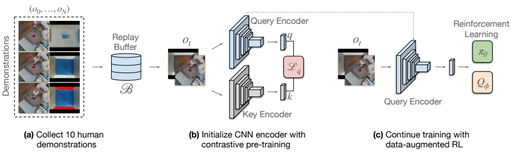
Fig. 2 : The CoDER architecture. (a) Demonstrations are collected, and stored in a replay buffer. (b) The observations from the demonstrations are used to pre-train the encoder with a contrastive loss. (c) The encoder and replay buffer are then used to train an RL agent using an off-policy data-augmented RL algorithm.
원문 · CC BY 4.0 · Albert Zhan, Ruihan Zhao, Lerrel Pinto, Pieter Abbeel, Michael Laskin · Learning Visual Robotic Control Efficiently with Contrastive Pre-training and Data Augmentation · 원문 그림 인용 · 원본 PDF 2쪽에서 그림 영역을 추출했습니다.실제 로봇과 시뮬레이션 과제에서의 학습 결과
실제 xArm 로봇 실험에서 CoDER는 6개 과제(reach, pickup, move, pull, light switch, drawer open)를 평균 30분 이내, 15~50분 범위의 학습 시간으로 학습했다고 보고됩니다. 최종 정책은 과제별 30회 에피소드로 평가되었으며, 성공률은 reach, pickup, light switch, drawer open에서 100%, pull에서 93%, move에서 86%입니다. 기준선 비교에서는 시뮬레이션 과제 3개와 실제 로봇 과제 3개에서 RAD와 행동 복제를 함께 비교했습니다. 시뮬레이션 과제는 200k 환경 스텝으로 학습하고 100 에피소드로 평가했으며, 실제 과제는 수렴할 때까지 학습하고 30 에피소드로 평가했습니다.
행동 복제는 데이터셋에 대해 200 epoch 학습했습니다. 이 비교에서 RAD는 데모 없이 희소 보상 과제를 하나만 학습했고, 행동 복제는 10개 데모만으로 FetchReach와 Light Switch 같은 단순 과제에서만 성공했습니다.
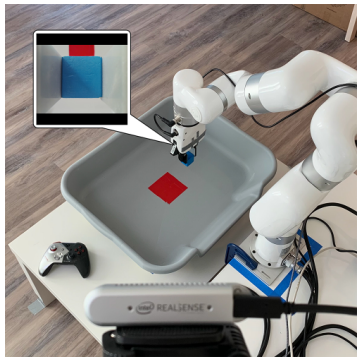
Fig. 1 : CoDER enables robotic agents to learn skills directly from pixels in less than one hour of training. Our setup requires a robotic arm, two cameras, and a joystick to provide 10 demonstrations.
원문 · CC BY 4.0 · Albert Zhan, Ruihan Zhao, Lerrel Pinto, Pieter Abbeel, Michael Laskin · Learning Visual Robotic Control Efficiently with Contrastive Pre-training and Data Augmentation · 원문 그림 인용 · 원본 PDF 1쪽에서 그림 영역을 추출했습니다.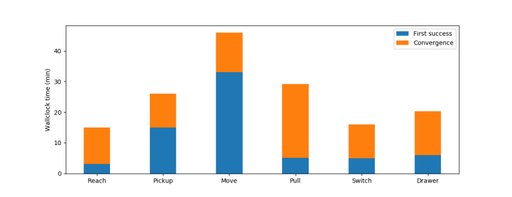
Fig. 4 : The speed at which our agents learn to complete the tasks. Plotted above are the times at which the policy first achieves a success, as well as when an optimal policy is learnt. Our method starts to complete the tasks in around 30 minutes of training, and as little as 3 minutes for simple tasks such as Reach.
원문 · CC BY 4.0 · Albert Zhan, Ruihan Zhao, Lerrel Pinto, Pieter Abbeel, Michael Laskin · Learning Visual Robotic Control Efficiently with Contrastive Pre-training and Data Augmentation · 원문 그림 인용 · 원본 PDF 4쪽에서 그림 영역을 추출했습니다.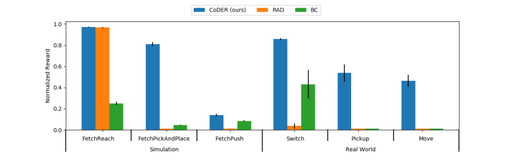
Fig. 5 : Baseline Comparisons. Shown are normalized rewards of the agent at the end of training for the simulated as well as the real robot results, as well as standard error. Reward is normalized by the maximum possible reward for all environments. While CoDER is able to learn all the tasks, the baseline RL agent (RAD) is able to learn only one sparse reward task without demonstrations. Conversely, with access to only 10 demonstrations, behavior cloning is unable to learn in the more difficult environments, and only succeeds on the simpler tasks (FetchReach, Light Switch). CoDER and RAD are trained for 200k environment steps in simulated tasks, and until convergence for real world tasks (30 episodes for Switch and Pickup, 60 episodes for Move). BC is trained over the dataset for 200 epochs for both simulated and real world tasks. Simulated tasks are evaluated over 100 episodes, while real world tasks are evaluated over 30 episodes.
원문 · CC BY 4.0 · Albert Zhan, Ruihan Zhao, Lerrel Pinto, Pieter Abbeel, Michael Laskin · Learning Visual Robotic Control Efficiently with Contrastive Pre-training and Data Augmentation · 원문 그림 인용 · 원본 PDF 5쪽에서 그림 영역을 추출했습니다.
원문 그림 TABLE I: The success rates when evaluating the final policy learned by CoDER over 30 episodes. Our method is able to achieve perfect success rate on the simpler tasks (Reach, Pickup, Light Switch, Drawer Open), and high success rates on the harder tasks (Move, Pull).
원문 · CC BY 4.0 · Albert Zhan, Ruihan Zhao, Lerrel Pinto, Pieter Abbeel, Michael Laskin · Learning Visual Robotic Control Efficiently with Contrastive Pre-training and Data Augmentation · 원문 그림 인용 · 원본 PDF 5쪽에서 그림 영역을 추출했습니다.데모 수, pre-training, 데이터 증강의 역할
데모 수 절제 실험은 시뮬레이션 pick and place 과제에서 수행되었습니다. 데모가 0개이면 에이전트는 학습에 완전히 실패했고, 1개의 데모로도 학습을 시작할 수 있었습니다. 저자들은 10개의 데모가 빠른 학습에 충분하다고 보고합니다. 대조 pre-training의 절제는 실제 pickup과 move 과제에서 0회와 1600회 pre-training 반복을 비교했으며, 1600회 pre-training을 한 경우 에이전트가 성공적인 정책을 학습했지만 pre-training이 없는 경우에는 전체 학습 시간 동안 한 번만 성공했습니다. 데이터 증강의 효과는 조밀 보상 FetchReach 과제에서 확인되었습니다. 데이터 증강이 없으면 RL 에이전트는 과제를 학습하지 못하고 평가 성공률이 점차 붕괴했습니다.
이 결과는 조밀 보상 설정에서 얻은 것이며, 저자들은 희소 보상 과제에서는 학습 신호가 더 적어 증강의 필요성이 더 크다고 해석합니다.
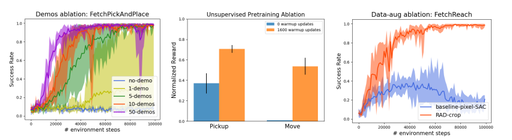
Fig. 6 : Left: We ablate the number of demonstrations required by CoDER, and find that although the agent fails to learn with zero demonstrations, it can learn the PickAndPlace task efficiently using only 10 demonstrations. Center: We compare the performance of the move task with and without the use of pre-training on the real xArm robot. The plotted episode returns at convergence show that the contrastive pre-training substantially boosts performance. Right: Using data augmentation, the agent achieves successful performance. Using non-augmented observations, the agent fails to learn the task.
원문 · CC BY 4.0 · Albert Zhan, Ruihan Zhao, Lerrel Pinto, Pieter Abbeel, Michael Laskin · Learning Visual Robotic Control Efficiently with Contrastive Pre-training and Data Augmentation · 원문 그림 인용 · 원본 PDF 6쪽에서 그림 영역을 추출했습니다.적용 범위와 한계
저자들은 CoDER가 재설정에 도움이 필요할 수 있으며, 학습된 과제와 질적으로 다른 과제로는 일반화되지 않을 것으로 예상합니다. 또한 희소 보상 신호에 의존하므로 무작위 상호작용으로 보상에 도달하기 어려운 장기 과제에서는 성공하지 않을 것으로 예상합니다. 장면의 시각 조건이 크게 바뀌는 비실험실 환경에서는 성능이 저하될 것으로 예상된다고 서술합니다. 이 한계는 저자의 예상이며, 해당 조건에서 직접 측정한 결과는 본문에 보고되지 않았습니다.
논문 정보
- 저자
- Albert Zhan, Ruihan Zhao, Lerrel Pinto, Pieter Abbeel, Michael Laskin
- 학회·저널
- arXiv · 프리프린트
- 최초 공개일
- 2020년 12월 14일
- 등록일
- 2026년 11월 4일
- 수정일
- 2022년 10월 17일
- 버전
- v3
- arXiv
- 2012.07975
- 분류
- cs.RO · cs.AI · cs.LG
- 원문 이용 조건
- CC BY 4.0
- 제공 범위
- 논문 정보, 해설, 허용된 원문 그림
AI 해설은 논문 원문과 별개의 설명이며 오류가 있을 수 있습니다. 원문과 그림은 각 출처의 이용 조건과 따로 표시된 권리를 따릅니다.
초록
Recent advances in unsupervised representation learning significantly improved the sample efficiency of training Reinforcement Learning policies in simulated environments. However, similar gains have not yet been seen for real-robot reinforcement learning. In this work, we focus on enabling data-efficient real-robot learning from pixels. We present Contrastive Pre-training and Data Augmentation for Efficient Robotic Learning (CoDER), a method that utilizes data augmentation and unsupervised learning to achieve sample-efficient training of real-robot arm policies from sparse rewards. While contrastive pre-training, data augmentation, demonstrations, and reinforcement learning are alone insufficient for efficient learning, our main contribution is showing that the combination of these disparate techniques results in a simple yet data-efficient method. We show that, given only 10 demonstrations, a single robotic arm can learn sparse-reward manipulation policies from pixels, such as reaching, picking, moving, pulling a large object, flipping a switch, and opening a drawer in just 30 minutes of mean real-world training time. We include videos and code on the project website: https://sites.google.com/view/efficient-robotic-manipulation/home
원문 인용
Albert Zhan, Ruihan Zhao, Lerrel Pinto, Pieter Abbeel, Michael Laskin (2020). Learning Visual Robotic Control Efficiently with Contrastive Pre-training and Data Augmentation. arXiv:2012.07975v3. https://arxiv.org/abs/2012.07975v3
BibTeX
@misc{zhan2020learning,
  title = {{Learning Visual Robotic Control Efficiently with Contrastive Pre-training and Data Augmentation}},
  author = {Albert Zhan and Ruihan Zhao and Lerrel Pinto and Pieter Abbeel and Michael Laskin},
  year = {2020},
  eprint = {2012.07975},
  archivePrefix = {arXiv},
  url = {https://arxiv.org/abs/2012.07975v3}
}