논문 해설
English Calibration Erodes Lithuanian in Expert-Pruned Mixture-of-Experts Language Models
전문가 가지치기를 적용한 혼합 전문가 언어 모델에서 영어 보정이 리투아니아어 성능을 약화시킨다
- 연구 문제 영어 calibration으로 MoE 전문가를 가지치기하면 리투아니아어 성능이 영어보다 훨씬 크게 떨어지는지를 검증합니다.
- 연구 방법 REAP으로 네 MoE 모델을 25%와 50% 비율로 가지치기하고, calibration 언어를 영어, 리투아니아어, 혼합으로 바꿔 두 언어의 독해, 번역, 언어 모델링을 비교합니다.
- 주요 결과 25% 가지치기에서 영어 calibration은 영어 독해를 중앙값 1.7포인트, 리투아니아어 독해를 21.4포인트 떨어뜨렸습니다. 리투아니아어 calibration은 이 격차의 대부분을 줄이고 영어 독해를 해치지 않았습니다.
영어 calibration이 리투아니아어까지 보존하는지에 대한 문제
Mixture-of-Experts 모델은 각 토큰을 일부 전문가에게만 보내므로 실행 비용은 작지만 모든 전문가를 저장해야 하므로 메모리 비용이 큽니다. 전문가 가지치기는 중요도가 낮은 전문가를 통째로 삭제해 이 저장 비용을 줄입니다. 중요도는 calibration 집합으로 계산하며, 기존 연구는 대부분 영어 calibration을 사용해 왔습니다. 이 논문은 그 영어 calibration이 리투아니아어에서도 같은 정도로 안전한지를 묻습니다. 리투아니아어는 웹 텍스트 비중이 작고 토큰 수가 많아 영어와 조건이 다르므로, 영어만으로 평가하면 리투아니아어의 손상을 놓칠 수 있습니다. 따라서 이 연구의 범위는 REAP 가지치기를 영어와 리투아니아어 성능의 격차 측면에서 검증하는 것입니다.
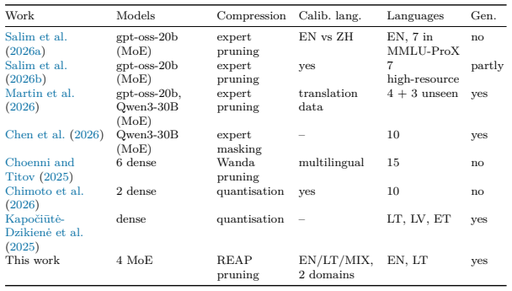
Table 1 :How this study differs from the closest prior work (“Calib. lang.”: calibration language varied; “Gen.”: open generation evaluated).
원문 · CC BY 4.0 · Tomas Rasymas, Povilas Kvedaras · English Calibration Erodes Lithuanian in Expert-Pruned Mixture-of-Experts Language Models · 원문 그림 인용 · 원본 PDF 6쪽에서 그림 영역을 추출했습니다.REAP의 전문가 중요도 계산과 제거 방식
REAP은 각 라우팅 전문가 j에 중요도 점수 S_j를 매기고, 점수가 낮은 전문가를 제거합니다. 점수는 다음 식으로 계산됩니다. \[S_j = \frac{1}{|X_j|}\sum_{x\in X_j} g_j(x)\,\lVert f_j(x)\rVert_2\] 여기서 X_j는 calibration 토큰 가운데 전문가 j로 라우팅된 집합이고, g_j(x)는 라우터의 게이트 가중치, f_j(x)는 전문가의 출력입니다. 라우터가 그 전문가를 강하게 선택하고 출력의 크기가 클수록 점수가 커집니다. 점수는 평균이므로 적은 토큰만 받는 전문가도 높은 점수를 받을 수 있습니다. 반면 calibration 토큰을 전혀 받지 않은 전문가는 점수가 0이 되어 가장 먼저 제거됩니다.
가지치기는 각 MoE 층에서 점수가 낮은 라우팅 전문가를 25% 또는 50%씩 제거하며, 공유 전문가와 dense 층, 활성 전문가 수는 그대로 둡니다. 구현은 llm-compressor 0.15.0을 사용하며, 층을 하나씩 순서대로 가지치기합니다.
모델, calibration 집합, 평가 설계
연구는 Qwen3-30B-A3B-Instruct-2507, Qwen3.6-35B-A3B, gemma-4-26B-A4B-it, GLM-4.7-Flash 네 모델을 가지치기합니다. 이 모델들은 라우팅 전문가 수가 64에서 256 사이이고, 리투아니아어 성능이 영어보다 낮습니다. calibration 집합은 각각 1,024개 샘플이며 샘플은 2,048 토큰입니다. 도메인은 Wikipedia 또는 Europarl이고, 언어는 영어(EN), 리투아니아어(LT), 50/50 혼합(MIX) 중 하나입니다. 토큰 예산이 고정되어 있어 리투아니아어는 단어당 토큰이 많으므로 LT 집합은 EN 집합의 약 절반 분량의 텍스트를 담습니다.
네 모델, 두 도메인, 세 언어, 두 가지치기 비율을 조합하면 48개의 가지치기 모델이 생깁니다. 평가는 Belebele 900문항의 독해 정확도, FLORES-200 devtest 1,012문장의 chrF++ 번역 점수, Wikipedia 5,000문서의 NLL 언어 모델링입니다. 리투아니아어 쪽 성능 저하 D_LT에서 영어 쪽 저하 D_EN을 뺀 LT–EN 격차 G를 주 지표로 사용하며, 양수는 리투아니아어가 더 크게 손실되었음을 뜻합니다.
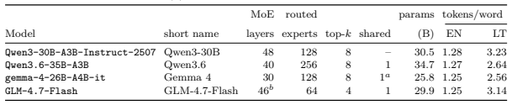
Table 2 :The four models (a) and their unpruned scores (b). Tokens per word: mean tokens per word in each model’s FLORES translations into that language. Bits per byte: Wikipedia NLL per UTF-8 byte, in bits (lower is better). aGemma 4 runs a dense MLP alongside its routed experts. bGLM’s first layer is dense. Parameter counts include the vision towers of Gemma 4 and Qwen3.6 and exclude multi-token- prediction heads. Gemma 4’s bits per byte are high because it is an instruction-tuned model scored inside its chat template; compare it only with itself.
원문 · CC BY 4.0 · Tomas Rasymas, Povilas Kvedaras · English Calibration Erodes Lithuanian in Expert-Pruned Mixture-of-Experts Language Models · 원문 그림 인용 · 원본 PDF 7쪽에서 그림 영역을 추출했습니다.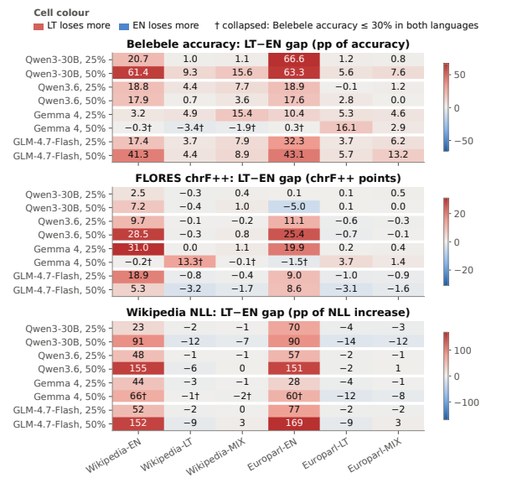
Figure 8 : LT–EN gap for all 48 configurations.Panels from top: Belebele (pp), FLORES (chrF++), Wikipedia (pp); rows: model and ratio; columns: calibration set. Red = Lithuanian loses more, blue = English loses more; Wikipedia values rounded to integers.†=collapsedinbothlanguages(Belebeleaccuracy≤30%): agapnear0there means that both languages broke, not that they degraded equally. The EN-calibrated columns are red throughout.
원문 · CC BY 4.0 · Tomas Rasymas, Povilas Kvedaras · English Calibration Erodes Lithuanian in Expert-Pruned Mixture-of-Experts Language Models · 원문 그림 인용 · 원본 PDF 32쪽에서 그림 영역을 추출했습니다.영어 calibration의 비대칭적 손상과 리투아니아어 calibration의 효과
영어 calibration으로 25% 가지치기를 하면 영어 독해 정확도는 중앙값 1.7포인트 떨어졌지만 리투아니아어 독해 정확도는 21.4포인트 떨어졌습니다. 예를 들어 Qwen3-30B를 Europarl-EN으로 25% 가지치기하면 영어 Belebele 정확도는 93.3%로 원래 모델보다 1.0포인트만 낮지만, 리투아니아어 정확도는 89.9%에서 22.3%로 떨어져 무작위 추측 수준에 가깝습니다. 이 격차는 Wikipedia 기준 16개 설정 모두에서 유의하게 양수였습니다. 리투아니아어 calibration으로 바꾸면 리투아니아어 Belebele 정확도는 평균 25.5포인트, 리투아니아어로 번역하는 chrF++는 28.2포인트 개선됩니다.
같은 변경에서 영어 Belebele는 평균 2.5포인트 높아져, 리투아니아어 calibration이 영어 독해를 해치지 않았습니다. 다만 영어 언어 모델링은 조금 나빠졌습니다. 혼합 calibration은 리투아니아어 Belebele에서 리투아니아어 calibration보다 평균 3.0포인트 낮았고, 더 나은 균형이라는 가설은 16개 중 3개 설정에서만 지지되어 뒷받침되지 않았습니다.
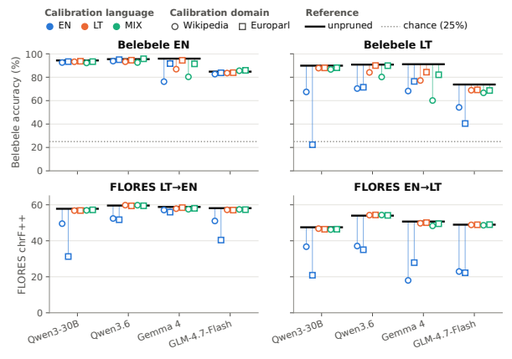
Figure 1 : At 25% expert pruning, English calibration erodes Lithuanian far more than English.Black bars are the unpruned models and points their 25%-pruned versions. Unless a caption says otherwise, colour marks the calibration language in all figures (EN blue, LT orange, MIX green); circles and squares mark Wikipedia and Europarl calibration, and hollow and filled markers mark 25% and 50% pruning. Higher is better; the dotted line is chance on Belebele. English-calibrated models keep their English comprehension (except Gemma 4 with English Wikipedia calibration) but lose up to 67.6 points in Lithuanian, and they translate worse, espe- cially into Lithuanian.
원문 · CC BY 4.0 · Tomas Rasymas, Povilas Kvedaras · English Calibration Erodes Lithuanian in Expert-Pruned Mixture-of-Experts Language Models · 원문 그림 인용 · 원본 PDF 4쪽에서 그림 영역을 추출했습니다.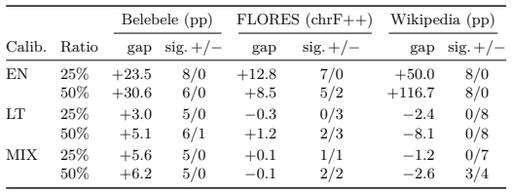
Table 3 :Mean LT–EN gap over the four models and two domains (positive = Lithua- nian loses more), and the number of the 8 configurations whose gap is significantly positive/negative.
원문 · CC BY 4.0 · Tomas Rasymas, Povilas Kvedaras · English Calibration Erodes Lithuanian in Expert-Pruned Mixture-of-Experts Language Models · 원문 그림 인용 · 원본 PDF 9쪽에서 그림 영역을 추출했습니다.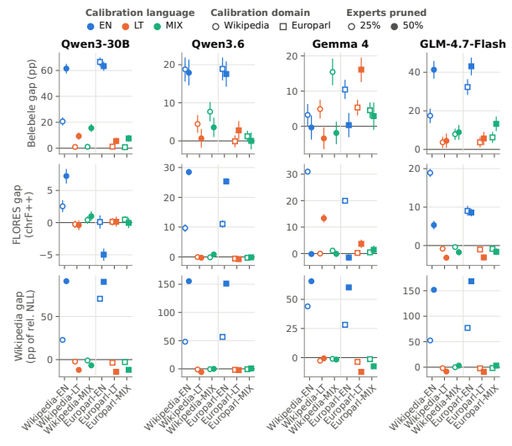
Figure 2 : LT–EN gap with 95% intervalsfor each model (columns) and cali- bration set (x axis). Rows: Belebele (pp), FLORES (chrF++) and Wikipedia (pp of relative NLL increase), with different y scales. Positive means that Lithuanian loses more; markers as in Figure 1. English-calibrated gaps are large except for Gemma 4 and runs where both languages collapsed; LT and MIX gaps are small except for Gemma 4.
원문 · CC BY 4.0 · Tomas Rasymas, Povilas Kvedaras · English Calibration Erodes Lithuanian in Expert-Pruned Mixture-of-Experts Language Models · 원문 그림 인용 · 원본 PDF 10쪽에서 그림 영역을 추출했습니다.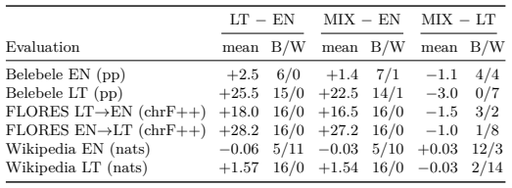
Table 4 :Effect of switching the calibration language: mean difference over 16 config- urations (positive = the first is better; Wikipedia: NLL reduction in nats per token). B/W: how many are significantly better/worse.
원문 · CC BY 4.0 · Tomas Rasymas, Povilas Kvedaras · English Calibration Erodes Lithuanian in Expert-Pruned Mixture-of-Experts Language Models · 원문 그림 인용 · 원본 PDF 11쪽에서 그림 영역을 추출했습니다.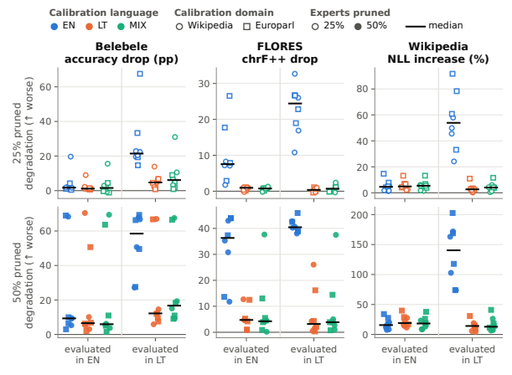
Figure 3 : Transfer between calibration languages is asymmetric.Degrada- tion (positive = worse) of English (left) and Lithuanian (right) for each calibration language, at 25% (top) and 50% (bottom); one point per model and domain; black bars are medians. For FLORES, English is LT→EN. Every calibration language preserves English; only LT and MIX preserve Lithuanian.
원문 · CC BY 4.0 · Tomas Rasymas, Povilas Kvedaras · English Calibration Erodes Lithuanian in Expert-Pruned Mixture-of-Experts Language Models · 원문 그림 인용 · 원본 PDF 12쪽에서 그림 영역을 추출했습니다.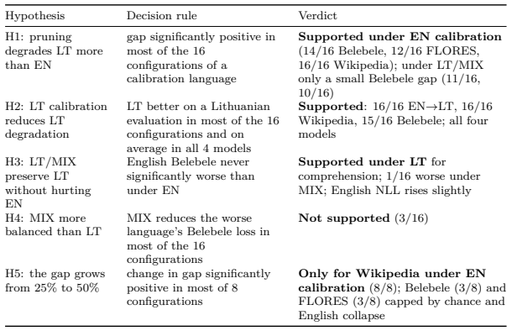
Table 5 :Hypotheses, decision rules and verdicts. Counts are configurations with a significant effect.
원문 · CC BY 4.0 · Tomas Rasymas, Povilas Kvedaras · English Calibration Erodes Lithuanian in Expert-Pruned Mixture-of-Experts Language Models · 원문 그림 인용 · 원본 PDF 18쪽에서 그림 영역을 추출했습니다.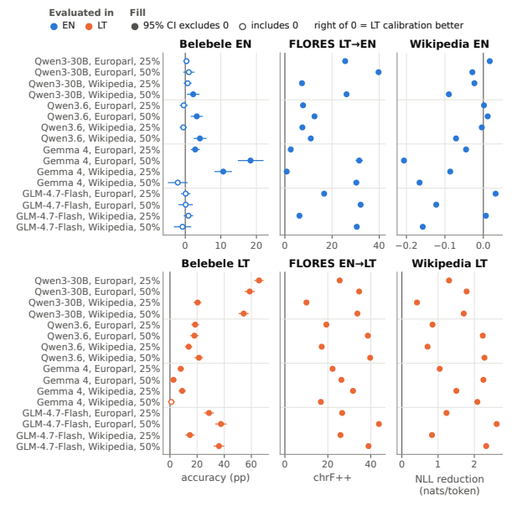
Figure 9 : LT vs EN calibration, paired by model, domain and ratio (rows). Columns: benchmarks; top row evaluated in English, bottom row in Lithuanian. Right of 0 = LT calibration better (Wikipedia NLL negated, nats/token); bars are 95% intervals; here fill = significance (filled = interval excludes 0), not ratio; colour = evaluated language. LT calibration is better for every Lithuanian evaluation except collapsed Gemma 4Wikipedia, 50%; English Belebele never gets significantly worse.
원문 · CC BY 4.0 · Tomas Rasymas, Povilas Kvedaras · English Calibration Erodes Lithuanian in Expert-Pruned Mixture-of-Experts Language Models · 원문 그림 인용 · 원본 PDF 35쪽에서 그림 영역을 추출했습니다.전문가 집합의 중복과 리투아니아어 라우팅의 집중
영어와 리투아니아어 calibration은 같은 도메인에서 25% 가지치기 시 전문가의 90–94%를 공유합니다. 두 언어의 saliency 순위 상관은 층 평균 기준 0.72–0.85이며, 나머지 전문가가 성능 차이를 설명하는 핵심 원인입니다. 영어 calibration에서 제거된 전문가는 리투아니아어 라우팅을 더 많이 받았습니다. 25%에서 제거된 전문가는 리투아니아어 선택의 20.2%를, 영어 선택의 13.6%를 받았습니다. 리투아니아어 calibration에서는 순서가 바뀌어 12.2%와 15.3%였습니다. 마지막 층에서는 리투아니아어의 상위 8개 전문가가 선택의 55–72%를 처리하지만 영어는 19–39%에 그칩니다.
이 차이는 중간 층에서 줄어듭니다. 저자들은 영어 라우팅이 많은 전문가에 고르게 퍼져 있어 리투아니아어 calibration이 영어로 전이된다고 해석합니다. 이 해석은 상관 분석에 기반한 가설이며, 제거된 라우팅의 양은 손상 크기를 완전히 예측하지 못합니다.
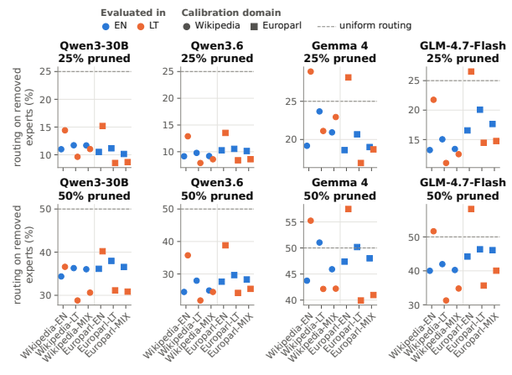
Figure 5 : Removed routing share: the share of each language’s routing that went to the experts pruning removed, measured on the unpruned model for English (blue) and Lithuanian (orange) Wikipedia text, at 25% (top) and 50% (bottom); circles and squares are Wikipedia and Europarl calibration; the dashed line is uniform routing. Under EN calibration Lithuanian loses more routing than English in every model; under LT calibration the order reverses.
원문 · CC BY 4.0 · Tomas Rasymas, Povilas Kvedaras · English Calibration Erodes Lithuanian in Expert-Pruned Mixture-of-Experts Language Models · 원문 그림 인용 · 원본 PDF 14쪽에서 그림 영역을 추출했습니다.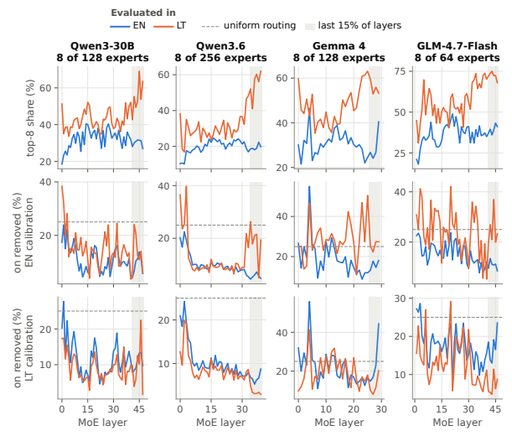
Figure 6 : Lithuanian relies on few experts at the end of the network, and EN calibration removes some of them.Top: share of routing handled by the 8 most-used experts in each MoE layer (unpruned; colour = evaluated language). Middle and bottom: removed routing share of each language at 25% under EN and LT calibration (mean of the two domains); dashed = uniform; the last 15% of layers are shaded. How much more Lithuanian routing EN calibration removes there depends on the model.
원문 · CC BY 4.0 · Tomas Rasymas, Povilas Kvedaras · English Calibration Erodes Lithuanian in Expert-Pruned Mixture-of-Experts Language Models · 원문 그림 인용 · 원본 PDF 16쪽에서 그림 영역을 추출했습니다.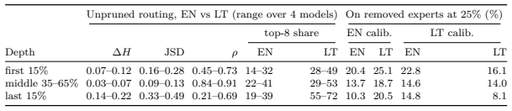
Table 10 : Where in the network English and Lithuanian differ.Left: routing of the unpruned models, as ranges over the four models: EN−LT difference in nor- malised selection entropy (∆H), routing divergence (JSD), rank correlation of expert usage (ρ), and share of routing handled by the 8 most-used experts (%). Right: share of each language’s routing on the experts removed at 25% (%, mean of 8 configura- tions). Depth bands: first 15%, middle 35–65% and last 15% of the MoE layers; the measures are defined in Appendix A.
원문 · CC BY 4.0 · Tomas Rasymas, Povilas Kvedaras · English Calibration Erodes Lithuanian in Expert-Pruned Mixture-of-Experts Language Models · 원문 그림 인용 · 원본 PDF 38쪽에서 그림 영역을 추출했습니다.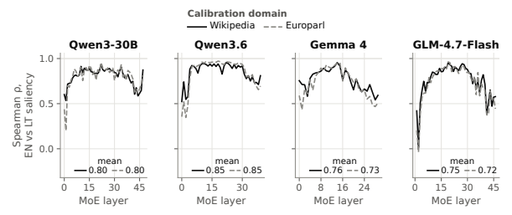
Figure 10 : Per-layer EN vs LT saliency rank correlation(saliency-only runs; solid = Wikipedia, dashed = Europarl). Agreement is lowest in the first and last layers.
원문 · CC BY 4.0 · Tomas Rasymas, Povilas Kvedaras · English Calibration Erodes Lithuanian in Expert-Pruned Mixture-of-Experts Language Models · 원문 그림 인용 · 원본 PDF 38쪽에서 그림 영역을 추출했습니다.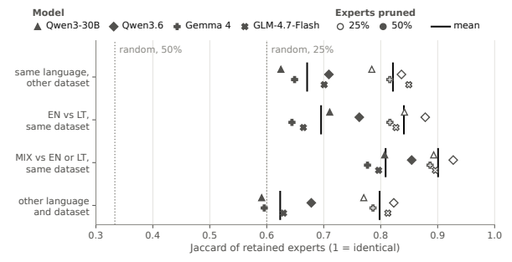
Figure 11 : Which calibration changes move the retained expert set?Jaccard of retained experts per kind of calibration pair, averaged per model (glyph = model); hollow = 25%, filled = 50%; black bars are means; dotted lines are random selection. Changing the domain moves the set at least as much as changing EN to LT in three of the four models.
원문 · CC BY 4.0 · Tomas Rasymas, Povilas Kvedaras · English Calibration Erodes Lithuanian in Expert-Pruned Mixture-of-Experts Language Models · 원문 그림 인용 · 원본 PDF 39쪽에서 그림 영역을 추출했습니다.검증 범위와 해석의 한계
각 설정은 한 번만 greedy decoding으로 실행되었으므로 신뢰구간은 calibration 샘플의 변동이 아니라 테스트 항목의 표집을 반영합니다. 두 비율과 하나의 calibration 예산만 확인했기 때문에 각 모델이 어느 비율에서 붕괴하기 시작하는지는 알 수 없습니다. Wikipedia 테스트 문서는 평행 텍스트가 아니어서, 내용을 통제한 비교는 Europarl에 의존합니다. 연구는 리투아니아어 한 언어만 다루며 영어 개방형 생성, 지시 수행, 대화 품질은 평가하지 않았습니다. 라우팅과 손상의 연결은 상관 관계이며, 제거된 라우팅 비율과 Belebele 손실의 상관은 네 모델에서 얻은 16개 점 수준의 분석입니다.
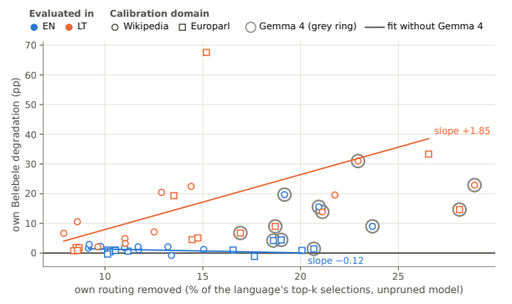
Figure 12 : Coverage vs robustness.Each language’s own routing share removed (x) against its own Belebele degradation (y; positive = worse), every configuration at 25%; colour = evaluated language; circle/square = Wikipedia/Europarl; grey rings mark Gemma 4, which is excluded from the fitted lines. Lithuanian accuracy falls steeply with the share of its routing removed, English accuracy barely moves.
원문 · CC BY 4.0 · Tomas Rasymas, Povilas Kvedaras · English Calibration Erodes Lithuanian in Expert-Pruned Mixture-of-Experts Language Models · 원문 그림 인용 · 원본 PDF 39쪽에서 그림 영역을 추출했습니다.논문 정보
- 저자
- Tomas Rasymas, Povilas Kvedaras
- 학회·저널
- arXiv · 프리프린트
- 최초 공개일
- 2026년 11월 5일
- 등록일
- 2026년 11월 6일
- 수정일
- 2026년 11월 5일
- 버전
- v1
- arXiv
- 2611.07654
- 분류
- cs.CL · cs.LG
- 원문 이용 조건
- CC BY 4.0
- 제공 범위
- 논문 정보, 해설, 허용된 원문 그림
AI 해설은 논문 원문과 별개의 설명이며 오류가 있을 수 있습니다. 원문과 그림은 각 출처의 이용 조건과 따로 표시된 권리를 따릅니다.
초록
Expert pruning compresses Mixture-of-Experts (MoE) language models by removing the experts that a calibration set marks as unimportant. Studies of high-resource languages largely find that English calibration transfers well to other languages. We test this for Lithuanian: we pruned four MoE models with REAP, removing 25% or 50% of the experts with English, Lithuanian or mixed calibration, and evaluated both languages on reading comprehension, translation and language modelling. English calibration does not transfer to Lithuanian: at 25% pruning, English comprehension fell by a median of 1.7 points but Lithuanian by 21.4. The transfer is asymmetric. Lithuanian calibration removed most of the Lithuanian loss and never significantly hurt English comprehension, which was on average 2.5 points better than under English calibration; only English language modeling got slightly worse. Routing suggests why: in the last layers, Lithuanian sends 55-72% of its expert selections to just eight experts, against 19-39% for English, and English calibration removes some of these experts. Compressed models should be calibrated, and evaluated, in every language they must serve.
원문 인용
Tomas Rasymas, Povilas Kvedaras (2026). English Calibration Erodes Lithuanian in Expert-Pruned Mixture-of-Experts Language Models. arXiv:2611.07654v1. https://arxiv.org/abs/2611.07654v1
BibTeX
@misc{rasymas2026english,
  title = {{English Calibration Erodes Lithuanian in Expert-Pruned Mixture-of-Experts Language Models}},
  author = {Tomas Rasymas and Povilas Kvedaras},
  year = {2026},
  eprint = {2611.07654},
  archivePrefix = {arXiv},
  url = {https://arxiv.org/abs/2611.07654v1}
}