논문 해설
BirdDreams: Joint Perspective and BEV Video Generation for a Plausible, Reactive Driving World Model
BirdDreams: 그럴듯하고 반응하는 주행 월드 모델을 위한 시점 및 BEV 공동 비디오 생성
- 연구 문제 주변 차량의 움직임을 퍼스펙티브 비디오만으로 학습하기는 어렵고, 외부 레이아웃을 쓰면 차량이 기록된 궤적에 고정됩니다.
- 연구 방법 퍼스펙티브 비디오와 BEV 비디오를 두 분기에서 joint attention으로 함께 생성하고, 예측된 BEV를 재투영해 ego 궤적을 조건화합니다.
- 주요 결과 ego 조건이 없는 설정에서 minADE를 PhysicalAI-AV에서 OmniDreams (Vanilla) 대비 21%, nuScenes에서 37% 줄였습니다.
외부 레이아웃 없이 주변 차량을 예측하기
주행 월드 모델은 ego 행동에 따라 장면이 어떻게 펼쳐지는지 시뮬레이션해야 합니다. 이때 주변 차량이 ego의 기동에 그럴듯하게 반응해야 하고, 동시에 ego 궤적도 입력대로 정확히 따라가야 합니다. 그런데 퍼스펙티브 비디오만으로 차량 움직임을 배우기는 어렵습니다. 움직임이 질감과 조명에 얽혀 있고, 차량이 가려지며, 같은 픽셀 변위라도 카메라와의 거리에 따라 실제 속도가 달라지기 때문입니다.
기존 연구 중 OmniDreams 같은 모델은 도로 기하와 주변 차량의 미래 상태를 담은 외부 레이아웃을 조건으로 줍니다. 이 방식은 차량 움직임을 통제하기 쉽지만, 레이아웃을 로그에서 재생하면 차량이 기록된 궤적에 고정되어 ego 기동에 반응하지 못합니다. 별도의 교통 모델을 쓰면 상호작용 예측이 비디오 월드 모델 바깥에 남습니다.
이 논문은 레이아웃 자체를 예측 대상으로 바꿉니다. 퍼스펙티브 비디오와 함께 단순한 도형으로 그린 정사영 BEV 비디오를 동시에 생성해, 장면 구조가 외부 입력이 아니라 생성되는 미래의 일부가 되도록 했습니다.

Figure 1 :Motivation: scene structure as a prediction target.(a) OmniDreams conditions RGB video generation on schematic views rendered from external road geometry and future vehicle states. (b) BirdDreams jointly generates perspective and schematic BEV videos, predicting scene structure and surrounding-vehicle motion without HD-map or layout inputs at inference. Schematic BEV targets supervise vehicle motion during training, while the predicted BEV provides a geometric interface for ego-trajectory control.
원문 · CC BY 4.0 · Junyoung Seo, Jaewoo Seo, Seungryong Kim, Laura Leal-Taixé, Xiuming Zhang, Seung Wook Kim · BirdDreams: Joint Perspective and BEV Video Generation for a Plausible, Reactive Driving World Model · 원문 그림 인용 · 원본 PDF 2쪽에서 그림 영역을 추출했습니다.두 스트림의 공동 생성 구조
BirdDreams는 OmniDreams의 사전 학습된 causal video diffusion transformer를 기반으로 합니다. 퍼스펙티브 분기는 이 백본을 그대로 쓰고, BEV 분기는 그 가중치의 복사본으로 초기화합니다. 두 분기는 매 transformer 블록마다 joint attention으로 서로의 키와 값을 참조하며, 각 분기는 자기 표현을 위한 별도의 attention 투영, 피드포워드 층, 출력 head를 유지합니다. 입력은 초기 퍼스펙티브 RGB 이미지이고, 선택적으로 미터 단위 ego 궤적을 줄 수 있습니다.
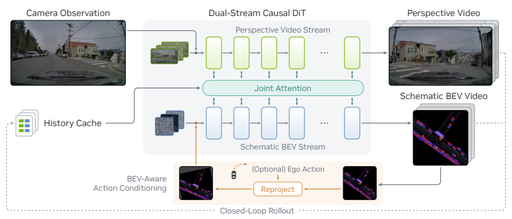
Figure 2 :Overview of BirdDreams.Two causal video diffusion transformers jointly generate perspective and schematic bird’s-eye-view (BEV) videos from an initial camera image, with joint attention over tokens from both streams. Noise levels are sampled independently across streams during training. For ego-action conditioning, the latest predicted BEV frame is reprojected along the input ego trajectory to form a soft condition for the BEV branch. Joint attention conveys this condition to the perspective branch, and cached history supports generation of successive chunks. The VAE encoder and decoder are omitted for clarity.
원문 · CC BY 4.0 · Junyoung Seo, Jaewoo Seo, Seungryong Kim, Laura Leal-Taixé, Xiuming Zhang, Seung Wook Kim · BirdDreams: Joint Perspective and BEV Video Generation for a Plausible, Reactive Driving World Model · 원문 그림 인용 · 원본 PDF 4쪽에서 그림 영역을 추출했습니다.잠재 표현은 세 개의 잠재 프레임으로 이루어진 청크로 나뉩니다. 청크 내부의 attention은 양방향이고 청크 사이는 인과적이어서, 현재 퍼스펙티브와 BEV 예측이 정보를 교환하면서 이전 장면 이력을 참조합니다. 퍼스펙티브 분기는 BEV에서 차량 움직임을 가져오고, BEV 분기는 퍼스펙티브에서 신호등 상태 같은 시각 정보를 가져옵니다.
독립 노이즈 샘플링과 학습 목표
학습은 Diffusion Forcing을 따릅니다. 청크마다 노이즈 수준을 샘플링하되, 퍼스펙티브와 BEV 스트림의 노이즈 수준을 서로 독립적으로 뽑습니다. 그래서 한쪽은 비교적 깨끗하고 다른 쪽은 잡음이 많은 쌍도 학습에 포함됩니다. 깨끗한 BEV 잠재 표현은 퍼스펙티브 분기에 도로 기하와 차량 위치를 제공하고, 깨끗한 퍼스펙티브 잠재 표현은 BEV 분기에 시각 특징을 제공합니다.
손상은 rectified-flow 보간으로 주어집니다. 깨끗한 잠재 변수 z와 가우시안 노이즈 ε를 σ에 따라 선형으로 섞으며, σ는 한 청크 안의 세 잠재 프레임에서 공유되지만 청크와 스트림 사이에서는 독립적으로 샘플링됩니다. 모델은 속도 ε−z를 예측하고, 손실은 각 스트림 안에서 잠재 원소에 대해 평균한 제곱 오차를 구한 뒤 두 스트림에 같은 가중치를 줍니다. 이렇게 하면 원소 수가 많은 퍼스펙티브 프레임이 원소 수 때문에 더 큰 가중치를 받지 않습니다.
BEV 재투영 기반 행동 조건화
ego 행동을 주기 위해 모델은 마지막으로 예측된 BEV 프레임을 입력 궤적에 맞춰 재투영합니다. BEV는 고정된 미터 스케일과 정사영을 가지므로 ego 위치 변화는 장면의 균일한 픽셀 이동으로, 헤딩 변화는 ego 주변의 회전으로 나타납니다. 이 변환을 이용해 각 궤적 포즈에서 참조 BEV 프레임을 ego 좌표계로 옮깁니다. 참조 장면은 정지해 있다고 가정하므로, 결과 프레임은 주변이 고정되어 있을 때 장면이 어떻게 움직여 보일지를 보여 줍니다.
이 재투영 프레임은 BEV 분기의 soft condition으로 쓰이고, 퍼스펙티브 분기는 joint attention을 통해 이 조건을 참조합니다. 학습 때는 이전 주석 BEV 프레임과 기록된 ego 포즈로 재투영을 만들고 실제 미래 BEV 비디오를 정답으로 씁니다. 행동 조건은 학습 중 무작위로 제거되어, 같은 모델이 ego 행동 조건 없이도 동작합니다. 깊이 추정 없이 평면 BEV 기하만 사용한다는 점도 구현상의 특징입니다.
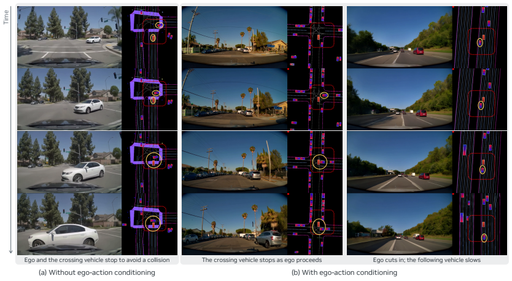
Figure 5 :Reactive behavior with and without ego-action conditioning.(a) Without ego-action conditioning, the ego and surrounding vehicles respond to one another. (b) In both examples with ego-action conditioning, the ego follows the input trajectory while surrounding vehicles react to its motion.
원문 · CC BY 4.0 · Junyoung Seo, Jaewoo Seo, Seungryong Kim, Laura Leal-Taixé, Xiuming Zhang, Seung Wook Kim · BirdDreams: Joint Perspective and BEV Video Generation for a Plausible, Reactive Driving World Model · 원문 그림 인용 · 원본 PDF 9쪽에서 그림 영역을 추출했습니다.Resampling Forcing fine-tuning
Diffusion Forcing으로 학습한 뒤, 모델은 Resampling Forcing으로 한 번 더 미세조정됩니다. 이 단계는 추론 때 모델이 자기 자신이 만든 이력을 조건으로 받으면서 생기는 오류 누적에 노출되도록 합니다. 깨끗한 정답 청크를 시퀀스마다 공유하는 같은 노이즈 수준 τ로 손상시키고, 한 번의 Euler 단계로 각 청크를 자기회귀적으로 복원해 이력을 만듭니다. 이 재표집된 이력의 기울기는 멈추고, 본 학습의 목표 청크는 여전히 스트림마다 독립적인 노이즈로 denoise되며 flow-matching 손실로 학습됩니다.

Figure 4 :Training procedure.Starting from pretrained vanilla OmniDreams, we train with Diffusion Forcing (DF) using noise levels sampled independently across chunks and streams. During Resampling Forcing (RF) fine-tuning, noisy ground-truth chunks are autoregressively denoised with one Euler step per chunk to form the conditioning history. Both stages retain independent noise sampling across chunks and streams for target denoising.
원문 · CC BY 4.0 · Junyoung Seo, Jaewoo Seo, Seungryong Kim, Laura Leal-Taixé, Xiuming Zhang, Seung Wook Kim · BirdDreams: Joint Perspective and BEV Video Generation for a Plausible, Reactive Driving World Model · 원문 그림 인용 · 원본 PDF 7쪽에서 그림 영역을 추출했습니다.주요 비교 결과
행동 조건이 없는 설정에서 BirdDreams는 PhysicalAI-AV와 nuScenes 모두에서 평가한 방법 중 minADE, minDTW, FTD, FVD, FID가 가장 낮았습니다. 이 minADE와 minDTW는 장면마다 세 개의 랜덤 시드로 생성한 샘플 중 최솟값을 취한 값입니다. OmniDreams (Vanilla) 대비 minADE는 PhysicalAI-AV에서 21%, nuScenes에서 37% 줄었습니다. 프레임 단위 Image Quality에서는 PhysicalAI-AV에서 OmniDreams (Vanilla)에, nuScenes에서는 DrivingDojo에 이어 두 번째였습니다.
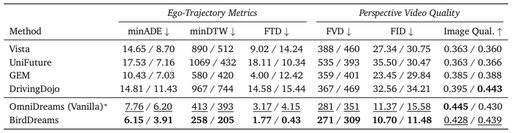
Table 1 :Quantitative comparison without ego-action conditioning.Each entry reports PhysicalAI- AV / nuScenes. Trajectory metrics use ego motion reconstructed from generated perspective videos; minADE and minDTW report the minimum over three samples per scene against the logged trajectory.*OmniDreams (Vanilla) uses no external scene-layout conditioning and is post-trained on the same dataset as BirdDreams.
원문 · CC BY 4.0 · Junyoung Seo, Jaewoo Seo, Seungryong Kim, Laura Leal-Taixé, Xiuming Zhang, Seung Wook Kim · BirdDreams: Joint Perspective and BEV Video Generation for a Plausible, Reactive Driving World Model · 원문 그림 인용 · 원본 PDF 8쪽에서 그림 영역을 추출했습니다.ego 행동 조건이 있는 설정에서는 장면마다 생성 샘플 하나를 평가했고, 기준 비교는 OmniDreams (Plücker)입니다. 여기서 BirdDreams는 ADE를 PhysicalAI-AV에서 35%, nuScenes에서 36% 줄였으며, 두 설정 모두 궤적 개선과 함께 FVD와 FID도 낮아졌습니다. 궤적은 Depth Anything 3으로 생성된 퍼스펙티브 비디오에서 복원했으므로, 이 수치는 복원 경로에 의존합니다.
주변 차량 행동에 대한 사람 평가
반응 행동은 자동 지표로 포착하기 어려워 쌍별 사람 평가를 했습니다. BirdDreams (HDMap)와 OmniDreams (HDMap)에 같은 초기 프레임, 반사실적 ego 행동, 정적 도로 기하를 주었습니다. 그 결과 참가자는 BirdDreams (HDMap)를 57%의 비교에서 선호했고, OmniDreams (HDMap)는 24%, 동률은 19%였습니다.
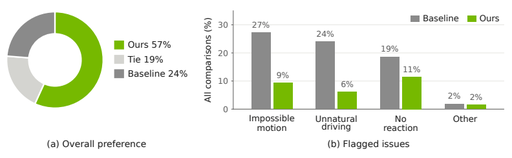
Figure 8 :Human evaluation of surrounding-vehicle behavior.BirdDreams (HDMap) and OmniDreams (HDMap) receive the same initial observations, counterfactual ego actions, and static road geometry, without surrounding-vehicle-state conditions. (a) Overall preference from 375 judgments by 25 participants. (b) Issues flagged for the non-preferred video, with percentages over all 375 judgments and multiple selections allowed.
원문 · CC BY 4.0 · Junyoung Seo, Jaewoo Seo, Seungryong Kim, Laura Leal-Taixé, Xiuming Zhang, Seung Wook Kim · BirdDreams: Joint Perspective and BEV Video Generation for a Plausible, Reactive Driving World Model · 원문 그림 인용 · 원본 PDF 14쪽에서 그림 영역을 추출했습니다.선호하지 않은 영상에 대해 참가자가 표시한 문제는 불가능한 움직임, 비현실적 주행, 반응 부재의 세 범주로 나뉩니다. 베이스라인은 각각 27%, 24%, 19%의 비교에서 표시되었고, BirdDreams (HDMap)는 9%, 6%, 11%였습니다. 이 평가는 도로 기하를 주고 차량 움직임만 모델이 예측하게 한 조건의 결과입니다.
WAM post-training 예비 실험
BirdDreams를 ego 궤적을 예측하는 world-action model로 확장하는 예비 실험도 있습니다. 두 모델 모두 OmniDreams (Vanilla)와 BirdDreams가 같은 데이터에서 22,000 반복 동안 사후 학습되었고, 퍼스펙티브 분기와 행동 head를 미세조정했습니다. BirdDreams의 BEV 분기는 고정되어 있으며, 행동 예측 중 BEV 입력에는 순수 가우시안 노이즈(σ=1)가 들어갑니다.
100개의 보류 클립에서 3초 구간 best-of-six minADE를 비교하면 BirdDreams는 0.295m, OmniDreams (Vanilla)는 0.318m였습니다. 실제 BEV를 입력으로 준 진단 실험은 0.274m를 기록했으나, 이는 퍼스펙티브 비디오 이외의 정보를 쓰는 별도 진단입니다. 이 실험은 100개 클립의 예비 결과이므로 주 실험과 같은 규모로 읽을 수 없습니다.
한계와 확인되지 않은 범위
사람 평가는 베이스라인과 달리 도로 기하를 같이 주는 HDMap 조건에서만 수행되었습니다. 따라서 이 결과는 주변 차량 행동 비교에 한정되며, 다른 설정이나 전체 생성 품질을 대신하지 않습니다. WAM 실험은 100개 보류 클립의 예비 실험이며, 모델 규모와 학습 예산도 주 실험과 다릅니다.
또한 ego 궤적 지표는 생성된 퍼스펙티브 비디오에서 Depth Anything 3으로 복원한 궤적에 기대므로, 복원 오류가 지표에 섞일 수 있습니다. 행동 조건 실험에서 ADE와 DTW가 낮아졌다는 결과도 원문이 보고한 두 데이터셋과 해당 기준 모델에 대한 것입니다.
논문 정보
- 저자
- Junyoung Seo, Jaewoo Seo, Seungryong Kim, Laura Leal-Taixé, Xiuming Zhang, Seung Wook Kim
- 학회·저널
- arXiv · 프리프린트
- 최초 공개일
- 2026년 11월 10일
- 등록일
- 2026년 11월 13일
- 수정일
- 2026년 11월 10일
- 버전
- v1
- arXiv
- 2611.14815
- 분류
- cs.CV
- 원문 이용 조건
- CC BY 4.0
- 제공 범위
- 논문 정보, 해설, 허용된 원문 그림
AI 해설은 논문 원문과 별개의 설명이며 오류가 있을 수 있습니다. 원문과 그림은 각 출처의 이용 조건과 따로 표시된 권리를 따릅니다.
초록
Driving world models aim to simulate how a scene unfolds under different ego actions. This requires plausible motion of surrounding vehicles as well as precise ego-trajectory control. Learning vehicle motion from perspective video alone is challenging because motion is entangled with appearance and vehicles can be occluded. Prior work therefore conditions video generation on layouts that specify vehicle motion, providing control over surrounding vehicles but requiring their future trajectories as inputs. We introduce BirdDreams, an autoregressive driving world model that jointly generates perspective video and a schematic bird's-eye-view (BEV) video, making scene layout part of the predicted future. The BEV, rendered from scene annotations for training, depicts roads and vehicles as simple shapes at a fixed metric scale, providing a top-down view of their positions and motion with reduced occlusion between vehicles. Perspective video, by contrast, retains scene details that the BEV omits, such as traffic signals and object appearance. Joint attention between two video diffusion transformers, one per stream, lets each stream inform the other during generation. The predicted BEV also provides a geometric interface for ego control: we translate and rotate its latest frame along an input ego trajectory and use the resulting frames as a soft condition that shows how the scene would appear to move if only the ego vehicle moved. At inference, BirdDreams generates both videos from a single camera image without requiring an HD map or vehicle-state inputs. On PhysicalAI-AV and nuScenes, BirdDreams follows input ego trajectories more faithfully than prior driving world models and generates more plausible ego motion without ego-action conditioning. Human evaluation shows that BirdDreams outperforms a perspective-only baseline in generating realistic surrounding-vehicle behavior.
원문 인용
Junyoung Seo, Jaewoo Seo, Seungryong Kim, Laura Leal-Taixé, Xiuming Zhang, Seung Wook Kim (2026). BirdDreams: Joint Perspective and BEV Video Generation for a Plausible, Reactive Driving World Model. arXiv:2611.14815v1. https://arxiv.org/abs/2611.14815v1
BibTeX
@misc{seo2026birddreams,
  title = {{BirdDreams: Joint Perspective and BEV Video Generation for a Plausible, Reactive Driving World Model}},
  author = {Junyoung Seo and Jaewoo Seo and Seungryong Kim and Laura Leal-Taixé and Xiuming Zhang and Seung Wook Kim},
  year = {2026},
  eprint = {2611.14815},
  archivePrefix = {arXiv},
  url = {https://arxiv.org/abs/2611.14815v1}
}