논문 해설
CauchyNet: Compact and Data-Efficient Learning using Holomorphic Activation Functions
CauchyNet: 정칙 활성화 함수를 이용한 compact하고 데이터 효율적인 학습
- 연구 문제 데이터가 적고 연산 자원이 제한된 환경에서 날카로운 피크와 결측 구간을 적은 파라미터로 근사하는 문제를 다룹니다.
- 연구 방법 입력을 복소 평면에 임베딩하고 역수형 Cauchy 활성화를 쓰는 단일 은닉층 CauchyNet을 제안합니다.
- 주요 결과 저자들은 날카로운 함수, 결측 구간, M4 추세 예측에서 CauchyNet이 기준 모델보다 낮은 오차를 보고하며 파라미터 수도 적다고 보고합니다.
연구 문제와 동기
CauchyNet은 데이터가 적고 연산 자원이 제한된 환경에서 함수 근사와 결측값 보간을 수행하려는 신경망입니다. 저자들은 Transformer나 LSTM처럼 파라미터가 많은 모델이 소규모 연구실이나 엣지 장치에서 부담이 크다고 설명합니다. 또한 날카로운 피크나 특이점처럼 급격히 변하는 함수를 ReLU 기반 다층 퍼셉트론이 적은 파라미터로 근사하기 어렵다고 지적합니다. 이 논문은 이러한 상황에서 파라미터 효율적이면서 정확도를 유지하는 구조를 찾는 것을 목표로 합니다.
Cauchy 활성화와 CauchyNet 구조
CauchyNet은 실수 입력 x를 허수부가 0인 복소 벡터 z=x+i0으로 임베딩합니다. 이후 은닉 뉴런마다 학습 가능한 복소 바이어스를 더하고, 각 성분의 역수를 곱하는 Cauchy 활성화 함수 X(z)=∏z_i^{-1}를 적용합니다. 은닉 활성값은 복소 계수 벡터로 결합되어 복소 출력 o=y+ie가 되며, 실수부 y가 예측값으로 사용됩니다. 학습 손실은 실수 예측 오차에 λ|e|^2를 더한 형태이며, 허수 오차 e를 0에 가깝게 유도합니다. 역전파는 Wirtinger 미분을 사용하여 복소 파라미터의 기울기를 계산합니다.
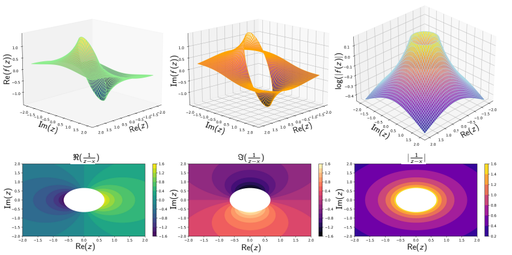
Figure 2 : Visual representation of the Cauchy activation function X (z) for z values outside a small circular disc. (Top row) 3D surface plots showing the real part, imaginary part, and magnitude of X (z). (Bottom row) Corresponding 2D contour plots for each component. The white region in the middle represents the excluded circular disc, demonstrating how the activation function transforms inputs in the complex plane.
원문 · CC BY 4.0 · Zhang, Hong-Kun, Li, Xin, Yang, Sikun, Xia, Zhihong · CauchyNet: Compact and Data-Efficient Learning using Holomorphic Activation Functions · 원문 그림 인용 · 원본 PDF 4쪽에서 그림 영역을 추출했습니다.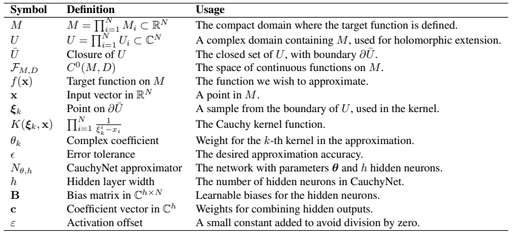
Table 1 : Key Mathematical Notaitons and Symbols.
원문 · CC BY 4.0 · Zhang, Hong-Kun, Li, Xin, Yang, Sikun, Xia, Zhihong · CauchyNet: Compact and Data-Efficient Learning using Holomorphic Activation Functions · 원문 그림 인용 · 원본 PDF 11쪽에서 그림 영역을 추출했습니다.Cauchy 커널과 근사 정리
이론 부분은 Cauchy 적분 공식에서 나오는 역수 형태의 커널 K(ξ_k,x)=∏_i 1/(ξ_k^i−x_i)를 도입합니다. Cauchy Approximation Theorem은 이 커널들의 유한 선형 결합으로 M 위의 연속함수를 임의의 ε 정밀도까지 균일하게 근사할 수 있다고 주장합니다. 저자들은 CauchyNet의 바이어스가 커널의 점 ξ_k에, 출력 계수가 θ_k에 대응한다고 설명하며, 이를 바탕으로 충분히 큰 은닉 폭의 CauchyNet에 대한 보편 근사 정리(Theorem 3)를 제시합니다. 이 결과는 컴팩트 정의역에서 연속함수를 다루는 조건 위에서 성립하며, 단일 층 모델에 대한 분석이라는 범위를 가집니다.
함수 근사와 결측 구간 보간 실험
첫 번째 실험은 [−1,1]에서 날카로운 피크와 특이점을 가진 함수를 150개의 학습점으로 근사하는 설정입니다. 저자들은 CauchyNet과 기준 모델의 MSE와 MAE에 대해 대응표본 t-검정을 수행했고 모든 비교에서 p<0.05라고 보고합니다. 두 번째로 1차원 결측 구간 보간에서는 turning point 주변 ±0.15 구간의 학습 데이터를 제외했습니다. 이때 CauchyNet의 테스트 MAE는 1.5로 보고되며, 기준 모델들은 3.2 이상으로 보고됩니다. 2차원 실험에서는 원판 영역을 제외한 결측 보간과 다항-유리 곡면 근사를 평가합니다.
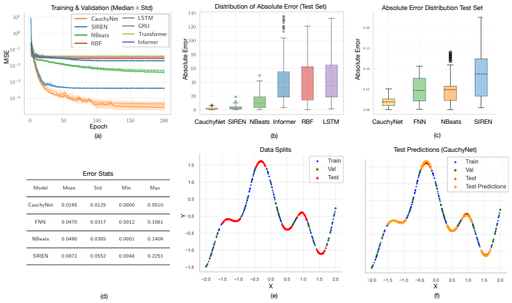
Figure 5 : (a) Training and validation loss (log scale) over 200 epochs. CauchyNet converges faster and retains lower valida- tion loss. (b) Box plot of absolute errors on the test set for various models. CauchyNet shows the smallest median error and least variability, excelling under data scarcity (MAE of 1.5 vs. 3.2 or much higher for baselines). (c) Box plot of absolute errors on the 1D test set for various models. (d) A table listing of error statistics of CauchyNet and other baseline models. CauchyNet achieves the smallest median error and the tightest error distribution, significantly outperforming baselines like SIREN, N-BEATS, and FNN in imputing missing values. (e) Training (blue) and test (red) points for the one-dimensional gap-filling task, with missing zones centered around turning points. (f) Predictions from CauchyNet (orange) closely match the true function (dashed line) within the missing regions, demonstrating accurate reconstruction.
원문 · CC BY 4.0 · Zhang, Hong-Kun, Li, Xin, Yang, Sikun, Xia, Zhihong · CauchyNet: Compact and Data-Efficient Learning using Holomorphic Activation Functions · 원문 그림 인용 · 원본 PDF 8쪽에서 그림 영역을 추출했습니다.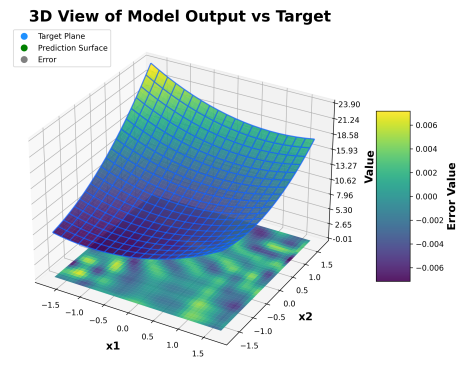
Figure 8 : (Top) Predicted 2D surface by CauchyNet over[−1.5,1.5]2, approximating a target polynomial rational function. (Bottom) Error map showing discrepancies between the predicted surface and ground truth, ranging from -0.006 (blue) to 0.006 (yellow).
원문 · CC BY 4.0 · Zhang, Hong-Kun, Li, Xin, Yang, Sikun, Xia, Zhihong · CauchyNet: Compact and Data-Efficient Learning using Holomorphic Activation Functions · 원문 그림 인용 · 원본 PDF 14쪽에서 그림 영역을 추출했습니다.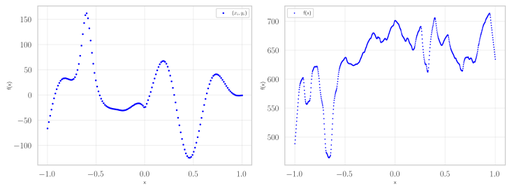
Figure 10 : (Left) Target function with sharp peaks and singularities. Only 150 points (blue) are used for training. (Right) Sample time series trend data from M4 used in Experiment 6.4, illustrating variety in datasets.
원문 · CC BY 4.0 · Zhang, Hong-Kun, Li, Xin, Yang, Sikun, Xia, Zhihong · CauchyNet: Compact and Data-Efficient Learning using Holomorphic Activation Functions · 원문 그림 인용 · 원본 PDF 15쪽에서 그림 영역을 추출했습니다.시계열 예측과 파라미터 효율
M4 부분집합의 추세 성분 예측 실험에서는 700개의 시계열을 사용하며, 승법 모델로 분해한 추세 성분만 [−1,1]로 정규화하여 350개 학습, 175개 검증, 175개 테스트로 나눕니다. 이 설정에서 CauchyNet의 MAE는 2.3으로 보고되고, 대부분의 기준 모델은 10 이상으로 보고됩니다. 파라미터 수 표에서는 CauchyNet이 256개로 제시되며 SIREN과 N-BEATS는 385개, LSTM은 6,720개, Transformer는 132,993개, Informer는 149,377개로 보고됩니다. 이 파라미터 비교는 모든 모델을 은닉 128 뉴런의 단일 은닉층으로 구성했다는 표의 설명과 함께 읽어야 합니다.
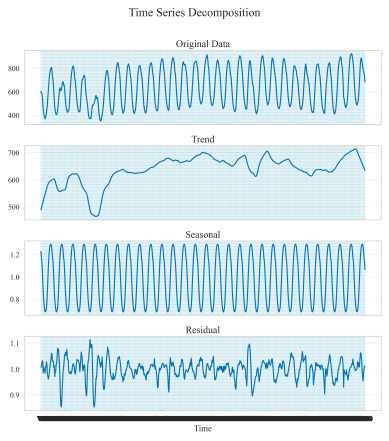
Figure 9 : Time series decomposition using a multiplicative model, separating the original time series into trend, seasonal, and residual components. This preprocessing step is used in Experiment 6.3 to focus on predicting the trend component, which captures the long-term patterns of the data.
원문 · CC BY 4.0 · Zhang, Hong-Kun, Li, Xin, Yang, Sikun, Xia, Zhihong · CauchyNet: Compact and Data-Efficient Learning using Holomorphic Activation Functions · 원문 그림 인용 · 원본 PDF 15쪽에서 그림 영역을 추출했습니다.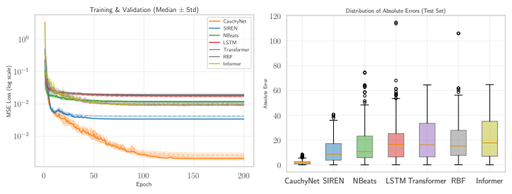
Figure 11 : (Left) Training/validation loss for 200 epochs. CauchyNet converges fastest and stays lower than baselines. (Right) Absolute errors on the test set: CauchyNet has the smallest median and tightest spread (MAE of 2.3 vs. 10+ for most baselines).
원문 · CC BY 4.0 · Zhang, Hong-Kun, Li, Xin, Yang, Sikun, Xia, Zhihong · CauchyNet: Compact and Data-Efficient Learning using Holomorphic Activation Functions · 원문 그림 인용 · 원본 PDF 16쪽에서 그림 영역을 추출했습니다.절제 실험과 적용 범위
허수부 penalty에 대한 실험에서 λ를 0.1, 0.3, 0.5, 1, 1.5로 바꾸었을 때, 저자들은 허수 성분을 손실에 포함하는 것이 테스트 MSE를 낮추는 경향이 있다고 보고합니다. penalty를 제거하면 성능이 저하된다고 기술되어 있으므로, 이 결과는 허수부 항을 유지하는 설정에 대한 근거로 읽어야 합니다. 저자들은 현재 이론 분석이 단일 층 모델에 초점을 둔다고 명시하며, 더 깊은 구조와 고차원 입력에 대한 검증은 향후 과제로 남겨 둡니다. 따라서 실험된 1차원과 2차원 설정, 특정 데이터셋의 결과를 모든 실제 과제에 그대로 일반화할 수는 없습니다.
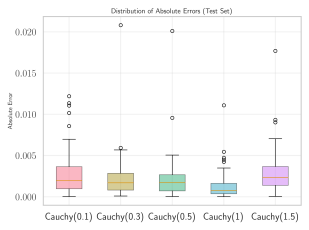
Figure 13 : Box plot of the test performance (MSE loss in log scale) across 200 epochs for the jyperparameterλtaken values in0.1,0.3,0.5,1,1.5, which defines the CauchyNet variants, denoted as Cauchy(λ). Retaining the imaginary component in the output and incorporating it into the loss withλ= 1improves test MSE.
원문 · CC BY 4.0 · Zhang, Hong-Kun, Li, Xin, Yang, Sikun, Xia, Zhihong · CauchyNet: Compact and Data-Efficient Learning using Holomorphic Activation Functions · 원문 그림 인용 · 원본 PDF 18쪽에서 그림 영역을 추출했습니다.논문 정보
- 저자
- Zhang, Hong-Kun, Li, Xin, Yang, Sikun, Xia, Zhihong
- 학회·저널
- arXiv · 프리프린트
- 최초 공개일
- 2025년 10월 11일
- 등록일
- 2026년 10월 30일
- 수정일
- 2025년 10월 11일
- 버전
- v1
- arXiv
- 2510.10195
- 원문 이용 조건
- CC BY 4.0
- 제공 범위
- 논문 정보, 해설, 허용된 원문 그림
AI 해설은 논문 원문과 별개의 설명이며 오류가 있을 수 있습니다. 원문과 그림은 각 출처의 이용 조건과 따로 표시된 권리를 따릅니다.
초록
A novel neural network inspired by Cauchy's integral formula, is proposed for function approximation tasks that include time series forecasting, missing data imputation, etc. Hence, the novel neural network is named CauchyNet. By embedding real-valued data into the complex plane, CauchyNet efficiently captures complex temporal dependencies, surpassing traditional real-valued models in both predictive performance and computational efficiency. Grounded in Cauchy's integral formula and supported by the universal approximation theorem, CauchyNet offers strong theoretical guarantees for function approximation. The architecture incorporates complex-valued activation functions, enabling robust learning from incomplete data while maintaining a compact parameter footprint and reducing computational overhead. Through extensive experiments in diverse domains, including transportation, energy consumption, and epidemiological data, CauchyNet consistently outperforms state-of-the-art models in predictive accuracy, often achieving a 50% lower mean absolute error with fewer parameters. These findings highlight CauchyNet's potential as an effective and efficient tool for data-driven predictive modeling, particularly in resource-constrained and data-scarce environments.
원문 인용
Zhang, Hong-Kun, Li, Xin, Yang, Sikun, Xia, Zhihong (2025). CauchyNet: Compact and Data-Efficient Learning using Holomorphic Activation Functions. arXiv:2510.10195v1. https://arxiv.org/abs/2510.10195v1
BibTeX
@misc{hongkun2025cauchynet,
  title = {{CauchyNet: Compact and Data-Efficient Learning using Holomorphic Activation Functions}},
  author = {Zhang, Hong-Kun and Li, Xin and Yang, Sikun and Xia, Zhihong},
  year = {2025},
  eprint = {2510.10195},
  archivePrefix = {arXiv},
  url = {https://arxiv.org/abs/2510.10195v1}
}