논문 해설
A review of ensemble learning and data augmentation models for class imbalanced problems: combination, implementation and evaluation
클래스 불균형 문제를 위한 앙상블 학습 및 데이터 증강 모델 리뷰: 조합, 구현 및 평가
- 연구 문제 클래스 불균형 데이터에서는 일반적인 분류 모델이 다수 클래스에 편향되어 소수 클래스 분류가 실패하기 쉽습니다.
- 연구 방법 9개의 데이터 증강 방법과 9개의 앙상블 학습 방법을 이진 및 다중 클래스 불균형 데이터셋에서 비교하는 계산 평가 틀을 사용합니다.
- 주요 결과 SMOTE-LightGBM과 ROS-LightGBM이 가장 효과적인 조합으로 보고되며, CT-GAN은 최상위 성능을 보이지 않았습니다.
클래스 불균형 문제와 연구 질문
클래스 불균형(CI)은 한 클래스의 관측치 수가 다른 클래스보다 적은 상황을 말합니다. 이때 일반적인 분류 모델은 다수 클래스에 편향되어 소수 클래스를 잘못 분류하기 쉽습니다. 원문은 전체 정확도가 98%에 이르더라도 의료 진단처럼 소수 클래스를 놓치면 모델이 실제로 쓸모없을 수 있다고 지적합니다. 그래서 정확도 대신 민감도와 특이도, F1 점수 같은 지표가 함께 쓰입니다.
이 논문은 데이터 증강과 앙상블 학습을 결합하는 여러 방법 중 어떤 조합이 불균형 데이터에서 분류 성능을 가장 효과적으로 높이는지 계산 실험으로 평가합니다. 저자들은 9개의 데이터 증강 방법과 9개의 앙상블 학습 방법을 하나의 틀에서 비교합니다.
평가 틀과 데이터 증강 방법
평가 틀은 이진 불균형 데이터셋과 다중 클래스 데이터셋을 입력으로 받습니다. 각 학습 실행에서는 분류 단계 이전에 데이터 증강을 적용해 학습 데이터의 클래스 불균형을 줄입니다. 그 뒤 증강된 학습 데이터로 앙상블 모델을 학습하고, 데이터를 60:40으로 나눈 테스트 데이터에서 정확도, F1 점수, AUC를 측정합니다.
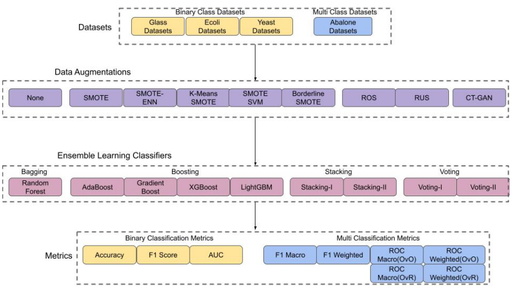
Figure 4 : The evaluation framework showing the family of datasets, data augmentation methods, ensemble learning methods, and evaluation metrics for binary and multi-class classification tasks.
원문 · CC BY 4.0 · Azal Ahmad Khan, Omkar Chaudhari, Rohitash Chandra · A review of ensemble learning and data augmentation models for class imbalanced problems: combination, implementation and evaluation · 원문 그림 인용 · 원본 PDF 12쪽에서 그림 영역을 추출했습니다.데이터 증강 방법으로는 SMOTE, SMOTE-ENN, Borderline SMOTE, SVM-SMOTE, ADASYN, RUS, ROS, CT-GAN이 사용됩니다. SMOTE는 소수 클래스 샘플과 최근접 이웃을 잇는 선분 위에 합성 예제를 만드는 방식입니다. SMOTE-ENN은 SMOTE 뒤에 편집된 최근접 이웃 규칙으로 잡음 샘플을 제거합니다. CT-GAN은 이산·연속 열이 섞인 표형 데이터를 생성하도록 설계된 조건부 GAN 기반 방법입니다. 이 연구에서는 CT-GAN을 새로운 증강 방법으로 사용합니다.
앙상블 모델과 평가 지표
앙상블 모델로는 LightGBM, AdaBoost, XGBoost, Gradient Boosting, Random Forest, Voting-Soft, Voting-Hard, Stacking-I, Stacking-II가 사용됩니다. 원문은 이들이 배깅, 부스팅, 스태킹, 보팅에 기반한다고 설명합니다. 특히 LightGBM은 여러 데이터 증강 방법의 순위를 매길 때 고정 앙상블 모델로 사용되었습니다.
이진 분류에서는 정확도, F1 점수, AUC를 사용합니다. 불균형 데이터에서 정확도만으로는 소수 클래스의 실패를 드러내기 어렵다는 점이 이 지표 선택의 이유입니다. 불균형 정도는 음성 인스턴스 수를 양성 인스턴스 수로 나눈 불균형 비율(IR)로 분류됩니다. 다중 클래스 평가에서는 Macro-F1과 OvO·OvR 방식의 AUC가 사용됩니다.
이진 및 다중 클래스 결과의 요약
이진 분류 결과는 Glass, Yeast, Ecoli 데이터셋의 여러 변형에서 평균과 최고 값, 표준편차로 보고됩니다. 이 연구는 각 데이터셋 집합에서 F1 점수 기준으로 증강 방법과 앙상블 모델을 순위화합니다. 원문에 따르면 Ecoli 계열에서는 ADASYN이 가장 높은 순위를 얻었고 Glass 계열에서는 SMOTE-ENN이 가장 높은 순위를 얻었습니다. 최고 조합으로는 SMOTE와 LightGBM, ROS와 LightGBM이 보고됩니다.
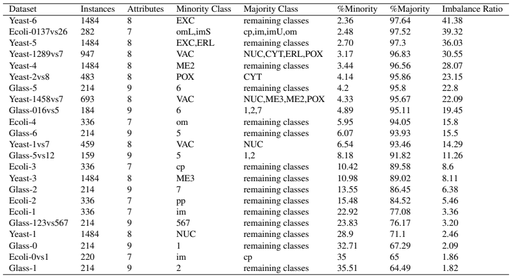
Table 2 : Description of the binary class datasets used in the computational study
원문 · CC BY 4.0 · Azal Ahmad Khan, Omkar Chaudhari, Rohitash Chandra · A review of ensemble learning and data augmentation models for class imbalanced problems: combination, implementation and evaluation · 원문 그림 인용 · 원본 PDF 14쪽에서 그림 영역을 추출했습니다.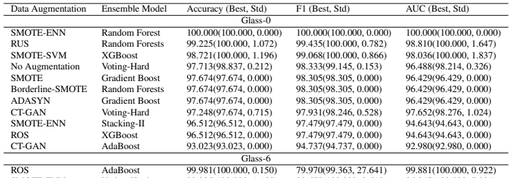
Table 4 : Test results for glass datasets
원문 · CC BY 4.0 · Azal Ahmad Khan, Omkar Chaudhari, Rohitash Chandra · A review of ensemble learning and data augmentation models for class imbalanced problems: combination, implementation and evaluation · 원문 그림 인용 · 원본 PDF 15쪽에서 그림 영역을 추출했습니다.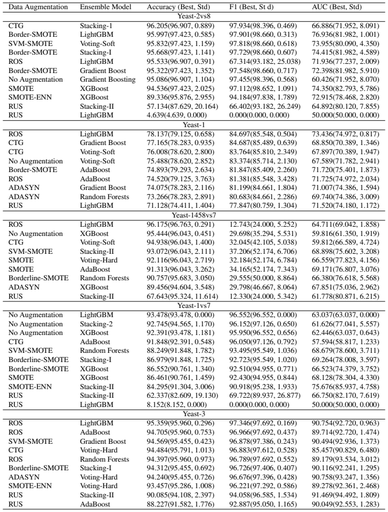
Table 5 : Test results for the Yeast datasets
원문 · CC BY 4.0 · Azal Ahmad Khan, Omkar Chaudhari, Rohitash Chandra · A review of ensemble learning and data augmentation models for class imbalanced problems: combination, implementation and evaluation · 원문 그림 인용 · 원본 PDF 16쪽에서 그림 영역을 추출했습니다.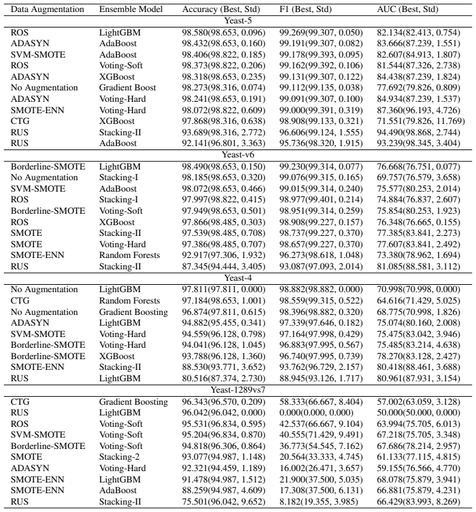
Table 6 : Test results for Yeast datasets.
원문 · CC BY 4.0 · Azal Ahmad Khan, Omkar Chaudhari, Rohitash Chandra · A review of ensemble learning and data augmentation models for class imbalanced problems: combination, implementation and evaluation · 원문 그림 인용 · 원본 PDF 17쪽에서 그림 영역을 추출했습니다.다중 클래스 실험은 Abalone 데이터를 5개 나이 구간으로 바꾼 뒤 3개와 4개 클래스 변형으로 구성한 평가입니다. 이 결과는 서로 다른 지표와 집계 방식에 따라 최고 조합이 달라지므로, 단일 조합으로 모든 평가를 대표하기 어렵습니다.

Table 3 : Description of the multi-class datasets used in the experimental study
원문 · CC BY 4.0 · Azal Ahmad Khan, Omkar Chaudhari, Rohitash Chandra · A review of ensemble learning and data augmentation models for class imbalanced problems: combination, implementation and evaluation · 원문 그림 인용 · 원본 PDF 14쪽에서 그림 영역을 추출했습니다.
Table 9 : Best and worst performing combinations of the Abalone datasets according to F1 macro-average score
원문 · CC BY 4.0 · Azal Ahmad Khan, Omkar Chaudhari, Rohitash Chandra · A review of ensemble learning and data augmentation models for class imbalanced problems: combination, implementation and evaluation · 원문 그림 인용 · 원본 PDF 20쪽에서 그림 영역을 추출했습니다.
Table 10 : Best and worst performing combinations of the Abalone dataset according to F1 weighted-average score.
원문 · CC BY 4.0 · Azal Ahmad Khan, Omkar Chaudhari, Rohitash Chandra · A review of ensemble learning and data augmentation models for class imbalanced problems: combination, implementation and evaluation · 원문 그림 인용 · 원본 PDF 20쪽에서 그림 영역을 추출했습니다.
Table 11 : Best and worst performing combinations of the Abalone dataset according to AUC macro-average score (One vs. One approach).
원문 · CC BY 4.0 · Azal Ahmad Khan, Omkar Chaudhari, Rohitash Chandra · A review of ensemble learning and data augmentation models for class imbalanced problems: combination, implementation and evaluation · 원문 그림 인용 · 원본 PDF 20쪽에서 그림 영역을 추출했습니다.
Table 12 : Best and worst performing combinations of the Abalone datasets according to AUC macro-average score (One vs. Rest approach).
원문 · CC BY 4.0 · Azal Ahmad Khan, Omkar Chaudhari, Rohitash Chandra · A review of ensemble learning and data augmentation models for class imbalanced problems: combination, implementation and evaluation · 원문 그림 인용 · 원본 PDF 20쪽에서 그림 영역을 추출했습니다.
Table 13 : Best and worst performing combinations of the Abalone dataset according to AUC weighted-average score (One vs. One approach).
원문 · CC BY 4.0 · Azal Ahmad Khan, Omkar Chaudhari, Rohitash Chandra · A review of ensemble learning and data augmentation models for class imbalanced problems: combination, implementation and evaluation · 원문 그림 인용 · 원본 PDF 20쪽에서 그림 영역을 추출했습니다.
Table 14 : Best and worst performing combinations of the Abalone datasets according to AUC weighted-average (One vs. Rest approach).
원문 · CC BY 4.0 · Azal Ahmad Khan, Omkar Chaudhari, Rohitash Chandra · A review of ensemble learning and data augmentation models for class imbalanced problems: combination, implementation and evaluation · 원문 그림 인용 · 원본 PDF 20쪽에서 그림 영역을 추출했습니다.결론의 해석과 적용 범위
저자들은 SMOTE-LightGBM과 ROS-LightGBM을 가장 효과적인 조합으로 보고합니다. 또한 CT-GAN은 최상위 성능을 보이지 않았으며, SMOTE와 ROS가 GAN보다 성능이 좋고 계산 비용도 낮다고 보고합니다. 다만 이 결과는 Glass, Yeast, Ecoli 등 상대적으로 작은 표형 데이터셋에서 얻은 것입니다.
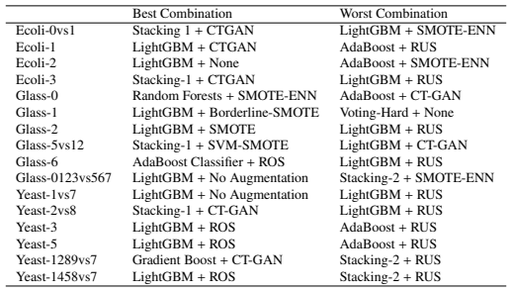
Table 8 : Best and worst performing combinations for all datasets.
원문 · CC BY 4.0 · Azal Ahmad Khan, Omkar Chaudhari, Rohitash Chandra · A review of ensemble learning and data augmentation models for class imbalanced problems: combination, implementation and evaluation · 원문 그림 인용 · 원본 PDF 20쪽에서 그림 영역을 추출했습니다.따라서 이 결과를 대규모 데이터나 이미지·텍스트 같은 다른 모달리티로 바로 넓히기는 어렵습니다. 원문도 벤치마크 데이터셋이 작고 다양한 응용 분야를 충분히 대표하지 못한다는 점을 한계로 제시합니다.
논문 정보
- 저자
- Azal Ahmad Khan, Omkar Chaudhari, Rohitash Chandra
- 학회·저널
- arXiv · 프리프린트
- 최초 공개일
- 2023년 4월 6일
- 등록일
- 2026년 11월 6일
- 수정일
- 2023년 11월 27일
- 버전
- v3
- arXiv
- 2304.02858
- 분류
- cs.LG · cs.AI · stat.ML
- 원문 이용 조건
- CC BY 4.0
- 제공 범위
- 논문 정보, 해설, 허용된 원문 그림
AI 해설은 논문 원문과 별개의 설명이며 오류가 있을 수 있습니다. 원문과 그림은 각 출처의 이용 조건과 따로 표시된 권리를 따릅니다.
초록
Class imbalance (CI) in classification problems arises when the number of observations belonging to one class is lower than the other. Ensemble learning combines multiple models to obtain a robust model and has been prominently used with data augmentation methods to address class imbalance problems. In the last decade, a number of strategies have been added to enhance ensemble learning and data augmentation methods, along with new methods such as generative adversarial networks (GANs). A combination of these has been applied in many studies, and the evaluation of different combinations would enable a better understanding and guidance for different application domains. In this paper, we present a computational study to evaluate data augmentation and ensemble learning methods used to address prominent benchmark CI problems. We present a general framework that evaluates 9 data augmentation and 9 ensemble learning methods for CI problems. Our objective is to identify the most effective combination for improving classification performance on imbalanced datasets. The results indicate that combinations of data augmentation methods with ensemble learning can significantly improve classification performance on imbalanced datasets. We find that traditional data augmentation methods such as the synthetic minority oversampling technique (SMOTE) and random oversampling (ROS) are not only better in performance for selected CI problems, but also computationally less expensive than GANs. Our study is vital for the development of novel models for handling imbalanced datasets.
원문 인용
Azal Ahmad Khan, Omkar Chaudhari, Rohitash Chandra (2023). A review of ensemble learning and data augmentation models for class imbalanced problems: combination, implementation and evaluation. arXiv:2304.02858v3. https://arxiv.org/abs/2304.02858v3
BibTeX
@misc{khan2023review,
  title = {{A review of ensemble learning and data augmentation models for class imbalanced problems: combination, implementation and evaluation}},
  author = {Azal Ahmad Khan and Omkar Chaudhari and Rohitash Chandra},
  year = {2023},
  eprint = {2304.02858},
  archivePrefix = {arXiv},
  url = {https://arxiv.org/abs/2304.02858v3}
}