논문 해설
Backdoor Learning: A Survey
백도어 학습: 서베이
- 연구 문제 학습 과정이 통제되지 않는 환경에서 백도어 공격이 심각한 위협이 되지만, 이를 체계적으로 정리한 연구가 부족합니다.
- 연구 방법 이 설문은 백도어 공격과 방어를 특성에 따라 분류하고, 포이즈닝 기반 백도어 공격을 위한 통합 프레임워크를 제시합니다.
- 주요 결과 포이즈닝 기반 공격은 트리거 가시성, 공격 공간, 목표 유형, 데이터 접근성 등의 기준으로 비교됩니다. 경험적 방어는 실용 성능이 높지만 이론적 보장이 없고, 인증 방어는 보장이 있지만 실제 성능이 약하다고 설명됩니다.
백도어 위협의 배경
백도어 공격은 학습 과정이 통제되지 않을 때 모델에 숨은 백도어를 심는 위협입니다. 제3자 데이터셋이나 제3자 플랫폼, 제3자 모델을 쓰는 상황에서는 사용자가 학습 단계를 직접 통제하지 못하므로 이 위협이 현실적입니다. 감염된 모델은 정상 입력에서는 정상적으로 동작하지만, 공격자가 지정한 트리거가 포함되면 예측이 바뀝니다. 설문은 이러한 백도어 공격과 그에 대한 방어가 아직 체계적으로 정리되지 않았다는 점에서 출발합니다.
포이즈닝 기반 공격의 동작
포이즈닝 기반 백도어 공격은 정상 학습 이미지에 트리거를 삽입하고 그 샘플의 레이블을 공격자가 지정한 목표 레이블로 바꿉니다. BadNets는 트리거를 선택된 정상 이미지에 스탬프하는 방식으로 이러한 공격을 구현한 최초의 딥러닝 백도어 공격으로 제시됩니다. 오염 샘플과 나머지 정상 샘플을 함께 학습하면 감염 모델은 정상 테스트 샘플에서는 정상 예측을 유지하고, 트리거가 포함된 공격 샘플은 목표 레이블로 예측합니다.
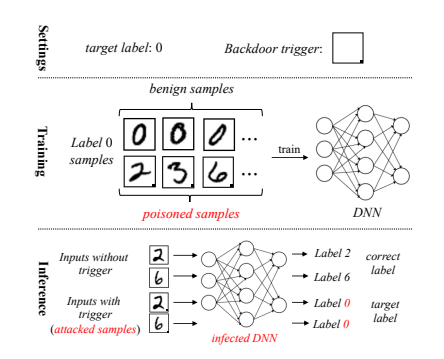
Fig. 1 . An illustration of poisoning-based backdoor attacks. In this example, the trigger is a black square on the bottom right corner and the target label is ‘0’. Part of the benign training images are modified to have the trigger stamped, and their label is re-assigned as the attacker-specified target label. Accordingly, the trained DNN is infected, which will recognize attacked images (i.e., test images containing backdoor trigger) as the target label while still correctly predicting the label for the benign test images.
원문 · CC BY 4.0 · Yiming Li, Yong Jiang, Zhifeng Li, Shu-Tao Xia · Backdoor Learning: A Survey · 원문 그림 인용 · 원본 PDF 1쪽에서 그림 영역을 추출했습니다.통합 프레임워크와 공격 범주
이 설문은 포이즈닝 기반 공격을 트리거 가시성, 공격 공간, 목표 유형, 데이터 접근성 등의 기준으로 나누는 통합 틀을 제시합니다. 이 틀은 표준 위험, 백도어 위험, 가시성 위험을 각각 정의하고, 개별 공격을 트리거 종류와 목표 레이블 대응 규칙을 바꾼 사례로 설명합니다. 따라서 여러 공격을 같은 기준에서 비교할 수 있습니다.
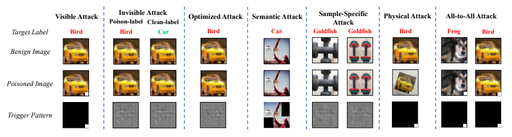
Fig. 4 . An example of poisoned samples generated by different types of backdoor attacks. (1) In the visible attack, the backdoor trigger is a white-square stamped on the bottom right corner of the poisoned image, which is visible. (2) In the invisible attack, the trigger is a noise with a small magnitude, which is invisible. Moreover, the target label of the poisoned image is different from the ground-truth label of its benign version in the poison-label attack, whereas these labels are the same in the clean-label attack. (3) In the optimized attack, the trigger is optimized through the targeted universal adversarial attack associated with the target class instead of a simple handcraft pattern. (4) The poisoned image is exactly the same as its benign version in the semantic attack. In this case, the trigger is the combination of two semantic objects ( i.e., ‘bird’ and ‘human’). Images containing these objects simultaneously will be classified by the infected models as the ‘car’. (5) In the sample-specific attack, the trigger patterns are sample-specific instead of sample-agnostic. (6) In the physical attack, the (digital) poisoned image is captured by the camera from the physical space. (7) Different from all-to-one attacks where all poisoned samples have the same target label, different poisoned samples may have different target labels in the all-to-all attack.
원문 · CC BY 4.0 · Yiming Li, Yong Jiang, Zhifeng Li, Shu-Tao Xia · Backdoor Learning: A Survey · 원문 그림 인용 · 원본 PDF 6쪽에서 그림 영역을 추출했습니다.공격 성능 평가 지표
이미지 분류에서 공격 성능은 주로 Benign accuracy (BA)와 Attack success rate (ASR)로 평가합니다. Benign accuracy (BA)는 정상 테스트 샘플을 감염 모델이 올바르게 예측한 정확도입니다. Attack success rate (ASR)는 공격 샘플 중 감염 모델이 목표 레이블로 성공적으로 예측한 비율입니다. 두 값이 모두 높을수록 공격이 우수하다고 보며, 공격 샘플의 은밀성은 오염 비율과 섭동 크기로 함께 고려됩니다.
경험적 방어와 인증 방어
백도어 방어는 경험적 방어와 인증 방어로 나뉩니다. 경험적 방어는 기존 공격의 관찰에 기반해 실용 성능이 좋지만 효과에 대한 이론적 보장이 없고 적응형 공격에 우회될 수 있습니다. 인증 방어는 일정한 가정 아래 이론적으로 보장되지만, 그 가정이 자주 충족되지 않아 실제 성능은 경험적 방어보다 약하다고 설명됩니다. 경험적 방어 가운데 Neural Cleanse는 클래스별 잠재 트리거를 합성하고 이상 탐지로 최종 트리거를 정하는 대표 방어입니다.
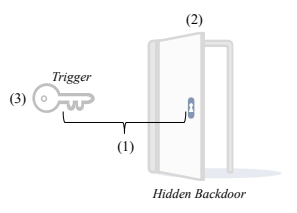
Fig. 5 . An illustration of backdoor attacks and three corresponding defense paradigms. Intuitively, the poisoning-based backdoor attack is similar to unlock a door with the corresponding key. Accord- ingly, three main paradigms, including (1) trigger- backdoor mismatch, (2) backdoor elimination, and (3) trigger elimination, can be adopted to defend the attack. Different types of approaches were proposed towards the aforementioned paradigms, as illustrated in Table IV.
원문 · CC BY 4.0 · Yiming Li, Yong Jiang, Zhifeng Li, Shu-Tao Xia · Backdoor Learning: A Survey · 원문 그림 인용 · 원본 PDF 9쪽에서 그림 영역을 추출했습니다.설문의 한계와 열린 질문
이 설문은 새로운 실험을 수행하지 않고 기존 연구의 공격과 방어 분류, 보고된 결과를 정리합니다. 따라서 각 수치는 원 논문의 데이터, 모델, 설정에 묶여 있으며 여러 연구를 하나의 공통 조건으로 비교할 수 없습니다. 적응형 공격에 대한 방어의 취약성과 인증 방어의 실용성 문제는 아직 열린 과제로 남아 있습니다.
논문 정보
- 저자
- Yiming Li, Yong Jiang, Zhifeng Li, Shu-Tao Xia
- 학회·저널
- arXiv · 프리프린트
- 최초 공개일
- 2020년 7월 17일
- 등록일
- 2026년 11월 6일
- 수정일
- 2022년 2월 16일
- 버전
- v5
- arXiv
- 2007.08745
- 분류
- cs.CR · cs.CV · cs.LG
- 원문 이용 조건
- CC BY 4.0
- 제공 범위
- 논문 정보, 해설, 허용된 원문 그림
AI 해설은 논문 원문과 별개의 설명이며 오류가 있을 수 있습니다. 원문과 그림은 각 출처의 이용 조건과 따로 표시된 권리를 따릅니다.
초록
Backdoor attack intends to embed hidden backdoor into deep neural networks (DNNs), so that the attacked models perform well on benign samples, whereas their predictions will be maliciously changed if the hidden backdoor is activated by attacker-specified triggers. This threat could happen when the training process is not fully controlled, such as training on third-party datasets or adopting third-party models, which poses a new and realistic threat. Although backdoor learning is an emerging and rapidly growing research area, its systematic review, however, remains blank. In this paper, we present the first comprehensive survey of this realm. We summarize and categorize existing backdoor attacks and defenses based on their characteristics, and provide a unified framework for analyzing poisoning-based backdoor attacks. Besides, we also analyze the relation between backdoor attacks and relevant fields ($i.e.,$ adversarial attacks and data poisoning), and summarize widely adopted benchmark datasets. Finally, we briefly outline certain future research directions relying upon reviewed works. A curated list of backdoor-related resources is also available at \url{https://github.com/THUYimingLi/backdoor-learning-resources}.
원문 인용
Yiming Li, Yong Jiang, Zhifeng Li, Shu-Tao Xia (2020). Backdoor Learning: A Survey. arXiv:2007.08745v5. https://arxiv.org/abs/2007.08745v5
BibTeX
@misc{li2020backdoor,
  title = {{Backdoor Learning: A Survey}},
  author = {Yiming Li and Yong Jiang and Zhifeng Li and Shu-Tao Xia},
  year = {2020},
  eprint = {2007.08745},
  archivePrefix = {arXiv},
  url = {https://arxiv.org/abs/2007.08745v5}
}