논문 해설
EmoBipedNav: Emotion-aware Social Navigation for Bipedal Robots with Deep Reinforcement Learning
EmoBipedNav: 심층 강화학습 기반 이족 로봇을 위한 감정 인식 사회적 내비게이션
- 연구 문제 양족 로봇은 복잡한 동역학과 제한된 기동성 때문에 보행자가 있는 환경에서 사회적 내비게이션을 수행하기 어렵습니다. EmoBipedNav는 감정 기반 불편 영역을 포함한 관측과 전신 동역학 학습으로 이 문제를 다룹니다.
- 연구 방법 EmoBipedNav는 순차 LiDAR 격자 지도와 감정별 불편 거리를 CNN 인코더로 요약하고, SAC 강화학습으로 ROM 기반 행동을 학습합니다. 학습 시 Digit의 전신 시뮬레이션을 사용해 ROM과 전신 동역학의 차이를 줄입니다.
- 주요 결과 MuJoCo 시뮬레이션의 500회 무작위 시험에서 EmoBipedNav는 SR 0.950을 기록했습니다. 다만 DWA는 NT가 더 짧았고 Single–LGM과 OGM도 일부 지표에서 가까운 결과를 보였습니다.
양족 로봇의 사회적 내비게이션 문제
양족 로봇은 사람과 비슷한 형태와 다양한 이동 능력을 갖추고 있어 보행자가 많은 환경에서 쓰일 가능성이 주목받고 있습니다. 그러나 양족 로봇은 복잡한 동역학과 높은 자유도를 가지므로, 동적인 환경에서 안전하게 움직이는 능력이 제한됩니다. 여기에 보행자의 의도와 상호작용, 그리고 감정 같은 사회적 단서가 더해지면 내비게이션의 난도가 크게 높아집니다. 원문은 이러한 결합된 문제를 해결하기 위해 양족 전신 동역학과 사회적 내비게이션을 함께 고려하는 두 단계 파이프라인을 제안한다고 밝힙니다.
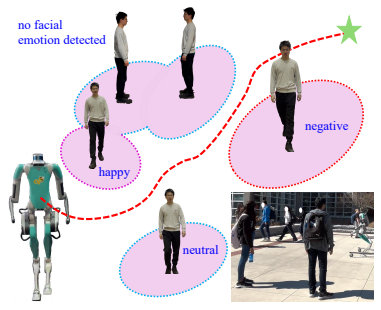
Fig. 1 . Emotion-aware social navigation with the bipedal robot Digit. Digit is required to maintain customized comfort distances from pedestrians with specific emotions while navigating toward a designated goal location. Note that, the comfort distances vary according to different pedestrian emotions.
원문 · CC BY 4.0 · Wei Zhu, Abirath Raju, Abdulaziz Shamsah, Anqi Wu, Seth Hutchinson, Ye Zhao · EmoBipedNav: Emotion-aware Social Navigation for Bipedal Robots with Deep Reinforcement Learning · 원문 그림 인용 · 원본 PDF 1쪽에서 그림 영역을 추출했습니다.기존 연구는 두 방향으로 나뉩니다. 하나는 축약 모델(ROM)로 경로를 계획하고 전신 동역학 기반 제어기로 추종하는 방식입니다. 이 구조는 저수준 제어기의 추종 오차와 관절 토크 제한을 계획 단계에서 충분히 반영하지 못합니다. 다른 하나는 바퀴 로봇용 심층 강화학습 방법을 가져오는 방식인데, 이 방법들은 완전 관측 가능성을 가정하고 로봇의 운동 제약이 보행자와 비슷하다고 가정하므로 양족 로봇에는 그대로 적용하기 어렵습니다. 이 연구는 이 두 문제를 함께 다루는 범위로 설정됩니다.
감정 인식 LGM 관측과 전신 동역학 기반 학습
EmoBipedNav는 환경을 순차 LiDAR 격자 지도(LGM)로 표현하는 것이 핵심입니다. LiDAR 스캔을 원형 pie-shape 격자로 만든 뒤 사각형 이미지로 펼쳐 CNN 인코더에 넣습니다. 격자에는 충돌 영역과 함께 보행자 감정에 따라 크기가 달라지는 불편 영역이 표시됩니다. 원문은 감정을 세 가지 상태(happy, neutral, negative)로 나누고 불편 거리를 각각 0.2m, 0.35m, 0.5m로 설정합니다. 인코더가 만든 잠재 특징은 목표 위치 상태와 직전 로봇 명령과 연결되어 SAC 액터와 크리틱에 입력됩니다.
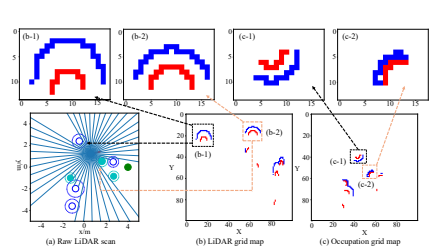
Fig. 3 . LiDAR scan and its corresponding grid maps. (a) illustrates the raw LiDAR scan. The red solid circle with an arrow represents the ego-agent and its orientation in the world frame, and the green solid one is the goal. Moving pedestrians are blue hollow circles, and static obstacles are depicted as solid cyan circles. The outer dashed circles illustrate the discomfort margins. (b) and (c) are the corresponding LiDAR grid map and occupation grid map, respectively. X and Y axes in (b) represent rotational and radial indices, while X and Y in (c) are horizontal and vertical pixel positions, respectively. (b-1) and (b-2) shown in (b) are the margins corresponding to two close objects surrounding the ego-agent illustrated in (a). (c-1) and (c-2) correspond to the same objects as (b-1) and (b-2), respectively. Their zoomed-in views are shown on the top row.
원문 · CC BY 4.0 · Wei Zhu, Abirath Raju, Abdulaziz Shamsah, Anqi Wu, Seth Hutchinson, Ye Zhao · EmoBipedNav: Emotion-aware Social Navigation for Bipedal Robots with Deep Reinforcement Learning · 원문 그림 인용 · 원본 PDF 4쪽에서 그림 영역을 추출했습니다.행동은 LIP 기반 ROM에서 파생됩니다. 정책은 0 이상 최대 속도 이하의 시상면 CoM 속도와 방향각 변화량을 출력하며, 이 값은 ALIP로 발자국을 계산하고 passivity 기반 전신 제어기로 추종됩니다. 핵심은 학습 시 Digit의 전신 시뮬레이션을 입력 경로에 넣어 ROM과 전신 동역학의 차이를 학습 과정에 포함한다는 점입니다. 공유 인코더는 크리틱을 통해서만 갱신되며, 액터에는 기울기 계산 없이 복사됩니다.
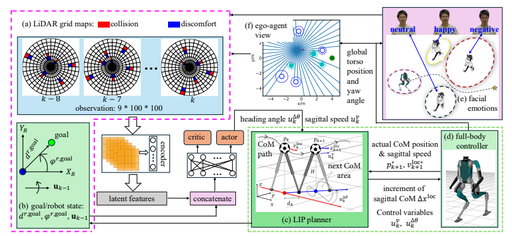
Fig. 2 . Overview of the proposed EmoBipedNav framework using the bipedal robot Digit. Our framework begins by obtaining estimated facial emotions (Fig. (e)) using pre-trained CNN models. Simultaneously, we transform raw LiDAR scans (Fig. (f)) into sequential pie-shape LGMs (Fig. (a)), where the red cells denote collision areas and the blue patches highlight discomfort zones associated with pedestrian emotions. These grid maps are converted into stacked pixel images which are further processed through an encoder constructed using CNNs to extract socially interactive and emotionally aware features. The resulting latent features are concatenated with the robot’s last command and target position (Fig. (b)), which are fed into an actor-critic DRL structure implemented with multi-layer perceptrons (MLPs). The action output from the actor network is derived from the ROM (Fig. (c)) and practically applied to a bipedal robot with full-body dynamics and constraints (Fig. (d)). The torso position and yaw angle obtained from Digit correspond to the ego-agent state in Fig. (f). We use the Angular momentum LIP planner (ALIP) [39] and a passivity full-body controller with ankle actuation [23] to track the desirable ROM trajectory.
원문 · CC BY 4.0 · Wei Zhu, Abirath Raju, Abdulaziz Shamsah, Anqi Wu, Seth Hutchinson, Ye Zhao · EmoBipedNav: Emotion-aware Social Navigation for Bipedal Robots with Deep Reinforcement Learning · 원문 그림 인용 · 원본 PDF 3쪽에서 그림 영역을 추출했습니다.충돌·목표·감정 보상의 구성
보상은 충돌 회피, 목표 도달, 감정 인식의 세 항의 합으로 정의됩니다. 충돌 보상은 모든 주변 물체 경계까지의 최소 거리가 로봇 반지름 이하이면 -0.6을, 정적 장애물과의 거리가 안전 거리와 로봇 반지름의 합보다 작으면 -0.1을 부여합니다. 목표 보상은 목표 거리가 임계값 이하이면 0.5를, 그렇지 않으면 목표 거리의 감소량에 0.3을 곱한 값을 줍니다. 감정 보상은 보행자별 불편 거리 조건 C가 성립하면 -0.1을 주며, 여러 물체에 동시에 들어가도 같은 스텝에서는 한 번만 더합니다.
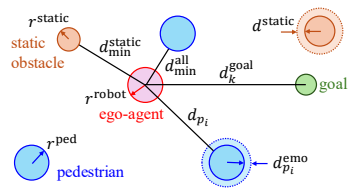
Fig. 4 . Geometry representations of reward-related notations.
원문 · CC BY 4.0 · Wei Zhu, Abirath Raju, Abdulaziz Shamsah, Anqi Wu, Seth Hutchinson, Ye Zhao · EmoBipedNav: Emotion-aware Social Navigation for Bipedal Robots with Deep Reinforcement Learning · 원문 그림 인용 · 원본 PDF 6쪽에서 그림 영역을 추출했습니다.원문은 큰 패널티를 쓰면 불편 영역 진입이 줄지만 항행 시간이 길어진다고 관찰하고, 여러 값을 탐색한 뒤 안전과 효율의 균형을 맞춘 조합을 경험적으로 선택했다고 밝힙니다. 따라서 이 보상 값은 여러 후보를 비교한 결과이며, 다른 과제나 모델에 대한 최적값으로 해석하지 않습니다.
기준선과 절제 변형의 전신 시뮬레이션 비교
검증은 Digit을 MuJoCo에서 시뮬레이션하고 ORCA로 보행자를 생성한 500회 무작위 시험에서 이루어졌습니다. 이 비교에서 감정 관련 관측과 보상은 끈 상태로 SOTA 기준선과 맞추어 평가되었습니다. 측정 지표는 성공률(SR), 항행 시간(NT), 불편 횟수(DT)입니다. DWA는 LIP 모델로 수정되어 사용되었고, Single–LGM은 과거 시퀀스 대신 현재 LGM만 사용하는 변형입니다.
결과에서 EmoBipedNav는 SR 0.950으로 가장 높았습니다. DWA는 NT 27.20±3.55로 가장 짧았지만 SR은 0.892였고 DT는 415였습니다. Single–LGM은 SR 0.928을 보였으나 NT가 33.15±4.84로 늘었고, 원문은 이를 시간 동역학을 반영하지 않은 보수적 정책으로 해석합니다. OGM은 SR 0.944였지만 DT가 312로 EmoBipedNav의 226보다 높았습니다. LNDNL은 학습 중 정체 문제로 SR 0.660이었습니다. 원문은 DWA를 LIP 모델만으로 배치하면 SR이 0.950으로 높아진다고 보고하며, 이를 ROM과 전신 동역학의 차이를 보여 주는 근거로 해석합니다.
감정 불편 거리 설정과 LIP 학습 비교
감정 기반 설정은 Table III로 평가되었습니다. 학습은 0.2m 또는 0.5m의 고정 불편 거리와 감정별 가변 거리 [0.2,0.35,0.5]m를 비교합니다. 테스트 IDT는 정적 장애물과 happy, neutral, negative 보행자 각각에 대해 계산됩니다. 가변 거리 설정은 0.2m 고정 설정과 비교해 neutral과 negative 보행자의 IDT를 줄이고 happy 보행자와 정적 장애물의 IDT를 늘렸습니다. 이 결과는 감정에 따라 더 먼 거리를 주는 설계가 더 민감한 보행자를 우선한다는 관찰로 읽습니다.
LIP 모델만으로 학습한 정책은 LIP 테스트에서 SR 0.962를 보였지만, 같은 정책을 Digit에서 테스트하면 SR이 0.900으로 떨어지고 IDT가 증가했습니다. 이는 ROM 기반 학습 정책이 전신 동역학으로 옮겨질 때 성능이 줄어드는 조건에서의 결과입니다. OGM 학습 설정에서는 정적 장애물의 SR과 IDT가 함께 악화되어 LGM의 충돌·불편 회피 이점이 나타났습니다.
시간 변화 감정과 실제 배치의 범위
시간에 따라 바뀌는 감정 설정에서는 한 보행자의 감정이 2초마다 happy, neutral, negative로 바뀝니다. 원문은 SR이 대체로 같게 유지되지만 IDT가 [213; 56,166,1198]에서 [258; 42,204,1317]로 증가한다고 보고합니다. 이는 주변 보행자의 감정이 갑자기 바뀌어 더 넓은 불편 영역에 침범한 결과로 설명됩니다.
실제 배치에서는 MuJoCo에서 학습한 정책을 Digit에 옮기고, 원형 물체로 근사한 LiDAR 재구성을 사용했습니다. 감정은 ZED 카메라와 pre-training CNN으로 추정되며, 얼굴이 보이지 않으면 neutral로 처리됩니다. 원문은 벽, 집단 보행자, 현실적인 사회 규범을 향후 과제로 남겨 두었습니다. 따라서 실제 배치 결과는 이 실험 조건에서의 전이 가능성을 보여 주는 것이며, 복잡한 사회 시나리오까지 검증했다고 보지는 않습니다.
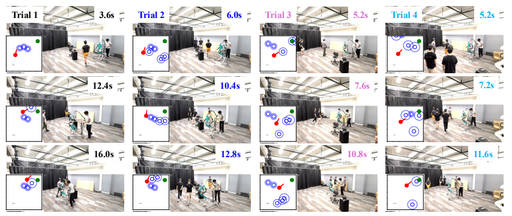
Fig. 9 . Screenshots of hardware deployments under various pedestrian navigation patterns. Each column corresponds to an implementation. In each screenshot, a LiDAR scan figure is overlaid to illustrate the robot’s position and orientation, represented by a solid red circle and a red arrow, respectively. Object collision margins are depicted as blue hollow circles, while discomfort margins are indicated with dashed circles. We track the robot and pedestrians with an external motion capture system for accurate trajectory analysis. Pedestrian emotions are randomly set at the beginning and remain constant for each implementation.
원문 · CC BY 4.0 · Wei Zhu, Abirath Raju, Abdulaziz Shamsah, Anqi Wu, Seth Hutchinson, Ye Zhao · EmoBipedNav: Emotion-aware Social Navigation for Bipedal Robots with Deep Reinforcement Learning · 원문 그림 인용 · 원본 PDF 11쪽에서 그림 영역을 추출했습니다.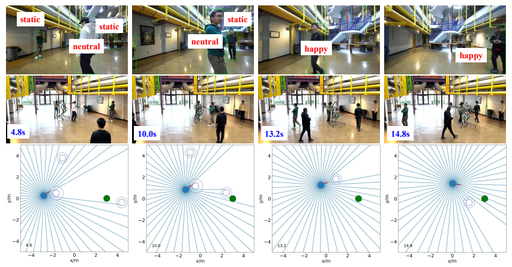
Fig. 10 . Emotion recognition with an on-board ZED camera. The top row presents the ZED camera’s perspective, showcasing detected pedestrians along with their recognized emotions. The middle row shows the recorded scenes from a fixed external camera view. The bottom figures illustrate a top-down view of the reconstructed LiDAR scan, position and orientation of the ego-agent, and collision and discomfort margins of pedestrians.
원문 · CC BY 4.0 · Wei Zhu, Abirath Raju, Abdulaziz Shamsah, Anqi Wu, Seth Hutchinson, Ye Zhao · EmoBipedNav: Emotion-aware Social Navigation for Bipedal Robots with Deep Reinforcement Learning · 원문 그림 인용 · 원본 PDF 11쪽에서 그림 영역을 추출했습니다.논문 정보
- 저자
- Wei Zhu, Abirath Raju, Abdulaziz Shamsah, Anqi Wu, Seth Hutchinson, Ye Zhao
- 학회·저널
- arXiv · 프리프린트
- 최초 공개일
- 2025년 3월 16일
- 등록일
- 2026년 11월 6일
- 수정일
- 2026년 1월 18일
- 버전
- v2
- arXiv
- 2503.12538
- 분류
- cs.RO · cs.LG
- 원문 이용 조건
- CC BY 4.0
- 제공 범위
- 논문 정보, 해설, 허용된 원문 그림
AI 해설은 논문 원문과 별개의 설명이며 오류가 있을 수 있습니다. 원문과 그림은 각 출처의 이용 조건과 따로 표시된 권리를 따릅니다.
초록
This study presents an emotion-aware navigation framework -- EmoBipedNav -- using deep reinforcement learning (DRL) for bipedal robots walking in socially interactive environments. The inherent locomotion constraints of bipedal robots challenge their safe maneuvering capabilities in dynamic environments. When combined with the intricacies of social environments, including pedestrian interactions and social cues, such as emotions, these challenges become even more pronounced. To address these coupled problems, we propose a two-stage pipeline that considers both bipedal locomotion constraints and complex social environments. Specifically, social navigation scenarios are represented using sequential LiDAR grid maps (LGMs), from which we extract latent features, including collision regions, emotion-related discomfort zones, social interactions, and the spatio-temporal dynamics of evolving environments. The extracted features are directly mapped to the actions of reduced-order models (ROMs) through a DRL architecture. Furthermore, the proposed framework incorporates full-order dynamics and locomotion constraints during training, effectively accounting for tracking errors and restrictions of the locomotion controller while planning the trajectory with ROMs. Comprehensive experiments demonstrate that our approach exceeds both model-based planners and DRL-based baselines. The hardware videos and open-source code are available at https://gatech-lidar.github.io/emobipednav.github.io/.
원문 인용
Wei Zhu, Abirath Raju, Abdulaziz Shamsah, Anqi Wu, Seth Hutchinson, Ye Zhao (2025). EmoBipedNav: Emotion-aware Social Navigation for Bipedal Robots with Deep Reinforcement Learning. arXiv:2503.12538v2. https://arxiv.org/abs/2503.12538v2
BibTeX
@misc{zhu2025emobipednav,
  title = {{EmoBipedNav: Emotion-aware Social Navigation for Bipedal Robots with Deep Reinforcement Learning}},
  author = {Wei Zhu and Abirath Raju and Abdulaziz Shamsah and Anqi Wu and Seth Hutchinson and Ye Zhao},
  year = {2025},
  eprint = {2503.12538},
  archivePrefix = {arXiv},
  url = {https://arxiv.org/abs/2503.12538v2}
}