논문 해설
Brain-inspired learning in artificial neural networks: a review
인공 신경망에서의 뇌 영감 학습: 리뷰
- 연구 문제 뇌처럼 지속적으로 학습하고 적응하는 능력은 현재 인공 신경망의 큰 약점이며, 이 리뷰는 뇌 기반 학습 메커니즘을 ANN에 통합하는 가능성을 검토합니다.
- 연구 방법 Hebbian 학습과 STDP, 3요인 규칙, 역전파 파생 지역 학습과 메타 최적화 같은 뇌 영감 학습 규칙을 정리하고 역전파와 비교합니다.
- 주요 결과 Feedback Alignment는 작은 데이터셋에서 좋은 결과를 보였으나 큰 데이터셋에서는 최적이 아닌 경우가 많다고 보고되며, 역전파 파생 지역 규칙은 일반화가 더 나쁘고 변동이 크다고 보고됩니다.
연구의 문제 설정
이 리뷰는 인공 신경망이 생물 뇌처럼 지속적으로 학습하고 적응하는 능력이 부족하다는 문제에서 출발합니다. 인공 신경망은 고정된 라벨 데이터셋을 최적화하도록 설계되어 있어, 새로운 과제에 일반화하거나 반복 학습 과정에서 이전 정보를 유지하는 데 어려움을 겪습니다. 원문은 이 문제를 생애 전반에 걸친 평생 학습, 즉 lifelong learning의 과제로 제시합니다. 또한 역전파에 의존하는 학습이 생물학적으로 그대로 구현되기 어렵다는 점도 함께 다룹니다. 이 논문은 뇌의 시냅스 가소성과 지역적 동역학을 정리하고, 이를 인공 신경망 학습 규칙과 비교하는 방식으로 이 문제를 검토합니다.
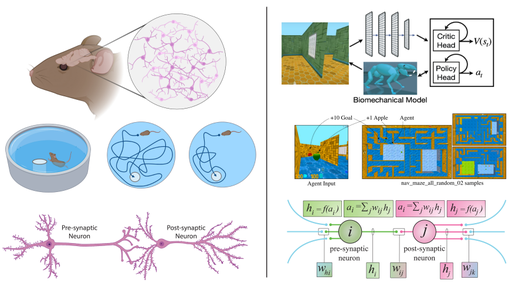
Fig. 2 . There are strong parallels between artificial and brain-like learning algorithms. Left. Top. Graphical depiction of a rodent and a cluster of interconnected neurons. Middle. Rodent is participating in the Morris water maze task to test its learning capabilities. Bottom A graphical depiction of biological pre- and post-synaptic pyramidal neuron. Right. Top. A rodent musculoskeletal physics model with artificial neural network policy and critic heads regulating learning and control (see ref. 51). Middle. A virtual maze environment used for benchmarking learning algorithms (see ref. 52). Bottom. An artificial pre- and post-synaptic neuron with forward propagation equations.
원문 · CC BY 4.0 · Samuel Schmidgall, Jascha Achterberg, Thomas Miconi, Louis Kirsch, Rojin Ziaei, S. Pardis Hajiseyedrazi, Jason Eshraghian · Brain-inspired learning in artificial neural networks: a review · 원문 그림 인용 · 원본 PDF 5쪽에서 그림 영역을 추출했습니다.지역적 학습 규칙과 역전파의 대비
역전파는 출력 오차를 네트워크 층을 따라 역방향으로 전파하여 각 가중치의 기울기를 계산하고 확률적 경사하강법 등으로 갱신하는 전역 오차 기반 방법입니다. 원문은 손실 함수 L(y, ŷ)를 제곱 오차 형태로 제시하고 연쇄 법칙으로 가중치 기울기를 구하는 과정을 보여 줍니다. 반면 지역적 학습 규칙은 전체 네트워크의 오차 전파 대신 시냅스 근처에서 이용 가능한 정보로 가중치를 갱신합니다. 대표적인 예로 Feedback Alignment는 역전파의 가중치 전달 행렬을 고정된 무작위 행렬로 대체하여 오차 신호를 전파합니다. 원문은 이 방식이 가중치 전달의 대칭성을 요구하지 않는다는 점을 강조하지만, 그 일반화 성능은 별도로 검토해야 합니다.
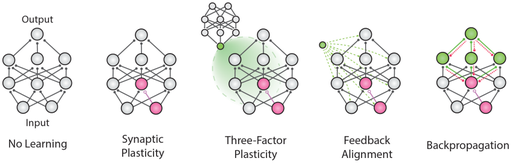
Fig. 3 . A feedforward neural network computes an output given an input by propagating the input information downstream. The precise value of the output is determined by the weight of synaptic coefficients. To improve the output for a task given an input, the synaptic weights are modified. Synaptic Plasticity algorithms represent computational models that emulate the brain’s ability to strengthen or weaken synapses-connections between neurons-based on their activity, thereby facilitating learning and memory formation. Three-Factor Plasticity refers to a model of synaptic plasticity in which changes to the strength of neural connections are determined by three factors: pre-synaptic activity, post-synaptic activity, and a modulatory signal, facilitating more nuanced and adaptive learning processes. TheFeedback Alignment algorithm is a learning technique in which artificial neural networks are trained using random, fixed feedback connections rather than symmetric weight matrices, demonstrating that successful learning can occur without precise backpropagation. Backpropagation is a fundamental algorithm in machine learning and artificial intelligence, used to train neural networks by calculating the gradient of the loss function with respect to the weights in the network.
원문 · CC BY 4.0 · Samuel Schmidgall, Jascha Achterberg, Thomas Miconi, Louis Kirsch, Rojin Ziaei, S. Pardis Hajiseyedrazi, Jason Eshraghian · Brain-inspired learning in artificial neural networks: a review · 원문 그림 인용 · 원본 PDF 9쪽에서 그림 영역을 추출했습니다.Hebbian 학습과 STDP의 기본 규칙
Hebbian 규칙은 두 뉴런이 함께 활성화될 때 연결 강도를 높이는 생물학적 원리에서 출발합니다. 원문은 단순 규칙을 Δw_ij = η x_i x_j로 제시하며, 여기서 η는 학습률이고 x_i, x_j는 두 뉴런의 활동입니다. 이 규칙은 상관이 있는 입력에서 가중치가 계속 커지는 불안정성을 갖기 때문에 가중치 제한이나 추가 안정화 규칙이 필요하다고 설명됩니다. STDP는 스파이크의 상대적 시간 차이 Δt에 따라 강화와 약화를 결정하며, 원문 식은 Δt가 0보다 크면 A+ exp(−Δt/τ+), 0보다 작으면 −A− exp(Δt/τ−)로 주어집니다. 따라서 사전 스파이크가 사후 스파이크보다 앞서면 연결이 강화되고, 반대 순서면 약화됩니다.
3요인 규칙과 섭동 기반 학습
Hebbian 업데이트에 보상 R을 곱하는 단순한 방식은 최적값에서도 가중치를 계속 흔들 수 있어 신뢰할 만한 강화학습을 만들지 못합니다. 이를 해결하기 위해 원문은 뉴런 활동에 무작위 섭동 Δx_j를 주고 Δw_ij = η x_i Δx_j R 형태의 node perturbation 규칙을 설명합니다. 이 규칙은 보상이 양수이면 섭동 방향으로, 음수이면 반대 방향으로 미래 반응을 밀어내며, 기대값으로는 보상의 기울기를 향하는 방향을 가집니다. 원문은 이것이 REINFORCE 알고리즘과 연결된다고 설명합니다. 한편 e-prop은 각 시냅스의 eligibility trace를 순방향으로 계산해 실시간 오차 신호와 곱하는 방식으로, 지연된 오차 신호를 다루기 어렵다는 제약을 함께 제시합니다.
검증 범위와 한계
원문은 Feedback Alignment가 MNIST와 CIFAR 같은 작은 데이터셋에서는 인상적인 결과를 보였지만, ImageNet 같은 큰 데이터셋에서는 성능이 최적이 아닌 경우가 많다고 보고합니다. 이 결과는 해당 데이터셋과 학습 설정에서의 관찰이며, 모든 지역적 규칙에 대한 일반적 결론으로 확대되지 않습니다. 또한 역전파 파생 지역 학습 규칙은 backpropagation through time과 비교할 때 일반화가 더 나쁘고 변동이 크다고 보고됩니다. 원문은 이 현상을 기울기 근사가 실제 기울기와 잘 정렬되지 않는 데서 비롯한 것으로 해석합니다. 반면 Differentiable plasticity는 시냅스마다 시간에 걸친 여러 매개변수를 최적화하므로 많은 메모리가 필요하다는 제약이 지적됩니다.
지속 학습의 과제: 파국적 망각
역전파를 반복 적용하면 새로운 데이터나 새로운 과제를 학습하는 동안 이전에 학습한 정보가 사라지는 파국적 망각이 발생합니다. 원문은 이 현상이 새 과제를 위해 기존 가중치가 크게 바뀌고, 역전파가 이전 정보를 보존하도록 설계되어 있지 않기 때문에 생긴다고 설명합니다. 이 문제는 지속 학습과 평생 학습에서 핵심 장애물로 제시되며, 리뷰는 뇌 기반 학습 규칙이 이를 완화할 수 있는지 검토해야 한다고 봅니다. 다만 원문은 이것이 이미 해결되었다고 보고하지 않으며, 해결 방향은 열린 질문으로 남겨 둡니다.
논문 정보
- 저자
- Samuel Schmidgall, Jascha Achterberg, Thomas Miconi, Louis Kirsch, Rojin Ziaei, S. Pardis Hajiseyedrazi, Jason Eshraghian
- 학회·저널
- arXiv · 프리프린트
- 최초 공개일
- 2023년 5월 18일
- 등록일
- 2026년 11월 6일
- 수정일
- 2023년 5월 18일
- 버전
- v1
- arXiv
- 2305.11252
- 분류
- cs.NE · cs.AI · cs.LG · q-bio.NC
- 원문 이용 조건
- CC BY 4.0
- 제공 범위
- 논문 정보, 해설, 허용된 원문 그림
AI 해설은 논문 원문과 별개의 설명이며 오류가 있을 수 있습니다. 원문과 그림은 각 출처의 이용 조건과 따로 표시된 권리를 따릅니다.
초록
Artificial neural networks (ANNs) have emerged as an essential tool in machine learning, achieving remarkable success across diverse domains, including image and speech generation, game playing, and robotics. However, there exist fundamental differences between ANNs' operating mechanisms and those of the biological brain, particularly concerning learning processes. This paper presents a comprehensive review of current brain-inspired learning representations in artificial neural networks. We investigate the integration of more biologically plausible mechanisms, such as synaptic plasticity, to enhance these networks' capabilities. Moreover, we delve into the potential advantages and challenges accompanying this approach. Ultimately, we pinpoint promising avenues for future research in this rapidly advancing field, which could bring us closer to understanding the essence of intelligence.
원문 인용
Samuel Schmidgall, Jascha Achterberg, Thomas Miconi, Louis Kirsch, Rojin Ziaei, S. Pardis Hajiseyedrazi, Jason Eshraghian (2023). Brain-inspired learning in artificial neural networks: a review. arXiv:2305.11252v1. https://arxiv.org/abs/2305.11252v1
BibTeX
@misc{schmidgall2023brain,
  title = {{Brain-inspired learning in artificial neural networks: a review}},
  author = {Samuel Schmidgall and Jascha Achterberg and Thomas Miconi and Louis Kirsch and Rojin Ziaei and S. Pardis Hajiseyedrazi and Jason Eshraghian},
  year = {2023},
  eprint = {2305.11252},
  archivePrefix = {arXiv},
  url = {https://arxiv.org/abs/2305.11252v1}
}