논문 해설
Benchmarking the State of AI for Crop Yield Forecasting: A Global Assessment Across Modeling Paradigms
작물 수확량 예측을 위한 AI 현황 벤치마킹: 모델링 패러다임 전반에 걸친 전 세계 평가
- 연구 문제 작물 수확량 예측은 모델 종류마다 조건이 달라 전체 정확도만으로는 어떤 모델이 강한지 가리기 어렵습니다.
- 연구 방법 CY-Bench의 국가-작물 데이터에서 다섯 패러다임을 같은 스크리닝과 워크포워드 절차로 비교하고, 전체·공간·시간·이상 예측을 나눠 측정했습니다.
- 주요 결과 밀에서는 표형 모델이 전체 예측에서 가장 강했고, 데이터 기반 모델은 옥수수 국가의 72%와 밀 국가의 78%에서 전통 베이스라인보다 NRMSE를 낮췄습니다. 시간 예측과 이상 예측은 공간 예측보다 크게 어려웠습니다.
수확량 예측 비교의 빈틈
작물 수확량 예측은 식량 안보와 조기 경보에 쓰이지만, 기존 비교는 대부분 한 국가, 한 작물, 한 패러다임에 머물렀습니다. 이 연구는 CY-Bench의 옥수수 36개국과 밀 27개국, 12,000개 이상의 행정구역 자료를 통계 베이스라인, 과정 기반 모델, 공학 특징 기계학습, 심층 시퀀스 모델, 표형 foundation 모델에 같은 조건으로 적용합니다. 핵심 문제는 전체 정확도 하나가 공간적 생산성 차이를 재현하는 능력과 해마다 달라지는 수확량 변동을 맞히는 능력을 함께 가려 버린다는 점입니다.
데이터 정리와 모델 구성
먼저 국가-작물 데이터셋마다 지역-연도 수확량을 이차 추세 모형과 비교하고, 추세보다 3표준편차 이상 높은 양의 이상치만 학습과 평가에서 제거했습니다. 낮은 수확량은 실제 작물 실패일 수 있어 유지합니다. 과정 기반 베이스라인인 LPJmL 5.9는 0.5° 격자에서 구동되며, 기온·강수·일사·풍속 입력은 AgERA5 기반 CY-Bench 자료로 맞췄습니다. 이후 학습 연도의 지역 평균과 분산에 맞춰 보정합니다. 공학 특징 계열은 월별 평균과 누적 변수를 mRMR로 줄인 뒤 Ridge Regression, Random Forest, LightGBM, XGBoost를 학습합니다. 표형 foundation 모델인 TabICL, TabPFN, TabDPT는 같은 특징 표현을 쓰고 in-context learning으로 예측합니다.
시퀀스 모델은 정적 맥락 인코더, 융합 모듈, 회귀 헤드를 공유하고 시간 인코더만 바꿔 비교합니다. LSTM, CNN, Transformer 같은 일반 인코더와 PatchTST 같은 아키텍처 고유 인코더가 여기에 포함됩니다.
스크리닝과 워크포워드 평가
스크리닝 단계에서는 각 국가-작물 데이터셋의 마지막 5년을 테스트, 그 앞 2년을 검증, 나머지를 학습으로 나눕니다. 이 단계에서 Optuna의 TPE 베이지안 최적화를 국가-작물-모델 조합마다 30번 시행하며 모델 구조, 하이퍼파라미터, mRMR이 고르는 특징 수 k, 신경망 학습 기간을 검증 성능만으로 정합니다. 최종 워크포워드 평가에서는 학습 기간을 매년 1년씩 늘려 재학습한 뒤 다음 해를 예측하고, 스크리닝에서 정한 하이퍼파라미터는 그대로 둡니다. 학습 가능한 모델은 다섯 개의 독립 난수 시드로 평가해 시드별 성능을 평균했고, 통계 베이스라인과 LPJmL은 한 번만 평가했습니다. 지표는 네 가지입니다.
전체 예측은 R²와 NRMSE로 보고, 공간 예측은 연도별로 관측과 예측 사이의 Pearson 상관을 구한 뒤 중앙값을 씁니다. 시간 예측은 지역별 연도 상관의 중앙값이고, 이상 예측은 지역 평균을 뺀 모든 지역-연도 값의 Pearson 상관입니다.
국가 단위의 데이터 기반 모델 개선
국가마다 가장 나은 데이터 기반 모델과 가장 나은 전통 베이스라인을 비교하면, 밀은 27개국 중 21개국(78%, 95% 신뢰구간 63–93%)에서, 옥수수는 36개국 중 26개국(72%, 95% 신뢰구간 58–86%)에서 NRMSE가 줄었습니다. 중앙값 감소율은 밀 11.9%(95% 신뢰구간 4.6–13.8%), 옥수수 8.8%(95% 신뢰구간 2.3–12.4%)였습니다. 옥수수는 개선 폭이 밀보다 작고 국가별 편차도 더 컸습니다. 표 1은 국가별 중앙값을 보여 주며, 여기서 밀은 TabDPT가 NRMSE 15.9로 가장 낮았습니다. 옥수수에서는 시퀀스 Transformer가 NRMSE 23.0으로 가장 낮았고, TabICL은 24.2로 뒤를 이었습니다.
이 결과는 대표 모델의 중앙값이므로, 패러다임 전체의 우열을 한 번에 정하는 값으로 읽지 않는 편이 맞습니다.

Table 1 : Performance of representative models for each model family. Values are reported as median [IQR] across countries.
원문 · CC BY 4.0 · Michiel Kallenberg, Philip Janz, Christoph Jörges, Vageesh Saxena, Pratishtha Poudel, Mohammed Musthafa Rafi, Ioannis N. Athanasiadis · Benchmarking the State of AI for Crop Yield Forecasting: A Global Assessment Across Modeling Paradigms · 원문 그림 인용 · 원본 PDF 6쪽에서 그림 영역을 추출했습니다.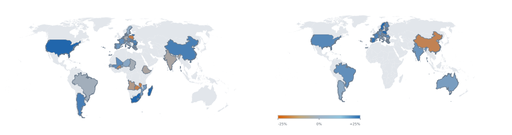
Figure 2 : Relative reduction in NRMSE of the best data-driven paradigm compared with the best traditional approach. Positive values indicate improved predictive performance through data-driven modeling.
원문 · CC BY 4.0 · Michiel Kallenberg, Philip Janz, Christoph Jörges, Vageesh Saxena, Pratishtha Poudel, Mohammed Musthafa Rafi, Ioannis N. Athanasiadis · Benchmarking the State of AI for Crop Yield Forecasting: A Global Assessment Across Modeling Paradigms · 원문 그림 인용 · 원본 PDF 8쪽에서 그림 영역을 추출했습니다.공간·시간·이상 예측의 차이
네 차원으로 나눠 보면 모든 모델 계열에서 공간 상관이 시간 상관과 이상 상관보다 크게 높았습니다. Trend는 전체 NRMSE가 밀 18.3, 옥수수 25.4로 경쟁력이 있었지만, 시간 상관은 밀 -0.46, 옥수수 -0.27로 음수였습니다. 이는 장기 지역 생산성 패턴을 재현하는 것만으로 전체 오차를 낮출 수 있음을 보여 줍니다. LPJmL은 전체 예측에서 밀 NRMSE 23.5로 데이터 기반 최강 모델보다 낮았지만, 밀의 시간 상관 0.34는 표의 대표 모델 가운데 가장 높았습니다. 이상 예측 상관은 표에 실린 대표 모델 중 옥수수 RF 0.16, 밀 LPJmL 0.18이 가장 높았으며, 공간 예측과 비교하면 여전히 낮았습니다.
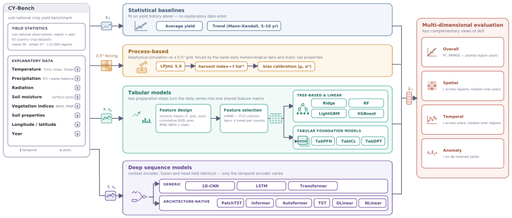
Figure 1 : Overview of the benchmark. CY-Bench provides harmonized sub-national crop yield observations and environmental predictors for benchmarking statistical, process-based, tabular, and deep sequence models under a common experimental protocol. Performance is evaluated using four complementary dimensions: overall, spatial, temporal, and anomaly prediction.
원문 · CC BY 4.0 · Michiel Kallenberg, Philip Janz, Christoph Jörges, Vageesh Saxena, Pratishtha Poudel, Mohammed Musthafa Rafi, Ioannis N. Athanasiadis · Benchmarking the State of AI for Crop Yield Forecasting: A Global Assessment Across Modeling Paradigms · 원문 그림 인용 · 원본 PDF 3쪽에서 그림 영역을 추출했습니다.중간 생육기 예측
중간 생육기 조건은 생육 기간의 약 50%만 관측한 상태이며, 종료 시점 약 100% 관측과 비교했습니다. 대표 모델의 차이는 대부분 작았고 사분위 범위가 0을 가로지르는 경우가 많았습니다. 종료 시점 예측이 대체로 조금 더 나았지만, 중간 생육기에도 상당한 예측 능력이 남아 있었습니다. 이 결과는 수확 몇 달 전에도 쓸 만한 전망이 가능하다는 근거로 제시되며, LPJmL은 중간 생육기 예측이 없어 이 비교에서 제외되었습니다.

Table 2 : Difference between mid-season (∼50% of the growing season observed) and end-of-season (∼100%) performance for the representative model of each family. Values denote the median Δ [IQR] across countries. Positive Δ indicates improved end-of-season performance.
원문 · CC BY 4.0 · Michiel Kallenberg, Philip Janz, Christoph Jörges, Vageesh Saxena, Pratishtha Poudel, Mohammed Musthafa Rafi, Ioannis N. Athanasiadis · Benchmarking the State of AI for Crop Yield Forecasting: A Global Assessment Across Modeling Paradigms · 원문 그림 인용 · 원본 PDF 11쪽에서 그림 영역을 추출했습니다.관리 변수와 LPJmL 대표성
CY-Bench에는 비료, 관개, 품종, 경운, 병해충 같은 관리 변수가 없어 수확량 변동의 일부를 설명하지 못합니다. 과정 기반 베이스라인은 단일 전역 매개변수 LPJmL 설정 하나이므로 모든 과정 기반 작물 모델을 대표하지 않습니다. 또 모든 패러다임에서 이상 예측은 여전히 어려웠으며, 연도 간 변동을 정확히 맞히는 문제는 남아 있습니다. 이번 벤치마크는 새로 나오는 foundation 모델과 다중모달 모델을 다루지 않았습니다.
논문 정보
- 저자
- Michiel Kallenberg, Philip Janz, Christoph Jörges, Vageesh Saxena, Pratishtha Poudel, Mohammed Musthafa Rafi, Ioannis N. Athanasiadis
- 학회·저널
- arXiv · 프리프린트
- 최초 공개일
- 2026년 11월 14일
- 등록일
- 2026년 11월 17일
- 수정일
- 2026년 11월 14일
- 버전
- v1
- arXiv
- 2611.19330
- 분류
- cs.LG · cs.AI
- 원문 이용 조건
- CC BY 4.0
- 제공 범위
- 논문 정보, 해설, 허용된 원문 그림
AI 해설은 논문 원문과 별개의 설명이며 오류가 있을 수 있습니다. 원문과 그림은 각 출처의 이용 조건과 따로 표시된 권리를 따릅니다.
초록
Accurate crop yield forecasting is essential for food security, agricultural policy, and commodity markets. Although statistical, process-based, and machine learning approaches have all been proposed, their relative strengths remain poorly understood due to the lack of large-scale, standardized comparisons. We address this gap through a comprehensive benchmark of five modeling paradigms -- statistical baselines, process-based models, conventional feature-engineered machine learning, deep sequence models, and tabular foundation models -- using the CY-Bench benchmark spanning 63 country-crop datasets (>12,000 administrative regions) across six continents. Beyond conventional pooled accuracy metrics, we introduce a multi-dimensional evaluation framework that separately quantifies overall, spatial, temporal, and anomaly prediction skill. Across multiple crops and countries, feature-engineered machine learning and tabular foundation models achieve the strongest overall predictive performance. Data-driven models reduce NRMSE in 72% of countries growing maize and 78% of countries growing wheat, with median reductions of 8.8% and 11.9%, respectively. Across all modeling paradigms, spatial prediction is substantially easier than temporal and anomaly prediction. While data-driven models markedly improve temporal and anomaly prediction over statistical baselines, accurately forecasting year-to-year yield variability remains challenging. These findings suggest that future progress in large-scale crop yield forecasting will depend on the improved characterization of the environmental and management factors driving inter-annual yield variability, founded on effective representations for crop yield forecasting systems that support agricultural decision-making, early-warning applications, and food security planning
원문 인용
Michiel Kallenberg, Philip Janz, Christoph Jörges, Vageesh Saxena, Pratishtha Poudel, Mohammed Musthafa Rafi, Ioannis N. Athanasiadis (2026). Benchmarking the State of AI for Crop Yield Forecasting: A Global Assessment Across Modeling Paradigms. arXiv:2611.19330v1. https://arxiv.org/abs/2611.19330v1
BibTeX
@misc{kallenberg2026benchmarking,
  title = {{Benchmarking the State of AI for Crop Yield Forecasting: A Global Assessment Across Modeling Paradigms}},
  author = {Michiel Kallenberg and Philip Janz and Christoph Jörges and Vageesh Saxena and Pratishtha Poudel and Mohammed Musthafa Rafi and Ioannis N. Athanasiadis},
  year = {2026},
  eprint = {2611.19330},
  archivePrefix = {arXiv},
  url = {https://arxiv.org/abs/2611.19330v1}
}