논문 해설
SLIC: Reinforcement Fine-Tuning Small LMs for Multi-Turn Analog Circuit Optimization
SLIC: 다중 턴 아날로그 회로 최적화를 위한 소형 언어 모델의 강화 미세 조정
- 연구 문제 아날로그 회로 설계는 공정 기술과 밀접하게 묶인 다중 턴 시뮬레이션 기반 작업이며, 독점 PDK 때문에 외부 LLM 사용이 어렵습니다.
- 연구 방법 SLIC는 4B 언어 모델을 SFT 후 다중 턴 GRPO로 학습하며, 구조화된 회로 표현과 이산화된 상대 업데이트, 도메인 게이트 보상, RGRS 롤아웃 선택을 결합합니다.
- 주요 결과 SLIC-RANDOM은 분포 내 8턴 Pass@1 87.1%를 보고하며, SLIC-SOFTMAX는 보류 토폴로지에서 72.6%를 보고합니다. 정책은 다른 기술 노드와 TSMC 65 nm PDK에도 추가 fine-tuning 없이 적용되었습니다.
아날로그 회로 설계 최적화의 어려움
아날로그 집적회로 설계는 사양 사이의 상충 관계를 여러 번 반복해서 조정해야 하는 작업이며, 공정 기술과 밀접하게 묶여 있어 회로와 기술 노드마다 설계 생산성을 확장하기 어렵습니다. 여기에 공개된 설계 데이터가 적고 공정 설계 키트(PDK)가 독점적이어서, 외부 호스팅 대형 언어 모델에 설계 정보를 보내는 방식은 실무 환경에서 쓰기 어렵습니다. 이 논문은 4B 규모의 언어 모델을 로컬에서 배포하면서 시뮬레이터 피드백을 받아 다중 턴으로 회로 크기를 조정하는 학습 방법을 다룹니다.
구조화된 회로 표현과 상대 업데이트 행동
SLIC는 회로를 구성요소, 편집 가능한 속성, 구조 경계를 명시한 XML 형식으로 표현하고, 정책은 추론 뒤 대상 소자, 파라미터, 방향, 비율로 이루어진 이산화된 상대 업데이트를 출력합니다. 시뮬레이터는 이 업데이트를 현재 파라미터 값에 곱하는 방식으로 적용하므로 절대값을 새로 생성하지 않습니다. 학습은 교사 모델의 시뮬레이터 롤아웃 중 유효하고 성능이 개선된 턴만 골라 SFT로 초기화한 뒤, 다중 턴 GRPO로 이어집니다. 보상은 도메인 유효성 게이트를 거쳐 사양별 점수를 합산하고, 모든 사양을 만족한 성공 설계에는 평균 여유도 기반의 보너스를 줍니다.
Reward-Guided Rollout Steering의 후보 선택
RGRS는 각 턴에서 같은 상호작용 이력으로부터 G개의 후보 편집을 샘플링하고, 각 후보를 시뮬레이션해 측정값과 보상을 얻습니다. 모든 후보 전이는 그룹 상대 업데이트에 사용되며, 다음 턴의 부모 상태는 하나의 후보가 선택되어 정해집니다. 적격 후보 집합은 유효 후보가 있을 때 유효 후보로 제한되고, 없으면 전체 후보가 대상이 됩니다. 연속 선택 정책은 RANDOM(균등 무작위), GREEDY(최고 점수), SOFTMAX(점수에 따른 확률 선택)의 세 가지로 비교되며, SOFTMAX는 높은 점수를 선호하면서도 다른 적격 후보에 0이 아닌 선택 확률을 남깁니다. 저자들은 이 구조가 한 번에 하나의 후보만 진행시키므로 후보 집합과 학습 롤아웃 길이를 늘리면서도 샘플링 비용을 선형으로 유지한다고 설명합니다.
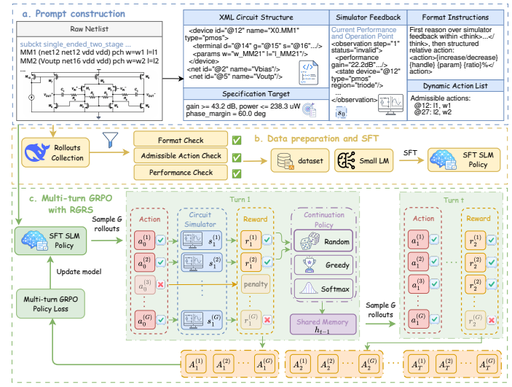
Figure 1 : Overview ofSLIC. Given a goal-conditioned analog circuit optimization task, SLIC builds a structured prompt from the circuit representation and target specifications, then trains a language- model agent through SFT and simulator-interactive RL. The upper path shows SFT data construction from filtered teacher rollouts. The lower loop shows multi-turn GRPO with Reward-Guided Rollout Steering (RGRS), where multiple candidate responses propose relative parameter updates that are evaluated through simulation, one eligible continuation is selected to advance the trajectory, and all candidates contribute to group-relative policy updates. Subscripts denote interaction steps, and superscripts index candidates within each group.
원문 · CC BY 4.0 · Yan Xu, Zhengqi Gao, Ching-Yun Ko, Zhang-Wei Hong, Wenjie Lu, Tao Yu, Xin Zhang, Duane S. Boning, Ruonan Han · SLIC: Reinforcement Fine-Tuning Small LMs for Multi-Turn Analog Circuit Optimization · 원문 그림 인용 · 원본 PDF 2쪽에서 그림 영역을 추출했습니다.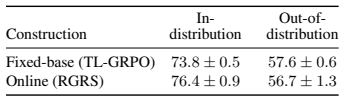
Table 6 : Trajectory construction with dynamic filtering, no slack bonus, and stopping at success. RGRS uses random continuation. Turn 8 Pass@1 (%).
원문 · CC BY 4.0 · Yan Xu, Zhengqi Gao, Ching-Yun Ko, Zhang-Wei Hong, Wenjie Lu, Tao Yu, Xin Zhang, Duane S. Boning, Ruonan Han · SLIC: Reinforcement Fine-Tuning Small LMs for Multi-Turn Analog Circuit Optimization · 원문 그림 인용 · 원본 PDF 21쪽에서 그림 영역을 추출했습니다.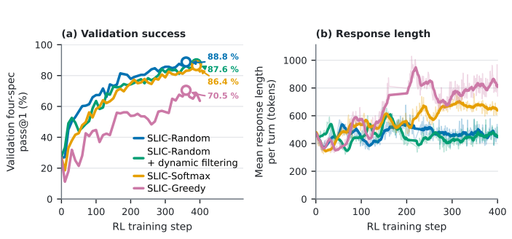
Figure 6 : Training dynamics of SLIC under different continuation strategies. (a) Four-specification Pass@1 on the validation set used for checkpoint selection; open circles mark the best validation checkpoint for each variant. (b) Mean generated response length per turn during training, including both reasoning and actions.
원문 · CC BY 4.0 · Yan Xu, Zhengqi Gao, Ching-Yun Ko, Zhang-Wei Hong, Wenjie Lu, Tao Yu, Xin Zhang, Duane S. Boning, Ruonan Han · SLIC: Reinforcement Fine-Tuning Small LMs for Multi-Turn Analog Circuit Optimization · 원문 그림 인용 · 원본 PDF 25쪽에서 그림 영역을 추출했습니다.유효성과 성능을 분리한 정규화
논문은 유효성 이득과 성능 이득을 같은 그룹 평균과 표준편차로 한꺼번에 정규화하지 않고, 각각 따로 정규화한 뒤 더합니다. 유효성 이득은 전체 후보 집합에서, 성능 이득은 측정이 가능한 후보 집합에서 계산되며, 측정이 없는 후보는 성능 비교에서 제외됩니다. 결합 정규화에서는 무효 행동 패널티와 측정된 설계 사이의 차이가 그룹 분산을 키워 성능 차이를 압축할 수 있다는 것이 저자들의 해석입니다. 분리 정규화를 쓴 SLIC-SOFTMAX는 결합 정규화보다 분포 내 Pass@1이 6.2포인트, 분포 외 Pass@1이 4.9포인트 높게 보고되었습니다.
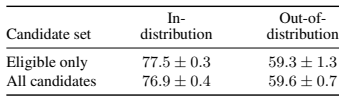
Table 7 : Continuation candidate set with soft- max selection, joint normalization, and contin- ued optimization after success. Turn 8 Pass@1 (%).
원문 · CC BY 4.0 · Yan Xu, Zhengqi Gao, Ching-Yun Ko, Zhang-Wei Hong, Wenjie Lu, Tao Yu, Xin Zhang, Duane S. Boning, Ruonan Han · SLIC: Reinforcement Fine-Tuning Small LMs for Multi-Turn Analog Circuit Optimization · 원문 그림 인용 · 원본 PDF 21쪽에서 그림 영역을 추출했습니다.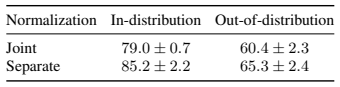
Table 8 : Normalization ablation for Qwen3.5- 4B with random continuation and continued optimization after success. Results are four- specification Pass@1 (%) at Turn 8.
원문 · CC BY 4.0 · Yan Xu, Zhengqi Gao, Ching-Yun Ko, Zhang-Wei Hong, Wenjie Lu, Tao Yu, Xin Zhang, Duane S. Boning, Ruonan Han · SLIC: Reinforcement Fine-Tuning Small LMs for Multi-Turn Analog Circuit Optimization · 원문 그림 인용 · 원본 PDF 21쪽에서 그림 영역을 추출했습니다.분포 내와 보류 토폴로지 평가
분포 내 평가는 PTM 65 nm 기술에서 840개 과제로 수행되었고, 4B SLIC-RANDOM은 8턴에서 네 사양 Pass@1 87.1%를 보고합니다. 같은 자리에서 GPT-6-Astra는 90.6%로 더 높습니다. Tree MT-GRPO는 단순 분포 내 토폴로지에서 8턴 기준 96.3%로 SLIC-RANDOM의 92.7%보다 높지만, 전체 분포 내 Pass@1은 81.2%로 SLIC-RANDOM의 87.1%보다 낮습니다. 이 비교의 결과는 PTM 65 nm 조건과 저자 측정의 설정에서 얻은 값입니다.
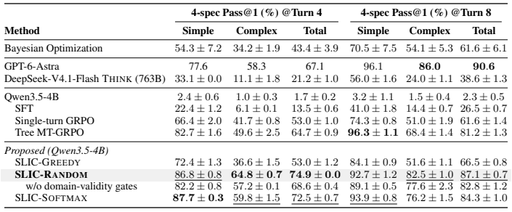
Table 1 : In-distribution evaluation at the PTM 65 nm technology node over 840 tasks with break- downs by topology complexity. GPT-6-Astra is evaluated once on the full evaluation set. Bayesian Optimization uses 96 and 192 simulator calls per topology to match SLIC’s total simulation budget. Boldand underline denote the best and second-best mean results in each column respectively.
원문 · CC BY 4.0 · Yan Xu, Zhengqi Gao, Ching-Yun Ko, Zhang-Wei Hong, Wenjie Lu, Tao Yu, Xin Zhang, Duane S. Boning, Ruonan Han · SLIC: Reinforcement Fine-Tuning Small LMs for Multi-Turn Analog Circuit Optimization · 원문 그림 인용 · 원본 PDF 7쪽에서 그림 영역을 추출했습니다.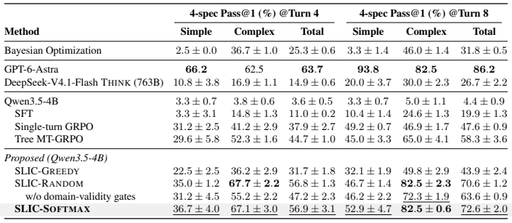
Table 2 : Out-of-distribution evaluation at the PTM 65 nm technology node over 240 tasks, with breakdowns by topology complexity (two simple and four complex). GPT-6-Astra is evaluated once on the full evaluation set. Bayesian Optimization uses 96 and 192 simulator calls per topology to match SLIC’s total simulation budget.Boldand underline denote the best and second-best reported mean results in each column respectively.
원문 · CC BY 4.0 · Yan Xu, Zhengqi Gao, Ching-Yun Ko, Zhang-Wei Hong, Wenjie Lu, Tao Yu, Xin Zhang, Duane S. Boning, Ruonan Han · SLIC: Reinforcement Fine-Tuning Small LMs for Multi-Turn Analog Circuit Optimization · 원문 그림 인용 · 원본 PDF 8쪽에서 그림 영역을 추출했습니다.기술 노드와 상용 PDK 전이
PTM 65 nm에서 학습한 정책은 22 nm에서 130 nm까지의 PTM 노드와 TSMC 65 nm PDK에 추가 fine-tuning 없이 적용되었습니다. 각 기술에서는 초기 파라미터를 유효 범위에 맞추고 목표 사양은 PTM 65 nm의 값을 재사용합니다. SLIC-SOFTMAX는 다섯 개의 미관측 PTM 노드에서 분포 내 73.3~79.8%, 보류 토폴로지에서 61.9~71.0%를 보고합니다. TSMC 65 nm PDK에서 SLIC-RANDOM은 보류 토폴로지 Pass@1 49.9%를 보이며, 이는 학습 없는 전이 평가로 제시됩니다. 원문은 이 하락을 PTM이 단순화한 공정 효과로 설명하지만, 원인을 직접 측정했다고 주장하지는 않습니다.
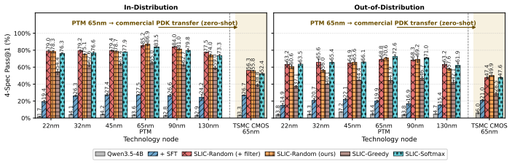
Figure 2 : Technology transfer under four-specification Pass@1 evaluation within eight turns. Policies are trained on PTM 65 nm and evaluated across PTM nodes from 22 to 130 nm and a TSMC CMOS 65 nm PDK without additional fine-tuning. Initial parameters are adjusted to the valid ranges of each technology, while the PTM 65 nm target specifications are reused. Left: a 420-task subset of the full 840 in-distribution tasks. Right: 240 held-out topology tasks.
원문 · CC BY 4.0 · Yan Xu, Zhengqi Gao, Ching-Yun Ko, Zhang-Wei Hong, Wenjie Lu, Tao Yu, Xin Zhang, Duane S. Boning, Ruonan Han · SLIC: Reinforcement Fine-Tuning Small LMs for Multi-Turn Analog Circuit Optimization · 원문 그림 인용 · 원본 PDF 8쪽에서 그림 영역을 추출했습니다.구성요소 절제와 보상 설계
도메인 유효성 게이트를 제거하면 8턴 Pass@1이 분포 내에서 4.3포인트, 분포 외에서 7.0포인트 낮아집니다. 성공 조건부 slack 보너스를 추가한 설정은 동적 필터링 아래에서 분포 내 8.5포인트, 보류 토폴로지에서 12.1포인트 개선됩니다. 연속 선택 정책에서는 GREEDY보다 RANDOM과 SOFTMAX가 높게 나타나며, SOFTMAX와 RANDOM의 차이는 통계적으로 유의하지 않다고 보고됩니다. 이 절제 결과는 각 구성요소를 제거했을 때의 변화이며, 다른 학습 설정과 결합했을 때의 효과를 모두 대표하지는 않습니다.
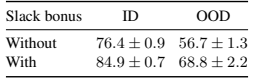
Table 3 : Slack bonus ablation with random continuation and dynamic filtering.
원문 · CC BY 4.0 · Yan Xu, Zhengqi Gao, Ching-Yun Ko, Zhang-Wei Hong, Wenjie Lu, Tao Yu, Xin Zhang, Duane S. Boning, Ruonan Han · SLIC: Reinforcement Fine-Tuning Small LMs for Multi-Turn Analog Circuit Optimization · 원문 그림 인용 · 원본 PDF 8쪽에서 그림 영역을 추출했습니다.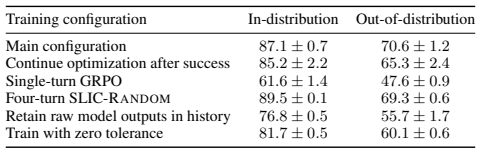
Table 10 : Ablations relative to the main SLIC-RANDOMconfiguration, which uses separate normal- ization, the success-conditional slack bonus, stopping at success, an eight-turn training budget, and structured history. All policies are evaluated at Turn 8.
원문 · CC BY 4.0 · Yan Xu, Zhengqi Gao, Ching-Yun Ko, Zhang-Wei Hong, Wenjie Lu, Tao Yu, Xin Zhang, Duane S. Boning, Ruonan Han · SLIC: Reinforcement Fine-Tuning Small LMs for Multi-Turn Analog Circuit Optimization · 원문 그림 인용 · 원본 PDF 22쪽에서 그림 영역을 추출했습니다.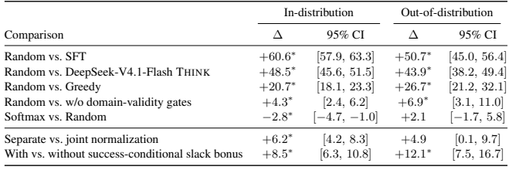
Table 14 : Task-paired differences in four-specification Pass@1 within eight turns. Differences ( ∆, in percentage points) are computed as the first method minus the second. Random, Softmax, and Greedy denote the corresponding SLIC variants. The normalization and slack-bonus comparisons use their respective matched training settings. Confidence intervals are pointwise 95% percentile bootstrap intervals. ∗ indicates significance at α= 0.05 after Holm correction across all 18 Turn 8 tests in the analysis.
원문 · CC BY 4.0 · Yan Xu, Zhengqi Gao, Ching-Yun Ko, Zhang-Wei Hong, Wenjie Lu, Tao Yu, Xin Zhang, Duane S. Boning, Ruonan Han · SLIC: Reinforcement Fine-Tuning Small LMs for Multi-Turn Analog Circuit Optimization · 원문 그림 인용 · 원본 PDF 30쪽에서 그림 영역을 추출했습니다.적용 범위와 한계
저자들은 SLIC가 주어진 토폴로지 안의 소자 크기 조정에 초점을 맞추며, 위상 생성, PVT 변동 검증, 물리적 레이아웃을 포함한 전체 설계 흐름은 향후 과제로 남겨 둔다고 밝힙니다. 평가 대상도 증폭기 4개 사양에 한정되며 LDO, LNA, PA나 잡음·오프셋 같은 추가 목적은 다루지 않습니다. 또한 주요 결과는 PTM 65 nm 학습 조건과 특정 백본(Qwen3.5-4B)에서 얻은 것이며, 다른 백본 결과는 부록 표에서 따로 보고됩니다.
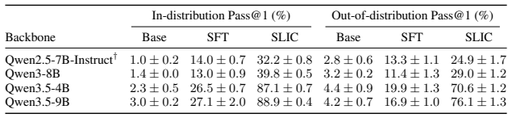
Table 4 : Generalization across backbones at Turn 8 on 840 ID and 240 OOD tasks. Qwen3 and Qwen3.5 backbones follow the main SLIC-RANDOMconfiguration. †Qwen2.5-7B-Instruct uses SLIC-SOFTMAXwith 800 RL updates (Appendix G.2).
원문 · CC BY 4.0 · Yan Xu, Zhengqi Gao, Ching-Yun Ko, Zhang-Wei Hong, Wenjie Lu, Tao Yu, Xin Zhang, Duane S. Boning, Ruonan Han · SLIC: Reinforcement Fine-Tuning Small LMs for Multi-Turn Analog Circuit Optimization · 원문 그림 인용 · 원본 PDF 9쪽에서 그림 영역을 추출했습니다.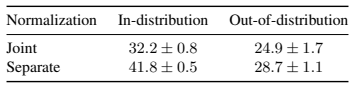
Table 12 : Qwen2.5-7B-Instruct four-specification Pass@1 (%) at Turn 8.
원문 · CC BY 4.0 · Yan Xu, Zhengqi Gao, Ching-Yun Ko, Zhang-Wei Hong, Wenjie Lu, Tao Yu, Xin Zhang, Duane S. Boning, Ruonan Han · SLIC: Reinforcement Fine-Tuning Small LMs for Multi-Turn Analog Circuit Optimization · 원문 그림 인용 · 원본 PDF 24쪽에서 그림 영역을 추출했습니다.논문 정보
- 저자
- Yan Xu, Zhengqi Gao, Ching-Yun Ko, Zhang-Wei Hong, Wenjie Lu, Tao Yu, Xin Zhang, Duane S. Boning, Ruonan Han
- 학회·저널
- arXiv · 프리프린트
- 최초 공개일
- 2026년 11월 10일
- 등록일
- 2026년 11월 11일
- 수정일
- 2026년 11월 10일
- 버전
- v1
- arXiv
- 2611.13452
- 분류
- cs.LG
- 원문 이용 조건
- CC BY 4.0
- 제공 범위
- 논문 정보, 해설, 허용된 원문 그림
AI 해설은 논문 원문과 별개의 설명이며 오류가 있을 수 있습니다. 원문과 그림은 각 출처의 이용 조건과 따로 표시된 권리를 따릅니다.
초록
Analog integrated circuit (IC) design is a multi-turn, simulator-grounded engineering task that demands iterative reasoning over coupled performance tradeoffs, yet proprietary process design kits (PDKs) make hosted large language model workflows difficult to deploy in practical design settings. We present SLIC (Small LM Iterating on Circuits), a reinforcement fine-tuning framework that trains a 4B-scale, locally deployable language model for closed-loop analog circuit optimization. SLIC pairs structured circuit representations with discretized relative-update actions, domain- and success-gated multiobjective rewards, and Reward-Guided Rollout Steering (RGRS), which turns per-step simulator feedback into signals for both policy learning and online rollout construction in this sparse, highly constrained domain. We further release an open, goal-conditioned benchmark of 41 amplifier topologies with standardized protocols for in-distribution validation, held-out topology evaluation, and cross-technology-node transfer. Trained solely with open source 65 nm CMOS predictive technology models (PTM), SLIC-Random achieves 87.1% in-distribution four-specification Pass@1 within eight turns, surpassing the 763B DeepSeek-V4.1-Flash Think by 48.5 percentage points. Beyond the training distribution, SLIC-Softmax reaches 72.6% Pass@1 on held-out topologies, and the trained policies consistently transfer across five unseen technology nodes without additional fine-tuning. This transfer extends to a commercial TSMC 65 nm CMOS PDK, where SLIC-Random achieves 49.9% held-out-topology Pass@1, demonstrating practical deployment through local inference without transmitting proprietary data to external LLM services. Performance further scales with test-time simulator interactions, reaching up to 83.2% held-out-topology Pass@1 at a 32-turn budget.
원문 인용
Yan Xu, Zhengqi Gao, Ching-Yun Ko, Zhang-Wei Hong, Wenjie Lu, Tao Yu, Xin Zhang, Duane S. Boning, Ruonan Han (2026). SLIC: Reinforcement Fine-Tuning Small LMs for Multi-Turn Analog Circuit Optimization. arXiv:2611.13452v1. https://arxiv.org/abs/2611.13452v1
BibTeX
@misc{xu2026slic,
  title = {{SLIC: Reinforcement Fine-Tuning Small LMs for Multi-Turn Analog Circuit Optimization}},
  author = {Yan Xu and Zhengqi Gao and Ching-Yun Ko and Zhang-Wei Hong and Wenjie Lu and Tao Yu and Xin Zhang and Duane S. Boning and Ruonan Han},
  year = {2026},
  eprint = {2611.13452},
  archivePrefix = {arXiv},
  url = {https://arxiv.org/abs/2611.13452v1}
}