논문 해설
Deep Multiagent Reinforcement Learning: Challenges and Directions
심층 다중 에이전트 강화학습: 과제와 방향
- 연구 문제 다중 에이전트 환경에서 한 에이전트의 최적 정책이 다른 에이전트의 행동에 따라 계속 바뀌어 단일 에이전트 강화학습의 가정이 깨집니다.
- 연구 방법 이 서베이는 다중 에이전트 문제 표현을 정리하고 중앙 집중 학습과 분산 실행, 상대 모델링, 통신, 효율적 협응, 보상 형성의 다섯 연구 영역으로 분류합니다.
- 주요 결과 중앙 집중 학습과 분산 실행 범주에서 VDN은 팀 가치를 개별 가치의 선형 합으로 분해하고 QMIX는 단조 제약 아래 비선형 결합으로 이를 확장합니다.
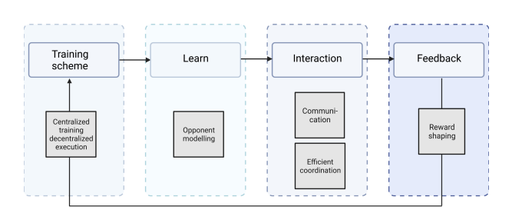
Fig. 3 Overview of taxonomy This figure shows how the paper is organised. We start by discussing the main training scheme in DMARL: centralised training and decentralised execution. We then move to how agents learn through opponent modelling and interact with other agents via communication and coordination. Finally, we discuss how different reward shaping methods act as a feedback mechanism.
원문 · CC BY 4.0 · Annie Wong, Thomas Bäck, Anna V. Kononova, Aske Plaat · Deep Multiagent Reinforcement Learning: Challenges and Directions · 원문 그림 인용 · 원본 PDF 11쪽에서 그림 영역을 추출했습니다.다중 에이전트 학습이 어려운 이유
단일 에이전트 강화학습은 환경이 정상적이라는 가정 위에서 MDP로 정리됩니다. 여러 에이전트가 함께 학습하면 상태 전이와 보상이 모든 에이전트의 결합 행동에 의존하므로 이 가정이 깨집니다. 각 에이전트는 다른 에이전트의 정책이 바뀔 때마다 최적 정책이 이동하는 비정상성 문제를 겪습니다. 여기에 에이전트 수가 늘어날수록 상태-행동 공간이 커져 계산 복잡도도 함께 증가합니다. 이 논문은 이러한 문제를 다루는 심층 다중 에이전트 강화학습 연구를 정리하는 서베이입니다.
단일 에이전트 기반과 MDP 가정
강화학습의 기본 틀은 상태, 행동, 전이 확률, 보상, 할인율로 정의되는 MDP입니다. MDP는 에이전트가 상태를 완전히 관측하고 환경이 정상적이라고 가정합니다. 전이 확률과 보상이 시간에 따라 변하지 않아야 한다는 조건이 핵심입니다. 가치 기반 방법은 행동 가치 함수에서 정책을 얻고, 정책 기반과 액터-크리틱 방법은 정책을 직접 갱신합니다. 이 논문의 다중 에이전트 문제 표현은 이 MDP 가정을 어떻게 완화하는지를 기준으로 구분됩니다.
다중 에이전트 문제 표현
이 논문은 상호작용의 성격과 관측 가능성, 행동 순서에 따라 문제 표현을 나눕니다. 완전 관측이고 협력적인 경우에는 팀 Markov game이 쓰입니다. 협력하지만 행동을 분산해서 실행하면 Dec-POMDP가 쓰이며, 모든 에이전트는 결합 보상 함수를 최대화하면서 서로 다른 지역 관측을 가집니다. 차례대로 행동하는 경우에는 extensive-form game으로 표현됩니다. 부분 관측의 혼합 또는 경쟁 설정은 POMG로 다룹니다. 이 구분은 뒤에서 다룰 계산 복잡도, 비정상성, 부분 관측성, 신용 할당 문제가 어떤 표현에서 생기는지 설명하는 틀이 됩니다.
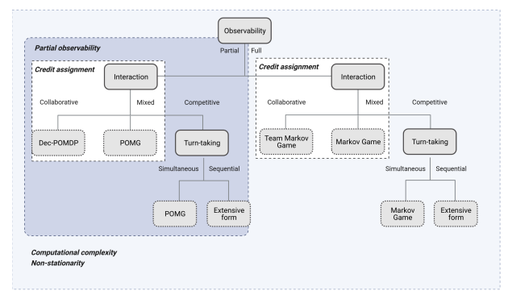
Fig. 1 Diagram of problem representations and their main challenges multiagent problem representations can be categorised along a number of axes. First, whether the en- vironment is fully or partially observable. Second, whether the nature of the interaction is collaborative, mixed or competitive. Third, whether turns are taken sequentially or simul- taneously. Different problem representations come with different challenges. The four main challenges include computational complexity, nonstationarity, partial observability and credit assignment. Computational complexity and nonstationarity are challenges found in all problem representations, while partial observability and credit assignment are specific to some.1
원문 · CC BY 4.0 · Annie Wong, Thomas Bäck, Anna V. Kononova, Aske Plaat · Deep Multiagent Reinforcement Learning: Challenges and Directions · 원문 그림 인용 · 원본 PDF 7쪽에서 그림 영역을 추출했습니다.네 가지 도전 과제
논문은 계산 복잡도, 비정상성, 부분 관측성, 신용 할당을 주요 도전 과제로 묶습니다. 계산 복잡도는 에이전트 수가 늘수록 탐색과 샘플 수가 커지는 문제입니다. 비정상성은 다른 에이전트의 정책 변화가 최적 정책을 계속 바꾸는 문제입니다. 부분 관측성은 에이전트가 전역 상태 대신 지역 관측에 기반해 결정해야 하는 조건입니다. 신용 할당은 공동 팀 보상에서 개별 에이전트의 기여를 구분하기 어려운 문제입니다. 이 네 가지는 서로 독립적으로 나타나지 않고 한 문제에서 여러 개가 동시에 생길 수 있습니다.
중앙 집중 학습과 가치 분해
중앙 집중 학습과 분산 실행은 학습 중에는 추가 정보를 공유하고 실행할 때는 각 에이전트가 지역 관측에 기반해 행동하는 방식입니다. 가치 기반 방법에서는 팀 가치 함수를 개별 에이전트의 가치로 분해하는 것이 핵심입니다. VDN은 팀 가치 함수를 개별 가치 함수의 선형 합으로 분해합니다. QMIX는 개별 가치 함수를 단조 제약 아래에서 비선형으로 결합하여 VDN을 개선하는 방법으로 설명됩니다. 다만 이 단조 제약은 강한 협응이 필요한 설정에서 성능을 제한할 수 있다고 원문은 지적합니다.
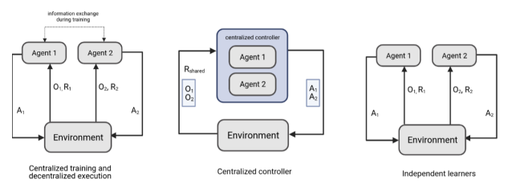
Fig. 5 Overview of training schemes The three main training schemes in multiagent settings are centralised training and decentralised execution, using a centralised controller and independent learning. The most popular approach is centralised training with decentralised execution, where agents can share information during training, but actions are executed de- centrally based on local observations.
원문 · CC BY 4.0 · Annie Wong, Thomas Bäck, Anna V. Kononova, Aske Plaat · Deep Multiagent Reinforcement Learning: Challenges and Directions · 원문 그림 인용 · 원본 PDF 16쪽에서 그림 영역을 추출했습니다.논문 정보
- 저자
- Annie Wong, Thomas Bäck, Anna V. Kononova, Aske Plaat
- 학회·저널
- arXiv · 프리프린트
- 최초 공개일
- 2021년 6월 29일
- 등록일
- 2026년 11월 6일
- 수정일
- 2022년 10월 12일
- 버전
- v2
- arXiv
- 2106.15691
- 분류
- cs.LG · cs.AI · cs.MA · cs.NE
- 원문 이용 조건
- CC BY 4.0
- 제공 범위
- 논문 정보, 해설, 허용된 원문 그림
AI 해설은 논문 원문과 별개의 설명이며 오류가 있을 수 있습니다. 원문과 그림은 각 출처의 이용 조건과 따로 표시된 권리를 따릅니다.
초록
This paper surveys the field of deep multiagent reinforcement learning. The combination of deep neural networks with reinforcement learning has gained increased traction in recent years and is slowly shifting the focus from single-agent to multiagent environments. Dealing with multiple agents is inherently more complex as (a) the future rewards depend on multiple players' joint actions and (b) the computational complexity increases. We present the most common multiagent problem representations and their main challenges, and identify five research areas that address one or more of these challenges: centralised training and decentralised execution, opponent modelling, communication, efficient coordination, and reward shaping. We find that many computational studies rely on unrealistic assumptions or are not generalisable to other settings; they struggle to overcome the curse of dimensionality or nonstationarity. Approaches from psychology and sociology capture promising relevant behaviours, such as communication and coordination, to help agents achieve better performance in multiagent settings. We suggest that, for multiagent reinforcement learning to be successful, future research should address these challenges with an interdisciplinary approach to open up new possibilities in multiagent reinforcement learning.
원문 인용
Annie Wong, Thomas Bäck, Anna V. Kononova, Aske Plaat (2021). Deep Multiagent Reinforcement Learning: Challenges and Directions. arXiv:2106.15691v2. https://arxiv.org/abs/2106.15691v2
BibTeX
@misc{wong2021deep,
  title = {{Deep Multiagent Reinforcement Learning: Challenges and Directions}},
  author = {Annie Wong and Thomas Bäck and Anna V. Kononova and Aske Plaat},
  year = {2021},
  eprint = {2106.15691},
  archivePrefix = {arXiv},
  url = {https://arxiv.org/abs/2106.15691v2}
}