논문 해설
OmniScore-Bench: Evaluating Vision-Language Models on Musical Score Reading
OmniScore-Bench: 악보 읽기에서의 Vision-Language Models 평가
- 연구 문제 VLM의 악보 판독을 기호 인식, 구조, 관계, 전사, 음악적 해석으로 나눠 측정하는 것이 어렵습니다.
- 연구 방법 여섯 측면과 24개 하위유형, 3,000개 질문과 참조 답변, 엄격 채점을 결합한 벤치마크를 만들었습니다.
악보 판독을 단계별로 나눠 평가하는 이유
VLM에게 악보를 묻는 질문에 답하게 하면 최종 답만으로는 기호를 찾지 못했는지, 기호들의 연결을 놓쳤는지, 음악적 의미를 잘못 해석했는지 구분할 수 없습니다. 기존 OMR 자원인 DeepScoresV2, MUSCIMA++, SMB, MSU-Bench 등은 탐지·전사·완전한 악보 이해를 각각 측정하지만, 한 VLM이 어떤 악보 판독 연산에서 강하고 약한지 한 번에 보여 주지는 못합니다. 이 논문은 요청된 연산마다 따로 관찰할 수 있도록 질문을 설계합니다.
여섯 측면과 3,000개 질문의 구성
OmniScore-Bench는 기호, 구조, 관계, 전사, 음악적 일관성, 악보 질의응답의 여섯 측면과 24개 하위유형으로 이루어집니다. 질문은 Rendered, Printed scan, Handwritten 입력에서 각각 1,000개씩 가져왔고, 하위유형마다 125개입니다. 질문은 보이는 범위, 참조 주석, 답변 스키마를 명시하며 답변을 자동 채점할 수 있게 설계되었습니다.
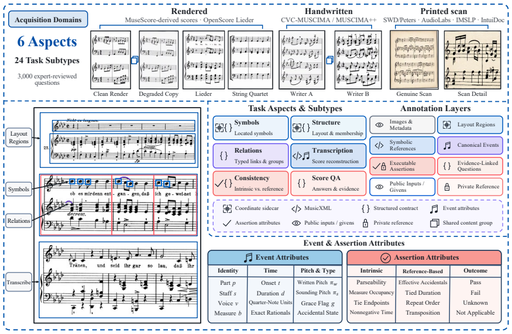
Figure 1 .Six aspects of musical score reading for vision-language models.The evaluation comprises 3,000 questions, with 1,000 each from Rendered, Printed scan and Handwritten inputs and 125 per subtype. The tasks connect visible symbols to structure, relations, transcription, musical consistency and evidence-linked answers. Event and assertion attributes describe reference annotations.
원문 · CC BY 4.0 · Dai, Congren, Guo, Zhancheng, Zhao, Danni, Wang, Wenchu, Li, Xiaobing, Sun, Maosong · OmniScore-Bench: Evaluating Vision-Language Models on Musical Score Reading · 원문 그림 인용 · 원본 PDF 2쪽에서 그림 영역을 추출했습니다.참조 답변 검토와 범위 고정
질문은 이미지와 주석의 대응에서 출발하며, 기호와 배치 주석은 기하 질문을, 기호 인코딩은 음높이·길이·구조 참조를 뒷받침합니다. 자동 검사로 답이 잘 정의되었는지와 이미지 범위와 참조 범위가 같은지 확인합니다. 두 명의 도메인 전문가가 3,000개 질문을 독립적으로 검토했고 초기 일치도는 92.50%였습니다. 불일치는 세 번째 전문가가 판정했습니다.
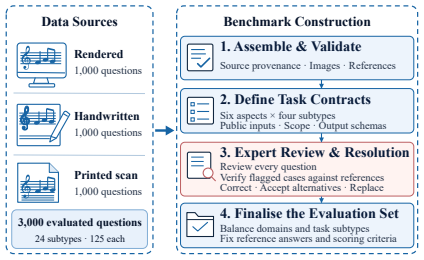
Figure 2 .References are bound to visible task scope.Sources and annotations define candidate questions; automatic checks and source-based resolution of flagged cases precede the final evaluation set. The evaluation uses one question per request.
원문 · CC BY 4.0 · Dai, Congren, Guo, Zhancheng, Zhao, Danni, Wang, Wenchu, Li, Xiaobing, Sun, Maosong · OmniScore-Bench: Evaluating Vision-Language Models on Musical Score Reading · 원문 그림 인용 · 원본 PDF 3쪽에서 그림 영역을 추출했습니다.동일 조건의 모델 답변과 집계 방식
열두 개 VLM에 모든 질문을 같은 입력과 지시문으로 독립적으로 제시했습니다. 엄격한 평가기는 JSON 또는 MusicXML 계약을 적용하며, 잘림·거절·형식 오류는 출력 실패로 셉니다. 비전사 지표는 질문을 출처 내용 그룹 안에서 평균한 뒤 그룹 사이에서 동등하게 평균합니다. 전사 지표는 말뭉치 비율로 계산하며, 값이 낮을수록 좋습니다.
연산마다 달라지는 모델 프로파일
시각 사실 추출은 여러 모델에서 음높이 해석보다 강했습니다. Opus는 T6.1 joint success 99.0%를 기록했지만 T5.2 exact answer는 56.0%였습니다. 위치 파악에서는 Sol과 Astra가 T1.1 F1 91.0%와 89.8%를 기록했고 Opus는 7.9%였습니다. 반면 Opus는 관계의 연결 정확도가 다른 과제에서 더 높았습니다. 전사에서도 단일 페이지 T4.3의 최저 NED는 도메인에 따라 다른 모델에서 나타났습니다.
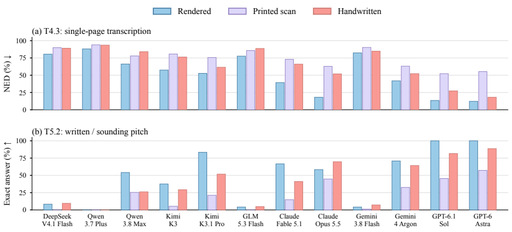
Figure 4 .Model profiles vary across domains.Each panel evaluates the same task across three domains for all twelve VLMs. T4.3 uses corpus NED (lower is better); T5.2 uses group-macro exact answer (higher is better). Model order stays fixed across panels.
원문 · CC BY 4.0 · Dai, Congren, Guo, Zhancheng, Zhao, Danni, Wang, Wenchu, Li, Xiaobing, Sun, Maosong · OmniScore-Bench: Evaluating Vision-Language Models on Musical Score Reading · 원문 그림 인용 · 원본 PDF 7쪽에서 그림 영역을 추출했습니다.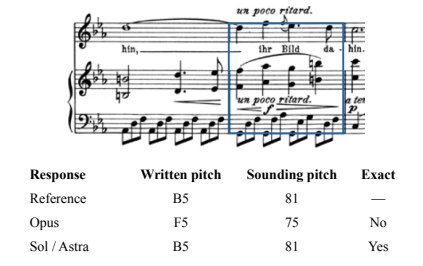
Figure 5 .A valid format can contain a musical error.T5.2 asks for the highest written pitch on the upper piano staff in the marked measure, with sounding pitch defined as written pitch minus two semitones (C4=60). The crop shows part of the fifth input page; the models receive all five pages. The blue outline reproduces the public measure scope.
원문 · CC BY 4.0 · Dai, Congren, Guo, Zhancheng, Zhao, Danni, Wang, Wenchu, Li, Xiaobing, Sun, Maosong · OmniScore-Bench: Evaluating Vision-Language Models on Musical Score Reading · 원문 그림 인용 · 원본 PDF 8쪽에서 그림 영역을 추출했습니다.다중 페이지 전사 순위의 역전
단일 페이지까지는 Astra가 T4.1, T4.2, T4.3에서 가장 낮은 corpus NED를 기록했지만, 다중 페이지 T4.4에서는 Opus가 39.9를 기록해 Astra의 50.6보다 낮았습니다. 이 역전은 균등 질문 가중과 균등 그룹 가중에서도 유지되었습니다. 다만 두 모델이 모두 유효한 80개 질문만 보면 NED는 33.3과 34.6으로 차이가 줄어듭니다. 저자들은 이 순서가 페이지 수만으로 생겼다고 보지 않으며, 출처 내용의 차이도 함께 고려해야 한다고 봅니다.
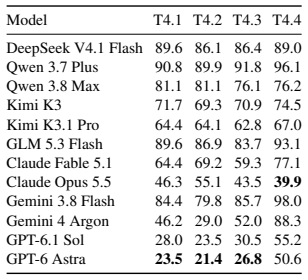
Table 5 .Transcription rankings depend on scope.Corpus NED multiplied by 100, lower is better; bold marks the best complete- population value. Every model/subtype NED aggregate covers all 125 questions. Corpus ratios combine edit counts and symbol counts across the subtype. All five metrics appear in SM Table S9.
원문 · CC BY 4.0 · Dai, Congren, Guo, Zhancheng, Zhao, Danni, Wang, Wenchu, Li, Xiaobing, Sun, Maosong · OmniScore-Bench: Evaluating Vision-Language Models on Musical Score Reading · 원문 그림 인용 · 원본 PDF 8쪽에서 그림 영역을 추출했습니다.이미지 제거가 드러내는 시각 의존성
이미지 제거 실험은 Sol과 DeepSeek Flash를 같은 270개 질문 부분집합에서 비교합니다. 텍스트, 좌표, 주어진 정보, 출력 스키마는 그대로 두고 악보 이미지만 제거했습니다. Sol의 쓰기·울림 음높이 점수는 83.3%에서 0으로 떨어졌고, 반복 순회는 92.0%에서 0으로 떨어졌습니다. 다만 여러 점수가 이미 낮아서 작은 차이는 진단력이 제한됩니다. 구조 소속과 조각 변환은 제거 후에도 각각 53.3%와 60.0%가 남아, 공개 텍스트와 좌표, 모델의 사전 지식이 일부 답을 지지한다는 점을 보여 줍니다.
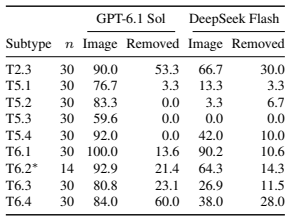
Table 4 .Score-image removal has task-dependent effects.Strict group-macro percentages on identical selected questions; higher is better. Image retains all inputs; Removed omits every image part. Metrics follow Table 2. ∗T6.2 shows retrieval; the 16 counting questions and all paired intervals appear in SM Table S15.
원문 · CC BY 4.0 · Dai, Congren, Guo, Zhancheng, Zhao, Danni, Wang, Wenchu, Li, Xiaobing, Sun, Maosong · OmniScore-Bench: Evaluating Vision-Language Models on Musical Score Reading · 원문 그림 인용 · 원본 PDF 7쪽에서 그림 영역을 추출했습니다.보조 입력과 페이지 맥락의 통제 실험
보조 입력 실험은 이미지를 유지하고 특정 보조 필드 하나만 제거합니다. Sol은 T5.2에서 95.0%를 유지했고, DeepSeek은 15.0%에서 5.0%로 떨어졌습니다. 페이지 맥락 실험은 대상 발췌와 참조 XML을 고정하고 같은 출처의 페이지를 덧붙입니다. Opus의 corpus NED는 T4.1에서 6.3포인트, T4.2에서 3.4포인트 올랐고, Astra는 0.6포인트와 8.6포인트 내렸습니다. 모든 쌍 신뢰구간은 0을 포함하므로 방향을 확정하기 어렵습니다.
집계 가정과 미완성 지표의 한계
그룹은 출처 식별자에 따른 집계 단위이며 검증된 서로 다른 작품 구성으로 간주되지 않습니다. T4.4 TEDn은 모든 모델에서 커버리지가 불완전해서 완전한 열두 모델 순위를 만들 수 없습니다. 또한 형식 준수가 점수를 크게 좌우합니다. Qwen 3.7 Plus는 엄격 기준에서 341개만 채점되었지만 외곽 코드 펜스를 제거하면 2,824개가 채점되었습니다. 따라서 엄격 점수만으로 모델의 악보 이해 능력을 단정하기 어렵습니다.
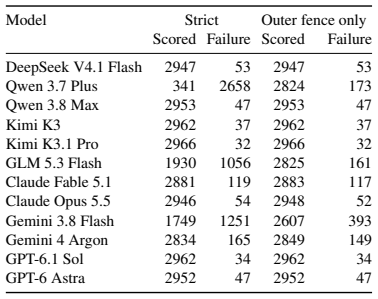
Table 6 .Removing a code fence changes scoreability.Counts out of 3,000, not correct-answer counts. “Scored” denotes task- level scoreability; “Failure” denotes model-output failure. The remaining items have partially unresolved metrics. SM Tables S9 and S10 report native metric availability.
원문 · CC BY 4.0 · Dai, Congren, Guo, Zhancheng, Zhao, Danni, Wang, Wenchu, Li, Xiaobing, Sun, Maosong · OmniScore-Bench: Evaluating Vision-Language Models on Musical Score Reading · 원문 그림 인용 · 원본 PDF 8쪽에서 그림 영역을 추출했습니다.논문 정보
- 저자
- Dai, Congren, Guo, Zhancheng, Zhao, Danni, Wang, Wenchu, Li, Xiaobing, Sun, Maosong
- 학회·저널
- arXiv · 프리프린트
- 최초 공개일
- 2026년 11월 13일
- 등록일
- 2026년 11월 16일
- 수정일
- 2026년 11월 13일
- 버전
- v1
- arXiv
- 2611.17870
- 분류
- cs.AI
- 원문 이용 조건
- CC BY 4.0
- 제공 범위
- 논문 정보, 해설, 허용된 원문 그림
AI 해설은 논문 원문과 별개의 설명이며 오류가 있을 수 있습니다. 원문과 그림은 각 출처의 이용 조건과 따로 표시된 권리를 따릅니다.
초록
Vision-language models (VLMs) can answer questions about musical scores, but their ability to recognise notation, recover its structure and interpret its musical meaning requires separate evaluation. Existing optical music recognition (OMR) resources establish detection and transcription measurements; a transcription score alone leaves the strengths and bottlenecks of a VLM score reader unresolved. We introduce OmniScore-Bench, an evaluation of OMR capabilities in VLMs through 3,000 questions spanning six aspects and 24 task subtypes. Each question specifies a visible scope, reference annotations and an answer schema, enabling automatic evaluation from symbol localisation to musical consistency and evidence-linked question answering. Our assessment of twelve VLMs reveals operation-specific capability profiles and different transcription leaders across excerpt, single-page and multipage tasks. Controlled analyses examine the roles of score images, auxiliary givens and additional page context. On the tested subset, image removal exposes visual dependence in pitch and repeat interpretation while measuring how much performance remains with public context alone. Separate format and content analyses distinguish answer-format violations from musical errors. OmniScore-Bench supports diagnosing which score-reading operations VLMs perform reliably and which require improvement.
원문 인용
Dai, Congren, Guo, Zhancheng, Zhao, Danni, Wang, Wenchu, Li, Xiaobing, Sun, Maosong (2026). OmniScore-Bench: Evaluating Vision-Language Models on Musical Score Reading. arXiv:2611.17870v1. https://arxiv.org/abs/2611.17870v1
BibTeX
@misc{congren2026omniscore,
  title = {{OmniScore-Bench: Evaluating Vision-Language Models on Musical Score Reading}},
  author = {Dai, Congren and Guo, Zhancheng and Zhao, Danni and Wang, Wenchu and Li, Xiaobing and Sun, Maosong},
  year = {2026},
  eprint = {2611.17870},
  archivePrefix = {arXiv},
  url = {https://arxiv.org/abs/2611.17870v1}
}