논문 해설
A trust layer for fast pedestal-stability surrogates: calibrated error bars, out-of-distribution alarms and few-shot recalibration
빠른 페데스탈 안정성 대리 모델을 위한 신뢰 계층: 보정된 오차 막대, 분포 외 경보 및 소수 샷 재보정
- 연구 문제 점 추정만 내놓는 성장률 대리모델은 오차 범위와 분포 밖 입력을 알려 주지 않아 설계 결정에 쓰기 어렵습니다.
- 연구 방법 기존 대리모델을 감싸는 trust layer로 split conformal 구간, 앙상블 산포와 Mahalanobis 거리 기반 경고, 소수 사례 재보정을 결합합니다.
- 주요 결과 KARHU 분포 내 커버리지는 89.9%이고 강한 형상 이동에서는 85.3%로 떨어지며, BOUT++ 보류 실행에서는 92.3%의 커버리지를 보였습니다.
대리모델이 답하지 못하는 질문
머신러닝 대리모델은 선형 peeling-ballooning 안정성의 성장률을 밀리초 단위로 계산하지만, 대부분 점 추정값만 내놓습니다. 그래서 예측이 얼마나 틀릴 수 있는지, 그리고 입력이 학습 데이터와 얼마나 다른지를 사용자가 알기 어렵습니다. 이 문제는 새 장치를 설계하는 융합 기업에서 특히 중요합니다. 설계 중인 평형은 정의상 기존 대리모델의 학습 분포 밖에 있기 때문입니다. 저자들은 이 문제를 해결하는 층을 trust layer라고 부르며, 이를 기존 대리모델을 감싸는 독립적인 구성으로 다룹니다.
세 가지 구성요소와 보정 방식
trust layer는 대리모델의 예측 주변에 split conformal 구간을 만듭니다. 보정 데이터의 절대 잔차 점수에서 분위수를 골라 구간의 반폭을 정하며, 교환 가능한 새 사례에 대해 목표 수준의 커버리지를 보장하도록 설계되었습니다. 이 보장은 주변 분포 수준의 것이며, 개별 예측 하나에 대한 보장은 아닙니다. 둘째로 out-of-distribution (OOD) alarms는 K=5 딥 앙상블의 산포와 입력의 Mahalanobis distance를 사용하며, 임계값은 분포 내 보정 데이터만으로 정해집니다. 경고된 사례는 물리 코드로 보내고, 남은 사례의 커버리지를 평가합니다. 셋째로 새 설계의 소수 라벨 사례로 split conformal 보정을 다시 수행하는 few-shot 재보정이 있습니다.
공변량 이동이 있을 때에는 로지스틱 도메인 분류기로 추정한 가능도비로 보정 점수에 가중치를 주는 weighted conformal을 사용합니다.
KARHU 데이터셋에서의 커버리지와 경고 검증
주요 검증은 공개 KARHU 데이터셋에서 MLP 앙상블로 수행되었으며, 여러 가설은 결과 확인 전에 사전 등록되었습니다. 분포 내 평가에서 90% 목표에 대한 커버리지는 89.9%이고 반폭은 0.016입니다. 학습과 보정을 δ≤0.356으로 하고 나머지를 테스트한 강한 형상 이동에서는 기본 보정의 커버리지가 85.3%로 떨어집니다. 이 결과는 사전 등록된 기준인 85% 미만을 충족하지 못했습니다. 가중 보정을 적용하면 소프트 이동 시험에서 커버리지가 91.1%로 회복되지만, 강한 이동 시험에서는 가중치가 지원 중첩이 없어 무한 구간을 만드는 사례가 99.7%였습니다. 경고 지표의 AUROC는 앙상블 산포가 0.63, Mahalanobis distance가 0.73으로 나와 결과가 혼합되었습니다.
사전 등록되지 않은 분석에서는 산포가 실제로 틀린 사례를 0.86의 AUROC로 구분했지만, 시프트된 사례의 2%에서만 경고가 발생했습니다.
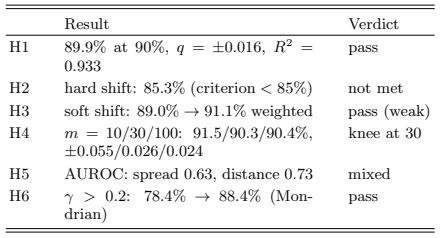
원문 그림 TABLE I. Pre-registered outcomes on KARHU (MLP ensem- ble).
원문 · CC BY 4.0 · Amin Vakhshouri · A trust layer for fast pedestal-stability surrogates: calibrated error bars, out-of-distribution alarms and few-shot recalibration · 원문 그림 인용 · 원본 PDF 2쪽에서 그림 영역을 추출했습니다.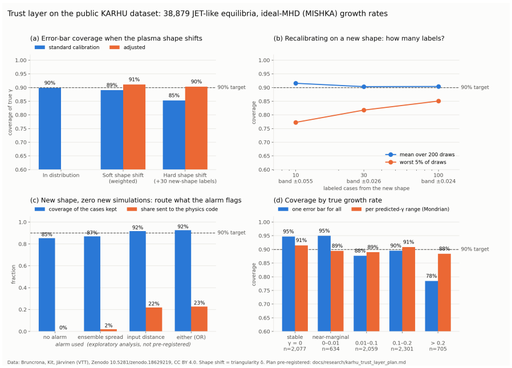
FIG. 1 . Trust layer on KARHU (MLP ensemble,K= 5). (a) Coverage in distribution and under a soft and a hard triangularity shift, with standard and adjusted calibration. (b) Few-shot recalibration on the new shape: mean and worst-5% coverage over 200 draws, and interval half-width. (c) Exploratory: coverage of the cases kept after routing what each alarm flags. (d) Coverage by true growth rate, one interval for all vs. per predicted-γrange.
원문 · CC BY 4.0 · Amin Vakhshouri · A trust layer for fast pedestal-stability surrogates: calibrated error bars, out-of-distribution alarms and few-shot recalibration · 원문 그림 인용 · 원본 PDF 3쪽에서 그림 영역을 추출했습니다.BOUT++ 대리모델과 시나리오 스캔
BOUT++ 실험은 저항성 MHD 성장률을 대상으로 하며, 학습 실행은 CBM18 평형에서 저항성 η와 점성 ν의 격자로 만든 50개 실행과 보류 실행 42개로 구성됩니다. 보류 실행에서 평균 절대 오차는 0.028이고, 분할 컨포멀 구간은 90% 목표에 대해 92.3%의 커버리지와 0.052에서 0.054 사이의 반폭을 보였습니다. 시나리오 스캔에서는 보류 운영점을 성장률 예산과 비교하여 구간 전체가 예산 아래면 수용하고 위면 거부하며, 나머지는 BOUT++로 보냅니다. 여러 예산에 걸쳐 확실한 결정 289개에는 오류가 없었고, 스캔 대상의 43%에서 98%가 BOUT++ 실행 없이 정해졌습니다. 스캔 자체는 약 2초가 걸렸고, BOUT++는 점당 중앙값 16.7분으로 직렬 실행하면 약 12시간이 필요했다고 보고됩니다.
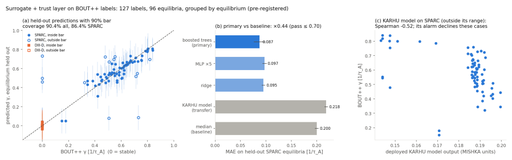
FIG. 5 . Surrogate and trust layer on BOUT++ labels, equilibria held out (pre-registered). Left: held-out predictions with the 90% CV+ interval. Centre: error on held-out SPARC equilibria by model. Right: the KARHU-trained surrogate’s output on the same SPARC cases, outside its range.
원문 · CC BY 4.0 · Amin Vakhshouri · A trust layer for fast pedestal-stability surrogates: calibrated error bars, out-of-distribution alarms and few-shot recalibration · 원문 그림 인용 · 원본 PDF 8쪽에서 그림 영역을 추출했습니다.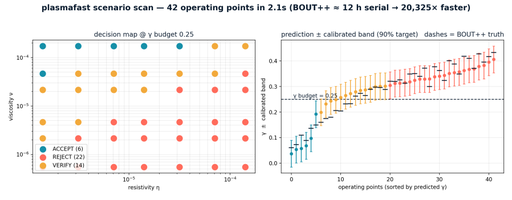
FIG. 6 . Scenario scan on 42 held-out BOUT++ operating points at a growth-rate budget of 0.25. Left: decision map in (η, ν). Right: prediction±calibrated interval, sorted by prediction, with BOUT++ values as dashes.
원문 · CC BY 4.0 · Amin Vakhshouri · A trust layer for fast pedestal-stability surrogates: calibrated error bars, out-of-distribution alarms and few-shot recalibration · 원문 그림 인용 · 원본 PDF 8쪽에서 그림 영역을 추출했습니다.적용 범위와 한계
커버리지 보장은 보정 데이터와 사용 데이터가 교환 가능하다는 가정에 의존합니다. 따라서 trust layer가 모든 개별 예측을 인증하지는 않으며, 물리 코드로의 라우팅이 설계의 일부로 남습니다. KARHU 검증은 하나의 평형 계열, 하나의 형상 이동 변수, 이상 MHD에 한정됩니다. BOUT++ 대리모델은 사실상 하나의 평형과 네 개의 실제 기계 사례로 학습되었으므로, 실제 기계에 대한 경고 결과는 여섯 개 평형에 근거합니다. 이 결과는 정확도 검증이 아니라 잘못된 확신을 피하는 능력에 관한 것입니다. 실험과 대조한 검증은 아직 수행되지 않았고, 그 다음 단계는 관측된 ELM 개시와의 비교로 제시되어 있습니다.
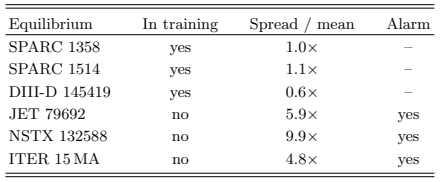
원문 그림 TABLE III. Ensemble-spread alarm on real equilibria (BOUT++ surrogate). Threshold: largest spread on 42 in- distribution held-out runs.
원문 · CC BY 4.0 · Amin Vakhshouri · A trust layer for fast pedestal-stability surrogates: calibrated error bars, out-of-distribution alarms and few-shot recalibration · 원문 그림 인용 · 원본 PDF 7쪽에서 그림 영역을 추출했습니다.논문 정보
- 저자
- Amin Vakhshouri
- 학회·저널
- arXiv · 프리프린트
- 최초 공개일
- 2026년 11월 4일
- 등록일
- 2026년 11월 6일
- 수정일
- 2026년 11월 4일
- 버전
- v1
- arXiv
- 2611.06597
- 분류
- cs.LG · physics.plasm-ph
- 원문 이용 조건
- CC BY 4.0
- 제공 범위
- 논문 정보, 해설, 허용된 원문 그림
AI 해설은 논문 원문과 별개의 설명이며 오류가 있을 수 있습니다. 원문과 그림은 각 출처의 이용 조건과 따로 표시된 권리를 따릅니다.
초록
Machine-learning surrogates of linear peeling-ballooning stability now run in milliseconds, but they are mostly deployed as point estimators: they do not say how wrong they may be, or when a query lies outside what they were trained on. For a fusion company designing a new device, every equilibrium of interest is outside the training data of existing surrogates, so this is the case that matters. We describe a model-agnostic trust layer for stability surrogates, made of conformal error bars, out-of-distribution alarms that route doubtful cases to the physics code, and recalibration from a few simulations of a new design, and we test it with pre-registered hypotheses. On a large public dataset of JET-like equilibria with ideal-MHD growth rates, the error bars hold their nominal coverage in distribution and fall short under a shift in plasma shape; a few dozen simulations of the new shape, or routing the cases the alarms flag, restore it. On resistive BOUT++ surrogates, the bars stay calibrated on held-out runs, the alarm flags tokamaks absent from training, and a scenario scan is screened in seconds instead of hours. Across equilibria from the SPARC library and the DIII-D coil set, a surrogate trained on our own graded BOUT++ labels beats the baseline on unseen equilibria, while a surrogate trained elsewhere ranks the same cases backwards and its alarm declines them. Building our own neural-operator surrogate, the harness exposed two input defects whose fix closed its gap to a simple network. For every surrogate tested, the trust layer keeps coverage near target, with a bar width set by that surrogate's own error. Not every pre-registered hypothesis held, and we report those results and the limits of all of them.
원문 인용
Amin Vakhshouri (2026). A trust layer for fast pedestal-stability surrogates: calibrated error bars, out-of-distribution alarms and few-shot recalibration. arXiv:2611.06597v1. https://arxiv.org/abs/2611.06597v1
BibTeX
@misc{vakhshouri2026trust,
  title = {{A trust layer for fast pedestal-stability surrogates: calibrated error bars, out-of-distribution alarms and few-shot recalibration}},
  author = {Amin Vakhshouri},
  year = {2026},
  eprint = {2611.06597},
  archivePrefix = {arXiv},
  url = {https://arxiv.org/abs/2611.06597v1}
}