논문 해설
RayMVSNet++: Learning Ray-based 1D Implicit Fields for Accurate Multi-View Stereo
RayMVSNet++: 정밀한 다중 시점 스테레오를 위한 광선 기반 1D 암묵적 필드 학습
- 연구 문제 기존 코스트 볼륨 기반 학습형 MVS는 3D 합성곱의 계산·메모리 비용 때문에 깊이 맵 해상도가 제한됩니다. 이 논문은 깊이를 카메라 광선마다 직접 최적화하는 접근으로 이 한계를 다룹니다.
- 연구 방법 RayMVSNet은 각 광선을 따라 SDF를 순차 예측하는 1D 암시적 필드를 LSTM으로 학습하고, Epipolar Transformer로 교차 뷰 매칭을 학습합니다. RayMVSNet++는 국소 프러스텀의 이웃 광선을 게이팅 유닛으로 선택해 문맥을 추가합니다.
- 주요 결과 DTU 점군 Overall은 RayMVSNet 0.330mm, RayMVSNet++ 0.328mm이며, Tanks & Temples F-score는 RayMVSNet 59.48%입니다. ScanNet에서 RayMVSNet++는 AbsRel 0.058을 보고하며 어려운 영역 부분 집합에서도 기준선을 앞섭니다.
풀고자 하는 문제: 코스트 볼륨 기반 MVS의 해상도 한계
다중 뷰 스테레오(MVS)의 학습 기반 방법은 대개 3D 코스트 볼륨 위의 3D 합성곱에 의존합니다. 원문은 3D CNN의 계산량과 메모리 소비가 크기 때문에 출력 깊이의 해상도가 크게 제한된다고 설명합니다. 기존 개선 방법은 코스트 볼륨을 업샘플링하거나 정제하지만, 깊이 해상도와 공간(영상) 해상도 사이에서 절충이 필요하다고 봅니다.
이 논문은 목표가 깊이 맵이라는 점에 주목하여, 코스트 볼륨 전체를 다듬는 대신 각 카메라 광선을 따라 깊이 값을 직접 최적화합니다. 깊이 맵은 시점에 의존하는 반면 코스트 볼륨은 그렇지 않으며, 코스트 볼륨의 많은 부분은 기준 시점에서 보이지 않는다는 것이 저자들의 논지입니다.
광선 기반 1D 암시적 필드와 에피폴라 트랜스포머
RayMVSNet은 각 카메라 광선 위에서 부호 있는 거리(SDF)가 0을 가로지르는 지점을 장면 깊이로 보는 1D 암시적 필드를 순차적으로 예측합니다. 참조 뷰의 광선마다 원천 뷰의 픽셀 단위 2D 특징 사이의 교차 뷰 매칭을 Epipolar Transformer가 어텐션으로 학습하며, 이는 전통 MVS의 에피폴라 선 탐색을 학습으로 모사한 것입니다.
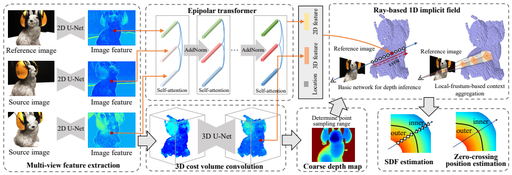
Fig. 2 : Method overview. Given multiple overlapping RGB images, the multi-view image features are extracted by a 2D U-Net. The coarse depth map is then estimated by a coarse 3D cost volume. 2D multi-view image features are then correlated and aggregated by epipolar transformer. At last, the ray-based 1D implicit field, which includes a local-frustum-based context aggregation module, is learnt on each camera viewing ray to simultaneously estimate the SDF of the sampled points and the location of the zero-crossing point.
원문 · CC BY 4.0 · Yifei Shi, Junhua Xi, Dewen Hu, Zhiping Cai, Kai Xu · RayMVSNet++: Learning Ray-based 1D Implicit Fields for Accurate Multi-View Stereo · 원문 그림 인용 · 원본 PDF 4쪽에서 그림 영역을 추출했습니다.Epipolar Transformer는 광선 위 샘플 점에서 원천 뷰 특징을 가져와 Softmax(QK^T)V 형태의 자기 어텐션으로 결합하고, 그 결과를 평균·분산 및 3D 볼륨 특징과 이어 붙입니다. 이후 LSTM이 샘플 점들을 깊이 순서대로 처리하여 광선 특징을 만들고, MLP가 정규화된 깊이와 정규화된 SDF를 예측합니다. 정규화된 SDF는 광선 위 최대 절댓값으로 나눈 값이며 [−1, 1] 범위로 제한됩니다. 별도의 MLP는 광선 위 0 교차점 위치를 회귀합니다.
저자들은 LSTM을 택한 이유로 순차 처리가 광선을 따라 SDF의 단조성을 학습하기 쉽게 하고, 시간 불변성이 0 교차점이 광선의 어느 위치에든 나타날 수 있게 한다고 설명합니다. 트랜스포머로 대체한 실험은 성능 향상을 보이지 않았다고 원문에 보고됩니다.
다중 작업 손실과 샘플링 범위
방법은 코스트 볼륨의 coarse 깊이 추정으로 광선마다 샘플 범위를 정합니다. 참조 뷰 광선 위에서 coarse 깊이 주변 ±δ 범위에 K개의 점을 균일하게 샘플링합니다. 원문은 이 범위를 고정 길이로 두어 광선 위 모델링을 제한하는 것이 학습 복잡도를 줄인다고 설명합니다.
학습 손실은 SDF 추정 손실 L_s, 0 교차점 위치 추정 손실 L_l, 두 예측의 불일치를 벌점으로 주는 관계 손실 L_sl을 가중합 L = w_s L_s + w_l L_l + w_sl L_sl로 결합합니다. 원문 구현에서 가중치는 0.1, 0.8, 0.1로 주어집니다. 관계 손실 L_sl은 예측 0 교차점 주변 두 샘플의 SDF 곱이 0보다 크면 1, 아니면 0을 취하는 형태로 정의됩니다.
RayMVSNet++의 국소 프러스텀 문맥 집계
RayMVSNet은 광선별 추론이므로 이웃 광선 사이의 상호작용을 반영하지 못하는 한계가 있습니다. RayMVSNet++는 각 광선 주변 국소 프러스텀에서 의미적으로 관련된 이웃 광선을 선택해 문맥을 더 집계합니다. 중심 픽셀 특징과 이웃 픽셀 특징의 차이를 입력으로 하는 게이팅 유닛 G가 이웃별 소프트 결정 G_s를 출력하고, Gumbel-Softmax 모듈 H가 순전파에서 이진 마스크를 만들며 역전파에서는 소프트 결정을 유지합니다.
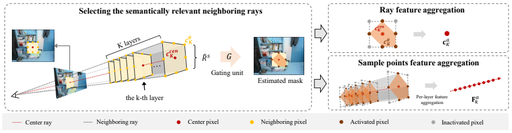
Fig. 6 : Attentional gating unit for the local-frustum-based context aggregation. For each camera rays of the reference image, the method estimates a mask that denotes the semantically relevant neighbouring rays. Based on the mask, ray feature and sample points feature, with more contextual information, are aggregated respectively.
원문 · CC BY 4.0 · Yifei Shi, Junhua Xi, Dewen Hu, Zhiping Cai, Kai Xu · RayMVSNet++: Learning Ray-based 1D Implicit Fields for Accurate Multi-View Stereo · 원문 그림 인용 · 원본 PDF 6쪽에서 그림 영역을 추출했습니다.선택된 마스크에 따라 광선 특징은 활성화된 위치의 평균을 중심 특징에 더해 갱신되고, 샘플 점 특징도 같은 마스크로 k번째 층에서 갱신됩니다. 갱신된 특징으로 SDF 예측과 0 교차점 위치를 계산합니다. 원문은 게이팅 유닛이 의미 감독 없이도 중심 픽셀과 같은 객체의 픽셀을 주로 고른다고 관찰하지만, 이를 명시적 의미 분할로 보증하지는 않습니다.
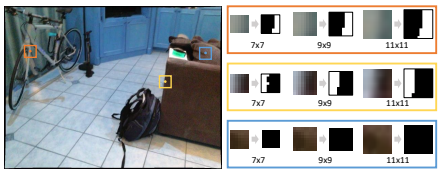
Fig. 20 : The effectiveness of the gating unit in the local-frustum- based context aggregation. We see the gating unit is able to successfully select the semantically relevant pixels with different width of the receptive field.
원문 · CC BY 4.0 · Yifei Shi, Junhua Xi, Dewen Hu, Zhiping Cai, Kai Xu · RayMVSNet++: Learning Ray-based 1D Implicit Fields for Accurate Multi-View Stereo · 원문 그림 인용 · 원본 PDF 13쪽에서 그림 영역을 추출했습니다.DTU 재구성 평가
DTU에서 RayMVSNet은 정확도·완전성 기준으로 Overall 0.330mm를 보고합니다. RayMVSNet++의 Overall은 0.328mm로 표에 제시됩니다. 이 비교는 점군 재구성 지표이며, 두 방법 모두 기존 학습 기반 방법과 비교해 가장 낮은 Overall 값을 보고합니다.
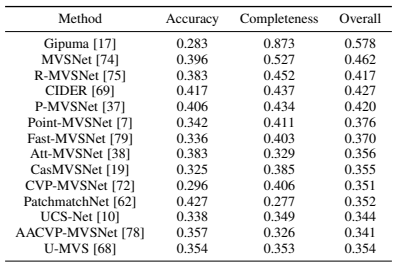
TABLE 2 : Quantitative results on the DTU dataset. We compare all methods using the distance metric [1]. The numbers are reported in mm (lower is better).
원문 · CC BY 4.0 · Yifei Shi, Junhua Xi, Dewen Hu, Zhiping Cai, Kai Xu · RayMVSNet++: Learning Ray-based 1D Implicit Fields for Accurate Multi-View Stereo · 원문 그림 인용 · 원본 PDF 8쪽에서 그림 영역을 추출했습니다.원문은 DTU 학습 세트와 22개 테스트 장면, 그리고 Specular reflection, Shadow, Occlusion 세 부분 집합을 설명합니다. 깊이 추정 평가에서 저자들은 Percentage@x 곡선으로 전체 테스트 세트와 도전적 부분 집합에서 RayMVSNet이 모든 기준선보다 높은 비율을 보인다고 보고합니다.
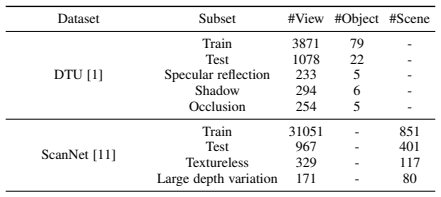
TABLE 1 : Statistics of the experimental datasets.
원문 · CC BY 4.0 · Yifei Shi, Junhua Xi, Dewen Hu, Zhiping Cai, Kai Xu · RayMVSNet++: Learning Ray-based 1D Implicit Fields for Accurate Multi-View Stereo · 원문 그림 인용 · 원본 PDF 8쪽에서 그림 영역을 추출했습니다.Tanks & Temples 일반화 평가와 한계
Tanks & Temples에서는 DTU로 학습한 모델을 미세조정 없이 적용하여 F-score를 측정합니다. 평균 F-score는 RayMVSNet이 59.48, RayMVSNet++가 58.47로 보고됩니다. 원문은 RayMVSNet++가 일부 장면에서 RayMVSNet을 앞서지만 평균은 비슷한 수준이라고 설명합니다. 저자들은 이 데이터의 대부분 이미지가 충분하고 안정적인 조명에서 촬영되어 RayMVSNet으로 충분히 처리된다고 해석합니다. 같은 표에서 D2HC-RMVSNet은 Horse와 Light house 같은 평면이 큰 장면에서 RayMVSNet++보다 높은 값을 보입니다.
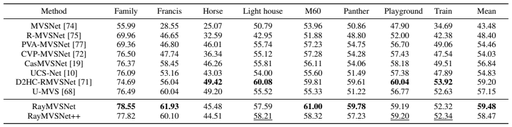
TABLE 3 : Quantitative results on the Tanks & temples dataset. We use the F-score as the evaluation metric (higher is better).
원문 · CC BY 4.0 · Yifei Shi, Junhua Xi, Dewen Hu, Zhiping Cai, Kai Xu · RayMVSNet++: Learning Ray-based 1D Implicit Fields for Accurate Multi-View Stereo · 원문 그림 인용 · 원본 PDF 9쪽에서 그림 영역을 추출했습니다.ScanNet 깊이·재구성과 어려운 영역
ScanNet에서 RayMVSNet++는 AbsRel 0.058을 달성하며, 표 4의 모든 지표에서 비교 방법보다 좋은 값을 보입니다. 이 실험에서 국소 프러스텀의 receptive field 폭 t는 9로 설정되었습니다. 원문은 ScanNet 이미지에 모션 블러와 낮은 조명이 있어 문맥 집계의 필요성을 보여준다고 설명합니다.
Textureless와 Large depth variation 부분 집합에서 Percentage@x 곡선으로 평가하면 RayMVSNet++는 모든 임계값에서 기준선을 앞섭니다. 점군 재구성 Overall은 RayMVSNet++가 0.083m입니다. 이 값은 ScanNet 테스트에서 자체 측정된 결과이며 다른 데이터셋의 점수와 같은 조건으로 묶지 않습니다.
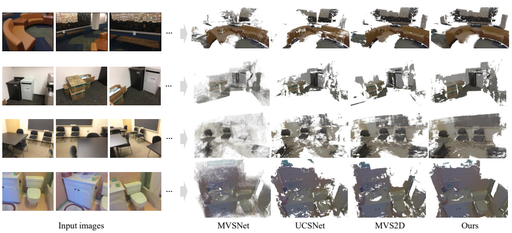
Fig. 12 : Visual comparisons on the reconstructed point cloud on theScanNet dataset [11]. RayMVSNet++ achieves better reconstruction results in terms of both accuracy and completeness, thanks to the local-frustum-based context aggregation which introduces more context to tolerate the imperfectness of the input images.
원문 · CC BY 4.0 · Yifei Shi, Junhua Xi, Dewen Hu, Zhiping Cai, Kai Xu · RayMVSNet++: Learning Ray-based 1D Implicit Fields for Accurate Multi-View Stereo · 원문 그림 인용 · 원본 PDF 10쪽에서 그림 영역을 추출했습니다.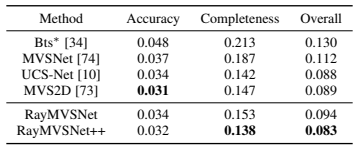
TABLE 6 : Quantitative results on theScanNet dataset. We evaluate the reconstructed point cloud using the distance metric [1]. The numbers are reported in m (lower is better).
원문 · CC BY 4.0 · Yifei Shi, Junhua Xi, Dewen Hu, Zhiping Cai, Kai Xu · RayMVSNet++: Learning Ray-based 1D Implicit Fields for Accurate Multi-View Stereo · 원문 그림 인용 · 원본 PDF 10쪽에서 그림 영역을 추출했습니다.절제 실험이 보여 주는 구성요소의 역할
RayMVSNet의 DTU 절제에서 w/o epipolar transformer는 Overall 0.343, w/o 3D volume feature는 0.378, w/o ray-based inference는 0.608로 보고되며, 원래 RayMVSNet의 Overall 0.330보다 모두 높습니다. 저자들은 광선 기반 추론을 제거하고 3D 참조 프러스텀에서 SDF를 직접 예측하는 기준선이 수렴이 어렵고 성능이 낮다고 보고합니다. 이 결과는 해당 제거 실험에서 광선 기반 추론을 유지하는 것이 유리했다는 뜻으로 읽어야 합니다.
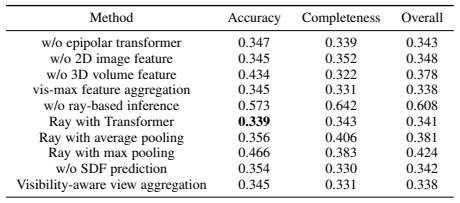
TABLE 7 : Ablation studies of RayMVSNet. The performance under distance metric is reported (lower is better).
원문 · CC BY 4.0 · Yifei Shi, Junhua Xi, Dewen Hu, Zhiping Cai, Kai Xu · RayMVSNet++: Learning Ray-based 1D Implicit Fields for Accurate Multi-View Stereo · 원문 그림 인용 · 원본 PDF 11쪽에서 그림 영역을 추출했습니다.RayMVSNet++의 ScanNet 절제에서는 w/o frustum이 RMSE 0.211, w/o gating unit이 0.193, w/o Gumbel-Softmax가 0.176, 전체 모델이 0.158입니다. 원문은 Gumbel-Softmax를 제거하면 RMSE와 p@0.2가 특히 악화된다고 보고합니다.
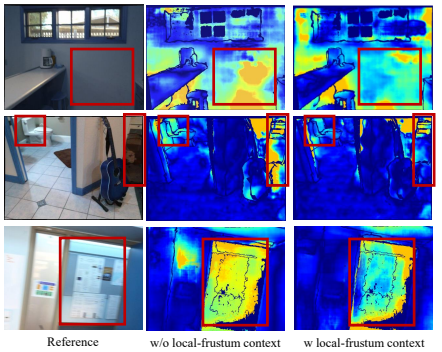
Fig. 8 : Visual comparison of depth estimation with and without the local-frustum-based context aggregation. Please pay attention to the results of the challenging areas highlighted in the figure.
원문 · CC BY 4.0 · Yifei Shi, Junhua Xi, Dewen Hu, Zhiping Cai, Kai Xu · RayMVSNet++: Learning Ray-based 1D Implicit Fields for Accurate Multi-View Stereo · 원문 그림 인용 · 원본 PDF 7쪽에서 그림 영역을 추출했습니다.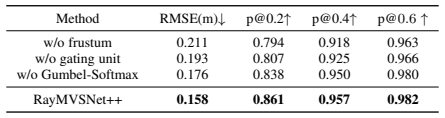
TABLE 8 : Ablation studies of RayMVSNet++. p@x represents Percentage@x.
원문 · CC BY 4.0 · Yifei Shi, Junhua Xi, Dewen Hu, Zhiping Cai, Kai Xu · RayMVSNet++: Learning Ray-based 1D Implicit Fields for Accurate Multi-View Stereo · 원문 그림 인용 · 원본 PDF 11쪽에서 그림 영역을 추출했습니다.한계와 적용 범위
저자들은 coarse 깊이의 품질이 낮아 일부 도전적 영역에서는 깊이를 정확히 추정하기 어렵다고 밝힙니다. 또한 방법은 주어진 정확한 카메라 자세에 의존하며, 카메라 자세와 3D 점을 동시에 최적화하지 않으므로 자세가 부정확한 장면에서는 정확한 출력을 내기 어렵다고 설명합니다.
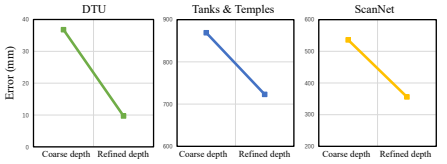
Fig. 21 : The errors in depth estimation on the rays whose ground- truth depth is outside the enlarged searching region. We see that ray-based inference is able to improve the accuracy, demonstrating its ability to handle inaccurate coarse depth estimation.
원문 · CC BY 4.0 · Yifei Shi, Junhua Xi, Dewen Hu, Zhiping Cai, Kai Xu · RayMVSNet++: Learning Ray-based 1D Implicit Fields for Accurate Multi-View Stereo · 원문 그림 인용 · 원본 PDF 13쪽에서 그림 영역을 추출했습니다.원문은 coarse 깊이 민감도 실험에서 Gaussian 노이즈 표준편차 0.4mm 이하의 중간 수준 교란에는 모델이 강건하다고 보고합니다. 그러나 이는 DTU에서의 결과이며, 다른 데이터셋이나 모든 노이즈 수준으로 일반화된 결론은 아닙니다.
논문 정보
- 저자
- Yifei Shi, Junhua Xi, Dewen Hu, Zhiping Cai, Kai Xu
- 학회·저널
- arXiv · 프리프린트
- 최초 공개일
- 2023년 7월 16일
- 등록일
- 2026년 11월 6일
- 수정일
- 2023년 7월 16일
- 버전
- v1
- arXiv
- 2307.10233
- 분류
- cs.CV
- 원문 이용 조건
- CC BY 4.0
- 제공 범위
- 논문 정보, 해설, 허용된 원문 그림
AI 해설은 논문 원문과 별개의 설명이며 오류가 있을 수 있습니다. 원문과 그림은 각 출처의 이용 조건과 따로 표시된 권리를 따릅니다.
초록
Learning-based multi-view stereo (MVS) has by far centered around 3D convolution on cost volumes. Due to the high computation and memory consumption of 3D CNN, the resolution of output depth is often considerably limited. Different from most existing works dedicated to adaptive refinement of cost volumes, we opt to directly optimize the depth value along each camera ray, mimicking the range finding of a laser scanner. This reduces the MVS problem to ray-based depth optimization which is much more light-weight than full cost volume optimization. In particular, we propose RayMVSNet which learns sequential prediction of a 1D implicit field along each camera ray with the zero-crossing point indicating scene depth. This sequential modeling, conducted based on transformer features, essentially learns the epipolar line search in traditional multi-view stereo. We devise a multi-task learning for better optimization convergence and depth accuracy. We found the monotonicity property of the SDFs along each ray greatly benefits the depth estimation. Our method ranks top on both the DTU and the Tanks & Temples datasets over all previous learning-based methods, achieving an overall reconstruction score of 0.33mm on DTU and an F-score of 59.48% on Tanks & Temples. It is able to produce high-quality depth estimation and point cloud reconstruction in challenging scenarios such as objects/scenes with non-textured surface, severe occlusion, and highly varying depth range. Further, we propose RayMVSNet++ to enhance contextual feature aggregation for each ray through designing an attentional gating unit to select semantically relevant neighboring rays within the local frustum around that ray. RayMVSNet++ achieves state-of-the-art performance on the ScanNet dataset. In particular, it attains an AbsRel of 0.058m and produces accurate results on the two subsets of textureless regions and large depth variation.
원문 인용
Yifei Shi, Junhua Xi, Dewen Hu, Zhiping Cai, Kai Xu (2023). RayMVSNet++: Learning Ray-based 1D Implicit Fields for Accurate Multi-View Stereo. arXiv:2307.10233v1. https://arxiv.org/abs/2307.10233v1
BibTeX
@misc{shi2023raymvsnet,
  title = {{RayMVSNet++: Learning Ray-based 1D Implicit Fields for Accurate Multi-View Stereo}},
  author = {Yifei Shi and Junhua Xi and Dewen Hu and Zhiping Cai and Kai Xu},
  year = {2023},
  eprint = {2307.10233},
  archivePrefix = {arXiv},
  url = {https://arxiv.org/abs/2307.10233v1}
}