논문 해설
Towards Explainable Traffic Flow Prediction with Large Language Models
대규모 언어 모델을 활용한 설명 가능한 교통 흐름 예측을 향하여
- 연구 문제 교통 흐름 예측 모델은 정확도를 높이기 위해 복잡해지기 쉽고, 예측 근거를 설명하기 어렵습니다.
- 연구 방법 교통량, 공간 속성, 기상·휴일 정보를 텍스트 프롬프트로 바꾼 뒤 Llama2-7B-chat을 LoRA로 미세 조정하여 예측과 설명을 함께 생성합니다.
- 주요 결과 CATraffic 평균 성능에서 xTP-LLM은 GWNET 대비 MAE가 18.37% 낮았고, zero-shot MAE는 GPT-4보다 낮게 보고되었습니다.
교통 흐름 예측의 설명 가능성 문제
교통 흐름 예측은 교통 관리와 경로 계획의 기초가 되지만, 최근의 딥러닝 모델은 구조가 복잡하고 입력에서 예측으로 이어지는 대응을 직관적으로 이해하기 어렵습니다. 원문은 정확도와 설명 가능성을 함께 확보하기 어렵다는 점을 이 연구의 출발점으로 제시합니다. 이 논문은 이 문제를 LLM이 다중 모달 교통 데이터를 자연어 프롬프트로 읽고 예측값과 설명을 함께 생성하는 방식으로 다룹니다. 다만 설명의 품질과 예측 정확도는 아래에서 확인하는 실험 조건 안에서만 평가됩니다.
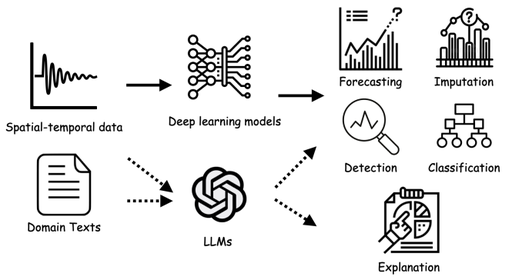
FIGURE 1 : Spatial-temporal learning formats for deep learning models and LLMs: Compared with well-developed deep learning models, LLMs for spatial-temporal learning advance in adapt- ing domain knowledge with urban multi-modal data and generate reasonable explanations.
원문 · CC BY 4.0 · Xusen Guo, Qiming Zhang, Junyue Jiang, Mingxing Peng, Meixin Zhu, Hao, Yang · Towards Explainable Traffic Flow Prediction with Large Language Models · 원문 그림 인용 · 원본 PDF 4쪽에서 그림 영역을 추출했습니다.텍스트 프롬프트와 LoRA fine-tuning
xTP-LLM은 교통량, PoI 기반 공간 속성, 날짜·휴일·기상 정보를 자연어 텍스트 프롬프트로 변환합니다. 프롬프트에는 시스템 프롬프트와 공간-시간 CoT 질문이 포함되며, 과거 12시간 교통량을 시간대별 수치로 제시합니다. 모델은 Llama2-7B-chat을 기반으로 하며 LoRA로 미세 조정합니다. LoRA는 원래 가중치 W0를 유지하고 저랭크 행렬 곱 ΔW=B×A로 갱신량을 근사하는 방식입니다. fine-tuning 목적함수는 다음 토큰 생성의 음의 로그 가능도 합으로 정의되며, 예측값 토큰만 손실 계산에 사용됩니다.
설명 생성에서는 예측과 설명의 정합성이 부족하다는 문제를 확인한 뒤, 2-3개의 정렬된 예시를 추론 시 입력 프롬프트에 포함하는 few-shot 방식을 사용합니다. 이 예시는 ChatGPT로 생성한 것으로 원문에 기록되어 있습니다.
CATraffic 구성과 비교 실험
실험은 캘리포니아 LargeST 데이터에서 선별한 1000개 센서로 구성된 CATraffic 데이터셋에서 수행되었습니다. 2018년 데이터는 학습에, 2019년 데이터는 검증에 사용되었고, 과거 12시간 교통 흐름으로 향후 12시간을 예측합니다. 평가 지표는 RMSE, MAE, MAPE이며, 기준선 9개와 비교되었습니다.
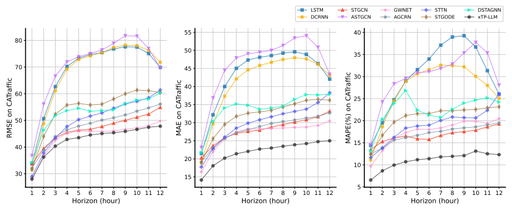
FIGURE 5 : Time step-based prediction comparison with baseline models and our xTP-LLM. All experiments are conducted based on our CATraffic dataset. Results show that the performance of all models decreases with increasing prediction time, whereas our model significantly outperforms the others in all prediction steps.
원문 · CC BY 4.0 · Xusen Guo, Qiming Zhang, Junyue Jiang, Mingxing Peng, Meixin Zhu, Hao, Yang · Towards Explainable Traffic Flow Prediction with Large Language Models · 원문 그림 인용 · 원본 PDF 14쪽에서 그림 영역을 추출했습니다.평균 성능에서 xTP-LLM은 최고 기준선 GWNET 대비 MAE를 18.37% 낮추고, STGCN 대비 MAPE를 34.00% 낮추었다고 보고됩니다. 이 수치는 12개 horizon 전체 평균이며, 미세 조정된 xTP-LLM과 기준선이 같은 데이터셋 설정에서 비교된 결과입니다.
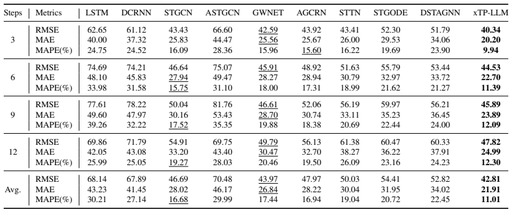
TABLE 1 : Performance comparison between our proposed xTP-LLM and baseline models on our CATraffic dataset. The horizon for traffic flow prediction is 12, and we show the results in Steps 3, 6, 9, and 12 in the table. The last three rows are the average performance for all 12 steps. We highlight the best results in bold and the second best in underline.
원문 · CC BY 4.0 · Xusen Guo, Qiming Zhang, Junyue Jiang, Mingxing Peng, Meixin Zhu, Hao, Yang · Towards Explainable Traffic Flow Prediction with Large Language Models · 원문 그림 인용 · 원본 PDF 14쪽에서 그림 영역을 추출했습니다.zero-shot 일반화와 대조 결과
zero-shot 평가는 샌디에이고 센서 100개의 데이터로 수행되었으며, 이 데이터는 fine-tuning에 사용되지 않았습니다. 이 평가에서 미세 조정하지 않은 GPT-4의 MAE는 103.32이고 xTP-LLM의 MAE는 29.73입니다. 이 결과는 해당 zero-shot 설정과 비교 LLM에 한정된 관찰입니다.
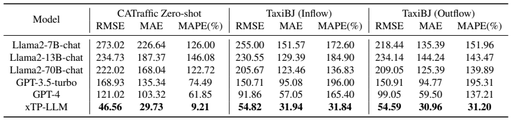
TABLE 5 : Zero-shot performance comparison of our proposed xTP-LLM with other LLMs with- out fine-tuning. We conducted tests on both the CATraffic zero-shot dataset and the TaxiBJ dataset to compare the zero-shot capabilities of different models. The results show that our model outper- forms other LLMs significantly on both unseen datasets.
원문 · CC BY 4.0 · Xusen Guo, Qiming Zhang, Junyue Jiang, Mingxing Peng, Meixin Zhu, Hao, Yang · Towards Explainable Traffic Flow Prediction with Large Language Models · 원문 그림 인용 · 원본 PDF 19쪽에서 그림 영역을 추출했습니다.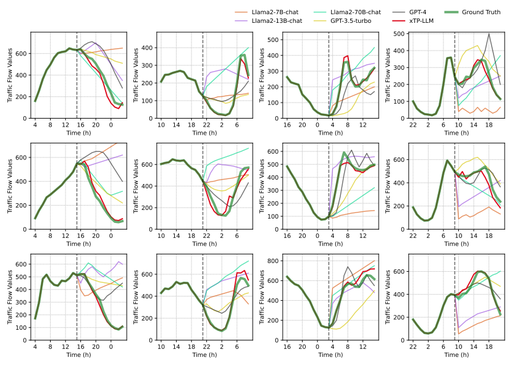
FIGURE 8 : Visualization of traffic flow prediction results on CATraffic zero-shot dataset. We randomly select test samples of three sensors with four time periods and visualized the prediction results of our proposed xTP-LLM, Llama2-chat models with three different sizes, GPT-3.5-turbo and GPT-4. The results show that our fine-tuned model performs significantly better than other LLMs.
원문 · CC BY 4.0 · Xusen Guo, Qiming Zhang, Junyue Jiang, Mingxing Peng, Meixin Zhu, Hao, Yang · Towards Explainable Traffic Flow Prediction with Large Language Models · 원문 그림 인용 · 원본 PDF 20쪽에서 그림 영역을 추출했습니다.절제 실험에서는 날짜, 날씨, PoI, 도메인 지식, CoT 프롬프트의 조합을 바꾸었습니다. 날짜 정보는 MAE를 가장 크게 낮추었고, 도메인 지식과 CoT는 단독 추가 시 뚜렷한 개선을 보이지 않았지만 함께 사용했을 때 MAE가 4.57% 낮아졌다고 보고됩니다.
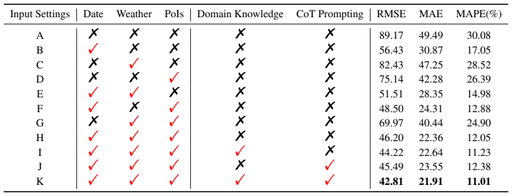
TABLE 2 : Ablation study results showing the impact of different input settings (Date, Weather, PoIs, Domain Knowledge, and CoT Prompting) on model performance.
원문 · CC BY 4.0 · Xusen Guo, Qiming Zhang, Junyue Jiang, Mingxing Peng, Meixin Zhu, Hao, Yang · Towards Explainable Traffic Flow Prediction with Large Language Models · 원문 그림 인용 · 원본 PDF 17쪽에서 그림 영역을 추출했습니다.해석의 범위와 한계
주 지표인 RMSE, MAE, MAPE는 예측 오차를 보여 주며 교통 흐름의 직접 측정을 대체하지 않습니다. 따라서 이 결과는 예측 오차 관점에서 해석해야 합니다. 또한 설명의 품질은 원문에 제시된 사례와 ChatGPT 요약을 통해 확인되었으며, 설명이 실제 교통 원인을 검증했다는 뜻은 아닙니다.
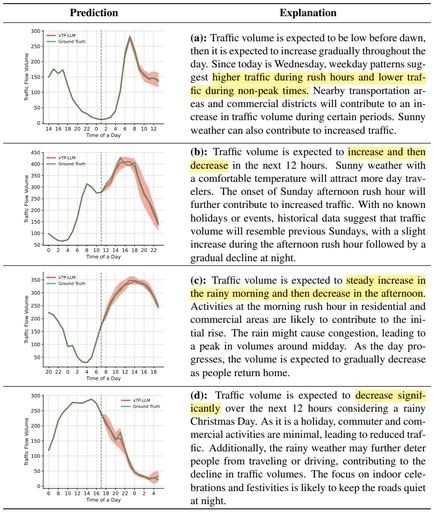
TABLE 6 : Examples of the explanations. We show the ground truth and our predicted result in the figure, with the 95% confidence interval represented in light red; and the generated explanations on the right, with predicted traffic trends highlighted in yellow. Since the original outputs are too long, we use ChatGPT to summarize them. A complete example can be found in Appendix A.2.
원문 · CC BY 4.0 · Xusen Guo, Qiming Zhang, Junyue Jiang, Mingxing Peng, Meixin Zhu, Hao, Yang · Towards Explainable Traffic Flow Prediction with Large Language Models · 원문 그림 인용 · 원본 PDF 22쪽에서 그림 영역을 추출했습니다.논문 정보
- 저자
- Xusen Guo, Qiming Zhang, Junyue Jiang, Mingxing Peng, Meixin Zhu, Hao, Yang
- 학회·저널
- arXiv · 프리프린트
- 최초 공개일
- 2024년 4월 3일
- 등록일
- 2026년 11월 6일
- 수정일
- 2024년 9월 3일
- 버전
- v5
- arXiv
- 2404.02937
- DOI
- 10.1016/j.commtr.2024.100150
- 분류
- cs.LG · cs.AI
- 원문 이용 조건
- CC BY 4.0
- 제공 범위
- 논문 정보, 해설, 허용된 원문 그림
AI 해설은 논문 원문과 별개의 설명이며 오류가 있을 수 있습니다. 원문과 그림은 각 출처의 이용 조건과 따로 표시된 권리를 따릅니다.
초록
Traffic forecasting is crucial for intelligent transportation systems. It has experienced significant advancements thanks to the power of deep learning in capturing latent patterns of traffic data. However, recent deep-learning architectures require intricate model designs and lack an intuitive understanding of the mapping from input data to predicted results. Achieving both accuracy and explainability in traffic prediction models remains a challenge due to the complexity of traffic data and the inherent opacity of deep learning models. To tackle these challenges, we propose a Traffic flow Prediction model based on Large Language Models (LLMs) to generate explainable traffic predictions, named xTP-LLM. By transferring multi-modal traffic data into natural language descriptions, xTP-LLM captures complex time-series patterns and external factors from comprehensive traffic data. The LLM framework is fine-tuned using language-based instructions to align with spatial-temporal traffic flow data. Empirically, xTP-LLM shows competitive accuracy compared with deep learning baselines, while providing an intuitive and reliable explanation for predictions. This paper contributes to advancing explainable traffic prediction models and lays a foundation for future exploration of LLM applications in transportation. To the best of our knowledge, this is the first study to use LLM for explainable prediction of traffic flows.
원문 인용
Xusen Guo, Qiming Zhang, Junyue Jiang, Mingxing Peng, Meixin Zhu, Hao, Yang (2024). Towards Explainable Traffic Flow Prediction with Large Language Models. arXiv:2404.02937v5. https://doi.org/10.1016/j.commtr.2024.100150
BibTeX
@article{guo2024towards,
  title = {{Towards Explainable Traffic Flow Prediction with Large Language Models}},
  author = {Xusen Guo and Qiming Zhang and Junyue Jiang and Mingxing Peng and Meixin Zhu and Hao and Yang},
  year = {2024},
  eprint = {2404.02937},
  archivePrefix = {arXiv},
  doi = {10.1016/j.commtr.2024.100150},
  url = {https://arxiv.org/abs/2404.02937v5}
}