논문 해설
Enhancing Deep Reinforcement Learning: A Tutorial on Generative Diffusion Models in Network Optimization
심층 강화학습 향상: 네트워크 최적화에서의 생성형 확산 모델 튜토리얼
- 연구 문제 무선 네트워크의 채널 변화 속에서 전력 할당 같은 최적화를 빠르고 안정적으로 푸는 것이 어렵습니다.
- 연구 방법 GDM의 노이즈 제거 과정을 조건부 해 생성기로 사용하고, 전문가 데이터 또는 해 평가 네트워크로 학습합니다.
- 주요 결과 전력 할당 사례에서 GDM은 M=5 실험에서 SAC와 비슷한 최종 간격에 더 빠르게 수렴했다고 보고되었으며, DRL 및 계약 기반 인센티브 사례에서도 비교 우위가 보고되었습니다.
네트워크 최적화의 어려움과 GDM의 등장 배경
무선 네트워크에서는 채널 이득이 계속 바뀌기 때문에 최적 자원 배분이 시시각각 달라집니다. 전통적인 수학적 해법은 정확한 채널 추정에 의존하고, 휴리스틱 방법은 반복 계산으로 에너지와 지연을 늘립니다. 워터필링 알고리즘은 전력 할당 문제의 상한을 주지만 채널 수가 많아지면 반복 비용이 커집니다. 이 논문은 이런 상황에서 생성 모델인 GDM을 네트워크 최적화의 해 생성기로 쓰는 방법을 튜토리얼 형식으로 정리합니다.
GDM의 순방향 확산과 역방향 노이즈 제거
GDM은 데이터에 가우시안 노이즈를 단계적으로 더하는 순방향 확산 과정과, 신경망이 노이즈를 제거하며 데이터를 복원하는 역방향 과정으로 구성됩니다. 순방향 과정은 마르코프 체인으로 정의되며, 누적 계수를 써서 임의의 시점 t의 x_t를 x_0에서 직접 샘플링할 수 있습니다. 역방향 과정은 노이즈 예측 네트워크로 평균을 근사하며, 이 논문의 최적화 사례에서는 채널 이득 벡터 g를 조건 입력으로 넣어 환경에 맞는 전력 할당 해를 생성합니다.
전력 할당 사례의 학습 설정과 비교 결과
전력 할당 사례에서 목적함수는 채널별 전송률의 합으로 정의되고, 워터필링으로 얻은 값이 상한으로 쓰입니다. 전문가 데이터가 있을 때는 최적 해에 노이즈를 더한 뒤 노이즈 예측으로 학습하고, 없을 때는 해 평가 네트워크가 기대 목적함수를 Q값으로 추정해 해 생성 네트워크를 안내합니다. M=5 실험에서 저자들은 GDM과 SAC의 최종 간격이 0에 가깝고 GDM이 더 빠르게 수렴했다고 보고합니다. 이 결과는 해당 채널 수와 채널 이득 범위에서 얻은 것입니다.
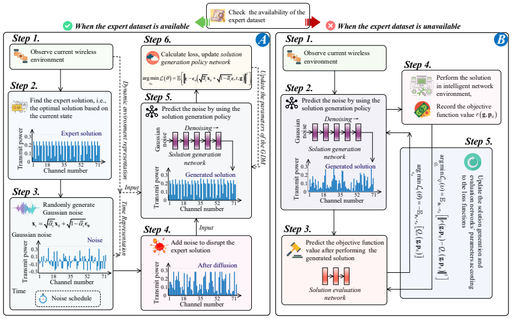
Fig. 5 : GDM training approaches with and without an expert dataset. Part A illustrates the GDM training scenario when an expert database is accessible. The process learns from the GDM applications in the image domain: the optimal solution is retrieved from the expert database upon observing an environmental condition, followed by the GDM learning to replicate this optimal solution through forward diffusion and reverse denoising process. Part B presents the scenario where no expert database exists. In this case, GDM, with the assistance of a jointly trained solution evaluation network, learns to generate the optimal solution for a given environmental condition by actively exploring the unknown environment.
원문 · CC BY 4.0 · Hongyang Du, Ruichen Zhang, Yinqiu Liu, Jiacheng Wang, Yijing Lin, Zonghang Li, Dusit Niyato, Jiawen Kang, Zehui Xiong, Shuguang Cui, Bo Ai, Haibo Zhou, Dong In Kim · Enhancing Deep Reinforcement Learning: A Tutorial on Generative Diffusion Models in Network Optimization · 원문 그림 인용 · 원본 PDF 10쪽에서 그림 영역을 추출했습니다.DRL 응용과 인센티브 설계에서의 결과
DRL 응용에서 D2SAC는 Acrobot-v1, CartPole-v1, CoinRun-v0, Maze-v0 같은 제어 과제에서 비교되었고, Acrobot-v1에서는 -70.77 ± 4.12, CartPole-v1에서는 500.00 ± 0.00, CoinRun-v0에서는 10.00 ± 0.00이라고 보고됩니다. 계약 기반 인센티브 사례에서는 GDM이 PPO보다 높은 보상을 얻었고 IC와 IR 제약을 만족하는 계약을 생성했다고 보고됩니다. 두 결과는 서로 다른 과제와 설정에서 얻은 것이므로 하나의 공통 프로토콜로 묶지 않아야 합니다.
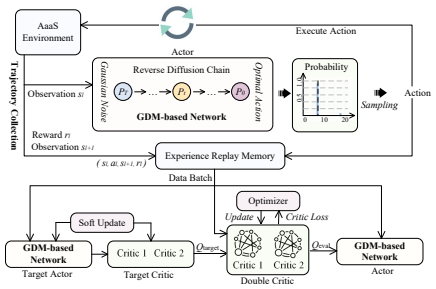
Fig. 13 : The overall architecture of the D2SAC algorithm [70].
원문 · CC BY 4.0 · Hongyang Du, Ruichen Zhang, Yinqiu Liu, Jiacheng Wang, Yijing Lin, Zonghang Li, Dusit Niyato, Jiawen Kang, Zehui Xiong, Shuguang Cui, Bo Ai, Haibo Zhou, Dong In Kim · Enhancing Deep Reinforcement Learning: A Tutorial on Generative Diffusion Models in Network Optimization · 원문 그림 인용 · 원본 PDF 18쪽에서 그림 영역을 추출했습니다.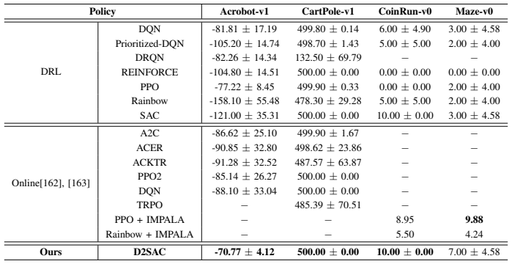
원문 그림 TABLE IV: Performance Comparisons on General Benchmark Tasks.
원문 · CC BY 4.0 · Hongyang Du, Ruichen Zhang, Yinqiu Liu, Jiacheng Wang, Yijing Lin, Zonghang Li, Dusit Niyato, Jiawen Kang, Zehui Xiong, Shuguang Cui, Bo Ai, Haibo Zhou, Dong In Kim · Enhancing Deep Reinforcement Learning: A Tutorial on Generative Diffusion Models in Network Optimization · 원문 그림 인용 · 원본 PDF 19쪽에서 그림 영역을 추출했습니다.계산 비용과 적용 범위의 한계
원문은 GDM의 반복적 노이즈 제거 구조가 계산 복잡도를 높여 대규모 DRL 과제에서 어려움을 줄 수 있다고 밝힙니다. 또한 노이즈가 많거나 불규칙한 데이터 분포를 다루기 어려울 수 있다고 설명합니다. 본문의 사례는 특정 채널 수와 이득 범위, 특정 벤치마크에서 얻은 것이므로 다른 네트워크 환경으로 그대로 일반화할 수 없습니다.
논문 정보
- 저자
- Hongyang Du, Ruichen Zhang, Yinqiu Liu, Jiacheng Wang, Yijing Lin, Zonghang Li, Dusit Niyato, Jiawen Kang, Zehui Xiong, Shuguang Cui, Bo Ai, Haibo Zhou, Dong In Kim
- 학회·저널
- arXiv · 프리프린트
- 최초 공개일
- 2023년 8월 10일
- 등록일
- 2026년 11월 6일
- 수정일
- 2024년 5월 8일
- 버전
- v2
- arXiv
- 2308.05384
- 분류
- cs.NI · eess.SP
- 원문 이용 조건
- CC BY 4.0
- 제공 범위
- 논문 정보, 해설, 허용된 원문 그림
AI 해설은 논문 원문과 별개의 설명이며 오류가 있을 수 있습니다. 원문과 그림은 각 출처의 이용 조건과 따로 표시된 권리를 따릅니다.
초록
Generative Diffusion Models (GDMs) have emerged as a transformative force in the realm of Generative Artificial Intelligence (GenAI), demonstrating their versatility and efficacy across various applications. The ability to model complex data distributions and generate high-quality samples has made GDMs particularly effective in tasks such as image generation and reinforcement learning. Furthermore, their iterative nature, which involves a series of noise addition and denoising steps, is a powerful and unique approach to learning and generating data. This paper serves as a comprehensive tutorial on applying GDMs in network optimization tasks. We delve into the strengths of GDMs, emphasizing their wide applicability across various domains, such as vision, text, and audio generation. We detail how GDMs can be effectively harnessed to solve complex optimization problems inherent in networks. The paper first provides a basic background of GDMs and their applications in network optimization. This is followed by a series of case studies, showcasing the integration of GDMs with Deep Reinforcement Learning (DRL), incentive mechanism design, Semantic Communications (SemCom), Internet of Vehicles (IoV) networks, etc. These case studies underscore the practicality and efficacy of GDMs in real-world scenarios, offering insights into network design. We conclude with a discussion on potential future directions for GDM research and applications, providing major insights into how they can continue to shape the future of network optimization.
원문 인용
Hongyang Du, Ruichen Zhang, Yinqiu Liu, Jiacheng Wang, Yijing Lin, Zonghang Li, Dusit Niyato, Jiawen Kang, Zehui Xiong, Shuguang Cui, Bo Ai, Haibo Zhou, Dong In Kim (2023). Enhancing Deep Reinforcement Learning: A Tutorial on Generative Diffusion Models in Network Optimization. arXiv:2308.05384v2. https://arxiv.org/abs/2308.05384v2
BibTeX
@misc{du2023enhancing,
  title = {{Enhancing Deep Reinforcement Learning: A Tutorial on Generative Diffusion Models in Network Optimization}},
  author = {Hongyang Du and Ruichen Zhang and Yinqiu Liu and Jiacheng Wang and Yijing Lin and Zonghang Li and Dusit Niyato and Jiawen Kang and Zehui Xiong and Shuguang Cui and Bo Ai and Haibo Zhou and Dong In Kim},
  year = {2023},
  eprint = {2308.05384},
  archivePrefix = {arXiv},
  url = {https://arxiv.org/abs/2308.05384v2}
}