논문 해설
BiPOP: Partial-Order Planning for Long-Horizon Bimanual Robotic Manipulation
BiPOP: 장기 지평 양손 로봇 조작을 위한 부분 순서 계획
- 연구 문제 장기 양손 조작에서는 두 팔의 배정, 동시 실행, 순서 제약을 함께 맞춰야 하는데 LLM만으로 계획하면 공간·시간 제약 위반이 잦습니다.
- 연구 방법 LLM이 장면과 작업 설명을 PDDL 문제로 옮기고, 시간 부분순서 계획기가 두 팔의 동시성과 제약을 처리해 검증된 계획 중 makespan이 가장 짧은 것을 고릅니다.
장기 양손 조작의 조정 문제
양손 로봇이 긴 작업을 수행하려면 두 팔의 행동 순서, 동시 실행, 팔 배정을 함께 정해야 합니다. 기존 연구는 주로 개별 기술 습득에 집중해 이 상위 수준의 시공간 조정을 충분히 다루지 못했습니다. 한편 LLM만으로 계획을 세우면 긴 작업에서 추론 오류와 환각이 생기고, 특히 공간 제약과 시간 제약을 어기기 쉽습니다. 이 논문은 LLM이 PDDL 명세를 만들고 시간 부분순서 계획기가 제약을 강제하는 방식으로 이 문제를 다룹니다. 연구 질문은 LLM과 기호 계획을 어떻게 결합해 두 팔의 공간적·시간적 조정을 효율적으로 달성할 수 있는지입니다.
작업 공간 분할과 PDDL 생성
BiPOP은 먼저 팔의 도달 가능성에 따라 작업 공간을 두 개의 단독 영역과 하나의 중첩 영역으로 나눕니다. 두 팔이 함께 닿는 중첩 영역에서만 비동기 또는 동기 조정이 필요하며, 서로 다른 단독 영역의 다른 물체는 병렬로 실행할 수 있습니다. 객체 탐지기가 준 바운딩 박스를 이 영역에 매핑하면 장면 정보가 초기 상태가 됩니다. LLM은 작업 설명을 목표 상태로 바꾸는 PDDL 문제를 작성합니다. 이때 원시 PDDL 텍스트 대신 Unified-Planning 라이브러리를 쓰는 Python 코드를 생성하도록 해 API 수준에서 출력을 제약합니다. 실행 오류는 해석기 메시지로, 계획이 없는 경우는 no-plan 결과로 LLM에 되돌려 다시 생성하게 합니다.
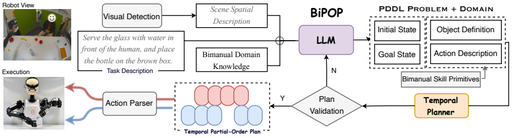
Fig. 1 : Overview of BiPOP, illustrated on the ServeWater task. From the visual scene description, the bimanual domain knowledge, and the natural-language instruction, BiPOP generates a PDDL problem solved by a temporal planner. The validated partial-order plan with the best symbolic makespan found (cf. Fig. 2) is executed by the bimanual robot NICOL [15].
원문 · CC BY 4.0 · Kun Chu, Xufeng Zhao, Jan-Gerrit Habekost, Cornelius Weber, Stefan Wermter · BiPOP: Partial-Order Planning for Long-Horizon Bimanual Robotic Manipulation · 원문 그림 인용 · 원본 PDF 2쪽에서 그림 영역을 추출했습니다.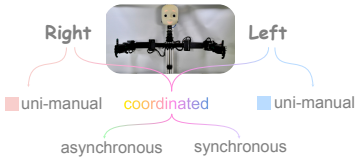
Fig. 3 : Spatio-temporal modelling between the two hands.
원문 · CC BY 4.0 · Kun Chu, Xufeng Zhao, Jan-Gerrit Habekost, Cornelius Weber, Stefan Wermter · BiPOP: Partial-Order Planning for Long-Horizon Bimanual Robotic Manipulation · 원문 그림 인용 · 원본 PDF 3쪽에서 그림 영역을 추출했습니다.시간 계획과 makespan 기준 선택
TFD는 시작·종료 조건을 가진 durative 행동을 지원하고, 독립 행동을 동시에 스케줄링합니다. 공유 자원이 없는 두 행동만 동시에 배치되고 나머지는 명시적 순서 제약으로 직렬화됩니다. 여러 파라미터 구성과 탐색 전략으로 후보 계획을 만든 뒤, VAL 검증기로 조건을 어기는 계획을 걸러냅니다. 검증을 통과한 후보 중 symbolic makespan이 가장 짧은 계획을 로봇 컨트롤러에 전달합니다. 모든 행동의 지속시간은 동일하게 두었으므로 makespan은 병렬 단계 수와 같습니다. TFD가 고정된 시간 예산 안에서 찾은 최선의 계획이므로, 이 값은 인증된 최적해가 아닙니다.
세 과제 시뮬레이션 비교
시뮬레이션은 ServeFruit, ServeWater, StackBlock 세 과제에서 과제당 100개의 무작위 인스턴스로 진행했습니다. BiPOP의 백본은 GPT-4.1이고, I/O 베이스라인은 o3, R1, GPT-4.1을 사용했으며 ReAct는 GPT-4.1로 실행했습니다. TFD의 최적화 예산은 ServeFruit, ServeWater, StackBlock에서 각각 1s, 1s, 25s입니다. Optimality Gap은 각 실행에서 방법의 symbolic makespan과 그 실행을 해결한 방법들 중 최소 makespan의 차이로 계산합니다.
계획 시간과 실패 양상
계획 시간에서 GPT-4.1과 BiPOP은 o3와 R1보다 훨씬 짧았습니다. 실패 양상은 I/O에서 공간·시간·기술 오류가, ReAct에서 잘못된 완료 판단과 중단이 주로 나타났습니다. BiPOP의 잔여 실패는 주로 StackBlock의 TFD 시간 초과였습니다.
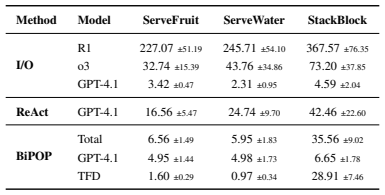
원문 그림 TABLE I: Planning Time (s) across the task domains. For BiPOP, LLM inference (code generation) and TFD planning times are listed separately.
원문 · CC BY 4.0 · Kun Chu, Xufeng Zhao, Jan-Gerrit Habekost, Cornelius Weber, Stefan Wermter · BiPOP: Partial-Order Planning for Long-Horizon Bimanual Robotic Manipulation · 원문 그림 인용 · 원본 PDF 6쪽에서 그림 영역을 추출했습니다.효율 차이와 StackBlock의 수렴
Optimality Gap 분석에서 BiPOP은 ServeFruit와 ServeWater에서 대부분 최소 makespan 계획을 냈습니다. StackBlock에서는 탐색 공간이 커서 TFD가 시간 예산 안에 항상 수렴하지 못했고, 그 결과 OG가 0보다 커지는 경우가 생겼습니다. I/O 에이전트는 StackBlock에서 BiPOP보다 짧은 계획을 낸 경우도 있었지만, 전체 성공률이 훨씬 낮았습니다. ReAct는 성공한 경우에도 symbolic makespan이 길었습니다.
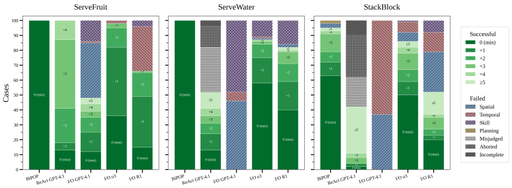
Fig. 5 : Per-method outcome breakdown on ServeFruit, ServeWater, and StackBlock. Each bar aggregates 100 instances: successes (green) are graded byOptimality Gap(0,+1, . . . ,≥5; dark = optimal), and failures are coloured by failure class as shown in the legend.
원문 · CC BY 4.0 · Kun Chu, Xufeng Zhao, Jan-Gerrit Habekost, Cornelius Weber, Stefan Wermter · BiPOP: Partial-Order Planning for Long-Horizon Bimanual Robotic Manipulation · 원문 그림 인용 · 원본 PDF 7쪽에서 그림 영역을 추출했습니다.실제 로봇 ServeWater 검증
실제 로봇 실험에서는 NICOL 로봇으로 ServeWater 과제를 end-to-end로 실행했습니다. 실제 장면에서는 유리와 병이 두 개의 컵을 대신했습니다. 객체 위치 파악은 과제 영역마다 다양한 배치의 실제 이미지 100장으로 평가했습니다. 결과는 ServeFruit와 ServeWater에서 모든 과제 관련 객체를 올바르게 위치시켰고, StackBlock에서는 회색 쟁반과 수직으로 쌓인 블록에서 일부 오류가 있었습니다. 이 검증은 ServeWater에 대한 것이며 StackBlock의 실제 로봇 실행은 보고되지 않았습니다.
남은 문제
논문은 행동 지속시간을 모두 같게 두었으며, 모션 계층의 지속시간 추정을 통합하는 일은 향후 과제로 남겼습니다. 또 TFD 결과는 고정된 예산 안에서 찾은 최선의 계획이라 인증된 최적해가 아닙니다. 실행 모니터링과 재계획은 아직 추가하지 않았고, 도메인 파일을 스킬 라이브러리나 시연에서 자동으로 만드는 일도 남은 과제입니다.
논문 정보
- 저자
- Kun Chu, Xufeng Zhao, Jan-Gerrit Habekost, Cornelius Weber, Stefan Wermter
- 학회·저널
- arXiv · 프리프린트
- 최초 공개일
- 2026년 11월 11일
- 등록일
- 2026년 11월 13일
- 수정일
- 2026년 11월 11일
- 버전
- v1
- arXiv
- 2611.15317
- 분류
- cs.RO
- 원문 이용 조건
- CC BY 4.0
- 제공 범위
- 논문 정보, 해설, 허용된 원문 그림
AI 해설은 논문 원문과 별개의 설명이며 오류가 있을 수 있습니다. 원문과 그림은 각 출처의 이용 조건과 따로 표시된 권리를 따릅니다.
초록
Bimanual robotic manipulation is versatile, yet its central challenge lies not only in executing dexterous motion with each hand, but also in coordinating the two arms for long-horizon manipulation under coupled spatial and temporal constraints. Prior work has largely focused on endowing robots with human-level manipulation skills, paying less attention to the structure of bimanual behaviour itself: many practical tasks are a coordinated composition of reusable unimanual skills and a small set of synchronous bimanual skills. This makes high-level spatio-temporal coordination, rather than skill acquisition alone, a key bottleneck for efficient bimanual execution. We propose BiPOP, a framework that couples Large Language Models (LLMs) with Temporal Partial-Order Planning for long-horizon bimanual manipulation. At its core is an explicit spatio-temporal model that partitions the workspace by arm reachability and captures inter-arm dependencies, arm assignment, synchronization requirements, and opportunities for safe concurrent execution. Building on this model, an LLM translates natural-language instructions into a formal PDDL specification, while a temporal planner enforces the constraints and schedules actions, yielding plans that are logically consistent at the symbolic level and efficient through parallel execution. On simulated long-horizon tasks of varying complexity, BiPOP outperforms open-loop planning with strong reasoning models and closed-loop ReAct-style planning in success rate, planning time, and plan efficiency, and the full pipeline runs end to end on the real bimanual robot NICOL. A failure analysis further shows that LLM-only planners mainly violate spatial and temporal coordination constraints, which motivates delegating these constraints to a symbolic planner. Code: https://github.com/Kchu/BiPOP
원문 인용
Kun Chu, Xufeng Zhao, Jan-Gerrit Habekost, Cornelius Weber, Stefan Wermter (2026). BiPOP: Partial-Order Planning for Long-Horizon Bimanual Robotic Manipulation. arXiv:2611.15317v1. https://arxiv.org/abs/2611.15317v1
BibTeX
@misc{chu2026bipop,
  title = {{BiPOP: Partial-Order Planning for Long-Horizon Bimanual Robotic Manipulation}},
  author = {Kun Chu and Xufeng Zhao and Jan-Gerrit Habekost and Cornelius Weber and Stefan Wermter},
  year = {2026},
  eprint = {2611.15317},
  archivePrefix = {arXiv},
  url = {https://arxiv.org/abs/2611.15317v1}
}