논문 해설
Self-supervised learning for zebrafish embryo phenotype evaluation: Systematic comparison of algorithms, label-efficient classification, and transfer learning
제브라피시 배아 표현형 평가를 위한 자기지도 학습: 알고리즘의 체계적 비교, 레이블 효율적 분류, 전이 학습
- 연구 문제 지도학습 기반 제브라피시 배아 표현형 분류는 많은 라벨과 일정한 촬영 조건을 전제로 해서, 라벨이 적거나 실험 조건이 바뀌면 성능이 떨어지기 쉽습니다.
- 연구 방법 ResNet50과 ConvNeXt-v2 pico 백본에 여섯 SSL 알고리즘을 적용해 비교하고, 최적 구성을 pre-training 전략, 증강 누적, 새 설정 전이 평가로 이어 검증합니다.
- 주요 결과 ResNet50 기반 SwAV는 EmbryoNet에서 사전학습했을 때 선형 프로빙 86.4%를 기록했고, 5% 레이블에서 70.2%를 보였습니다.
라벨이 부족한 배아 표현형 평가의 문제
제브라피시 배아 이미지로 표현형을 자동 분류하려면 보통 많은 전문가 라벨이 필요합니다. 이미지는 싸게 얻을 수 있지만 라벨은 비싸서, 지도학습 모델은 데이터가 적을 때 성능이 떨어집니다. 또 현미경, 조명, 처리 조건이 바뀌면 정확도가 크게 떨어져 실험실 사이에서 모델을 공유하기 어렵습니다.
자기지도학습(SSL)은 라벨 없는 이미지에서 전이 가능한 표현을 배우고, 이후 적은 라벨로 분류기를 붙이는 방식입니다. 그런데 이 분야에서는 SSL 알고리즘, pre-training 데이터, 증강 조합의 효과가 충분히 연구되지 않았습니다. 이 논문은 이 공백을 EmbryoNet 데이터셋으로 체계적으로 비교합니다.
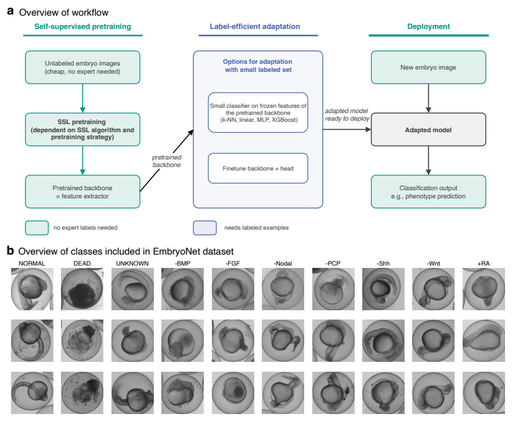
Figure 1 .Overview of (a) the example workflow of a model in this study and (b) the EmbryoNet dataset.(a) Self- supervised pretraining: A feature extractor is trained using SSL on unlabeled embryo images of the public EmbryoNet dataset and without expert labels. Label-efficient adaptation: The frozen features of the pretrained backbone are reused for adaptation to a specific task. Options are training small classifiers like k-NN, linear, MLP, or XGBoost on top of the frozen representations or full finetuning of the backbone. Deployment: The fully trained model is deployed for classification on unseen images, e.g., phenotype prediction. (b) Example images for each of the ten phenotypes in the EmbryoNet [26] dataset were chosen at random from the test dataset. NORMAL = normally developing embryos, DEAD = dead/coagulated embryos, UNKNOWN = embryos that annotators could not clearly identify. The remaining labels indicate phenotypes resulting from dysfunctional major signaling pathways, with "-" indicating loss of function and "+" indicating gain of function of the pathway. The affected pathways are: BMP (Bone Morphogenetic Protein), FGF (Fibroblast Growth Factor), Nodal, PCP (Planar Cell Polarity), Shh (Sonic Hedgehog), Wnt (Wingless-related integration site), and RA (Retinoic Acid) signaling.
원문 · CC BY 4.0 · Lautenschlager, Thomas, Hayot, Gaëlle, Brassart, Quentin, Sitcheu, Angelo Jovin Yamachui, Schilpp, Linus, Geroski, Tijana, Goldanova, Tetyana, Allgeier, Stephan, Soubrié, Thibaut, Nikolic, Milica, Dickmeis, Thomas, Mikut, Ralf, Friederich, Nils · Self-supervised learning for zebrafish embryo phenotype evaluation: Systematic comparison of algorithms, label-efficient classification, and transfer learning · 원문 그림 인용 · 원본 PDF 3쪽에서 그림 영역을 추출했습니다.5단계 연구 설계
연구는 다섯 단계로 진행됩니다. 1단계에서는 여러 합성곱·트랜스포머 구조를 전체 학습 세트에서 지도학습으로 학습해 백본을 고릅니다. 2단계에서는 ResNet50과 ConvNeXt-v2 pico 백본에 여섯 SSL 알고리즘을 적용해 200 에포크씩 학습하고, 고정된 백본 위에서 k-NN, 선형 프로빙, MLP 기반 비선형 프로빙으로 표현을 평가합니다. 각 단계의 결과가 다음 단계에 사용할 모델을 결정합니다.
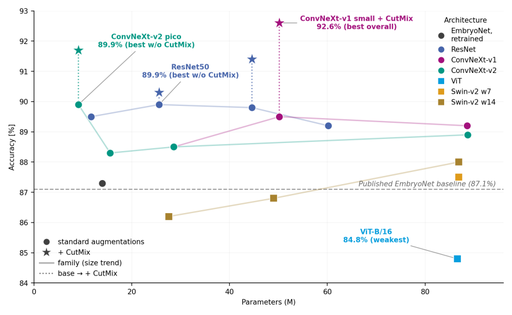
Figure 2 .Accuracy of the fully supervised networks on the test dataset as a function of the number of model parameters (in millions - M).Each point represents an architecture trained from scratch on the full training set. Solid lines connect the variants of one family in order of size. Dotted vertical lines link base models to their CutMix variant. The dashed line marks the published EmbryoNet baseline.
원문 · CC BY 4.0 · Lautenschlager, Thomas, Hayot, Gaëlle, Brassart, Quentin, Sitcheu, Angelo Jovin Yamachui, Schilpp, Linus, Geroski, Tijana, Goldanova, Tetyana, Allgeier, Stephan, Soubrié, Thibaut, Nikolic, Milica, Dickmeis, Thomas, Mikut, Ralf, Friederich, Nils · Self-supervised learning for zebrafish embryo phenotype evaluation: Systematic comparison of algorithms, label-efficient classification, and transfer learning · 원문 그림 인용 · 원본 PDF 4쪽에서 그림 영역을 추출했습니다.4단계에서는 자르기를 기본으로 두고 증강을 하나씩 추가하며 표현 평가 변화를 봅니다. 5단계에서는 다른 현미경에서 얻은 새 데이터에 재학습 없는 분류기와 XGBoost를 적용합니다.
SSL 알고리즘과 백본 비교
2단계에서 SwAV는 ResNet50 백본과 함께 선형 프로빙 82.7%, 비선형 프로빙 85.1%를 기록했습니다. SimCLR와 MoCov2는 각각 80.8%와 81.9%의 선형 프로빙 정확도를 보였습니다. BYOL과 Barlow Twins는 77.7%와 74.8%였고, DINO는 43.1%로 크게 낮았습니다. ConvNeXt-v2 pico 백본은 대부분의 SSL 알고리즘에서 ResNet50보다 낮았습니다.
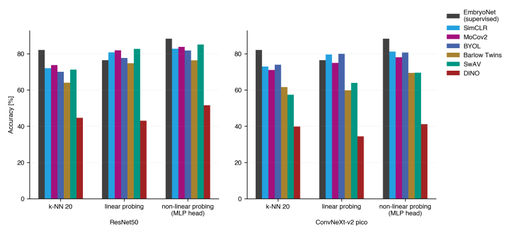
Figure 3 .Evaluation of the learned representations (200 epochs pretraining on the training dataset) of the self- supervised algorithms with ResNet50 and ConvNeXt-v2 pico backbones on the test dataset.Accuracy is determined through k-NN classification with a k of 20 neighbors, linear probing, and non-linear probing with an MLP head on the frozen backbones. The representations of the published EmbryoNet model [26] obtained by removing its classification head serve as a baseline. All results, including k-NN classifications with different numbers of neighbors, are given in Supplementary Table S2.
원문 · CC BY 4.0 · Lautenschlager, Thomas, Hayot, Gaëlle, Brassart, Quentin, Sitcheu, Angelo Jovin Yamachui, Schilpp, Linus, Geroski, Tijana, Goldanova, Tetyana, Allgeier, Stephan, Soubrié, Thibaut, Nikolic, Milica, Dickmeis, Thomas, Mikut, Ralf, Friederich, Nils · Self-supervised learning for zebrafish embryo phenotype evaluation: Systematic comparison of algorithms, label-efficient classification, and transfer learning · 원문 그림 인용 · 원본 PDF 5쪽에서 그림 영역을 추출했습니다.이 비교에서 SwAV 표현은 공개 EmbryoNet 지도 모델에서 분류 헤드를 제거한 표현의 선형 프로빙 76.5%보다 높았습니다. 다만 비선형 프로빙에서는 85.1%로 EmbryoNet의 88.3%보다 낮았습니다. 저자들은 DINO가 낮은 이유를 아직 명확하지 않다고 봅니다.
pre-training 데이터와 레이블 효율
EmbryoNet만으로 800 에포크 사전학습한 SwAV는 선형 프로빙 86.4%, 비선형 프로빙 87.1%를 기록했습니다. IN1k 단독 pre-training은 선형 프로빙 53.9%에 그쳤고, 순차 pre-training은 83.0%였습니다. 200 에포크 결과에서 800 에포크로 늘리면서 선형 프로빙이 82.7%에서 86.4%로 올랐습니다.
레이블 효율 실험에서 EmbryoNet pre-training 모델은 5% 레이블로 70.2%를 기록했고, 처음부터 학습한 지도 모델은 45.7%였습니다. 50% 레이블에서는 EmbryoNet pre-training 모델이 88.0%에 이르렀습니다. 이 차이는 레이블이 늘어날수록 줄어들었습니다.
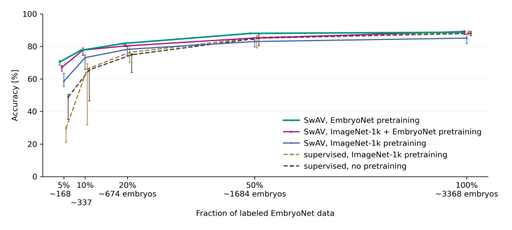
Figure 5 .Mean accuracies (and standard deviations across five different learning rates) of the label-efficient training on the test dataset.Backbones of the different self-supervised pretraining strategies are finetuned with labeled data fractions of 5%, 10%, 20%, 50%, and 100% of the EmbryoNet dataset. Supervised backbones trained from scratch or with IN1k pretraining serve as baselines. Two of the five training runs with the supervised IN1k pretraining using 5% labels did not converge. These runs were excluded from mean and standard deviation calculation. All results are given in Supplementary Table S3. Results of individual training runs with the different learning rates are reported in Supplementary Table S4.
원문 · CC BY 4.0 · Lautenschlager, Thomas, Hayot, Gaëlle, Brassart, Quentin, Sitcheu, Angelo Jovin Yamachui, Schilpp, Linus, Geroski, Tijana, Goldanova, Tetyana, Allgeier, Stephan, Soubrié, Thibaut, Nikolic, Milica, Dickmeis, Thomas, Mikut, Ralf, Friederich, Nils · Self-supervised learning for zebrafish embryo phenotype evaluation: Systematic comparison of algorithms, label-efficient classification, and transfer learning · 원문 그림 인용 · 원본 PDF 7쪽에서 그림 영역을 추출했습니다.증강 누적 실험
증강 연구에서는 자르기만 한 구성에서 시작해 증강을 하나씩 추가했습니다. 처음 몇 개의 증강을 더할 때 k-NN과 프로빙 정확도가 크게 올랐습니다. 이후 증강을 더해도 결과가 일정하게 좋아지지 않았고, 일부 증강은 한두 평가 지표를 낮췄습니다. 따라서 필요한 증강 수에는 포화 지점이 있었지만, 하나의 최적 조합은 평가 방법마다 달랐습니다.
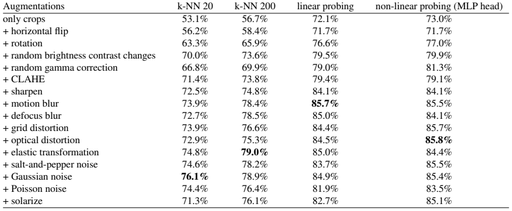
Table 2 .Accuracy of SwA V with ResNet50 backbone trained with an increasing number of augmentations from our augmentation pipeline on the test dataset.Augmentations are added one after another, with each row adding one augmentation to those listed above. Augmentations are grouped by categories (geometric, brightness/contrast, sharpness/blur, deformation, noise, color). The best result for each evaluation metric is marked in bold. Note that the results using all augmentations correspond to the results of SwA V with a ResNet50 backbone from the second test step (cf. Figure 3 and Supplementary Table S2).
원문 · CC BY 4.0 · Lautenschlager, Thomas, Hayot, Gaëlle, Brassart, Quentin, Sitcheu, Angelo Jovin Yamachui, Schilpp, Linus, Geroski, Tijana, Goldanova, Tetyana, Allgeier, Stephan, Soubrié, Thibaut, Nikolic, Milica, Dickmeis, Thomas, Mikut, Ralf, Friederich, Nils · Self-supervised learning for zebrafish embryo phenotype evaluation: Systematic comparison of algorithms, label-efficient classification, and transfer learning · 원문 그림 인용 · 원본 PDF 8쪽에서 그림 영역을 추출했습니다.새 설정으로의 전이
새 실험실의 696장 브라이트필드 이미지에서 SwAV는 재학습 없이 고정 선형 분류기만으로 81.3%를 기록했습니다. 같은 조건의 EmbryoNet 모델은 75.9%였습니다. 고정 특징 위에 XGBoost를 학습하면 SwAV는 98.3%, EmbryoNet 표현은 99.1%였습니다. 이 평가는 정상과 사망 배아에 잘못 잘린 배아를 세 번째 클래스로 더한 세 클래스 문제입니다.
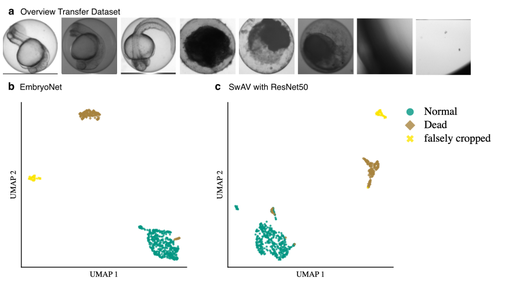
Figure 6 .Example images and UMAPs [38] from the transfer dataset.Example images from the transfer dataset are shown in (a): from left to right: three normal, three dead, two falsely cropped. UMAP [38] projections of the representations of the published EmbryoNet model [26] with the classification head removed are shown in (b). UMAP projections of the learned representations of SwA V with a ResNet50 backbone trained for 800 epochs are depicted in (c).
원문 · CC BY 4.0 · Lautenschlager, Thomas, Hayot, Gaëlle, Brassart, Quentin, Sitcheu, Angelo Jovin Yamachui, Schilpp, Linus, Geroski, Tijana, Goldanova, Tetyana, Allgeier, Stephan, Soubrié, Thibaut, Nikolic, Milica, Dickmeis, Thomas, Mikut, Ralf, Friederich, Nils · Self-supervised learning for zebrafish embryo phenotype evaluation: Systematic comparison of algorithms, label-efficient classification, and transfer learning · 원문 그림 인용 · 원본 PDF 9쪽에서 그림 영역을 추출했습니다.한계와 남은 문제
SSL 알고리즘 비교는 단일 학습 실행에 기반하므로 작은 차이는 주의해서 읽어야 합니다. 평가는 26 hpf 한 시점만 사용했기 때문에 다른 시점에서도 같은 결과가 나온다고 보장할 수 없습니다. SwAV 표현은 현미경 장치에 따라 강하게 묶였고, 이 점은 모델을 여러 실험실에서 재사용할 때 따로 고려해야 합니다.
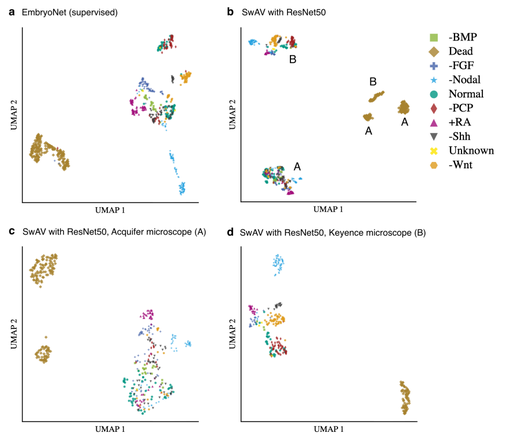
Figure 4 .UMAP [38] projections of the learned representations from the test data of the published EmbryoNet model [26] with the classification head removed (a) and of SwA V with a ResNet50 backbone (b, c, d).SwA V separates based on the microscopes used for acquisition (Panel (b), A = Acquifer, B = Keyence). Separate UMAPs for Acquifer and Keyence are shown in Panel (c) and (d), respectively. SwA V was trained for 800 epochs on the EmbryoNet dataset.
원문 · CC BY 4.0 · Lautenschlager, Thomas, Hayot, Gaëlle, Brassart, Quentin, Sitcheu, Angelo Jovin Yamachui, Schilpp, Linus, Geroski, Tijana, Goldanova, Tetyana, Allgeier, Stephan, Soubrié, Thibaut, Nikolic, Milica, Dickmeis, Thomas, Mikut, Ralf, Friederich, Nils · Self-supervised learning for zebrafish embryo phenotype evaluation: Systematic comparison of algorithms, label-efficient classification, and transfer learning · 원문 그림 인용 · 원본 PDF 6쪽에서 그림 영역을 추출했습니다.논문 정보
- 저자
- Lautenschlager, Thomas, Hayot, Gaëlle, Brassart, Quentin, Sitcheu, Angelo Jovin Yamachui, Schilpp, Linus, Geroski, Tijana, Goldanova, Tetyana, Allgeier, Stephan, Soubrié, Thibaut, Nikolic, Milica, Dickmeis, Thomas, Mikut, Ralf, Friederich, Nils
- 학회·저널
- arXiv · 프리프린트
- 최초 공개일
- 2026년 11월 15일
- 등록일
- 2026년 11월 17일
- 수정일
- 2026년 11월 15일
- 버전
- v1
- arXiv
- 2611.20269
- 분류
- cs.CV · cs.AI · cs.LG
- 원문 이용 조건
- CC BY 4.0
- 제공 범위
- 논문 정보, 해설, 허용된 원문 그림
AI 해설은 논문 원문과 별개의 설명이며 오류가 있을 수 있습니다. 원문과 그림은 각 출처의 이용 조건과 따로 표시된 권리를 따릅니다.
초록
Zebrafish embryos are a prominent model organism for image-based phenotyping and especially suited for large-scale imaging studies, for which machine learning (ML) models can automate evaluation. However, training ML models usually requires large labeled datasets, and differences in imaging conditions often impede reuse across laboratories. Self-supervised learning (SSL) addresses both constraints by learning transferable representations from unlabeled images. Yet central aspects like the choice of algorithm remain underexplored for domain-specific applications. To close this gap, we benchmark popular SSL algorithms on the public EmbryoNet dataset, explore label-efficient learning, and test transfer to an unseen setting. Using representations from our strongest model, a ResNet50 network trained with SwAV, a simple linear classifier reaches 86.4% accuracy and a non-linear classifier 87.1%, rivaling the fully supervised EmbryoNet model (87.1%). The SwAV model decisively outperforms supervised training from scratch when labels are scarce (70.2% vs. 45.7% accuracy with 5% of labels). On a three-class problem (normal, dead, falsely cropped) with a small, previously unseen zebrafish toxicity dataset, recorded in a different setting, our model reaches 81.3% accuracy without retraining, while EmbryoNet achieves 75.9%. Overall, self-supervised models for zebrafish embryos seem to mostly facilitate label-efficiency and transfer to new settings rather than improving supervised results.
원문 인용
Lautenschlager, Thomas, Hayot, Gaëlle, Brassart, Quentin, Sitcheu, Angelo Jovin Yamachui, Schilpp, Linus, Geroski, Tijana, Goldanova, Tetyana, Allgeier, Stephan, Soubrié, Thibaut, Nikolic, Milica, Dickmeis, Thomas, Mikut, Ralf, Friederich, Nils (2026). Self-supervised learning for zebrafish embryo phenotype evaluation: Systematic comparison of algorithms, label-efficient classification, and transfer learning. arXiv:2611.20269v1. https://arxiv.org/abs/2611.20269v1
BibTeX
@misc{thomas2026self,
  title = {{Self-supervised learning for zebrafish embryo phenotype evaluation: Systematic comparison of algorithms, label-efficient classification, and transfer learning}},
  author = {Lautenschlager, Thomas and Hayot, Gaëlle and Brassart, Quentin and Sitcheu, Angelo Jovin Yamachui and Schilpp, Linus and Geroski, Tijana and Goldanova, Tetyana and Allgeier, Stephan and Soubrié, Thibaut and Nikolic, Milica and Dickmeis, Thomas and Mikut, Ralf and Friederich, Nils},
  year = {2026},
  eprint = {2611.20269},
  archivePrefix = {arXiv},
  url = {https://arxiv.org/abs/2611.20269v1}
}