논문 해설
Quantifying the biomimicry gap in biohybrid robot-fish pairs
생체혼성 로봇-물고기 쌍의 생체모방 격차 정량화
- 연구 문제 생체혼합 시스템에서 시뮬레이션 기반 사회적 상호작용 모델을 실제 로봇으로 옮길 때 생기는 생체모방 격차를 정량화하는 문제입니다.
- 연구 방법 물고기 쌍을 추적해 DLI 모델로 가속도를 예측하고, 이를 LureBot의 목표 위치와 PID 구동으로 바꾸어 폐루프 상호작용을 구성합니다.
- 주요 결과 DLI-BP는 DLI-SP와 평균 Hellinger 거리 0.11로 가깝고, 물고기 전용 실험과는 평균 0.20으로 차이가 있으며 방향 차이 분포에서 가장 큰 불일치가 나타납니다.
생체모방 격차라는 문제
생체혼합 시스템은 로봇 루어가 동물과 상호작용하며 집단행동의 기제를 검증하는 도구로 주목받고 있습니다. 그러나 시뮬레이션에서 만든 사회적 상호작용 모델을 실제 로봇으로 옮기면, 모델의 누락, 로봇 루어의 시각적 불완전성, 물리 제약이 겹쳐 차이가 생깁니다. 이 논문은 이 누적 차이를 생체모방 격차라고 부르며, 이를 짧은 시간과 긴 시간 척도에서 함께 측정할 수 있는지 묻습니다.
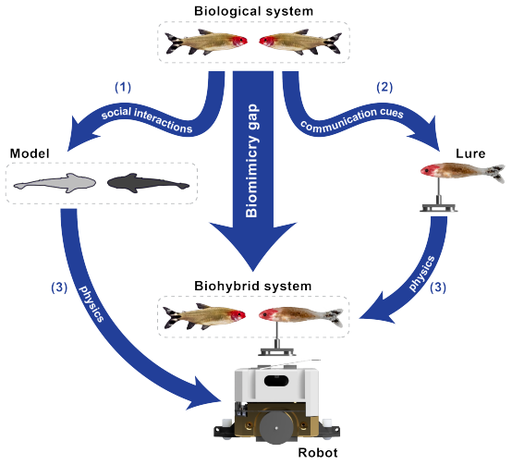
Figure 1 : Illustration of the sources of the biomimicry gap. (1) The modeling phase may introduce a first source of discrepancy between the effect of social interactions on the swimming patterns in the model and the ones observed in real fish. (2) A second source of discrepancy between the visual appearance of the lure and that of a real fish might introduce imperfect communication cues and elicit unrealistic behavioral responses from neighboring organisms. (3) Finally, a third source of discrepancy between the characteristics of the movement produced by the model and its realization by the lure occurs when the numerical model is transferred to real-world scenarios due to the physics constrains that were not accounted for in the model. H. rhodostomus photo was taken by David Villa ScienceImage/CBI/CNRS, Toulouse.
원문 · CC BY 4.0 · Vaios Papaspyros, Guy Theraulaz, Clément Sire, Francesco Mondada · Quantifying the biomimicry gap in biohybrid robot-fish pairs · 원문 그림 인용 · 원본 PDF 2쪽에서 그림 영역을 추출했습니다.LureBot과 DLI 모델의 폐루프 구성
이 연구는 물고기의 쌍별 상태를 실시간으로 추적하고, 그 정보를 사전 학습된 Deep Learning Interaction(DLI) 모델에 입력합니다. DLI는 두 개체의 상태를 담은 5 × 11 시퀀스를 받아 x, y 가속도의 평균과 표준편차를 출력하며, 가속도는 가우시안 분포에서 샘플링됩니다. 샘플링된 가속도는 속도와 위치 갱신식으로 다음 시점의 목표 위치가 되고, BOBI의 PID 제어기가 이를 LureBot의 차동 구동 모터 명령으로 바꿉니다. 여기서 DLI의 학습은 실험 전에 끝나 있으며, 실행 중에는 학습된 모델이 입력을 받아 예측합니다.
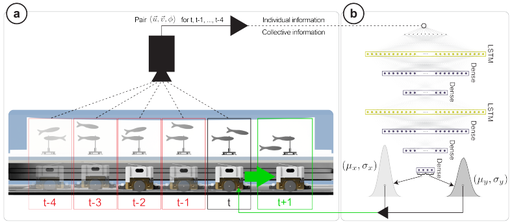
Figure 2 : Closed-loop robot control with Deep Learning Interaction (DLI) model. (a) We use the top setup camera to track all agents (fish and/or lure) in real-time, and store unique trajectories for each agent. A 5 × 11 vector of individual and collective states, spanning 5 timesteps is fed to the DLI. (b) The DLI outputs two acceleration distributions, one for each Cartesian component. Then, the acceleration is used to compute the updated desired speed and position for t + 1, which are communicated to the robot.
원문 · CC BY 4.0 · Vaios Papaspyros, Guy Theraulaz, Clément Sire, Francesco Mondada · Quantifying the biomimicry gap in biohybrid robot-fish pairs · 원문 그림 인용 · 원본 PDF 3쪽에서 그림 영역을 추출했습니다.짧은 시간과 긴 시간 척도의 관측량 비교
검증은 물고기 전용 실험, DLI 시뮬레이션 쌍(DLI-SP), DLI 생체혼합 쌍(DLI-BP)의 세 조건을 비교합니다. 개별 관측량으로는 속도, 벽까지의 거리, 벽에 대한 입사각을, 집단 관측량으로는 쌍 사이 거리, 방향 차이, 지각 각도를 씁니다. 장기 동역학은 평균제곱변위 CX(t), 속도 자기상관 CV(t), 벽 각도의 상관 Cθw(t)로 확인합니다. 두 PDF의 차이는 Hellinger 거리로 측정하며, 이 거리는 두 분포의 중첩을 기준으로 0이면 동일, 1에 가까우면 겹침이 거의 없음을 뜻합니다.
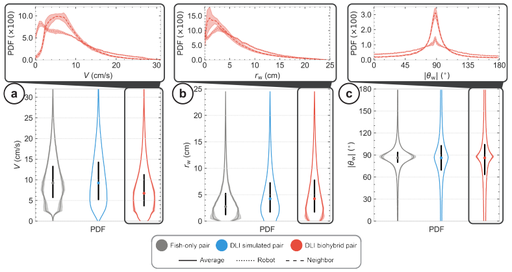
Figure 4 : Instantaneous individual quantities. (a)Speed V probability density function. (b) Distance to the wall rw probability density function. (c) Angle of incidence to the wall θw probability density function. Dark gray, blue, and red colors correspond to the distributions of the fish-only experiment, the DLI simulated pairs, and the DLI biohybrid pairs, respectively. In all PDFs, the colored dot corresponds to the median, and the thick horizontal black line corresponds to the limits of the first and third quartile. The top inset plots depict the PDFs of the DLI biohybrid pair experiments, where the dotted and dashed lines correspond to the robot’s and its neighbor’s distributions, respectively. The shaded areas correspond to the standard deviation.
원문 · CC BY 4.0 · Vaios Papaspyros, Guy Theraulaz, Clément Sire, Francesco Mondada · Quantifying the biomimicry gap in biohybrid robot-fish pairs · 원문 그림 인용 · 원본 PDF 10쪽에서 그림 영역을 추출했습니다.시뮬레이션 대비 생체혼합 쌍의 차이
DLI-SP와 DLI-BP의 평균 Hellinger 거리는 0.11로, 물고기 전용 실험을 무작위로 두 집합으로 나눈 bootstrap 기준선 0.10과 비교됩니다. 이는 DLI-BP가 DLI-SP와 가까우면서도 물고기 전용 실험과의 차이가 더 큰 구조를 보여 줍니다. 물고기 전용 대비 DLI-BP의 평균 거리는 0.20이며, 방향 차이 |ϕij|의 Hellinger 거리 0.30이 가장 큰 불일치로 보고됩니다. 이 값은 로봇이 실제로 생성한 집단 방향 분포가 물고기와 가장 다르다는 의미로 읽힙니다.
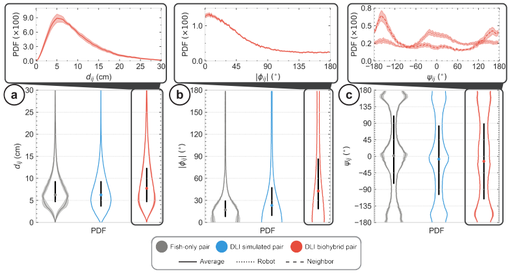
Figure 5 : Instantaneous collective quantities. (a)Interindividual distance dij probability density function. (b) Difference in heading angles |ϕij| probability density function. (c) Viewing angle ψij probability density function. Dark gray, blue, and red colors correspond to the distributions of the experiment, DLI simulated pairs and DLI biohybrid pairs, respectively. In all PDFs, the colored dot corresponds to the median, and the thick horizontal black line corresponds to the limits of the first and third quartile. The inset plots depict the PDFs of the DLI biohybrid pair experiments where the dotted, dashed, and solid lines correspond to the robot, neighbor and average agent distributions, respectively. The shaded areas correspond to the standard deviation.
원문 · CC BY 4.0 · Vaios Papaspyros, Guy Theraulaz, Clément Sire, Francesco Mondada · Quantifying the biomimicry gap in biohybrid robot-fish pairs · 원문 그림 인용 · 원본 PDF 11쪽에서 그림 영역을 추출했습니다.DLIv2 결과와 각도 제어의 한계
DLIv2는 현재 물고기 전용 실험 데이터로 재학습되었으며, 시뮬레이션에서 물고기 전용 실험과 높은 일치를 보였습니다. 그러나 이 모델은 LureBot 실험에 사용되지 않아 로봇 상호작용 결과로는 평가되지 않았습니다. 저자들은 로봇의 각도 제어가 상대적으로 덜 정밀하여 각도 관련 분포의 편차에 기여한다고 해석합니다. 이 해석은 관찰된 분포 차이에 대한 해석이며, 별도의 제어 실험으로 확정된 원인은 아닙니다.
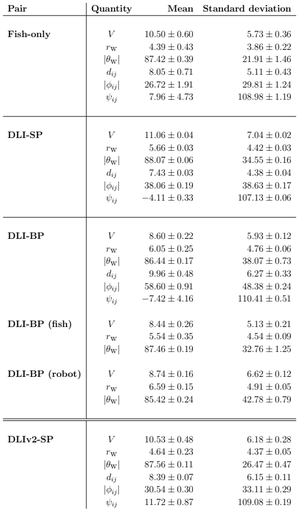
Table 1 : Means and standard deviations.For fish-only experiments, DLI simulated pairs (DLI-SP), and biohybrid pairs (DLI-SP), we report the mean and the standard deviation (SD) of the 6 observables introduced in Section 1.3, along with their respective standard error. The speed V is given in cm/s, the distances rw and dij are given in cm, and the angles |θw|, |ϕij|, and ψij are in degrees. Note the small standard error in the case of the (DLI-SP) resulting from extensive simulations (16.6 h long, almost twice the amount of data collected for other cases) and the fact that the 2 agents are statistically identical. For the biohybrid experiments, we report the mean and SD for V , rw, and |θw|, averaged over the fish and the LureBot, as well as for each of them. Finally, we present the corresponding results for a DLI model retrained on the present fish experiments (DLIv2-SP).
원문 · CC BY 4.0 · Vaios Papaspyros, Guy Theraulaz, Clément Sire, Francesco Mondada · Quantifying the biomimicry gap in biohybrid robot-fish pairs · 원문 그림 인용 · 원본 PDF 12쪽에서 그림 영역을 추출했습니다.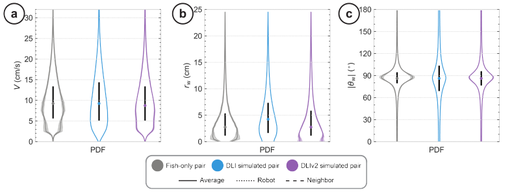
Figure 7 : Instantaneous individual quantities. (a)Speed V probability density function. (b) Distance to the wall rw probability density function. (c) Angle of incidence to the wall θw probability density function. Dark gray, blue, and red colors correspond to the distributions of the fish-only experiment, the DLI simulated pairs, and the DLIv2 simulated pairs, respectively. In all PDFs, the colored dot corresponds to the median, and the thick horizontal black line corresponds to the limits of the first and third quartile. The shaded areas correspond to the standard deviation.
원문 · CC BY 4.0 · Vaios Papaspyros, Guy Theraulaz, Clément Sire, Francesco Mondada · Quantifying the biomimicry gap in biohybrid robot-fish pairs · 원문 그림 인용 · 원본 PDF 17쪽에서 그림 영역을 추출했습니다.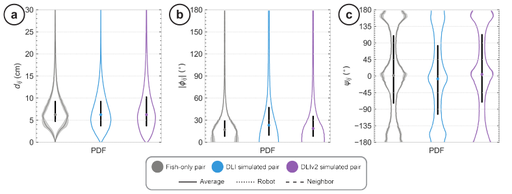
Figure 8 : Instantaneous collective quantities. (a)Interindividual distance dij probability density function. (b) Difference in heading angles |ϕij| probability density function. (c) Viewing angle ψij probability density function. Dark gray, blue, and red colors correspond to the distributions of the experiment, DLI simulated pairs and DLIv2 simulated pairs, respectively. In all PDFs, the colored dot corresponds to the median, and the thick horizontal black line corresponds to the limits of the first and third quartile. The shaded areas correspond to the standard deviation.
원문 · CC BY 4.0 · Vaios Papaspyros, Guy Theraulaz, Clément Sire, Francesco Mondada · Quantifying the biomimicry gap in biohybrid robot-fish pairs · 원문 그림 인용 · 원본 PDF 18쪽에서 그림 영역을 추출했습니다.논문 정보
- 저자
- Vaios Papaspyros, Guy Theraulaz, Clément Sire, Francesco Mondada
- 학회·저널
- arXiv · 프리프린트
- 최초 공개일
- 2023년 8월 17일
- 등록일
- 2026년 11월 6일
- 수정일
- 2024년 3월 17일
- 버전
- v2
- arXiv
- 2308.08978
- 분류
- cs.RO · cs.LG · q-bio.QM
- 원문 이용 조건
- CC BY 4.0
- 제공 범위
- 논문 정보, 해설, 허용된 원문 그림
AI 해설은 논문 원문과 별개의 설명이며 오류가 있을 수 있습니다. 원문과 그림은 각 출처의 이용 조건과 따로 표시된 권리를 따릅니다.
초록
Biohybrid systems in which robotic lures interact with animals have become compelling tools for probing and identifying the mechanisms underlying collective animal behavior. One key challenge lies in the transfer of social interaction models from simulations to reality, using robotics to validate the modeling hypotheses. This challenge arises in bridging what we term the "biomimicry gap", which is caused by imperfect robotic replicas, communication cues and physics constraints not incorporated in the simulations, that may elicit unrealistic behavioral responses in animals. In this work, we used a biomimetic lure of a rummy-nose tetra fish (Hemigrammus rhodostomus) and a neural network (NN) model for generating biomimetic social interactions. Through experiments with a biohybrid pair comprising a fish and the robotic lure, a pair of real fish, and simulations of pairs of fish, we demonstrate that our biohybrid system generates social interactions mirroring those of genuine fish pairs. Our analyses highlight that: 1) the lure and NN maintain minimal deviation in real-world interactions compared to simulations and fish-only experiments, 2) our NN controls the robot efficiently in real-time, and 3) a comprehensive validation is crucial to bridge the biomimicry gap, ensuring realistic biohybrid systems.
원문 인용
Vaios Papaspyros, Guy Theraulaz, Clément Sire, Francesco Mondada (2023). Quantifying the biomimicry gap in biohybrid robot-fish pairs. arXiv:2308.08978v2. https://arxiv.org/abs/2308.08978v2
BibTeX
@misc{papaspyros2023quantifying,
  title = {{Quantifying the biomimicry gap in biohybrid robot-fish pairs}},
  author = {Vaios Papaspyros and Guy Theraulaz and Clément Sire and Francesco Mondada},
  year = {2023},
  eprint = {2308.08978},
  archivePrefix = {arXiv},
  url = {https://arxiv.org/abs/2308.08978v2}
}