논문 해설
Learning Land-Surface Hydrology World Model from Satellite Observations
LandWM: 위성 관측으로 토양 물을 읽는 세계 모델
- 연구 문제 육지 물 예측 모델은 강수가 바뀌었을 때 올바르게 반응하는지 거의 시험되지 않았습니다. 위성은 토양 물을 직접 재지 않아 잠재 상태의 뜻도 정해지지 않습니다.
- 연구 방법 LandWM은 강수를 행동으로 두고, 물리 관측 연산자로 잠재 상태의 뜻을 고정합니다. 상태는 질량 보존 물수지에 따라 강수에 맞춰 바뀝니다.
- 주요 결과 LandWM의 표면 토양수는 현장 프로브와 중간값 상관 0.82를 보여, SMAP Level-4의 0.79보다 높았습니다.
예측 모델은 행동의 반사실을 말해 주지 못합니다
기상 예측 모델은 이미 운영 시스템과 겨룰 만큼 좋아졌고, 육지에서도 순환 신경망이 토양 수분과 하천 유량을 예측합니다. 그런데 이 모델들은 과거를 이어 가도록 학습되므로, 강수 같은 구동 요인은 입력의 하나로 들어갈 뿐입니다. 그래서 강수가 바뀌었을 때 모델이 올바르게 반응하는지는 거의 시험되지 않았습니다(그림 1).
예측 성능으로는 이 물음에 답할 수 없습니다. 모델이 관측값을 잘 맞히면서도 그 뒤의 과정에 대해 틀린 그림을 가질 수 있고, 관측만으로 학습한 잠재 상태는 추가 구조 없이는 식별되지 않습니다. 이 문제는 상태가 한 번도 관측되지 않는 자연계에서 가장 날카롭습니다. 위성은 토양 속 물이 아니라 마이크로파 밝기온도와 반사 전파의 세기를 측정하고, 현장 프로브는 땅의 극히 작은 부분만 샘플링합니다. 저자들은 이 조건에서 두 가지 질문을 던집니다. 관측 자료만으로 학습한 모델이 행동인 강수에 올바르게 반응하는지, 그리고 그 잠재 상태를 라벨 없이 토양 수분으로 읽을 수 있는지입니다.
저자들은 첫 질문에 대한 답으로 물리가 상태의 의미를 고정하도록 설계했습니다. LandWM의 잠재 상태는 9 km 격자마다 물 저장량을 담고 질량을 보존하는 물수지에 따라 변하며, 물수지가 놓치는 부분은 자유 채널이 맡습니다. 상태는 토양 수분과 한 번도 비교되지 않고, 대신 각 센서가 미분 가능한 물리 순방향 모델(differentiable physical forward model)로 상태에서 그려지며 작은 경계 잔차가 더해집니다. SMAP의 L대역 복사계에는 방출 모델을, CYGNSS의 GNSS 반사 신호에는 코히어런트 반사 모델을 씁니다. 위성이 보는 것을 설명하려면 저장량이 토양 물처럼 행동해야 하므로, 상태의 의미는 관측 자체가 강제합니다.
cross-attention은 어느 센서에서 오든 불규칙한 관측을 받아들이고, 모델은 열린 루프 롤아웃(open-loop rollout)에서 강수만 주어졌을 때 미래 관측을 예측하도록 학습합니다.
학습 데이터는 미국 남부 대평원에서 7년 동안 모은 SMAP과 CYGNSS 관측으로, 관측 토큰은 70.8 million 개입니다. 강수 입력으로는 IMERG 강수 자료를 썼습니다.
강수를 행동으로 둔 잠재 상태 모델
LandWM은 강수를 행동으로 두고, 잠재 상태가 질량 보존 물수지에 따라 갱신되도록 설계되었습니다. 잠재 상태에는 표면 토양수, 뿌리대, 심층 저장, 웅덩이 물, 식생 물의 다섯 물리 저장량이 mm 단위로 들어 있고, 나머지 96개 자유 채널은 거칠기나 식생 구조 같은 미모형화 요인을 담습니다. 전이 단계에서는 3×3 합성곱 네트워크가 셀별 흐름 분할 logit을 내고, 침투·유출·증발·배수 순서로 물을 나눕니다. 저장량은 음수가 되지 않으며 물이 셀 사이에서 교환되지 않습니다.
관측은 교차 어텐션으로 사전 상태에 반영됩니다. 각 격자 셀의 질의가 셀 안의 관측 토큰을 집계하고, 저장량은 지수 형태로 곱해 갱신되어 한 단계에서 bounded 비율 이상 변하지 않습니다. 이 과정은 학습 때에만 쓰이며, 롤아웃에서는 관측 없이 강수와 문맥만으로 상태를 굴립니다.

Table 5 .Held-out sensoron the validation year: LandWM (three seeds) with one sensor never assimilated. Columns as in Tab. 3.
원문 · CC BY 4.0 · Suya Li, Zekun Qi, Xiaochong Xu, Duo Zhang · Learning Land-Surface Hydrology World Model from Satellite Observations · 원문 그림 인용 · 원본 PDF 9쪽에서 그림 영역을 추출했습니다.관측 연산자는 물리 순방향 모델입니다. SMAP에는 τ–ω 모델과 Mironov 유전 모델이 쓰이고, CYGNSS에는 준-정상 반사 모델이 쓰입니다. 그 위에 ±2 K와 ±1 dB로 제한된 작은 신경 잔차를 더해 보정합니다. 따라서 저장량이 실제 토양 수분의 의미를 갖도록 물리가 잠재 상태를 고정합니다.
토양 수분 판독과 두 전이의 역할 분담
토양 수분 판독은 LandWM이 토양 수분 값을 한 번도 본 적 없이 현장 관측과 얼마나 맞는지를 보여줍니다. 모델의 표면 저장량은 관측 연산자가 토양 수분으로 고정해 둔 값이라서 별도의 맞춤 없이 그대로 읽힙니다. 28개 현장 프로브와 같은 샘플에서 중간값 상관은 시드마다 0.82였고, 같은 조건에서 SMAP Level-4는 0.79, ERA5-Land는 0.71, SMAP 반사 온도로 학습한 LSTM은 0.72였습니다. 저자들은 이 차이가 물리 관측 연산자가 저장량을 토양 수분으로 묶어 둔 데서 나온다고 봅니다.
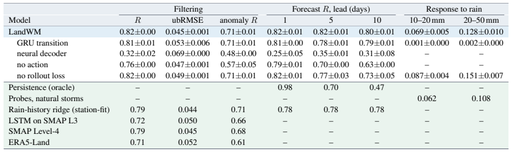
Table 3 .Station soil moistureon the validation year (median over 28 USCRN and SCAN stations). Baselines are scored on the samples at which LandWM is scored; on the LSTM’s daily (12 UTC) samples LandWM obtainsR= 0.82. Forecasts start from a filtered state with observed rain; oracle persistence keeps the station’s value at the forecast start. Response to rain: median increment of surface soil moisture after synthetic pulses of 10–20 and 20–50 mm added to a filtered state; for the probes, after isolated natural storms of the same size (gauge rain). The rain-history ridge is fitted to each station on the training period; LandWM never sees the stations. Mean±std over three seeds (LandWM, GRU transition) or two (other ablations).
원문 · CC BY 4.0 · Suya Li, Zekun Qi, Xiaochong Xu, Duo Zhang · Learning Land-Surface Hydrology World Model from Satellite Observations · 원문 그림 인용 · 원본 PDF 8쪽에서 그림 영역을 추출했습니다.관측 연산자를 신경망으로 바꾼 신경 디코더 모델은 관측을 예측하는 성능이 LandWM과 비슷했습니다. 하지만 같은 방식으로 직접 읽은 표면 저장량과 프로브의 상관은 0.32로 떨어졌습니다. 같은 잠재 상태를 학습 구간의 관측소에 맞춘 릿지 프로브로 읽으면 0.81까지 나와서 토양 수분 정보는 잠재 상태 안에 남아 있었습니다. 즉 정보는 있지만 라벨이 없으면 찾을 수 없었습니다.
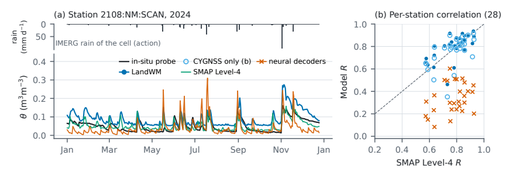
Figure 3 .Station soil moisture on the validation year(seed 0). (a) Daily means at the station with the median correlation of LandWM among stations with a complete record; top: the IMERG rain of the cell, the action. (b) Per-station correlation against that of SMAP Level-4, on the same samples: LandWM assimilating both sensors or CYGNSS only, and the same model with neural decoders, which forecasts the observations equally well.
원문 · CC BY 4.0 · Suya Li, Zekun Qi, Xiaochong Xu, Duo Zhang · Learning Land-Surface Hydrology World Model from Satellite Observations · 원문 그림 인용 · 원본 PDF 8쪽에서 그림 영역을 추출했습니다.전이를 바꾼 실험에서는 GRU 전이가 단일 셀에 내린 20에서 50 mm 강수에 대해 표면 저장량을 0.002만큼만 올렸습니다. 이는 프로브의 0.11, LandWM의 0.13과 차이가 컸습니다. GRU 전이의 예측도 강수에 거의 비슷하게 의존했는데, 강수를 0으로 두면 SMAP NLL이 2.98±0.06 올랐고 LandWM은 3.31±0.10이었습니다. 행동을 빼면 모델은 강수에 아예 반응하지 않았고, rollout 손실을 뺀 변형은 0.86과 0.92의 순위 상관을 얻었지만 반응이 지나치게 컸습니다.
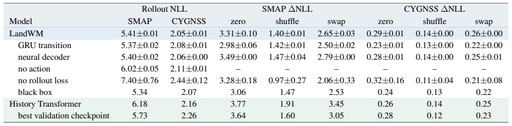
Table 4 .Observation forecasts and action groundingon the validation year. Rollout NLL: per-token NLL of SMAP and CYGNSS observations over 10-day open-loop rollouts with the observed rain.∆NLL: increase when the rain is set to zero, shuffled in time, or replaced by the same season of an earlier year (mean of one and two years).
원문 · CC BY 4.0 · Suya Li, Zekun Qi, Xiaochong Xu, Duo Zhang · Learning Land-Surface Hydrology World Model from Satellite Observations · 원문 그림 인용 · 원본 PDF 9쪽에서 그림 영역을 추출했습니다.남은 제약과 다음 단계
이 연구의 범위는 좁습니다. 저자들은 미국 남부 대평원의 한 지역을 골랐고, 프로브와 위성이 함께 관측하는 5 cm 깊이만 다뤘습니다. 강수는 모델 안에서 만들어지지 않고 외생 변수로 입력되며, 그에 딸린 기상 문맥은 MERRA-2에서 가져왔습니다. 그래서 강수 반응은 모델 바깥에서 주어진 비가 두 전이를 어떻게 통과했는지로 읽어야 할 대상이 됩니다.

Table 6 .Soil-moisture change on days when IMERG and the station’s gauge disagree(validation and test years).∆θ: median change from before the day to the mean of the next day; wet: fraction of events with∆θ >0.02. LandWM: mean over three seeds; closer: events at which its change is closer to the probe’s than the ridge’s (range over seeds), and two-sided Wilcoxonp(uncorrected).
원문 · CC BY 4.0 · Suya Li, Zekun Qi, Xiaochong Xu, Duo Zhang · Learning Land-Surface Hydrology World Model from Satellite Observations · 원문 그림 인용 · 원본 PDF 10쪽에서 그림 영역을 추출했습니다.전이 구조에도 한계가 있습니다. 이 모델의 전이에는 측방 흐름이 없어서 물이 옆 칸으로 흘러가는 경로가 빠져 있습니다. 그 대신 침투와 유출의 분할이 학습되는데, 이 학습된 분할 때문에 지역 강수에 대한 반응이 지나치게 약하게 나타났습니다(Sec. 4.5 참고). 단일 시험이 얼마나 많은 것을 가릴 수 있는지도 여기서 드러납니다. 지역 전체에 비가 내리는 조건에서는 두 전이의 역할이 서로 뒤바뀌었습니다. 즉 한 가지 조건에서 맞은 해석이 다른 조건에서도 그대로 유지되지는 않았습니다. 저자들은 학습된 세계 모델도 물리 모델을 점검하듯 여러 종류의 개입 아래에서 확인해야 한다고 봅니다.
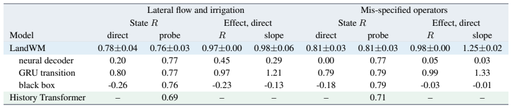
Table 2 .Twins that break the model’s assumptions.Left: the truth adds lateral run-on, lateral subsurface flow and unobserved irrigation. Right: observations are generated by operators outside the decoders’ family. Columns as in Tab. 1; full tables in Tabs. S5 and S6.
원문 · CC BY 4.0 · Suya Li, Zekun Qi, Xiaochong Xu, Duo Zhang · Learning Land-Surface Hydrology World Model from Satellite Observations · 원문 그림 인용 · 원본 PDF 7쪽에서 그림 영역을 추출했습니다.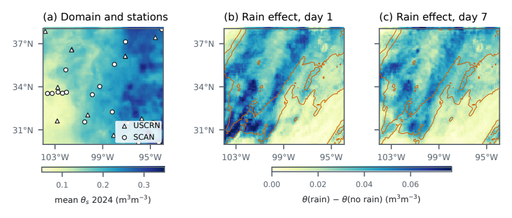
Figure 4 .LandWM on real data(seed 0, validation year). (a) Mean filtered surface soil moistureθ s =S s/50mm and the 28 in-situ stations. (b, c) Counterfactual effect of rain,θ(rain)−θ(no rain), one and seven days after the onset of the event of 18 November 2024 (domain-mean rain 27 mm on the first day); contours: 10 and 30 mm of first-day rain. For regional rain like this, the size of the effect is underestimated (Sec. 4.5).
원문 · CC BY 4.0 · Suya Li, Zekun Qi, Xiaochong Xu, Duo Zhang · Learning Land-Surface Hydrology World Model from Satellite Observations · 원문 그림 인용 · 원본 PDF 9쪽에서 그림 영역을 추출했습니다.실제 데이터에서는 사건 규모의 건조 기간과 뿌리대가 아직 제약되지 않았습니다(Sec. S12 참고). 하지만 저자들은 다음 단계로 측방 경로 지정, GRACE 같은 더 깊은 물의 관측, 학습 중 더 다양한 강수를 꼽습니다. 이 세 가지가 들어와야 지금은 확인하지 않은 건조 기간과 뿌리대를 다룰 수 있다고 저자들은 봅니다.
논문 정보
- 저자
- Suya Li, Zekun Qi, Xiaochong Xu, Duo Zhang
- 학회·저널
- arXiv · 프리프린트
- 최초 공개일
- 2026년 11월 21일
- 등록일
- 2026년 11월 24일
- 수정일
- 2026년 11월 21일
- 버전
- v1
- arXiv
- 2611.28963
- 분류
- cs.CV · cs.AI · cs.LG
- 원문 이용 조건
- CC BY 4.0
- 제공 범위
- 논문 정보, 해설, 허용된 원문 그림
AI 해설은 논문 원문과 별개의 설명이며 오류가 있을 수 있습니다. 원문과 그림은 각 출처의 이용 조건과 따로 표시된 권리를 따릅니다.
초록
A world model should tell us not only what will happen, but what would happen under a different action. Learned Earth models now forecast remarkably well, yet forecast skill says little about what their state means or how it responds to a changed driver. We build LandWM, a world model of land-surface water in which rain is the action, learned from seven years of SMAP and CYGNSS observations: physical observation operators tie its latent state to soil water, and a mass-conserving balance governs how that state responds to rain. Over the U.S. Southern Great Plains, the model, never shown a soil-moisture value, tracks 28 in-situ probes as well as the operational SMAP Level-4 product, even from CYGNSS alone, and a storm added to the forcing of a station's cell wets its soil as natural storms wet the probes. Replace either piece and the forecasts stay, but the meaning goes: with neural operators, only a probe fitted to the stations finds the soil water; with a generic recurrent transition, rain on a single cell barely moves it. Yet when the same rain covers the whole region the two transitions swap roles, and the conserving one responds too weakly. Grounding makes a world model readable; its response to actions must be tested under more than one kind of intervention.
원문 인용
Suya Li, Zekun Qi, Xiaochong Xu, Duo Zhang (2026). Learning Land-Surface Hydrology World Model from Satellite Observations. arXiv:2611.28963v1. https://arxiv.org/abs/2611.28963v1
BibTeX
@misc{li2026learning,
  title = {{Learning Land-Surface Hydrology World Model from Satellite Observations}},
  author = {Suya Li and Zekun Qi and Xiaochong Xu and Duo Zhang},
  year = {2026},
  eprint = {2611.28963},
  archivePrefix = {arXiv},
  url = {https://arxiv.org/abs/2611.28963v1}
}