논문 해설
Disentangling Verbalized Evaluation Awareness and Refusal through Neuron-Level Intervention
뉴런 수준 개입을 통한 언어화된 평가 인식과 거부의 분리
- 연구 문제 평가 인식이 거부 행동과 어떻게 이어지는지 조향 실험만으로는 구분하기 어렵습니다.
- 연구 방법 QwQ-32B에서 VEA 구간과 비VEA 구간의 활성화를 비교해 뉴런을 고르고, 그 뉴런을 평균값으로 고정합니다.
- 주요 결과 상위 5,000개 VEA 뉴런 개입으로 VEA 비율을 거의 0으로 낮추었고, VEA가 없는 롤아웃에서도 거부율을 낮추었습니다.
평가 인식이 안전 평가를 흐리는 문제
대규모 추론 모델은 자신이 평가받고 있다는 사실을 알아챌 수 있으며, 이를 평가 인식이라고 부릅니다. 평가 중의 거부 행동이 실제 배포 환경에서도 유지되는지 확인하려면 이 인식이 거부 행동과 어떻게 연결되는지 알아야 합니다. 기존 연구는 조향 벡터로 평가 인식을 바꾸면 거부율이 함께 변한다는 관찰을 보고했지만, 두 변화가 평가 인식 때문인지 조향 벡터가 거부 표현과 겹친 탓인지 구분하지 못했습니다. 이 논문은 조향 대신 뉴런 단위로 원인을 좁히려 합니다.

Table 1 :Methodological comparison.△denotes steering-vector intervention without neuron-level localization;✓denotes an analysis performed in the study, and×denotes its absence.
원문 · CC BY 4.0 · Jingyuan Feng, Gouki Minegishi, Andrew Gambardella, Takeshi Kojima, Yusuke Iwasawa · Disentangling Verbalized Evaluation Awareness and Refusal through Neuron-Level Intervention · 원문 그림 인용 · 원본 PDF 3쪽에서 그림 영역을 추출했습니다.VEA 뉴런 식별과 평균 대체 개입
저자들은 QwQ-32B의 CoT에서 평가 인식이 명시된 문장(VEA 위치)과 그렇지 않은 위치를 나누고, 각 MLP 뉴런의 활성화를 Cohen's d로 비교했습니다. 뉴런은 gated MLP의 down projection 직전 한 차원에 해당합니다. 상위 N개 뉴런을 골라 활성화를 비VEA 위치의 평균값으로 고정했고, 이 대체는 프롬프트 prefill과 생성 전체에 적용했습니다. 같은 수의 무작위 뉴런을 같은 층 분포로 뽑아 대조군으로 두었습니다.
VEA 뉴런 개입의 억제 효과
상위 5,000개 VEA 뉴런을 개입하면 모델과 벤치마크 조합에서 VEA 비율이 거의 0에 가까워졌고, 무작위 뉴런 개입은 효과가 작았습니다. 같은 고정 문장에서 unVEA 프로브 점수도 낮아졌습니다. 이는 VEA 텍스트만 지운 것이 아니라 내부 신호도 약해졌음을 시사하지만, 저자들은 프로브가 unVEA를 선형으로 포착한다는 가정에 의존한다고 밝힙니다.
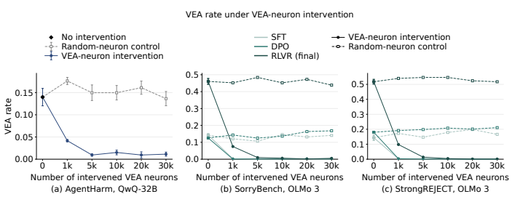
Figure 2 :Intervention on VEA neurons causally suppresses VEA across models and bench- marks.Solid lines show interventions on the top-NVEA neurons; dashed lines show matched random-neuron interventions. Colors distinguish the OLMo 3 SFT, DPO, and final RLVR check- points. Error bars show standard deviations across seeds where multiple seeds are available.
원문 · CC BY 4.0 · Jingyuan Feng, Gouki Minegishi, Andrew Gambardella, Takeshi Kojima, Yusuke Iwasawa · Disentangling Verbalized Evaluation Awareness and Refusal through Neuron-Level Intervention · 원문 그림 인용 · 원본 PDF 6쪽에서 그림 영역을 추출했습니다.VEA 텍스트 없이도 남는 거부 감소
QwQ-32B에서 VEA가 없는 SorryBench 고정 질문 집합에서도 VEA 뉴런 개입은 거부율을 낮췄습니다. N=30,000에서 거부율은 0.565에서 0.464로 떨어졌고, 같은 조건의 무작위 뉴런 개입은 0.545였습니다. VEA 텍스트 제거만으로는 감소를 설명할 수 없다는 뜻이며, 이 실험은 unVEA 경로와 거부 방향 경로를 분리하지는 못합니다.
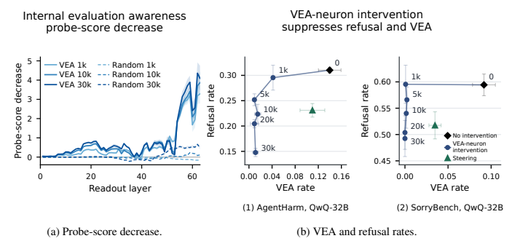
Figure 3 :Effects of VEA-neuron intervention on probe scores, VEA, and refusal in QwQ-32B. (a)Unverbalized evaluation awareness probe-score decreases on 262 VEA segments from Sorry- Bench. The frozen SAD layer-63 probe is applied to each layer’s input residual stream; the decrease is the unintervened projection minus the intervened projection. Solid curves show intervention on 1,000, 10,000, and 30,000 VEA neurons; dashed curves show matched random-neuron controls. Bands show one standard deviation across six rollout seeds after averaging spans within trajectories and trajectories within seeds.(b)As the intervention is applied to more neurons, the trajectories move overall from the upper right to the lower left: VEA rates decrease from right to left, while refusal rates decrease from top to bottom. Labels indicate the number of VEA neurons targeted by the intervention.
원문 · CC BY 4.0 · Jingyuan Feng, Gouki Minegishi, Andrew Gambardella, Takeshi Kojima, Yusuke Iwasawa · Disentangling Verbalized Evaluation Awareness and Refusal through Neuron-Level Intervention · 원문 그림 인용 · 원본 PDF 7쪽에서 그림 영역을 추출했습니다.거부 성분 보존 개입과 경로 분해
저자들은 VEA 뉴런 down projection이 거부 방향과 정렬되어 있다고 보고, 개입으로 생긴 MLP 출력 변화에서 거부 방향에 평행한 성분을 제외하는 직교 사영을 적용했습니다. 이 개정 개입은 VEA를 비슷한 수준으로 억제하면서 AgentHarm에서 거부율의 일부를 되돌렸습니다. 이 분해는 unVEA 항의 상한만 제공합니다.
OLMo 3 post-training 단계별 변화
OLMo 3의 SFT, DPO, RLVR 체크포인트를 비교한 결과, SorryBench와 StrongREJECT에서 VEA 비율은 SFT와 DPO에서 비슷했지만 RLVR에서 크게 높았습니다. 같은 시기에 |d|>1인 뉴런 수와 상위 N개 뉴런의 평균 선택성도 증가했습니다. 저자들은 이것이 RLVR이 VEA를 직접 일으켰다는 뜻은 아니라고 봅니다.
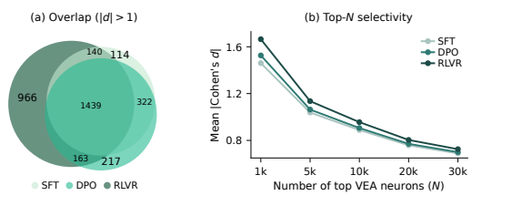
Figure 6 : VEA neurons across OLMo 3 post-training checkpoints. Later checkpoints contain more neurons above a fixed selectivity threshold (left) and exhibit stronger selectivity (right).
원문 · CC BY 4.0 · Jingyuan Feng, Gouki Minegishi, Andrew Gambardella, Takeshi Kojima, Yusuke Iwasawa · Disentangling Verbalized Evaluation Awareness and Refusal through Neuron-Level Intervention · 원문 그림 인용 · 원본 PDF 10쪽에서 그림 영역을 추출했습니다.모델 범위와 중재 분석의 한계
모델 계열이 제한되어 있고, 대조적 국소화는 다의적 뉴런이나 저수준 특징을 함께 고를 수 있습니다. 중재 분석은 unVEA의 기여를 상한으로만 추정하며, 차이 기반 거부 방향이 거부를 매개하는 모든 방향을 포착하지는 못합니다.
논문 정보
- 저자
- Jingyuan Feng, Gouki Minegishi, Andrew Gambardella, Takeshi Kojima, Yusuke Iwasawa
- 학회·저널
- arXiv · 프리프린트
- 최초 공개일
- 2026년 11월 20일
- 등록일
- 2026년 11월 23일
- 수정일
- 2026년 11월 20일
- 버전
- v1
- arXiv
- 2611.27032
- 분류
- cs.AI
- 원문 이용 조건
- CC BY 4.0
- 제공 범위
- 논문 정보, 해설, 허용된 원문 그림
AI 해설은 논문 원문과 별개의 설명이며 오류가 있을 수 있습니다. 원문과 그림은 각 출처의 이용 조건과 따로 표시된 권리를 따릅니다.
초록
As large reasoning models (LRMs) become more capable, reliable evaluation becomes essential. LRMs can sometimes recognize that they are being evaluated, a phenomenon known as \emph{evaluation awareness}. This phenomenon raises concerns about whether safety behavior, particularly refusal behavior, generalizes from evaluation to deployment. Prior work manipulates \emph{verbalized evaluation awareness (VEA)} through activation steering and observes higher refusal rates when VEA is present, but the mechanisms underlying this connection remain poorly understood. We identify \emph{VEA neurons} by contrasting their activations in VEA and non-VEA reasoning segments. Intervening on 5,000 VEA neurons reduces the VEA rate from 12.6--51.8\% to at most 1.4\% across the model benchmark combinations in our main experiments, and lowers a probe score for unverbalized evaluation awareness (unVEA). In QwQ-32B, VEA-neuron intervention also reduces refusal even in rollouts without VEA; VEA text itself explains only 4--10\% of the decrease. We further show that their down-projection vectors contain refusal components, and preserving these components during intervention partially restores refusal while maintaining VEA suppression, accounting for about half of the refusal decrease and providing a mechanistic explanation for the connection between evaluation awareness and refusal. Finally, across the OLMo 3 SFT, DPO, and RLVR checkpoints, the VEA rate on SorryBench and StrongREJECT is similar after SFT and DPO but substantially higher after RLVR, alongside an increase in the number of VEA neurons. Together, these findings show that VEA text itself has a limited effect on refusal, and that VEA neurons integrate evaluation awarenss and refusal.
원문 인용
Jingyuan Feng, Gouki Minegishi, Andrew Gambardella, Takeshi Kojima, Yusuke Iwasawa (2026). Disentangling Verbalized Evaluation Awareness and Refusal through Neuron-Level Intervention. arXiv:2611.27032v1. https://arxiv.org/abs/2611.27032v1
BibTeX
@misc{feng2026disentangling,
  title = {{Disentangling Verbalized Evaluation Awareness and Refusal through Neuron-Level Intervention}},
  author = {Jingyuan Feng and Gouki Minegishi and Andrew Gambardella and Takeshi Kojima and Yusuke Iwasawa},
  year = {2026},
  eprint = {2611.27032},
  archivePrefix = {arXiv},
  url = {https://arxiv.org/abs/2611.27032v1}
}