논문 해설
Efficient Reinforcement Learning for StarCraft by Abstract Forward Models and Transfer Learning
추상 순방향 모델과 전이 학습을 이용한 스타크래프트의 효율적인 강화 학습
- 연구 문제 실시간 전략 게임 StarCraft II에서 강화학습은 막대한 계산 자원과 긴 학습 시간을 요구합니다. 이 논문은 사람이 설계한 추상 순방향 모델인 Thought-game(TG)과 transfer learning을 결합해 학습 비용을 줄이는 방법을 제안합니다.
- 연구 방법 TG는 실제 게임의 규칙을 중요도 순으로 추상화한 단순 환경으로, 여기서 ACRL로 먼저 학습한 정책을 XfrNet을 통해 실제 게임으로 전이합니다.
- 주요 결과 저자들은 단일 기기 환경에서 64×64 맵의 Level-7 내장 AI에 대해 99% 승률을 1.08시간 만에 달성했다고 보고하며, 치팅 Level-10 AI에 대해서는 90% 승률을 보고합니다. 비교 실험에서는 기존 방법보다 학습 시간과 단계 수가 적다고 보고합니다.
StarCraft II 강화학습의 비용 문제
실시간 전략 게임인 StarCraft II에서 강화학습은 큰 계산 자원과 긴 학습 시간을 요구합니다. 논문은 TStarBot이 3840개의 CPU 코어를 쓰고, OpenAIdota2는 128400개를 쓴다고 소개합니다. 또한 [6]의 전체 학습에는 44일이 걸린다고 언급합니다. 이 때문에 저자들은 이러한 비용이 실제 과제에 강화학습을 적용하기 어렵게 만든다고 봅니다.
논문은 사람의 지식을 주입하는 방법 중 효과적인 지식 주입 방식이 충분히 연구되지 않았다고 지적하고, 모델 기반 강화학습 관점에서 사람이 설계한 추상 순방향 모델을 제안합니다. 특히 SC2는 규칙이 많아 탐색 부담이 커집니다. 저자들은 시간 지평, 상태 공간, 행동 공간 같은 기존 어려움 이외에 과거 관측 누락, pysc2의 선택 문제, 규칙과 의존 관계의 누적을 추가 원인으로 제시합니다. 이 연구는 이러한 조건에서 사람이 만든 단순한 환경 모델이 실제 게임 학습의 출발점이 될 수 있는지를 묻습니다.
Thought-game: 규칙을 추상화한 순방향 모델
Thought-game(TG)은 실제 게임 RG를 대체하는 단순화된 MDP입니다. 실제 게임을 \(M_s=\langle S_s,A_s,P_s,R_s,\gamma,T_s\rangle\)로, TG를 \(M_m=\langle S_m,A_m,P_m,R_m,\gamma,T_m\rangle\)로 두고, 상태 대응 함수 \(f_s\)와 행동 대응 함수 \(f_a\)가 있으면 \(a_s=f_a(\pi_\phi(f_s(s_s)))\)로 TG 정책을 RG 행동으로 옮길 수 있다고 정의합니다. 실제 구현에서는 이 대응 함수를 직접 계산하기 어려우므로 \(\phi(S_m)\subset\phi(S_s)\), \(A_m=A_s\), \(P_m\approx P_s\)로 단순화합니다.
보상은 승패 결과만 사용합니다.
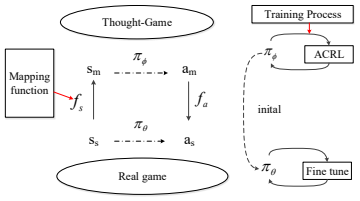
Fig. 1 : Thought-Game Architecture. Sm and Ss are the state spaces for TG and RG respectively. Am andAs are the action spaces while πφ and πθ are the policies. The dashed line in the right means the weight-parameters in πθ are initialed as ones in πφ before finetune training.
원문 · CC BY 4.0 · Ruo-Ze Liu, Haifeng Guo, Xiaozhong Ji, Yang Yu, Zhen-Jia Pang, Zitai Xiao, Yuzhou Wu, Tong Lu · Efficient Reinforcement Learning for StarCraft by Abstract Forward Models and Transfer Learning · 원문 그림 인용 · 원본 PDF 1쪽에서 그림 영역을 추출했습니다.TG-SC2의 설계는 유닛과 건물 정보, 그리고 SC2 규칙을 나누는 두 부분으로 이루어집니다. 규칙은 9개 모듈로 나누고 중요도 순서대로 추상화하며, 복잡한 전투 모듈은 Heroes of Might and Magic의 전투 방식으로 근사합니다. TG의 한 스텝은 RG의 9초에 해당하고, 상대인 Dummy는 시간에 따라 병사를 늘리며 난이도를 조절합니다. 논문은 이 설계 절차를 GTG 과정으로 정리합니다.
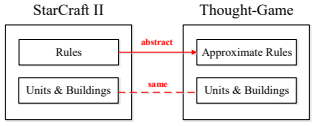
Fig. 4 : A module description of TG-SC2.
원문 · CC BY 4.0 · Ruo-Ze Liu, Haifeng Guo, Xiaozhong Ji, Yang Yu, Zhen-Jia Pang, Zitai Xiao, Yuzhou Wu, Tong Lu · Efficient Reinforcement Learning for StarCraft by Abstract Forward Models and Transfer Learning · 원문 그림 인용 · 원본 PDF 4쪽에서 그림 영역을 추출했습니다.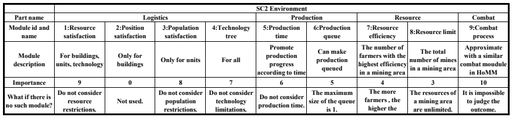
Fig. 5 : Modules of StarCraft II.
원문 · CC BY 4.0 · Ruo-Ze Liu, Haifeng Guo, Xiaozhong Ji, Yang Yu, Zhen-Jia Pang, Zitai Xiao, Yuzhou Wu, Tong Lu · Efficient Reinforcement Learning for StarCraft by Abstract Forward Models and Transfer Learning · 원문 그림 인용 · 원본 PDF 5쪽에서 그림 영역을 추출했습니다.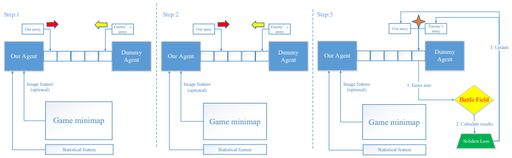
Fig. 6 : A spatial-temporal description of the battle process in TG-SC2. In terms of spatial, as we are playing 1v1 mode, we assume the main-bases of both players are in a straight line. The length of the line represents the distance between the two players in the RG map. This value can be set (e.g., 5 in this experiment). Each player has an army (simulating the control group in the RG, that is, different types of soldiers) in his base. When the player commands “attack”, its army begins to move to the enemy’s base, one grid per one step. When two armies meet in the same grid, they will enter a battlefield on which each army calculates total damages (enemy’s loss) based on its soldiers’ damage, number, and ranged type. At the end of the step, the army makes a reduction based on the loss (melee first). Then the next step. If one’s army is at the opponent’s base and the opponent’s soldiers reduce to empty, the excess damage is allocated to buildings. If the hit points of all buildings of one side drop to 0, it loses the game. In our experiment, 1 step in TG simulates 9 seconds of RG.
원문 · CC BY 4.0 · Ruo-Ze Liu, Haifeng Guo, Xiaozhong Ji, Yang Yu, Zhen-Jia Pang, Zitai Xiao, Yuzhou Wu, Tong Lu · Efficient Reinforcement Learning for StarCraft by Abstract Forward Models and Transfer Learning · 원문 그림 인용 · 원본 PDF 5쪽에서 그림 영역을 추출했습니다.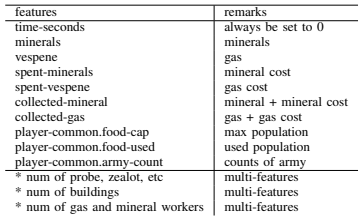
원문 그림 TABLE VIII: Thought-game state features
원문 · CC BY 4.0 · Ruo-Ze Liu, Haifeng Guo, Xiaozhong Ji, Yang Yu, Zhen-Jia Pang, Zitai Xiao, Yuzhou Wu, Tong Lu · Efficient Reinforcement Learning for StarCraft by Abstract Forward Models and Transfer Learning · 원문 그림 인용 · 원본 PDF 13쪽에서 그림 영역을 추출했습니다.ACRL로 TG에서 학습하고 RG로 전이하는 TTG 절차
TTG는 두 단계로 진행됩니다. 먼저 TG 1부터 TG 7까지 ACRL로 정책을 학습합니다. ACRL은 승률이 임계값 η를 넘으면 커리큘럼 난이도를 올리는 방식이며, 논문의 Algorithm 1에서 TG 단계는 η=0.95로 설정됩니다. 그다음 TG 7의 정책을 RG 7로 transfer learning의 finetune 방식으로 옮깁니다. 상태나 행동 공간이 다르면 XfrNet을 사용합니다. 이후 RG 7부터 RG 10까지 ACRL을 다시 적용하며, 이 단계의 임계값은 η=0.93입니다.
정책 최적화에는 PPO의 ϵ-클리핑 변형을 사용하고, 정책 모델은 OrigNet입니다. 일반 finetune은 이전 층을 동결하지만, 논문은 TG와 RG의 차이 때문에 동결 방식의 결과가 좋지 않았다고 보고합니다. 또한 RG 8에서 RG 10은 치팅 수준이라 전략이 더 무작위적이므로, 저자들은 RG 10으로 직접 전이하는 방식보다 RG 7에서 시작하는 단계적 절차가 학습 효과가 더 좋았다고 설명합니다.
XfrNet: 관측과 행동이 늘어난 실제 게임으로 정책 옮기기
XfrNet은 OrigNet을 확장한 구조입니다. TG에서 학습한 입력층과 은닉층은 그대로 복원하고, RG에서 추가되는 관측은 added obs 층과 minimap을 처리하는 ResNet-18 경로로 입력받습니다. 추가 행동은 added action logits 층에서 처리됩니다. 이 두 경로는 기존 Layer 1의 출력과 가중합(weighted sum)으로 합쳐지며, 논문은 w=0.2로 설정합니다. 행동 로짓층의 크기가 달라지므로 기존 가중치 일부만 복원하는 partially restore를 쓰고, 복원되지 않은 가중치는 \(U(-d,+d)\) 분포에서 초기화합니다. 이때 d는 1.0/500으로 설정되며, Xavier와 He 초기화보다 좋은 결과를 보고합니다.
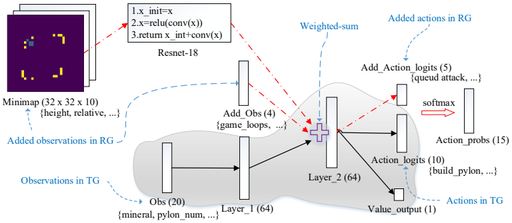
Fig. 7 : The proposed XfrNet. The layers in the grey region are OrigNet inside XfrNet. The value in the parenthesis after each layer name is the number of units for that layer. The text in the braces besides each layer name is the sample input features for that layer. Solid black lines are weighs trained in ∅⇒TG and then be restored in TG⇒RG. Red dash lines are weights newly trained in TG ⇒ RG. We use the minimap as the image input and pass it through a Resnet-18 (meaning it has 18 Resblocks). We use a weighted sum of the added image input, added observation, and the output of the Layer 1. Moreover, we only partially restore the weights in the action logit layer.
원문 · CC BY 4.0 · Ruo-Ze Liu, Haifeng Guo, Xiaozhong Ji, Yang Yu, Zhen-Jia Pang, Zitai Xiao, Yuzhou Wu, Tong Lu · Efficient Reinforcement Learning for StarCraft by Abstract Forward Models and Transfer Learning · 원문 그림 인용 · 원본 PDF 7쪽에서 그림 영역을 추출했습니다.
Fig. 11 : (a) Using or using not freezing layers. (b) Using or using not partially restore. (c) Using or using not weighted sum. (d) Effects of different initialization strategies. All experiments are done while TG⇒RG with XfrNet.
원문 · CC BY 4.0 · Ruo-Ze Liu, Haifeng Guo, Xiaozhong Ji, Yang Yu, Zhen-Jia Pang, Zitai Xiao, Yuzhou Wu, Tong Lu · Efficient Reinforcement Learning for StarCraft by Abstract Forward Models and Transfer Learning · 원문 그림 인용 · 원본 PDF 11쪽에서 그림 영역을 추출했습니다.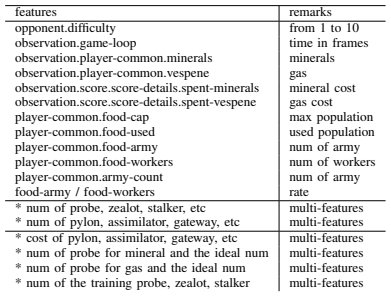
원문 그림 Table VIII. The added state vector features in XfrNet are: difficulty, game loop, food army, food workers. The macro- actions of the TG and RG are shown in Table IX. The added macro-actions in RG are: attack queued, retreat queued, gas worker only, attack main base, attack sub base.
원문 · CC BY 4.0 · Ruo-Ze Liu, Haifeng Guo, Xiaozhong Ji, Yang Yu, Zhen-Jia Pang, Zitai Xiao, Yuzhou Wu, Tong Lu · Efficient Reinforcement Learning for StarCraft by Abstract Forward Models and Transfer Learning · 원문 그림 인용 · 원본 PDF 13쪽에서 그림 영역을 추출했습니다.XfrNet은 \(S_m\leq S_s\)와 \(A_m\leq A_s\) 조건에서 TG에서 학습한 뒤 RG로 옮길 수 있습니다. 반대로 TG의 상태나 행동이 더 큰 경우에는 상태 패딩과 행동 마스킹으로 처리한다고 설명합니다. Table II는 TG에서 RG로 전이할 때 XfrNet 사용 여부에 따른 승률을 보여 줍니다. 예를 들어 \(S_m<S_s, A_m=A_s\) 조건에서 XfrNet 없이는 0.01, 사용하면 0.96입니다. 이 값은 10000 에피소드를 학습한 결과이며, XfrNet을 쓰지 않으면 상태 또는 행동 공간이 다를 때 처음부터 다시 학습해야 합니다.
SC2 결과: 승률, 학습 시간, 기존 방법과의 비교
TG를 사용한 에이전트는 64×64 맵에서 Level-7 내장 AI를 상대로 99% 승률을 1.08시간 만에 달성했다고 보고합니다. 이 결과는 논문 초록의 주장이며, 실험 기기는 48개 CPU 코어와 4개의 GPU로 기술됩니다. 또한 ACRL의 효과는 ACRL을 5회 실행한 경우와 사용하지 않은 경우를 각각 5회 실행하여 비교했고, 평균 7.5 percentage point의 승률 향상과 p-value 0.0225를 보고합니다. XfrNet을 사용한 에이전트는 치팅 Level-10 AI를 상대로 90% 승률을 보였으며, Level-8과 Level-9에서는 각각 95%와 94%로 보고됩니다.
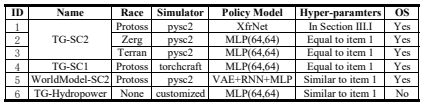
Fig. 8 : Setups for all experiments. OS=Open-Sourced.
원문 · CC BY 4.0 · Ruo-Ze Liu, Haifeng Guo, Xiaozhong Ji, Yang Yu, Zhen-Jia Pang, Zitai Xiao, Yuzhou Wu, Tong Lu · Efficient Reinforcement Learning for StarCraft by Abstract Forward Models and Transfer Learning · 원문 그림 인용 · 원본 PDF 8쪽에서 그림 영역을 추출했습니다.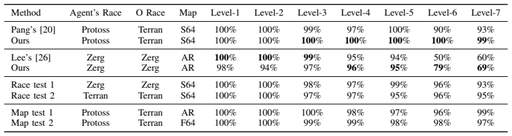
원문 그림 TABLE I: Performance results. We train our agent in level-7 and tested in the other six levels. O=Opponent’s, AR= AbyssalReef, S64=Simple64, F64=Float64. Each evaluation runs 100 games and is repeated for 3 times.
원문 · CC BY 4.0 · Ruo-Ze Liu, Haifeng Guo, Xiaozhong Ji, Yang Yu, Zhen-Jia Pang, Zitai Xiao, Yuzhou Wu, Tong Lu · Efficient Reinforcement Learning for StarCraft by Abstract Forward Models and Transfer Learning · 원문 그림 인용 · 원본 PDF 9쪽에서 그림 영역을 추출했습니다.기존 방법과의 비교에서 Pang의 방법은 Protoss vs Terran에서 Level-7 93%였고, 제안 방법은 99%였습니다. Lee의 Zerg 설정과 비교하면 Level-4부터 Level-7까지 제안 방법의 승률이 더 높다고 보고됩니다(L4 96%, L5 95%, L6 79%, L7 69%; Lee의 방법은 각각 95%, 94%, 50%, 60%). 치팅 AI에서는 Pang의 방법이 Level-8, 9, 10에서 0.74, 0.71, 0.43인 반면 제안 방법은 0.95, 0.94, 0.90입니다. 학습 시간은 Pang의 방법 94.50시간과 비교해 제안 방법 1.08시간으로 보고되고, 학습 단계 수는 22.68×10^6과 1.45×10^6입니다.
사람과의 대전에서는 SC2 novice에 5:0, SC2 golden 수준에 4:1로 이겼다고 보고합니다.

원문 그림 TABLE IV: Comparison of the RL methods on full-length SC2 by pysc2. SL=Supervised Learning, which is similar to behavior cloning. SP=self-play. ER=expert replays. BO=build orders. MA=hand-crafted macro actions. BM=builded model.
원문 · CC BY 4.0 · Ruo-Ze Liu, Haifeng Guo, Xiaozhong Ji, Yang Yu, Zhen-Jia Pang, Zitai Xiao, Yuzhou Wu, Tong Lu · Efficient Reinforcement Learning for StarCraft by Abstract Forward Models and Transfer Learning · 원문 그림 인용 · 원본 PDF 11쪽에서 그림 영역을 추출했습니다.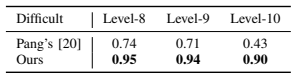
원문 그림 TABLE V: The average win-rate against cheating-level AIs.
원문 · CC BY 4.0 · Ruo-Ze Liu, Haifeng Guo, Xiaozhong Ji, Yang Yu, Zhen-Jia Pang, Zitai Xiao, Yuzhou Wu, Tong Lu · Efficient Reinforcement Learning for StarCraft by Abstract Forward Models and Transfer Learning · 원문 그림 인용 · 원본 PDF 11쪽에서 그림 영역을 추출했습니다.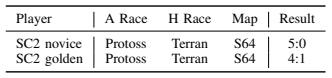
원문 그림 TABLE VI: Play against human. A=Agent, H=Human, S64=Simple64. Result=(agent:human)
원문 · CC BY 4.0 · Ruo-Ze Liu, Haifeng Guo, Xiaozhong Ji, Yang Yu, Zhen-Jia Pang, Zitai Xiao, Yuzhou Wu, Tong Lu · Efficient Reinforcement Learning for StarCraft by Abstract Forward Models and Transfer Learning · 원문 그림 인용 · 원본 PDF 12쪽에서 그림 영역을 추출했습니다.TG 충실도와 KL 분석
TG 가설은 RG에서 TG로 옮겨지는 규칙이 적을수록 TG에서의 학습은 쉬워지고 RG로의 전이는 어려워지며, 규칙이 많이 옮겨질수록 TG 학습은 어려워지고 전이는 쉬워진다는 상충 관계를 가정합니다. 논문은 규칙 모듈을 Combat, Logistics, Production, Resource 네 부분으로 나누고 TG3, TG2, TG1, TG0를 정의합니다. TG3는 Combat만 포함하고, 이후 단계는 이전 단계에 모듈을 추가합니다. 이 실험은 TG 학습 난이도와 RG 학습 난이도가 서로 반대 방향으로 움직인다는 가설을 검증하기 위해 설계되었습니다.

Fig. 10 : (a) Learning in different levels of TGs. (b) Win-rate of learning in RG from training 30 iterations firstly in different TGs. (c) Ours vs. Pang’s while TG⇒RG on map Simple64. (d) TG⇒RG vs. ∅⇒RG on SC2.
원문 · CC BY 4.0 · Ruo-Ze Liu, Haifeng Guo, Xiaozhong Ji, Yang Yu, Zhen-Jia Pang, Zitai Xiao, Yuzhou Wu, Tong Lu · Efficient Reinforcement Learning for StarCraft by Abstract Forward Models and Transfer Learning · 원문 그림 인용 · 원본 PDF 9쪽에서 그림 영역을 추출했습니다.분포 차이에 대해 논문은 \(\mathrm{KL}(\mathrm{TG}\Rightarrow\mathrm{RG})=0.53\), \(\mathrm{KL}(\varnothing\Rightarrow\mathrm{TG})=0.51\), \(\mathrm{KL}(\varnothing\Rightarrow\mathrm{RG})=1.47\)을 보고합니다. 저자들은 두 단계의 합이 직접 학습보다 작다는 점을 근거로, 분해 학습이 전이의 부드러움을 높인다고 해석합니다. 다만 이 KL 값은 학습된 두 정책 사이의 한 번의 측정으로 얻은 결과입니다.
적용 범위와 한계
논문이 설명하는 범위는 주로 SC2의 Protoss 중심 실험과 일부 Zerg, Terran 실험, 그리고 SC1과 수력 발전 과제입니다. Dummy는 7개 수준으로 설계되었지만, 실제 실험에서는 4개 수준만 사용되었다고 보고됩니다. 또한 TG 설계는 사람이 규칙을 직접 추상화하므로 시간이 필요합니다. 논문은 TG-SC2 구현에 3명의 프로그래머와 1명의 전문가가 3일을 썼다고 밝히고, 저자들이 제시한 비용 식에서 N>3일 때 TG 준비 비용이 정당화된다고 해석합니다. 이 식은 저자가 가정한 비용 모델이므로 다른 환경에 그대로 적용되지 않습니다.
비교 실험의 해석에도 주의가 필요합니다. WorldModel 비교에서 world-model과 dream-model은 기대만큼 좋지 않았고, 반복 학습으로도 탐색 문제를 해결하지 못했다는 결과는 이 구현과 설정에서 얻은 것입니다. 수력 발전 과제는 실제 파라미터를 공개하지 않은 TG 모델로 실험되었으며, 이 결과가 다른 실제 시스템으로 일반화되는지는 논문에서 확인되지 않습니다.

Fig. 3 : (a) Training process of the learning-based and rule-based models. (b) Effects of using the learning-based and rule-based model to learn policy in PT. (c) Effects of training in RG using TG, world-model, and dream-model. (d) Effects of training in RG using TG and different iteration of dream-models. PT=Prototype. TG=thought-game. RG=real game.
원문 · CC BY 4.0 · Ruo-Ze Liu, Haifeng Guo, Xiaozhong Ji, Yang Yu, Zhen-Jia Pang, Zitai Xiao, Yuzhou Wu, Tong Lu · Efficient Reinforcement Learning for StarCraft by Abstract Forward Models and Transfer Learning · 원문 그림 인용 · 원본 PDF 4쪽에서 그림 영역을 추출했습니다.
Fig. 14 : (a) Effects of BN while ∅⇒TG . (b) Effects of learning rate decay strategy with BN while TG⇒RG. (c) Using TG in a hydropower task. (d) TG hypothesis in the hydropower task.
원문 · CC BY 4.0 · Ruo-Ze Liu, Haifeng Guo, Xiaozhong Ji, Yang Yu, Zhen-Jia Pang, Zitai Xiao, Yuzhou Wu, Tong Lu · Efficient Reinforcement Learning for StarCraft by Abstract Forward Models and Transfer Learning · 원문 그림 인용 · 원본 PDF 13쪽에서 그림 영역을 추출했습니다.논문 정보
- 저자
- Ruo-Ze Liu, Haifeng Guo, Xiaozhong Ji, Yang Yu, Zhen-Jia Pang, Zitai Xiao, Yuzhou Wu, Tong Lu
- 학회·저널
- arXiv · 프리프린트
- 최초 공개일
- 2019년 3월 2일
- 등록일
- 2026년 11월 6일
- 수정일
- 2021년 11월 2일
- 버전
- v4
- arXiv
- 1903.00715
- 분류
- cs.LG · cs.AI · stat.ML
- 원문 이용 조건
- CC BY 4.0
- 제공 범위
- 논문 정보, 해설, 허용된 원문 그림
AI 해설은 논문 원문과 별개의 설명이며 오류가 있을 수 있습니다. 원문과 그림은 각 출처의 이용 조건과 따로 표시된 권리를 따릅니다.
초록
Injecting human knowledge is an effective way to accelerate reinforcement learning (RL). However, these methods are underexplored. This paper presents our discovery that an abstract forward model (thought-game (TG)) combined with transfer learning (TL) is an effective way. We take StarCraft II as our study environment. With the help of a designed TG, the agent can learn a 99% win-rate on a 64x64 map against the Level-7 built-in AI, using only 1.08 hours in a single commercial machine. We also show that the TG method is not as restrictive as it was thought to be. It can work with roughly designed TGs, and can also be useful when the environment changes. Comparing with previous model-based RL, we show TG is more effective. We also present a TG hypothesis that gives the influence of different fidelity levels of TG. For real games that have unequal state and action spaces, we proposed a novel XfrNet of which usefulness is validated while achieving a 90% win-rate against the cheating Level-10 AI. We argue that the TG method might shed light on further studies of efficient RL with human knowledge.
원문 인용
Ruo-Ze Liu, Haifeng Guo, Xiaozhong Ji, Yang Yu, Zhen-Jia Pang, Zitai Xiao, Yuzhou Wu, Tong Lu (2019). Efficient Reinforcement Learning for StarCraft by Abstract Forward Models and Transfer Learning. arXiv:1903.00715v4. https://arxiv.org/abs/1903.00715v4
BibTeX
@misc{liu2019efficient,
  title = {{Efficient Reinforcement Learning for StarCraft by Abstract Forward Models and Transfer Learning}},
  author = {Ruo-Ze Liu and Haifeng Guo and Xiaozhong Ji and Yang Yu and Zhen-Jia Pang and Zitai Xiao and Yuzhou Wu and Tong Lu},
  year = {2019},
  eprint = {1903.00715},
  archivePrefix = {arXiv},
  url = {https://arxiv.org/abs/1903.00715v4}
}