논문 해설
Camera equalisation of an 11.5x drop in environmental illuminance: four imitation-learning policies on an SO-101 arm
환경 조도가 11.5배 떨어졌을 때의 카메라 등화: SO-101 로봇 팔에서의 네 가지 모방 학습 정책
- 연구 문제 방의 조도(lux)만 기록하면 정책이 보는 카메라 입력의 변화를 설명하지 못할 수 있습니다.
- 주요 결과 성공률은 정상 조명 20/40, 저조도 19/40으로 큰 차이가 없었습니다.
로봇 평가에서 lux가 정책의 입력을 설명하지 못하는 문제
실제 로봇 벤치마크에서는 흔히 방의 조도(lux)를 조명 조건으로 기록합니다. 이 논문은 같은 lux가 같은 카메라 입력을 뜻하지 않을 수 있다는 가정을 실험으로 검토합니다. 연구 질문은 두 가지입니다. 첫째, SO-101 로봇 팔에서 네 가지 모방학습 정책의 pick-and-place 성공률이 방 조도가 약 11.5배 낮아질 때 얼마나 변하는지입니다. 둘째, 조도 변화가 정책이 실제로 받는 카메라 이미지의 밝기와 통계에 얼마나 반영되는지입니다. 이 실험은 탐색적 부수 연구이며 사전 등록되지 않았습니다.
동일 데모로 학습한 네 정책과 두 조명 조건
네 정책은 ACT, SmolVLA, Diffusion Policy, π0.5이며 모두 같은 50개의 teleoperated 시연으로 학습되었습니다. 시연은 약 500lux에서 기록되었습니다. ACT의 ResNet-18은 ImageNet 가중치로 시작하고, Diffusion Policy의 ResNet-18은 처음부터 학습되었습니다. SmolVLA와 π0.5는 사전학습된 vision-language-action 기반 모델에서 미세조정되었습니다. 평가 체크포인트는 정책마다 다르며, ACT는 30,000 steps, SmolVLA는 6,000 steps, Diffusion Policy는 50,000 steps, π0.5는 6,000 steps입니다.
정상 조명은 실내 인공조명을 켠 상태에서 녹화 시점의 조도에 맞춘 조건입니다. 저조도 조건은 인공조명을 모두 끄고 창문을 가려 자연광을 줄인 조건입니다. 따라서 저조도는 조도 수준만 바뀐 것이 아니라 광원, 색, 방향도 함께 바뀌었습니다. 각 블록은 배치 N00부터 N09까지 10회 rollout으로 구성되었습니다.

Table 1 : Checkpoints benched. Cooldowns used a1−√·learning-rate decay.
원문 · CC BY 4.0 · Simon Cowling · Camera equalisation of an 11.5x drop in environmental illuminance: four imitation-learning policies on an SO-101 arm · 원문 그림 인용 · 원본 PDF 2쪽에서 그림 영역을 추출했습니다.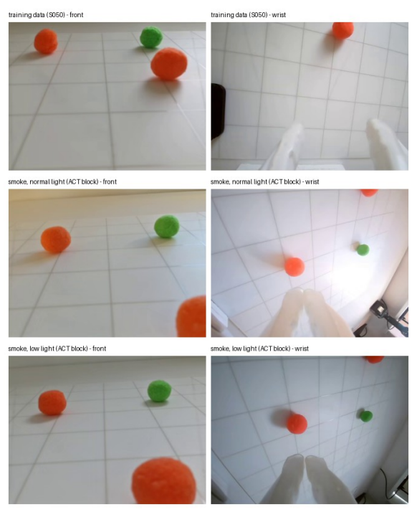
Figure 2 : First frames of a training episode and of placement N00 in the normal-light and low-light ACT blocks; front camera left, wrist camera right. The low-light frames are barely darker than the others. In normal light the wrist view shows a bright reflection on the floor that does not appear in training or in low light.
원문 · CC BY 4.0 · Simon Cowling · Camera equalisation of an 11.5x drop in environmental illuminance: four imitation-learning policies on an SO-101 arm · 원문 그림 인용 · 원본 PDF 5쪽에서 그림 영역을 추출했습니다.성공률 비교와 정책별 차이
정상 조명에서 네 정책의 성공은 20/40이었고, 저조도에서는 19/40이었습니다. 정책 간 감도 차이에 대한 상호작용 검정은 p = 0.86이었습니다. 풀링된 Mantel–Haenszel odds ratio는 0.89이며 95% 구간은 0.34에서 2.33입니다. 이 결과는 10회 rollout 블록을 바탕으로 한 것이므로 큰 변화만 탐지할 수 있습니다. 저자들은 큰 감소가 가능성이 낮다고 해석하지만, 10포인트 감소는 배제되지 않는다고 밝힙니다.
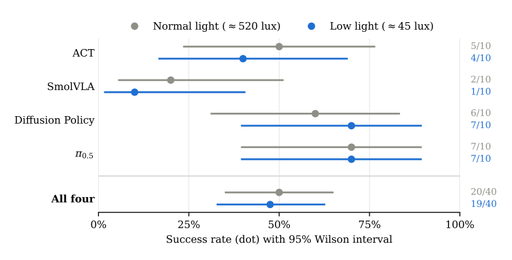
Figure 1 : Success by policy and light level; 80 rollouts, 10 per cell, placements N00–N09.
원문 · CC BY 4.0 · Simon Cowling · Camera equalisation of an 11.5x drop in environmental illuminance: four imitation-learning policies on an SO-101 arm · 원문 그림 인용 · 원본 PDF 3쪽에서 그림 영역을 추출했습니다.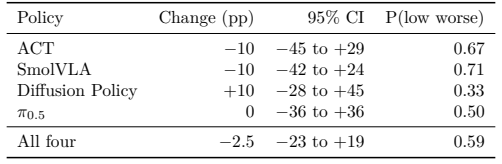
Table 2 : Change in success, low minus normal. Intervals are Newcombe intervals; P(low worse) is the Beta(1,1) posterior. The pooled change is the raw difference; the posterior median of the policy average is−2.1points. All Fisher and McNemarp-values were 1.00.
원문 · CC BY 4.0 · Simon Cowling · Camera equalisation of an 11.5x drop in environmental illuminance: four imitation-learning policies on an SO-101 arm · 원문 그림 인용 · 원본 PDF 3쪽에서 그림 영역을 추출했습니다.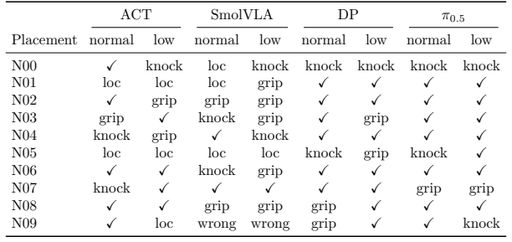
Table 6 : Every rollout. ✓ success; loc = location failure; grip = grip failure; knock = ball knocked out of reach; wrong = wrong object. The DP repeat block is in Table 5.
원문 · CC BY 4.0 · Simon Cowling · Camera equalisation of an 11.5x drop in environmental illuminance: four imitation-learning policies on an SO-101 arm · 원문 그림 인용 · 원본 PDF 9쪽에서 그림 영역을 추출했습니다.카메라 설정과 이미지 통계가 조도 차이를 흡수한 방식
조도는 작업 공간에서 크게 달랐지만 카메라 이미지 밝기는 그만큼 달라지지 않았습니다. 같은 설정에서 front 카메라의 평균 luma는 1.03배 낮아졌고, wrist 카메라는 1.24배 낮아졌습니다. 감마 2.2로 선형 빛을 환산하면 front는 약 7%, wrist는 약 38% 적은 선형 빛을 받은 것으로 계산됩니다. 다만 이 환산 수치는 원문의 설명을 바탕으로 한 것이며, 원문은 로그 기준으로 front 약 3%, wrist 약 20%의 감소가 실제 조도 감소에 반영되었다고 보고합니다. 두 카메라는 자동 노출과 자동 화이트 밸런스로 설정되어 있었고, 저자들은 이 자동 조절이 차이를 흡수했을 가능성이 높다고 해석합니다.
노출을 고정한 대조 실험은 수행되지 않았습니다. wrist 카메라에서는 밝기가 19% 낮아졌고 대비도 8% 낮아졌습니다. 정규화하지 않은 선명도 감소 34%는 밝기 감소로 설명되며, 밝기로 정규화하면 선명도는 133에서 134로 거의 같았습니다.
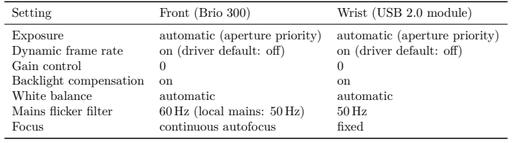
Table 3 : Camera settings.
원문 · CC BY 4.0 · Simon Cowling · Camera equalisation of an 11.5x drop in environmental illuminance: four imitation-learning policies on an SO-101 arm · 원문 그림 인용 · 원본 PDF 4쪽에서 그림 영역을 추출했습니다.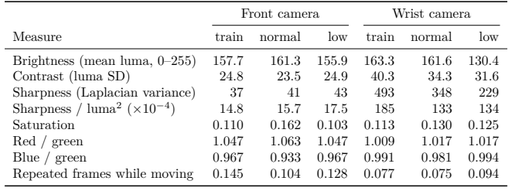
Table 4 : Image statistics, means over episodes (training: 20 S050 episodes).
원문 · CC BY 4.0 · Simon Cowling · Camera equalisation of an 11.5x drop in environmental illuminance: four imitation-learning policies on an SO-101 arm · 원문 그림 인용 · 원본 PDF 4쪽에서 그림 영역을 추출했습니다.
Table 7 : Illuminance by block (lux), normal / low.
원문 · CC BY 4.0 · Simon Cowling · Camera equalisation of an 11.5x drop in environmental illuminance: four imitation-learning policies on an SO-101 arm · 원문 그림 인용 · 원본 PDF 9쪽에서 그림 영역을 추출했습니다.반복 블록이 보여준 단일 블록의 변동성
DP 저조도 블록은 우연히 한 번 더 실행되었고, 두 번의 성공 횟수는 모두 7/10이었습니다. 그러나 두 실행이 같은 배치에서 성공한 것은 6/10이었으며, 독립 가정에서 기대되는 5.8과 비슷한 수준입니다. 따라서 같은 성공 횟수라도 배치별 결과는 우연에 가깝게 달라질 수 있습니다. 저자들은 이것이 단일 10-rollout 블록 비교가 넘어야 할 변동의 바닥이라고 해석합니다.

Table 5 : The two low-light DP blocks.✓success; loc, grip, knock: failure labels.
원문 · CC BY 4.0 · Simon Cowling · Camera equalisation of an 11.5x drop in environmental illuminance: four imitation-learning policies on an SO-101 arm · 원문 그림 인용 · 원본 PDF 6쪽에서 그림 영역을 추출했습니다.적용 범위와 남은 한계
이 결과는 한 대의 리그, 한 과제, 50개 시연이라는 한 데이터 수준, 정책별 한 체크포인트에서 얻은 것입니다. 저조도에서 그림자, 눈부심, 깜빡임, 정상광보다 밝은 조명은 시험되지 않았습니다. 카메라 설정은 실험 후 v4l2-ctl로 읽었으며 실험 중에는 기록되지 않았습니다. 센서 노이즈는 압축된 영상으로는 평가할 수 없었습니다. 또한 SmolVLA는 정상 조명에서 2/10만 성공하여 최대 20포인트 하락만 나타낼 수 있었습니다. 조명 효과에 대한 최종 결론은 노출을 고정한 추가 실험이 있어야 확인할 수 있습니다.
논문 정보
- 저자
- Simon Cowling
- 학회·저널
- arXiv · 프리프린트
- 최초 공개일
- 2026년 11월 10일
- 등록일
- 2026년 11월 11일
- 수정일
- 2026년 11월 10일
- 버전
- v1
- arXiv
- 2611.13810
- 분류
- cs.RO
- 원문 이용 조건
- CC BY 4.0
- 제공 범위
- 논문 정보, 해설, 허용된 원문 그림
AI 해설은 논문 원문과 별개의 설명이며 오류가 있을 수 있습니다. 원문과 그림은 각 출처의 이용 조건과 따로 표시된 권리를 따릅니다.
초록
Real-robot benchmarks of learned visuomotor policies often record room illuminance as the lighting condition. We show that, on a typical low-cost rig, room light and image light can be almost unrelated. Four imitation-learning policies (ACT, SmolVLA, Diffusion Policy and pi0.5) were trained on the same 50 demonstrations of a pick-and-place task on an SO-101 arm. Each was run for ten rollouts at about 520 lux and again at about 45 lux, an 11.5x reduction. Success was 20/40 in normal light and 19/40 in low light: a change of -2.5 percentage points (95% CI -23 to +19), with no evidence that the policies differed in sensitivity (interaction p = 0.86). The recorded video shows why: mean image brightness was only 3% lower in low light on the front camera and 19% lower on the wrist camera. Both cameras were set to automatic exposure and white balance, which most likely absorbed the difference; exposure was not locked in this experiment. An accidental repeat of one 10-rollout block reproduced its success count (7/10) but matched the first block at only 6 of 10 placements, consistent with chance. We conclude that lux alone does not describe what a policy sees. Camera settings, and image statistics compared with the training recordings, are the quantities to report and control. Data and code are public.
원문 인용
Simon Cowling (2026). Camera equalisation of an 11.5x drop in environmental illuminance: four imitation-learning policies on an SO-101 arm. arXiv:2611.13810v1. https://arxiv.org/abs/2611.13810v1
BibTeX
@misc{cowling2026camera,
  title = {{Camera equalisation of an 11.5x drop in environmental illuminance: four imitation-learning policies on an SO-101 arm}},
  author = {Simon Cowling},
  year = {2026},
  eprint = {2611.13810},
  archivePrefix = {arXiv},
  url = {https://arxiv.org/abs/2611.13810v1}
}