논문 해설
Revisiting Non-Acyclic GFlowNets in Discrete Environments
이산 환경에서 비비순환 GFlowNet 재검토
- 연구 문제 순환이 있는 이산 환경에서 GFlowNet의 이론을 단순하게 재구성하고, 백워드 정책과 흐름 척도가 학습 안정성과 기대 궤적 길이에 미치는 영향을 검토합니다.
- 연구 방법 백워드 정책에서 출발해 궤적 분포와 상태·간선 흐름을 정의하고, 상태 흐름 정규화를 더한 Detailed Balance 계열 손실로 학습합니다.
- 주요 결과 고정 백워드 정책에서는 손실 안정성이 최적화 결과에 영향을 주지 않는다고 제시됩니다. 흐름을 로그 척도로 계산하고 상태 흐름 정규화를 적용하면 하이퍼그리드와 순열 실험에서 기대 궤적 길이를 제어하면서 분포를 잘 맞춘다고 보고됩니다.
비순환 GFlowNet의 문제
GFlowNet은 보상에 비례하는 분포에서 객체를 샘플링하도록 학습하는 생성 모델이며, 객체를 직접 다루는 대신 방향 비순환 그래프 위에서 궤적을 샘플링합니다. 이 구성은 그래프가 순환을 갖지 않는다는 가정에 크게 의존합니다. 그런데 대칭군이나 루빅스 큐브 같은 대수적 환경은 생성원으로 상태를 바꾸므로 자연스럽게 순환을 포함합니다. 이 논문은 이러한 비순환 환경의 이론을 측도론 없이 이산 공간에서 다시 세우고, 순환이 있을 때 기대 궤적 길이가 무한히 커질 수 있다는 문제를 다룹니다.
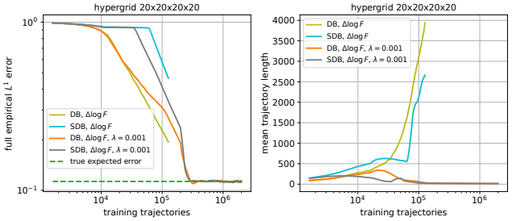
Figure 4 . Left: evolution of L1 distance between empirical distribution of samples and target distribution. Right: evolution of mean length of sampled trajectories. Here we note that when ∆ logF scale losses are employed without state flow regularization, mean trajectory length tends to infinity. Plots are not full since training is done on-policy. Thus, the time needed for full training also grows according to the length of trajectories.
원문 · CC BY 4.0 · Nikita Morozov, Ian Maksimov, Daniil Tiapkin, Sergey Samsonov · Revisiting Non-Acyclic GFlowNets in Discrete Environments · 원문 그림 인용 · 원본 PDF 24쪽에서 그림 영역을 추출했습니다.백워드 정책과 흐름의 구성
논문은 백워드 정책 PB를 출발점으로 삼아 궤적 분포 P(τ)를 정의합니다. 상태 흐름 F(s)와 간선 흐름은 기대 방문 횟수로 정의되며, 이 흐름은 세부 균형 조건과 흐름 매칭 조건을 만족합니다. PB가 양수이면 이를 유도하는 순방향 정책 PF가 유일하게 존재합니다. 이 결과는 고정된 PB에서 손실 안정성이 최적화에 영향을 주지 않는다는 따름정리의 근거가 됩니다. 반면 PB를 학습하면 기대 궤적 길이를 최소화하는 문제가 전체 상태 흐름의 합을 최소화하는 문제와 같아지며, 이 조건을 다루기 위해 상태 흐름 정규화가 제안됩니다.
실험 설정과 평가 지표
실험은 비순환 하이퍼그리드와 순열 생성 환경에서 수행됩니다. 하이퍼그리드에서는 샘플 분포와 참 보상 분포 사이의 전체 변동 거리를 마지막 2·10^5개 샘플로 계산합니다. 순열 실험에서는 고정점 개수 분포 C(k)의 L1 오차, 평균 보상의 상대 오차 ∆R, log Z 오차를 함께 봅니다. 평균 샘플 보상은 모드 붕괴된 모델에서도 높게 나올 수 있으므로 본 논문은 이 지표만으로 샘플링 정확도를 판단하지 않습니다.
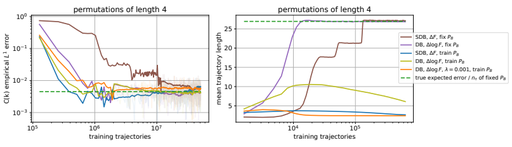
Figure 6 . Comparison of non-acyclic GFlowNet training losses on a small permutation environment. Left: evolution of L1 distance between true and empirical distribution of fixed point probabilities C(k). Right: evolution of mean length of sampled trajectories. The results are similar to the same experiment on hypergrids (Figure 1), with the only difference that here SDB loss in ∆F scale here has fast convergence with a trainable backward policy.
원문 · CC BY 4.0 · Nikita Morozov, Ian Maksimov, Daniil Tiapkin, Sergey Samsonov · Revisiting Non-Acyclic GFlowNets in Discrete Environments · 원문 그림 인용 · 원본 PDF 24쪽에서 그림 영역을 추출했습니다.흐름 척도와 상태 흐름 정규화의 결과
작은 7×7 하이퍼그리드에서 고정 PB의 DB와 SDB는 고정 PB가 유도한 참 기대 궤적 길이로 수렴합니다. 20×20×20×20 하이퍼그리드에서는 고정 PB가 실용적이지 않으므로 학습 가능한 PB만 고려되며, ∆logF 척도에 상태 흐름 정규화를 적용한 DB와 SDB가 보상 분포를 올바르게 샘플링한다고 보고됩니다. 순열 환경의 표 1에서 n=20일 때 DB ∆F의 C(k) L1은 0.453±0.002이고 E[nτ]는 2.00±0.00입니다. 같은 n=20 조건에서 DB ∆logF λ=10^-5의 C(k) L1은 0.017±0.002이고 E[nτ]는 7.55±0.50입니다. 이 값들은 3개 랜덤 시드의 평균과 표준편차이며, ∆F 척도 손실은 기대 궤적 길이가 짧아도 분포를 잘 맞추지 못합니다.
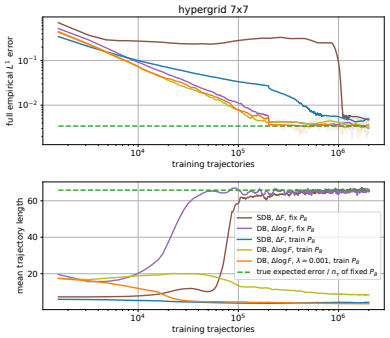
Figure 1 . Comparison of non-acyclic GFlowNet training losses on a small hypergrid environment. We use DB or SDB to specify the utilized loss, ∆ logF or ∆F to specify the flow scale used to compute the error in the loss, and use λ = C to specify the usage of the proposed state flow regularization. Top: evolution of L1 distance between an empirical distribution of samples and target distribution. Bottom: evolution of mean length of sampled trajectories.
원문 · CC BY 4.0 · Nikita Morozov, Ian Maksimov, Daniil Tiapkin, Sergey Samsonov · Revisiting Non-Acyclic GFlowNets in Discrete Environments · 원문 그림 인용 · 원본 PDF 7쪽에서 그림 영역을 추출했습니다.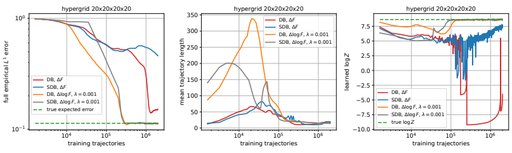
Figure 2 . Comparison of non-acyclic GFlowNet training losses on a larger hypergrid environment. We use DB or SDB to specify the utilized loss, ∆ logF or ∆F to specify the flow scale used to compute the error in the loss, and use λ = C to specify the usage of the proposed state flow regularization. Left: evolution of L1 distance between an empirical distribution of samples and target distribution. Middle: evolution of mean length of sampled trajectories. Right: evolution of the trained initial log flow log Zθ.
원문 · CC BY 4.0 · Nikita Morozov, Ian Maksimov, Daniil Tiapkin, Sergey Samsonov · Revisiting Non-Acyclic GFlowNets in Discrete Environments · 원문 그림 인용 · 원본 PDF 8쪽에서 그림 영역을 추출했습니다.
Table 1 . Comparison on the permutation environment. C(k) L1 is the L1 distance between the true and empirical distribution of fixed point probabilities C(k), ∆R is the relative error of mean reward proposed in (Shen et al., 2023), ∆ logZ is | log Zθ − log Z|. Mean and std values are computed over 3 random seeds. Blue indicates the best metric, red indicates the smallest expected trajectory length.
원문 · CC BY 4.0 · Nikita Morozov, Ian Maksimov, Daniil Tiapkin, Sergey Samsonov · Revisiting Non-Acyclic GFlowNets in Discrete Environments · 원문 그림 인용 · 원본 PDF 8쪽에서 그림 영역을 추출했습니다.한계와 적용 범위
고정 백워드 정책의 기대 궤적 길이는 직접 고르기 어렵고 매우 클 수 있습니다. 상태 흐름 정규화는 실험에서 기대 궤적 길이를 줄였지만, 계수 λ가 너무 크면 순방향 정책이 편향됩니다. 본 논문의 실험은 하이퍼그리드와 순열이라는 두 이산 환경에 한정되며, 다른 과제로 일반화했다는 근거는 제시되지 않습니다.
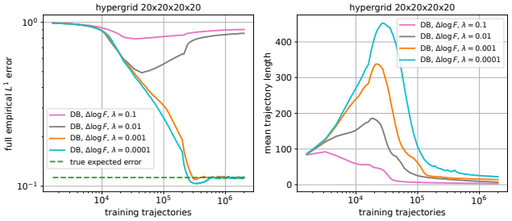
Figure 5 . Left: evolution of L1 distance between empirical distribution of samples and target distribution. Right: evolution of mean length of sampled trajectories. Here, we see the effects of state flow regularization of different strength λ. Larger values of λ lead to smaller mean trajectory length, however, if λ is too large, the obtained forward policy will be significantly biased.
원문 · CC BY 4.0 · Nikita Morozov, Ian Maksimov, Daniil Tiapkin, Sergey Samsonov · Revisiting Non-Acyclic GFlowNets in Discrete Environments · 원문 그림 인용 · 원본 PDF 24쪽에서 그림 영역을 추출했습니다.논문 정보
- 저자
- Nikita Morozov, Ian Maksimov, Daniil Tiapkin, Sergey Samsonov
- 학회·저널
- arXiv · 프리프린트
- 최초 공개일
- 2025년 2월 11일
- 등록일
- 2026년 10월 30일
- 수정일
- 2025년 9월 11일
- 버전
- v3
- arXiv
- 2502.07735
- 분류
- cs.LG · stat.ML
- 원문 이용 조건
- CC BY 4.0
- 제공 범위
- 논문 정보, 해설, 허용된 원문 그림
AI 해설은 논문 원문과 별개의 설명이며 오류가 있을 수 있습니다. 원문과 그림은 각 출처의 이용 조건과 따로 표시된 권리를 따릅니다.
초록
Generative Flow Networks (GFlowNets) are a family of generative models that learn to sample objects from a given probability distribution, potentially known up to a normalizing constant. Instead of working in the object space, GFlowNets proceed by sampling trajectories in an appropriately constructed directed acyclic graph environment, greatly relying on the acyclicity of the graph. In our paper, we revisit the theory that relaxes the acyclicity assumption and present a simpler theoretical framework for non-acyclic GFlowNets in discrete environments. Moreover, we provide various novel theoretical insights related to training with fixed backward policies, the nature of flow functions, and connections between entropy-regularized RL and non-acyclic GFlowNets, which naturally generalize the respective concepts and theoretical results from the acyclic setting. In addition, we experimentally re-examine the concept of loss stability in non-acyclic GFlowNet training, as well as validate our own theoretical findings.
원문 인용
Nikita Morozov, Ian Maksimov, Daniil Tiapkin, Sergey Samsonov (2025). Revisiting Non-Acyclic GFlowNets in Discrete Environments. arXiv:2502.07735v3. https://arxiv.org/abs/2502.07735v3
BibTeX
@misc{morozov2025revisiting,
  title = {{Revisiting Non-Acyclic GFlowNets in Discrete Environments}},
  author = {Nikita Morozov and Ian Maksimov and Daniil Tiapkin and Sergey Samsonov},
  year = {2025},
  eprint = {2502.07735},
  archivePrefix = {arXiv},
  url = {https://arxiv.org/abs/2502.07735v3}
}