논문 해설
SuperSpike: Supervised learning in multi-layer spiking neural networks
SuperSpike: 다층 스파이킹 신경망에서의 지도 학습
- 연구 문제 결정론적 다층 LIF 스파이킹 네트워크는 발화의 미분 문제로 인해 학습이 어렵습니다.
- 연구 방법 막전위 기반 표면 기울기와 시냅스 적격 흔적을 사용해 오차 신호를 가중치 갱신에 연결하는 세 요인 규칙을 제안합니다.
- 주요 결과 단일 뉴런과 XOR형 과제에서 학습이 확인되었고, 복잡한 시공간 과제에서는 대칭 피드백이 무작위 피드백보다 나은 성능을 보였습니다.
스파이킹 신경망 학습의 어려움
스파이킹 신경망은 입력과 출력이 시간에 따른 스파이크 패턴이라는 점에서 딥러닝의 실수값 활성화 벡터와 다릅니다. 결정론적 LIF 뉴런의 발화는 스파이크 시점에서만 정의되며, 그 밖의 시간에는 출력의 가중치 미분이 0입니다. 그래서 역전파를 그대로 적용하기 어렵습니다. 여기에 은닉층의 오차를 어떻게 전달할지에 대한 생물학적 타당성과 기술적 구현의 문제가 더해집니다. 기존의 여러 방법은 확률적 잡음을 도입하거나, 발화 시각을 미분 가능한 식으로 바꾸거나, 전압 기반 근사를 사용했습니다. 이 연구는 잡음을 넣지 않고 은닉 뉴런이 처음에 완전히 조용한 상태에서도 다층 결정론적 LIF 네트워크를 학습시키는 규칙을 다룹니다.
SuperSpike 규칙의 핵심 연산
SuperSpike는 스파이크열 자체 대신 막전위의 연속 함수 σ(U_i)를 사용해 미분을 근사합니다. 이 표면 기울기는 빠른 시그모이드의 음의 방향 부분으로 정의되며, 발화 임계값 근처에서 값이 커지도록 설계됩니다. 가중치 갱신은 오차 신호 e_i와 시냅스 적격 흔적 λ_ij의 곱을 시간에 대해 적분하는 형태로 나타납니다. 적격 흔적은 시냅스 전 필터링된 활동과 표면 기울기의 곱을 이중 지수 커널로 다시 필터링하여 만듭니다. 이 규칙은 전압 기반이며, 출력 뉴런에서는 목표 스파이크열과 실제 스파이크열의 차이로 오차를 만들고 은닉층에는 피드백 신호로 전달합니다. 이때 은닉층이 조용하더라도 막전위 기울기를 통해 학습 신호가 흐를 수 있다는 점이 핵심입니다.
피드백 신호와 가중치 갱신 조건
은닉층 뉴런은 세 가지 피드백 중 하나를 받습니다. 대칭 피드백은 하류 오차를 순방향 가중치와 같은 방식으로 가중 합산합니다. 무작위 피드백은 고정된 정규분포 난수 가중치로 오차를 투사하며, 이 가중치는 학습 중 변하지 않습니다. 균일 피드백은 모든 가중치를 1로 둔 전역 신호에 가깝습니다. 가중치는 오차와 적격 흔적의 곱을 0.5257초 구간마다 누적한 뒤, 구간 종료 시 per-parameter 학습률을 곱해 갱신하며 −0.1에서 0.1 사이로 제한합니다. 학습률은 RMSprop과 관련된 max 기반 변형을 사용하지만, 그 기본 설정은 실험별 조건과 함께 해석해야 합니다.
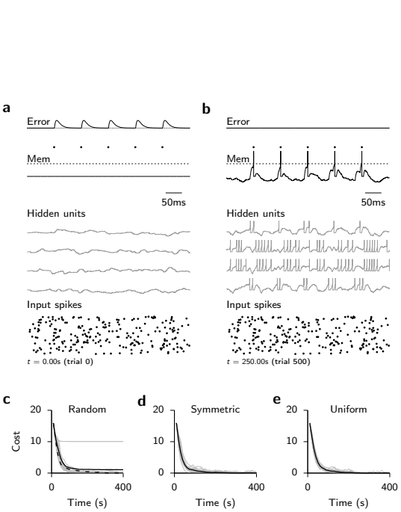
Figure 3 : SuperSpike learning with different types of feedback allows to train multi-layer networks. (a) Network activity at the initial trial at reference timet = 0s. The bottom panel shows the membrane potential traces of the four hidden units. The membrane potential of the output unit is shown in the middle. The dashed line is the output neuron firing threshold. The points correspond to target firing times and the top plot shows the error signal at the output layer. Hidden units receive the same input spikes as shown in Fig. 1a. ( b) Same as (a), but after 250s of training. The two hidden units which have started to respond to the repeating input spiking pattern are the ones with positive feedback weights, whereas the two hidden neurons which receive negative feedback connections from the output layer (middle traces) respond mostly at the offset of the repeating stimulus. ( c) Learning curves of networks trained with random feedback connections. Gray lines correspond to single trials and the black line to the average. The dashed line is the same average but for a network with 8 hidden layer units. (d) Same as (d), but for a network with symmetric feedback connections. (e) Same as (d–e), but for uniform “all one” feedback connections.
원문 · CC BY 4.0 · Friedemann Zenke, Surya Ganguli · SuperSpike: Supervised learning in multi-layer spiking neural networks · 원문 그림 인용 · 원본 PDF 14쪽에서 그림 영역을 추출했습니다.단일 뉴런과 XOR 과제의 검증
첫 실험은 100개의 입력 스파이크열을 받는 단일 LIF 뉴런이 500ms마다 반복되는 입력에서 5개의 등간격 목표 스파이크를 내도록 학습하는 과제입니다. 초기 가중치는 출력 뉴런이 발화하지 않는 조용한 상태에 두었으며, 500회 시행, 즉 250초의 시뮬레이션 뒤 목표 스파이크열을 생성하도록 학습했습니다. 이어서 은닉층이 필요한 스파이킹 배타적 논리합 과제에서 무작위 피드백 네트워크는 빠르게 완벽한 정확도에 도달했고, 은닉층이 없는 네트워크는 해결하지 못했습니다. 이 결과는 4개의 은닉 뉴런과 해당 과제 설정에서 얻은 것입니다.
복잡한 시공간 패턴과 피드백 방식 비교
복잡한 시공간 실험은 100개의 출력 뉴런이 3.5초 길이의 목표 패턴을 반복되는 고정 포아송 입력에서 학습하는 과제입니다. 대칭 피드백을 사용한 네트워크에서는 32개 이상의 은닉 뉴런이 있을 때 1000초 학습 안에서 목표 패턴과 시각적으로 유사한 출력을 얻었습니다. 같은 과제에서 무작위 피드백은 대칭 피드백보다 나쁜 성능을 보였고, 정규화 항을 추가하면 개선되었지만 은닉층이 없는 네트워크의 수준에는 이르지 못했습니다. 이 결과는 대표 설정인 대칭 피드백 256개 은닉 뉴런 비교와 무작위 피드백의 조건에 따른 것입니다. 저자들은 이 차이가 과제가 복잡해질수록 대칭 피드백의 필요성이 커진다는 해석으로 이어진다고 봅니다.
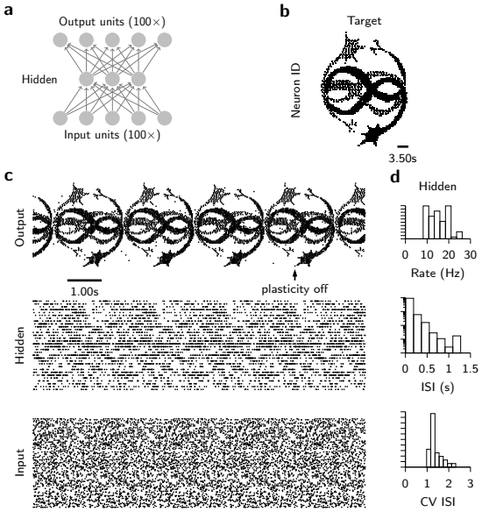
Figure 5 : Learning of complex spatiotemporal spike pattern transformations. (a) Spike raster of target firing pattern of 100 output neurons. The whole firing pattern has a duration of 3.5s. (b) Schematic illustration of the network architecture. (b) Spike raster of target firing pattern for reference. ( c) Snapshot of network activity of the network with symmetric feedback after 1000s of SuperSpike learning. Bottom panel: Spike raster of repeating frozen Poisson input spikes. Middle panel: Spike raster of hidden unit spiking activity. Top panel: Spike raster of output spiking activity. The black arrow denotes the point in time at which SuperSpike learning is switched off which freezes the spiking activity of the fully deterministic network. (d) Histograms of different firing statistics of hidden layer activity at then of learning. Top: Distribution of firing rates. Middle: Inter-spike-interval (ISI) distribution on semi-log axes. Bottom: Distribution of coefficient of variation (CV) of the ISI distribution.
원문 · CC BY 4.0 · Friedemann Zenke, Surya Ganguli · SuperSpike: Supervised learning in multi-layer spiking neural networks · 원문 그림 인용 · 원본 PDF 17쪽에서 그림 영역을 추출했습니다.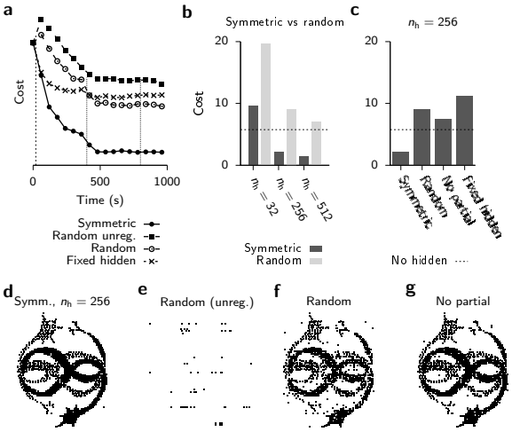
Figure 6 : Learning of spatiotemporal spike patterns. (a) Learning curves for networks with symmetric feedback or no hidden layer respectively. Learning was activated at the dashed line, whereas the learning rate was reduced by a factor of 10 at each dotted line. (b) Minimum cost after convergence for different feedback strategies and varying numbers of hidden units. Dashed line: Performance of a network without hidden units.
원문 · CC BY 4.0 · Friedemann Zenke, Surya Ganguli · SuperSpike: Supervised learning in multi-layer spiking neural networks · 원문 그림 인용 · 원본 PDF 18쪽에서 그림 영역을 추출했습니다.계산 비용과 근사의 범위
온라인 적격 흔적은 시냅스마다 계산되므로 계산 복잡도가 뉴런 수 n에 대해 O(n²)로 증가합니다. 저자들은 이를 향후 최적화의 대상으로 제시합니다. 또한 가중치 갱신 식의 근사는 발화율이 낮아 재설정 항이 작은 보정만 준다는 가정에 기대고 있으며, 이 가정은 항상성 조절로 발화율을 낮게 유지한다는 조건과 연결됩니다. 무작위 피드백의 결과는 고정된 과제와 설정에서 얻었으므로 다른 데이터나 더 깊은 네트워크로 일반화되었다고 말할 수 없습니다.
논문 정보
- 저자
- Friedemann Zenke, Surya Ganguli
- 학회·저널
- arXiv · 프리프린트
- 최초 공개일
- 2017년 5월 31일
- 등록일
- 2026년 11월 6일
- 수정일
- 2017년 10월 14일
- 버전
- v2
- arXiv
- 1705.11146
- DOI
- 10.1162/neco_a_01086
- 분류
- q-bio.NC · cs.LG · cs.NE · stat.ML
- 원문 이용 조건
- CC BY 4.0
- 제공 범위
- 논문 정보, 해설, 허용된 원문 그림
AI 해설은 논문 원문과 별개의 설명이며 오류가 있을 수 있습니다. 원문과 그림은 각 출처의 이용 조건과 따로 표시된 권리를 따릅니다.
초록
A vast majority of computation in the brain is performed by spiking neural networks. Despite the ubiquity of such spiking, we currently lack an understanding of how biological spiking neural circuits learn and compute in-vivo, as well as how we can instantiate such capabilities in artificial spiking circuits in-silico. Here we revisit the problem of supervised learning in temporally coding multi-layer spiking neural networks. First, by using a surrogate gradient approach, we derive SuperSpike, a nonlinear voltage-based three factor learning rule capable of training multi-layer networks of deterministic integrate-and-fire neurons to perform nonlinear computations on spatiotemporal spike patterns. Second, inspired by recent results on feedback alignment, we compare the performance of our learning rule under different credit assignment strategies for propagating output errors to hidden units. Specifically, we test uniform, symmetric and random feedback, finding that simpler tasks can be solved with any type of feedback, while more complex tasks require symmetric feedback. In summary, our results open the door to obtaining a better scientific understanding of learning and computation in spiking neural networks by advancing our ability to train them to solve nonlinear problems involving transformations between different spatiotemporal spike-time patterns.
원문 인용
Friedemann Zenke, Surya Ganguli (2017). SuperSpike: Supervised learning in multi-layer spiking neural networks. arXiv:1705.11146v2. https://doi.org/10.1162/neco_a_01086
BibTeX
@article{zenke2017superspike,
  title = {{SuperSpike: Supervised learning in multi-layer spiking neural networks}},
  author = {Friedemann Zenke and Surya Ganguli},
  year = {2017},
  eprint = {1705.11146},
  archivePrefix = {arXiv},
  doi = {10.1162/neco_a_01086},
  url = {https://arxiv.org/abs/1705.11146v2}
}