논문 해설
Fast and reliable entanglement distribution with quantum repeaters: principles for improving protocols using reinforcement learning
양자 중계기를 이용한 빠르고 신뢰할 수 있는 얽힘 분배: 강화학습으로 프로토콜을 개선하는 원리
- 연구 문제 양자 중계 체인에서 확률적 기본 링크 생성과 얽힘 교환, 메모리 잡음 아래 swap-asap 정책이 최적인지와 그 개선이 어디서 오는지를 질문합니다.
- 연구 방법 체인을 MDP로 모델링하고 Q-learning으로 대기 시간 또는 대기 시간과 충실도를 함께 보상하는 정책을 학습하며, 작은 체인의 정책을 중첩해 긴 체인에 확장합니다.
- 주요 결과 Q-learning 정책은 설정된 4노드와 5노드 조건에서 동적 swap-asap보다 평균 대기 시간과 평균 나이를 줄이며, m★=0에서도 swap-asap과 다른 정책임을 보입니다.
긴 양자 중계 체인에서 얽힘 분배의 문제
양자 네트워크에서 두 먼 노드 사이에 얽힘을 만들려면 중간 노드(양자 중계기)가 기본 링크를 만들고 얽힘 교환을 수행해야 합니다. 기본 링크 생성과 얽힘 교환은 확률적으로 성공하며, 양자 메모리는 시간이 지나면 잡음으로 충실도가 떨어집니다. 이 논문은 이런 조건에서 평균 대기 시간과 종단 간 얽힘의 충실도를 함께 개선하는 정책을 찾는 문제를 다룹니다. 기존의 널리 쓰인 정책인 swap-asap은 가능한 한 빨리 교환을 수행하는 단순한 규칙이며, 이 논문은 이 정책이 최적인지를 질문합니다.
저자들은 체인의 상태와 행동을 마르코프 결정 과정(MDP)으로 모델링하고, 노드 수가 늘수록 상태와 행동 공간이 커지므로 Q-learning으로 정책을 찾습니다. 여기서 얻은 정책이 어떤 조건에서 개선되는지, 그 개선이 무엇에서 오는지를 이어서 살펴봅니다.
MDP 모델과 기본 링크·가상 링크의 나이 갱신
체인은 n개의 노드로 이루어지며, 각 노드는 최대 두 개의 양자 메모리를 가집니다. 모든 메모리는 최대 컷오프 m★를 가지며, 얽힘이 m★ 시간 단계 동안 유지되면 폐기됩니다. 기본 링크는 확률 p_ℓ로 생성되고, 얽힘 교환은 확률 p_sw로 성공합니다. 시간 단계마다 노드 쌍은 기본 링크를 요청하거나 기존 링크를 버릴 수 있고, 노드는 두 메모리에 대해 얽힘 교환을 시도할 수 있습니다.
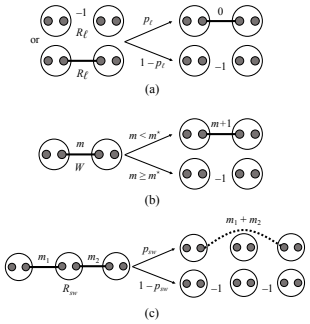
FIG. 2 . Illustration of the states, actions, and transition rules of our MDP for entanglement distribution in a quantum repeater chain; see Appendix A for details. (a) The effect of the elementary link request action (𝑅ℓ) between two nodes is to discard the entangled state, if there is one stored in their respective quantum memories, and attempt togenerateanelementarylinkbetweenthetwonodes,whichsucceeds with probability𝑝ℓ. We note that the agent can choose to discard a link at any time𝑡★≤ 𝑚★, thereby allowing it to choose a cutoff that is different from the maximum cutoff𝑚★. (b) The effect of the wait action (𝑊) is to increase the age𝑚 of a link by one time unit, if𝑚 is strictly less than the maximum cutoff time𝑚★; otherwise, if 𝑚 = 𝑚
원문 · CC BY 4.0 · Stav Haldar, Pratik J. Barge, Sumeet Khatri, Hwang Lee · Fast and reliable entanglement distribution with quantum repeaters: principles for improving protocols using reinforcement learning · 원문 그림 인용 · 원본 PDF 6쪽에서 그림 영역을 추출했습니다.Pauli 잡음을 가정하면 두 링크의 나이 m1, m2가 교환 뒤 가상 링크의 나이 m1+m2가 됩니다. 이 갱신 규칙은 f_swap(m1,m2)=f(m1+m2)로 표현되며, 종단 간 링크의 충실도는 f(m1+m2+⋯+m_{n−1})로 주어집니다. 따라서 조건 (n−1)t★ ≤ m★ 또는 더 엄격한 충실도 요구에 대한 조건으로 체인에 허용되는 링크 수가 결정됩니다.
Q-learning의 보상 설계와 정책 학습
저자들은 Q-learning을 사용해 정책을 학습합니다. Q-learning은 환경의 설명을 주지 않고도 상태-행동 쌍의 Q값을 갱신하는 모델 없는 강화학습 방법이며, 각 에피소드는 분리된 초기 상태에서 종단 상태까지 진행됩니다. 대기 시간을 최적화할 때 보상은 종단 상태에서 100, 그 밖에서는 −1로 정의되어 가장 짧은 단계로 종단에 도달하도록 유도합니다. 충실도를 함께 고려할 때는 종단 상태의 보상을 종단 링크의 나이 S_{1,n}에 따라 바꾸어, 나이가 낮을수록 보상을 크게 줍니다.

FIG. 18 . Schematic of the Q-learning algorithm, which is a model-free reinforcement learning technique. The Q-table is the central object in the algorithm and its update through numerous episodes starting from a disconnected state to a terminal state (end-to-end connected via a virtual link) constitutes the learning process. The final Q-table is an instruction on what are the best actions to take in a particular state, with the aim to reach the terminal state and at the same time optimize the desired figure of merit, namely the waiting time and the end-to-end link fidelity. The update of the Q-table is done according to the update rule in (B1).
원문 · CC BY 4.0 · Stav Haldar, Pratik J. Barge, Sumeet Khatri, Hwang Lee · Fast and reliable entanglement distribution with quantum repeaters: principles for improving protocols using reinforcement learning · 원문 그림 인용 · 원본 PDF 23쪽에서 그림 영역을 추출했습니다.이 보상은 충실도만 최대화하는 것과 다릅니다. 충실도만 고려하면 모든 기본 링크가 동시에 활성화될 때까지 기다린 뒤 교환하는 정책이 최적이 되지만 대기 시간이 매우 길어지므로, 두 지표를 함께 다루기 위해 이 보상을 설계했다고 저자들은 설명합니다.
대기 시간 비교: 동적 swap-asap 대비 개선
4노드와 5노드 체인에서 Q-learning 정책의 평균 대기 시간을 동적 swap-asap 정책과 비교합니다. 개선 정도는 (T_RL−T_SA)/T_RL로 정의된 improvement factor로 측정됩니다. 비결정적 얽힘 교환(p_sw=0.5)에서 저자들은 m★가 작을수록 Q-learning 정책의 개선이 크고, m★가 커지면 두 정책이 가까워진다고 보고합니다. 기본 링크 확률 p_ℓ이 커질수록 대기 시간은 줄어듭니다.
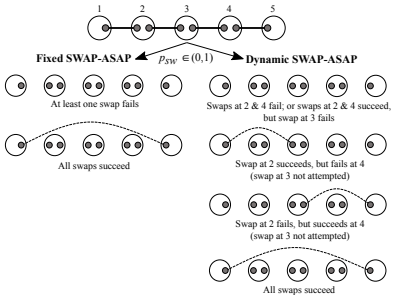
FIG.3 . Fixedanddynamicversionsofthe swap-asappolicy. Consider a five-node repeater chain in which all elementary links are active at the same time and the entanglement swapping is non-deterministic. In the fixedswap-asappolicy, all Bell measurements are performed at once, leading to two possibilities: either one of the swaps fails and consequently all elementary links become inactive, or all of them succeed and we obtain end-to-end entanglement. On the other hand, for the dynamicswap-asappolicy, there are four possibilities illustrated on the right-hand side. These possibilities are allowed within the framework ofswap-asapwhen LOCC are considered free.
원문 · CC BY 4.0 · Stav Haldar, Pratik J. Barge, Sumeet Khatri, Hwang Lee · Fast and reliable entanglement distribution with quantum repeaters: principles for improving protocols using reinforcement learning · 원문 그림 인용 · 원본 PDF 7쪽에서 그림 영역을 추출했습니다.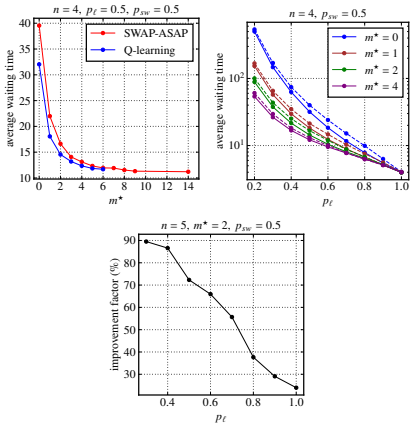
FIG. 4 . Average waiting time for a repeater chain with four and five nodes and non-deterministic entanglement swapping success probability𝑝𝑠𝑤 = 0.5. (Top left) Average waiting time as a function of the maximum memory cutoff𝑚★, with elementary link success probability𝑝ℓ = 0.5. (Top right) Average waiting time as a function of 𝑝ℓ, for different values of𝑚★. The solid line is the Q-learning policy and the dashed line is the dynamicswap-asappolicy. (Bottom) ImprovementfactorofourQ-learningpolicycomparedtothedynamic swap-asappolicy as a function of𝑝ℓ.
원문 · CC BY 4.0 · Stav Haldar, Pratik J. Barge, Sumeet Khatri, Hwang Lee · Fast and reliable entanglement distribution with quantum repeaters: principles for improving protocols using reinforcement learning · 원문 그림 인용 · 원본 PDF 8쪽에서 그림 영역을 추출했습니다.결정적 얽힘 교환에서는 개선이 낮은 p_ℓ에서 크며, m★=0인 경우에도 Q-learning 정책은 swap-asap과 같지 않습니다. 이 경우 Q-learning 정책은 모든 기본 링크가 동시에 활성화되기를 기다렸다가 한꺼번에 교환하는 정책과 일치하며, 그 대기 시간은 1/p_ℓ^{n−1}로 제시됩니다. 이 결과는 swap-asap이 m★=0에서도 최적이 아님을 보여준다고 저자들이 해석합니다.
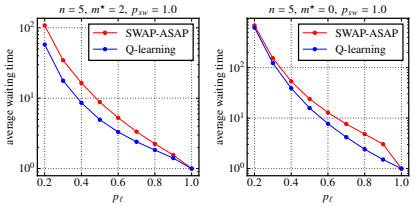
FIG. 5 . Average waiting time as a function of the elementary link suc- cess probability𝑝ℓ for a repeater chain with five nodes, deterministic entanglement swapping,𝑚★= 2 (left), and𝑚★= 0(right).
원문 · CC BY 4.0 · Stav Haldar, Pratik J. Barge, Sumeet Khatri, Hwang Lee · Fast and reliable entanglement distribution with quantum repeaters: principles for improving protocols using reinforcement learning · 원문 그림 인용 · 원본 PDF 8쪽에서 그림 영역을 추출했습니다.비균일 체인과 충실도 결과
기본 링크 확률이 링크마다 다른 비균일 체인에서도 같은 비교를 수행합니다. 4노드 체인에서는 중심 링크를 0.6으로 고정하고 비대칭 δp를 변화시켰으며, 개선 비율은 2%에서 8% 사이로 보고됩니다. 5노드 체인에서는 바깥 링크가 높고 중심 링크가 낮은 구성을 사용했으며, 개선 비율은 26%에서 38% 사이입니다. 이 결과는 비대칭이 큰 체인에서 개선이 더 크다는 저자들의 관찰입니다.
충실도 관점에서는 평균 나이를 최대 컷오프 m★로 나눈 비율을 보고합니다. 4노드 체인에서 Q-learning 정책은 swap-asap보다 평균 나이를 낮추며, p_ℓ=1에서 완전한 충실도(평균 나이 0)를 달성할 수 있다고 보고합니다. 이 결과는 Pauli 잡음 모델의 설정을 전제로 하며, 다른 잡음 모델로의 일반화는 본문에서 확인하지 않았습니다.
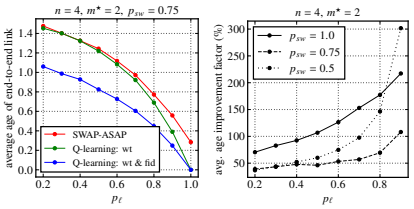
FIG. 9 . Average age of the end-to-end entangled state as a function of the elementary link success probability𝑝ℓ for a four-node re- peater chain with maximum cutoff𝑚★= 2and various entanglement swapping success probabilities𝑝𝑠𝑤. (Left) Comparison between the dynamicswap-asappolicy, the policy based on the waiting time reward in(5), as presented in Sec. III (“Q-learning: wt”), and the policy based on the waiting time and fidelity based reward in(6) (“Q-learning: wt & fid”). Here,𝑝𝑠𝑤 = 0.75. (Right) Average age improvement factor, as a function of𝑝ℓ and different choices of𝑝𝑠𝑤, for the Q-learning policy based on the reward in(6), when compared to the dynamicswap-asappolicy. Here, unlike the average waiting time, improvement increases with increasing𝑝ℓ.
원문 · CC BY 4.0 · Stav Haldar, Pratik J. Barge, Sumeet Khatri, Hwang Lee · Fast and reliable entanglement distribution with quantum repeaters: principles for improving protocols using reinforcement learning · 원문 그림 인용 · 원본 PDF 10쪽에서 그림 영역을 추출했습니다.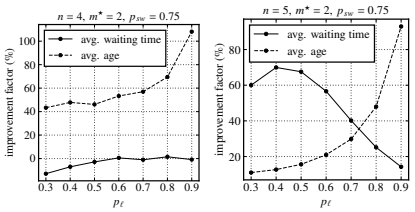
FIG. 10 . Improvement factor for the average waiting time and the average age of the end-to-end link when our Q-learning policy is based on the fidelity-based reward defined in(6). (Left) Four-node homogeneous repeater chain. Here we see that the decrease in the average age for our Q-learning policy comes at the expense of an increase in average waiting time (negative improvement factor) compared to theswap-asappolicy. (Right) Five-node homogeneous chain. Interestingly, here, unlike the four-node case, a positive improvement can be obtained simultaneously for both quantities. We still see a trade-off between the average waiting time and the average age improvement. In fact, the advantage in the low-probability regime is on average much higher for the five-node case compared to the four-node case, indicating again that our Q-learning policies become more advantageous for larger chains.
원문 · CC BY 4.0 · Stav Haldar, Pratik J. Barge, Sumeet Khatri, Hwang Lee · Fast and reliable entanglement distribution with quantum repeaters: principles for improving protocols using reinforcement learning · 원문 그림 인용 · 원본 PDF 11쪽에서 그림 영역을 추출했습니다.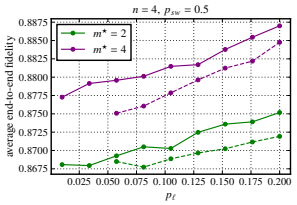
FIG. 13 . Average fidelities of the end-to-end link for a four-node repeater chain with low values of the elementary link success proba- bility𝑝ℓ, entanglement swapping success probability𝑝𝑠𝑤 = 0.5, and different values of the maximum cutoff time𝑚★. The solid line is the Q-learning policy, obtained via training at𝑝ℓ = 0.3, and the dashed line is theswap-asappolicy.
원문 · CC BY 4.0 · Stav Haldar, Pratik J. Barge, Sumeet Khatri, Hwang Lee · Fast and reliable entanglement distribution with quantum repeaters: principles for improving protocols using reinforcement learning · 원문 그림 인용 · 원본 PDF 12쪽에서 그림 영역을 추출했습니다.개선이 나오는 원인: 동적 컷오프와 전역 지식
저자들은 Q-learning 정책의 개선을 세 가지 특성으로 정량화합니다. 첫째, 링크별 평균 컷오프 ⟨t★⟩를 측정하면 내부 링크가 외곽 링크보다 더 오래 보존되고, 확률이 낮은 링크가 높은 링크보다 오래 보존됩니다. 둘째, 전역 지식은 행동과 상태 사이의 피어슨 상관계수로 측정합니다. swap-asap에서는 상관이 주로 같은 노드 안에 머물지만, Q-learning 정책에서는 먼 링크 사이에도 상관이 유지됩니다.
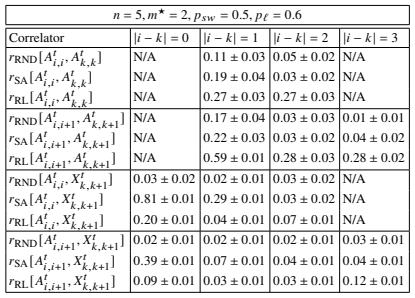
원문 그림 TABLE II. Equal-time correlation coefficients of states and actions (see(20))forourQ-learningpolicy( 𝑟RL),the swap-asappolicy(𝑟SA), and a random policy (𝑟RND). The values range between 0 and 1 (0 represents no correlation and 1 represents maximum correlation or anti-correlation). Averages of correlators are calculated over randomly generated states and actions determined for those states by the respective policies.
원문 · CC BY 4.0 · Stav Haldar, Pratik J. Barge, Sumeet Khatri, Hwang Lee · Fast and reliable entanglement distribution with quantum repeaters: principles for improving protocols using reinforcement learning · 원문 그림 인용 · 원본 PDF 16쪽에서 그림 영역을 추출했습니다.셋째, 미래 보상을 고려하는 정도는 서로 다른 시간의 상관을 통해 봅니다. swap-asap은 다음 시간 단계의 상태에만 영향을 받는 반면, Q-learning 정책의 상관은 더 긴 시간 범위에서 유지됩니다. 이 상관들은 개선의 원인을 설명하는 지표로 제시되며, 상관이 곧바로 인과를 증명하는 것은 아닙니다.
중첩 정책으로 긴 체인 확장
작은 체인에서 학습한 정책을 큰 체인에 적용하기 위해 중첩 방법을 사용합니다. 하위 수준에서는 5노드 같은 작은 구간의 정책을 사용하고, 상위 수준에서는 구간의 끝 노드들 사이의 링크를 하나의 기본 링크처럼 취급합니다. 상위 수준은 보통 국소적인 swap-asap 정책을 사용하며, 이는 통신 시간을 줄이기 위한 선택입니다.
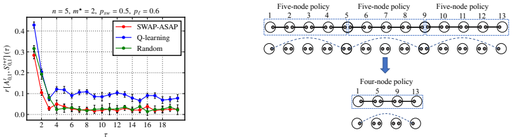
FIG. 16 . An example of the policy nesting strategy presented in Sec. VII. In this example, the policy for distributing entanglement to the end nodes of a quantum repeater chain with 13 nodes consists of performing a fixed policy for the three five-node segments indicated by the dashed boxes in the “first” nesting level. Then, in the “second” nesting level, a policy for four nodes is executed.
원문 · CC BY 4.0 · Stav Haldar, Pratik J. Barge, Sumeet Khatri, Hwang Lee · Fast and reliable entanglement distribution with quantum repeaters: principles for improving protocols using reinforcement learning · 원문 그림 인용 · 원본 PDF 17쪽에서 그림 영역을 추출했습니다.10노드(3개의 3링크 체인)와 13노드(3개의 4링크 체인)에서 여러 중첩 조합을 비교합니다. 저자들은 swap-asap 기반 중첩이 완전 로컬 정책보다 대기 시간을 줄이며, swap-asap 상위 수준과 Q-learning 하위 수준을 결합한 방식이 상당한 개선을 보인다고 보고합니다. 13노드 체인의 단순 swap-asap 대기 시간은 시뮬레이션 시간이 길어 신뢰할 만한 추정을 얻지 못했습니다.
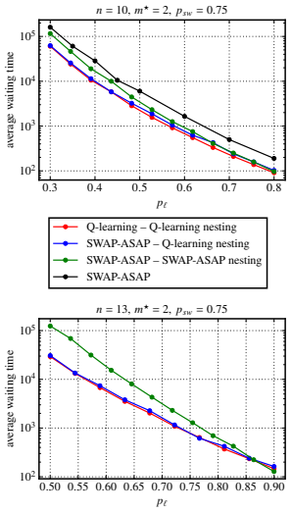
FIG.17 . Examplesoftheapplicationournestingstrategy,aspresented in Sec. VII, which uses our Q-learning policies in combination with thelocal swap-asappolicy, inordertoimprovewaitingtimesforlarge quantum repeater chains consisting of 10 nodes (three chains with threelinkseach)(top)and13nodes(threechainswithfourlinkseach) (bottom). See the main text for a description of the various nested polices shown. We also provide the waiting time for the simple, non- nested swap-asappolicyforthe10-nodechain. Forthe13-nodechain, the exceedingly long simulation times make it difficult to reasonably estimate the waiting time for the simpleswap-asappolicy.
원문 · CC BY 4.0 · Stav Haldar, Pratik J. Barge, Sumeet Khatri, Hwang Lee · Fast and reliable entanglement distribution with quantum repeaters: principles for improving protocols using reinforcement learning · 원문 그림 인용 · 원본 PDF 18쪽에서 그림 영역을 추출했습니다.한계와 적용 범위
이 분석은 체인의 노드 수를 입력으로 하며 물리적 거리와 실제 고전 통신 시간은 명시적으로 다루지 않습니다. 저자들은 LOCC를 자유로운 것으로 가정하고, 얽힘 교환 연산은 시간 단계를 추가하지 않는다고 설정합니다. 따라서 대기 시간 결과는 통신 비용을 반영하지 않은 조건에서 얻어진 것입니다.
또한 결과는 선형 체인, Pauli 잡음, 설정된 p_ℓ, p_sw, m★ 범위에서 얻어졌습니다. 충실도 결과는 특정 잡음 모델에 기반하며, 비Pauli 잡음에서의 갱신 규칙은 이 논문에서 다루지 않는다고 밝힙니다. 엔탱글먼트 증류와 임의 토폴로지는 향후 과제로 남겨져 있습니다.
논문 정보
- 저자
- Stav Haldar, Pratik J. Barge, Sumeet Khatri, Hwang Lee
- 학회·저널
- arXiv · 프리프린트
- 최초 공개일
- 2023년 3월 1일
- 등록일
- 2026년 11월 6일
- 수정일
- 2024년 4월 1일
- 버전
- v4
- arXiv
- 2303.00777
- DOI
- 10.1103/physrevapplied.21.024041
- 분류
- quant-ph
- 원문 이용 조건
- CC BY 4.0
- 제공 범위
- 논문 정보, 해설, 허용된 원문 그림
AI 해설은 논문 원문과 별개의 설명이며 오류가 있을 수 있습니다. 원문과 그림은 각 출처의 이용 조건과 따로 표시된 권리를 따릅니다.
초록
Future quantum technologies such as quantum communication, quantum sensing, and distributed quantum computation, will rely on networks of shared entanglement between spatially separated nodes. In this work, we provide improved protocols/policies for entanglement distribution along a linear chain of nodes, both homogeneous and inhomogeneous, that take practical limitations such as photon losses, non-ideal measurements, and quantum memories with short coherence times into account. For a wide range of parameters, our policies improve upon previously known policies, such as the "swap-as-soon-as-possible" policy, with respect to both the waiting time and the fidelity of the end-to-end entanglement. This improvement is greatest for the most practically relevant cases, namely, for short coherence times, high link losses, and highly asymmetric links. To obtain our results, we model entanglement distribution using a Markov decision process, and then we use the Q-learning reinforcement learning (RL) algorithm to discover new policies. These new policies are characterized by dynamic, state-dependent memory cutoffs and collaboration between the nodes. In particular, we quantify this collaboration between the nodes. Our quantifiers tell us how much "global" knowledge of the network every node has. Finally, our understanding of the performance of large quantum networks is currently limited by the computational inefficiency of simulating them using RL or other optimization methods. Thus, in this work, we present a method for nesting policies in order to obtain policies for large repeater chains. By nesting our RL-based policies for small repeater chains, we obtain policies for large repeater chains that improve upon the swap-as-soon-as-possible policy, and thus we pave the way for a scalable method for obtaining policies for long-distance entanglement distribution.
원문 인용
Stav Haldar, Pratik J. Barge, Sumeet Khatri, Hwang Lee (2023). Fast and reliable entanglement distribution with quantum repeaters: principles for improving protocols using reinforcement learning. arXiv:2303.00777v4. https://doi.org/10.1103/physrevapplied.21.024041
BibTeX
@article{haldar2023fast,
  title = {{Fast and reliable entanglement distribution with quantum repeaters: principles for improving protocols using reinforcement learning}},
  author = {Stav Haldar and Pratik J. Barge and Sumeet Khatri and Hwang Lee},
  year = {2023},
  eprint = {2303.00777},
  archivePrefix = {arXiv},
  doi = {10.1103/physrevapplied.21.024041},
  url = {https://arxiv.org/abs/2303.00777v4}
}