논문 해설
Quantum Deep Hedging
양자 딥 헤징
- 연구 문제 딥 헤징의 파생상품 헤지 학습에 양자 신경망을 적용했을 때 학습 가능성과 성능이 유지되는지, 분포형 액터-크리틱이 정책 탐색보다 나은지가 쟁점입니다.
- 연구 방법 직교 층과 복합 층을 사용하는 양자 신경망을 정책과 가치 함수에 적용하고, 복합 층 기반 분포형 액터-크리틱을 제안합니다.
- 주요 결과 직교 층 모델은 고전 GBM 환경에서 고전 모델과 비슷한 효용을 보이며 파라미터를 줄였습니다. 양자 환경의 Table 4 시뮬레이션에서는 분포형 액터-크리틱이 정책 탐색보다 높은 효용을 보였습니다.
딥 헤징의 어려움과 연구 질문
딥 헤징은 실제 시장의 거래 비용, 유동성 제약 같은 요인을 반영하여 파생상품 헤지 전략을 강화학습으로 학습하는 틀입니다. 이 논문은 양자 신경망이 이 문제에서 학습 가능하면서도 고전 모델과 비슷한 성능을 낼 수 있는지, 그리고 분포형 액터-크리틱이 정책 탐색 방법보다 나은지를 묻습니다. 설명은 고전 시장 환경에서의 직교 층 적용과 양자 환경에서의 복합 층 적용을 구분하여 따라갑니다.
직교 층과 RBS 게이트
직교 층은 n큐비트 회로에서 해밍 가중치 1인 단위 기저 부분공간에 작용하며, RBS 게이트의 합성으로 SO(n)의 원소처럼 동작합니다. 고전 데이터는 단위 데이터 로더로 진폭 인코딩되고, 출력은 토모그래피로 읽어 고전적으로 활성화 함수를 적용합니다. 이 구조는 선형 층을 대체하여 파라미터 수를 줄이는 방식으로 사용됩니다.
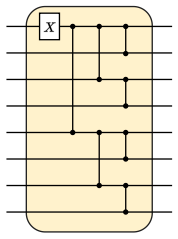
Figure 1 : A quantum circuit with logarithmic depth for data loading. Vertical lines represent RBS gates with parameters that are dependent on the inputx. The unitary represented by this data loader is denoted asUL(x).
원문 · CC BY 4.0 · El Amine Cherrat, Snehal Raj, Iordanis Kerenidis, Abhishek Shekhar, Ben Wood, Jon Dee, Shouvanik Chakrabarti, Richard Chen, Dylan Herman, Shaohan Hu, Pierre Minssen, Ruslan Shaydulin, Yue Sun, Romina Yalovetzky, Marco Pistoia · Quantum Deep Hedging · 원문 그림 인용 · 원본 PDF 8쪽에서 그림 영역을 추출했습니다.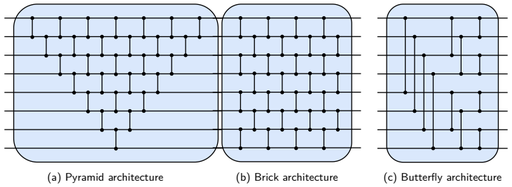
Figure 2 : Various Hamming-weight preserving circuits used in quantum orthogonal layers. These circuits are parameterized by a set of parametersθ, with each parameter representing the angle of a specific RBS gate. The parameterized unitary represented by this layer is expressed asU(θ).
원문 · CC BY 4.0 · El Amine Cherrat, Snehal Raj, Iordanis Kerenidis, Abhishek Shekhar, Ben Wood, Jon Dee, Shouvanik Chakrabarti, Richard Chen, Dylan Herman, Shaohan Hu, Pierre Minssen, Ruslan Shaydulin, Yue Sun, Romina Yalovetzky, Marco Pistoia · Quantum Deep Hedging · 원문 그림 인용 · 원본 PDF 8쪽에서 그림 영역을 추출했습니다.복합 층과 분포형 가치 근사
복합 층은 외적 거듭제곱 공간에서 선형 연산자를 구현하며, FBS 게이트로 구성되어 각 해밍 가중치 부분공간에 대해 블록 대각 유니터리로 작동합니다. 분포형 액터-크리틱은 미래 궤적을 해밍 가중치별 부분 집합으로 나누고, 각 부분 집합의 기대값을 고정 지지집합 위에서 학습합니다. 이때 Cramér 투영은 기대값을 보존하면서 Cramér 거리를 최소화하는 근사로 사용됩니다.
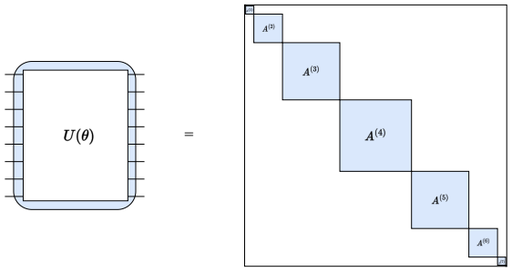
Figure 3 : A quantum compound layerU(θ) acts as a block diagonal unitary on each fixed Hamming- weight subspace.
원문 · CC BY 4.0 · El Amine Cherrat, Snehal Raj, Iordanis Kerenidis, Abhishek Shekhar, Ben Wood, Jon Dee, Shouvanik Chakrabarti, Richard Chen, Dylan Herman, Shaohan Hu, Pierre Minssen, Ruslan Shaydulin, Yue Sun, Romina Yalovetzky, Marco Pistoia · Quantum Deep Hedging · 원문 그림 인용 · 원본 PDF 9쪽에서 그림 영역을 추출했습니다.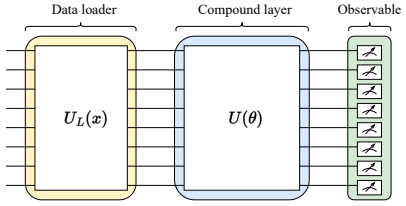
Figure 5 : A quantum compound neural network.UL(x) refers to a general data loader unitary.U(θ) denotes a Hamming-weight preserving unitary as for example the ones shown in Figure 2.
원문 · CC BY 4.0 · El Amine Cherrat, Snehal Raj, Iordanis Kerenidis, Abhishek Shekhar, Ben Wood, Jon Dee, Shouvanik Chakrabarti, Richard Chen, Dylan Herman, Shaohan Hu, Pierre Minssen, Ruslan Shaydulin, Yue Sun, Romina Yalovetzky, Marco Pistoia · Quantum Deep Hedging · 원문 그림 인용 · 원본 PDF 13쪽에서 그림 영역을 추출했습니다.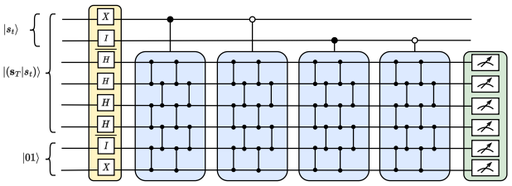
Figure 7 : The quantum compound neural network usingO(T ) + 2qubits for the Black-Scholes model. For loading the data (in yellow), firstt qubits are used to encode past jumps of the market state. The nextO(T−t) qubits encode the transition oracles which in the case of Black-Scholes corresponds to an equal superposition over all possible future jumps. The last two qubits are ancilla and are used to encode the state|01⟩. Next for the unitaries (in blue), we used a architecture controlled on past market state. Based on the direction of jump, a different compound layer constructed using Brick architecture (Figure 2) is applied onT−t + 2 qubits. Finally, each of the lastT−t + 2 qubits is measured (in green) independently. Fort = 0, the input state is an equal superposition of all possible future jumps followed by one unitary overT + 2 qubits without control. As described in Section 5.2.4 the control qubits are always in a computational basis state. Thus, they can be removed for efficient hardware implementation, and the appropriate parameters for unitary acting onT−t + 2 qubits can be chosen classically for each past state.
원문 · CC BY 4.0 · El Amine Cherrat, Snehal Raj, Iordanis Kerenidis, Abhishek Shekhar, Ben Wood, Jon Dee, Shouvanik Chakrabarti, Richard Chen, Dylan Herman, Shaohan Hu, Pierre Minssen, Ruslan Shaydulin, Yue Sun, Romina Yalovetzky, Marco Pistoia · Quantum Deep Hedging · 원문 그림 인용 · 원본 PDF 34쪽에서 그림 영역을 추출했습니다.학습 가능성 결과의 조건
Theorem 2는 복합 층을 사용하는 변분 양자 알고리즘에서 파라미터를 평균 0, 분산 O(1/n^2)의 정규분포로 초기화하고 초기 상태를 균등 중첩 또는 해밍 가중치 k의 균등 중첩으로 둘 때 기울기 노름의 기대값이 Ω(1/poly(n))임을 보입니다. 이 결과는 이러한 초기화와 측정 가정에 근거하며, 다른 설정으로의 일반화는 저자가 열린 질문으로 남겨 둡니다.
고전 및 양자 환경의 비교 결과
고전 GBM 환경에서 직교 층 모델은 정확한 시뮬레이션에서 고전 모델과 비슷한 기대효용을 보이면서 학습 파라미터 수를 줄였습니다. 양자 환경의 Table 4 시뮬레이션에서는 분포형 액터-크리틱의 기대효용이 -3.875로, 정책 탐색의 -4.064보다 높게 보고되었습니다. 하드웨어 실험에서 분포형 정책의 기대효용은 시뮬레이션과 하드웨어에서 각각 -3.309와 -3.369이며, Black-Scholes 델타 헤지의 -4.884보다 높게 나타났습니다. 이 결과들은 각 실험의 경로 수, 거래일 수, 거래 비용 조건 안에서 읽어야 합니다.
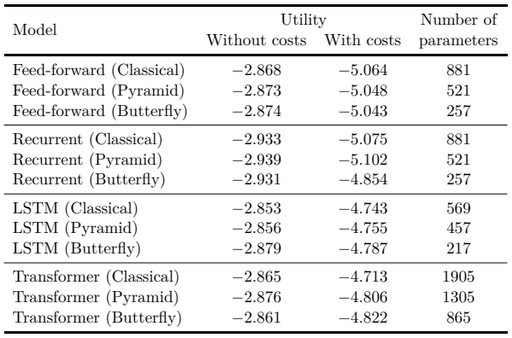
Table 1 : Comparison of expected utilities without and with transaction costs for models with classical and orthogonal layers using exact simulation over 256 paths and 30 trading days, including the number of trainable parameters.
원문 · CC BY 4.0 · El Amine Cherrat, Snehal Raj, Iordanis Kerenidis, Abhishek Shekhar, Ben Wood, Jon Dee, Shouvanik Chakrabarti, Richard Chen, Dylan Herman, Shaohan Hu, Pierre Minssen, Ruslan Shaydulin, Yue Sun, Romina Yalovetzky, Marco Pistoia · Quantum Deep Hedging · 원문 그림 인용 · 원본 PDF 31쪽에서 그림 영역을 추출했습니다.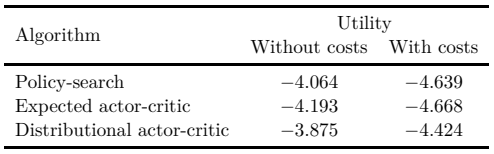
Table 4 : Comparison of compound neural networks trained using different algorithms with exact simulation, evaluating expected utilities over16 paths and 10 trading days, both without and with transaction costs.
원문 · CC BY 4.0 · El Amine Cherrat, Snehal Raj, Iordanis Kerenidis, Abhishek Shekhar, Ben Wood, Jon Dee, Shouvanik Chakrabarti, Richard Chen, Dylan Herman, Shaohan Hu, Pierre Minssen, Ruslan Shaydulin, Yue Sun, Romina Yalovetzky, Marco Pistoia · Quantum Deep Hedging · 원문 그림 인용 · 원본 PDF 35쪽에서 그림 영역을 추출했습니다.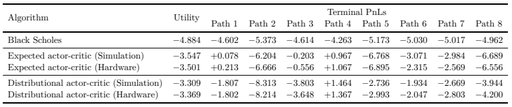
Table 6 : Comparison of compound neural networks trained using different algorithms with exact simulation and Quantinuum H1-1, H1-2 hardware results, evaluating expected utilities and terminal PnLs with transaction costs over8 paths and 10 trading days, benchmarked against the standard Black-Scholes delta-hedging model.
원문 · CC BY 4.0 · El Amine Cherrat, Snehal Raj, Iordanis Kerenidis, Abhishek Shekhar, Ben Wood, Jon Dee, Shouvanik Chakrabarti, Richard Chen, Dylan Herman, Shaohan Hu, Pierre Minssen, Ruslan Shaydulin, Yue Sun, Romina Yalovetzky, Marco Pistoia · Quantum Deep Hedging · 원문 그림 인용 · 원본 PDF 36쪽에서 그림 영역을 추출했습니다.적용 범위와 한계
저자들은 큐비트 수와 시뮬레이션 가능성 때문에 하드웨어 비교를 만기 10일의 제한된 설정에서 수행했다고 밝힙니다. 따라서 이 결과는 해당 GBM 설정과 실험 규모에서 얻은 것이며, 더 긴 만기나 다른 시장 모형으로 바로 확장된다고 볼 수 없습니다.
논문 정보
- 저자
- El Amine Cherrat, Snehal Raj, Iordanis Kerenidis, Abhishek Shekhar, Ben Wood, Jon Dee, Shouvanik Chakrabarti, Richard Chen, Dylan Herman, Shaohan Hu, Pierre Minssen, Ruslan Shaydulin, Yue Sun, Romina Yalovetzky, Marco Pistoia
- 학회·저널
- arXiv · 프리프린트
- 최초 공개일
- 2023년 3월 29일
- 등록일
- 2026년 11월 6일
- 수정일
- 2023년 11월 26일
- 버전
- v2
- arXiv
- 2303.16585
- DOI
- 10.22331/q-2023-11-29-1191
- 분류
- quant-ph · cs.LG · q-fin.CP
- 원문 이용 조건
- CC BY 4.0
- 제공 범위
- 논문 정보, 해설, 허용된 원문 그림
AI 해설은 논문 원문과 별개의 설명이며 오류가 있을 수 있습니다. 원문과 그림은 각 출처의 이용 조건과 따로 표시된 권리를 따릅니다.
초록
Quantum machine learning has the potential for a transformative impact across industry sectors and in particular in finance. In our work we look at the problem of hedging where deep reinforcement learning offers a powerful framework for real markets. We develop quantum reinforcement learning methods based on policy-search and distributional actor-critic algorithms that use quantum neural network architectures with orthogonal and compound layers for the policy and value functions. We prove that the quantum neural networks we use are trainable, and we perform extensive simulations that show that quantum models can reduce the number of trainable parameters while achieving comparable performance and that the distributional approach obtains better performance than other standard approaches, both classical and quantum. We successfully implement the proposed models on a trapped-ion quantum processor, utilizing circuits with up to $16$ qubits, and observe performance that agrees well with noiseless simulation. Our quantum techniques are general and can be applied to other reinforcement learning problems beyond hedging.
원문 인용
El Amine Cherrat, Snehal Raj, Iordanis Kerenidis, Abhishek Shekhar, Ben Wood, Jon Dee, Shouvanik Chakrabarti, Richard Chen, Dylan Herman, Shaohan Hu, Pierre Minssen, Ruslan Shaydulin, Yue Sun, Romina Yalovetzky, Marco Pistoia (2023). Quantum Deep Hedging. arXiv:2303.16585v2. https://doi.org/10.22331/q-2023-11-29-1191
BibTeX
@article{cherrat2023quantum,
  title = {{Quantum Deep Hedging}},
  author = {El Amine Cherrat and Snehal Raj and Iordanis Kerenidis and Abhishek Shekhar and Ben Wood and Jon Dee and Shouvanik Chakrabarti and Richard Chen and Dylan Herman and Shaohan Hu and Pierre Minssen and Ruslan Shaydulin and Yue Sun and Romina Yalovetzky and Marco Pistoia},
  year = {2023},
  eprint = {2303.16585},
  archivePrefix = {arXiv},
  doi = {10.22331/q-2023-11-29-1191},
  url = {https://arxiv.org/abs/2303.16585v2}
}