논문 해설
Bounded-Order Non-Identifiability in Latent Structure Block Models: The Fiber in Closed Form
Latent Structure Block Model에서의 차수 제한 비식별성: 닫힌 형태로 본 섬유
- 연구 문제 모티프 센서스로 같은 준동형 밀도를 갖는 LSBM 설정들이 얼마나 많은지 알기 어렵습니다.
- 연구 방법 잠재 위치가 K개의 직선 위에 있는 LSBM에서 모멘트 일치 조건을 Jacobi 행렬로 옮겨 닫힌 형태의 fiber를 구성합니다.
모티프 관측으로 무엇을 구별할 수 있는가
그래프 극한 이론은 그래프의 모든 준동형 밀도가 그래프 극한을 결정한다고 말합니다. 그러나 실제 방법은 유한 개의 작은 모티프만 셉니다. 이 논문은 잠재 위치가 K개의 원점 통과 직선 위에 놓인 LSBM이라는 계열에서, 이렇게 잘라낸 관측이 무엇을 잃는지 정확히 계산했습니다. 공유 반경 법칙을 가진 대칭 기울기 설정들 중 2K−2 차 이하의 센서스가 같은 설정들은 닫힌 형태의 곡선, 곧 fiber를 이룹니다. 저자들은 K가 커질수록 구별에 필요한 모티프 차수도 함께 커진다고 보고합니다.
준동형 밀도와 fiber의 구조
각 설정은 반경 법칙을 공유하고, 준동형 밀도는 반경 인자와 기울기 모멘트의 짝수 부분그래프 합으로 분해됩니다. 그래서 밀도는 모멘트 m_j의 다항식이 되며, 모멘트 일치의 차수가 모티프 구별을 결정합니다. 모티프 F의 기울기 지수 h(F)가 j 이하이면 m_0부터 m_j까지가 같을 때 F의 밀도가 같습니다. 같은 모멘트를 갖는 설정들은 Hankel 행렬의 Cholesky 분해로 얻은 Jacobi 행렬 J(ξ)의 한 자유 모서리 ξ로 매개되며, 허용 구간의 양 끝은 Gauss–Radau 규칙에 해당하는 식으로 정해집니다. 친구 그래프 F_{K−1}은 2K−1개 꼭짓점에서 가장 적은 간선으로 구별하는 분리자로 제시됩니다.
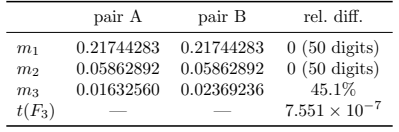
Table 1 : Two configurations on one K = 4 fiber. The census matches below order 7 exactly; the separator reads a 45% moment gap as 10−6 .
원문 · CC BY 4.0 · Dharmawan, Sie Hendrata, Chin, Peter · Bounded-Order Non-Identifiability in Latent Structure Block Models: The Fiber in Closed Form · 원문 그림 인용 · 원본 PDF 6쪽에서 그림 영역을 추출했습니다.센서스 비용과 신호 크기
저자들은 희소 그래프에서도 상대 분리가 반경 척도에 불변이라는 점을 들어 밀도 자체로는 이 억제가 바뀌지 않는다고 설명합니다.
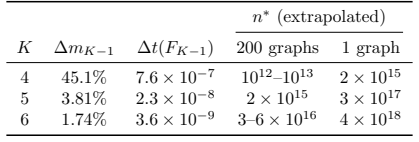
Table 2 : Census route byK(threshold order 2K−1): moment and density separation along the fiber, and the extrapolatedn ∗ with 200 graphs or one graph per configuration.
원문 · CC BY 4.0 · Dharmawan, Sie Hendrata, Chin, Peter · Bounded-Order Non-Identifiability in Latent Structure Block Models: The Fiber in Closed Form · 원문 그림 인용 · 원본 PDF 7쪽에서 그림 영역을 추출했습니다.스펙트럴 파이프라인의 fiber 위 변위
P1-cluster는 2차원 ASE 임베딩에서 노드별 기울기를 구하고 1차원 2-means로 군집화하는 파이프라인입니다. C=0.3, n=32,000, 평균 차수 720인 HI 설정에서 추정치는 fiber 위에 거의 놓이지만 호선 길이 기준 약 31.4% 떨어진 위치로 편향되었습니다. 이 편향은 복제본 산포의 7배에서 15배 수준으로 보고되었습니다. 즉 추정은 정밀하지만 틀린 위치에 있다는 것이 저자들의 해석입니다. 이 편향은 구현 오류가 아니라 fiber의 평탄한 방향과 추정기의 체계적 오차가 결합한 결과로 설명됩니다.
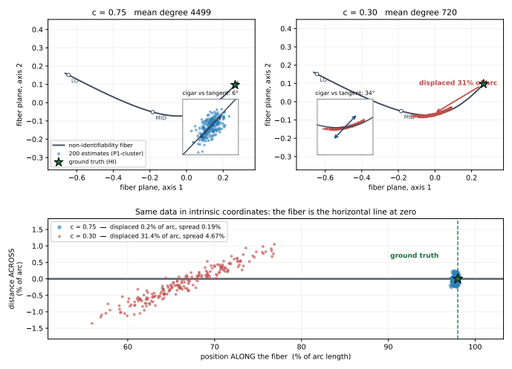
Figure 1 : P1-cluster at configuration HI (w min = 0.0375),n= 32,000. Top: the fiber and estimates in the fiber’s best-fit plane at two densities. Bottom: the same estimates in intrinsic coordinates (position along the fiber versus signed distance across it). At mean degree 720 every estimate lies close to the curve yet is displaced 31% of the arc along it.
원문 · CC BY 4.0 · Dharmawan, Sie Hendrata, Chin, Peter · Bounded-Order Non-Identifiability in Latent Structure Block Models: The Fiber in Closed Form · 원문 그림 인용 · 원본 PDF 8쪽에서 그림 영역을 추출했습니다.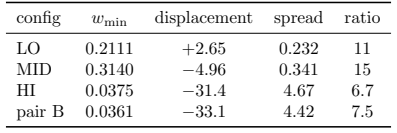
Table 5 : P1-cluster atC= 0.3,n= 32,000: intrinsic signed along-fiber displacement (bias) and spread, % of arc (+ toward the pair-B end).
원문 · CC BY 4.0 · Dharmawan, Sie Hendrata, Chin, Peter · Bounded-Order Non-Identifiability in Latent Structure Block Models: The Fiber in Closed Form · 원문 그림 인용 · 원본 PDF 36쪽에서 그림 영역을 추출했습니다.모델 기반 적합은 편향을 피하는가
RayEM은 ASE 행을 ray 혼합으로 보고 ASE 중심극한 공분산으로 EM을 수행합니다. 시험한 모든 셀에서 RayEM의 총 오차는 호선 길이의 1% 미만이었고, 적합된 소수 가중치도 편향이 없었습니다. LSBM 저자들의 Bayesian 샘플러도 두 셀에서 0.3%와 1.8% 이내였습니다. 저자들은 RayEM 목적함수가 fiber를 따라 평탄하지 않다는 점을 지적하지만, 잡음 모델과 ray 가족의 기여는 아직 분리하지 못했다고 밝힙니다. 이 결과는 ray 가족과 임베딩의 잡음 모델을 제공받는 조건에서 얻은 것입니다.
적용 범위와 한계
이론은 공유 반경 법칙을 가진 대칭 계열에 한정되며, 비대칭 기울기 계열에서 닫힌 형태가 유지되는지는 밝히지 않았습니다. 분광 실험은 K=4, n≤32,000에서 시뮬레이션 그래프로 수행했습니다. 센서스 비용 n*은 외삽값이고, 메시지 패싱 결과는 노드 특성이 없는 네트워크의 그래프 극한 진술입니다. 저자들은 K를 선택하는 문제는 다루지 않았다고 밝힙니다.
논문 정보
- 저자
- Dharmawan, Sie Hendrata, Chin, Peter
- 학회·저널
- arXiv · 프리프린트
- 최초 공개일
- 2026년 11월 17일
- 등록일
- 2026년 11월 20일
- 수정일
- 2026년 11월 17일
- 버전
- v1
- arXiv
- 2611.23547
- 분류
- stat.ML · cs.LG · math.ST
- 원문 이용 조건
- CC BY 4.0
- 제공 범위
- 논문 정보, 해설, 허용된 원문 그림
AI 해설은 논문 원문과 별개의 설명이며 오류가 있을 수 있습니다. 원문과 그림은 각 출처의 이용 조건과 따로 표시된 권리를 따릅니다.
초록
A graphon is determined by all of its homomorphism densities, but motif-based methods use finitely many. We compute exactly what that truncation costs in a natural family: latent structure block models whose positions lie on $K$ rays, equivalently degree-corrected block models of rank two. For a given radial law, the configurations that agree on every graph with fewer than $2K-1$ vertices form a one-dimensional fiber, which we give in closed form with explicit endpoints; the friendship graph $F_{K-1}$ is its unique edge-minimal separator, so no fixed motif order serves every $K$. The separating signal is suppressed by a factor of at most $m_1^{2(K-1)}$, where $m_1$ is the mean squared slope, about $10^{-4}$ at $K=4$: detecting it from motif counts would take about $10^{15}$ nodes in a single graph, at any edge density. The information is nonetheless in the graph; the fiber belongs to the statistic, not the model. Common spectral pipelines, which count no motifs, still slide along the fiber by more than a third of its length at ordinary densities, with confidence regions that almost never contain the truth, while model-based fits of the same embedding do not. We give practitioners four checks: whether a fit is at risk, what to run instead, why a confidence interval will not warn, and how wide the remaining ambiguity is.
원문 인용
Dharmawan, Sie Hendrata, Chin, Peter (2026). Bounded-Order Non-Identifiability in Latent Structure Block Models: The Fiber in Closed Form. arXiv:2611.23547v1. https://arxiv.org/abs/2611.23547v1
BibTeX
@misc{hendrata2026bounded,
  title = {{Bounded-Order Non-Identifiability in Latent Structure Block Models: The Fiber in Closed Form}},
  author = {Dharmawan, Sie Hendrata and Chin, Peter},
  year = {2026},
  eprint = {2611.23547},
  archivePrefix = {arXiv},
  url = {https://arxiv.org/abs/2611.23547v1}
}