논문 해설
Meta-iLaD: Identifiable Latent Dynamics via Meta-Learning of Dynamics Environments
Meta-iLaD: 동역학 환경의 메타 학습을 통한 식별 가능한 잠재 동역학
- 연구 문제 고차원 시계열의 잠재 동역학에서 기존 식별 가능 방법은 사전 정의된 환경 레이블에 의존해 새 환경으로 일반화하기 어렵고, 동역학 함수와 환경 변수의 식별 가능성은 충분히 다뤄지지 않았습니다.
- 연구 방법 Meta-iLaD는 few-shot 맥락 샘플로부터 환경 변수 c를 추론하는 메타 학습 구조로 F(z<t;c)를 조건화하여 잠재 상태, 환경 변수, 동역학 함수의 식별 가능성을 함께 다룹니다.
- 주요 결과 합성 시스템과 CMU MoCAP 실험에서 Meta-iLaD는 식별 품질과 예측 오차에서 보고된 기준선보다 높은 성능을 보였으며, 절제 실험은 TC 손실과 warm-up이 각각 MCC(c)와 MCC(zt)에 기여함을 보고합니다.
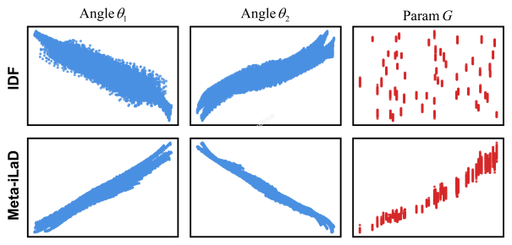
Figure 5 .Scatter plots of estimated versus true values for latent angles θ1, θ2 (blue) and environment parameter G (red) on Double Pendulum during reconstruction. Meta-iLaD successfully identifies both latent states and environment variable (clear linear relationships), while IDF identifies latent states but fails to recoverG(noise pattern).
원문 · CC BY 4.0 · Yubo Ye, Sweekar Piya, Xiajun Jiang, Linwei Wang · Meta-iLaD: Identifiable Latent Dynamics via Meta-Learning of Dynamics Environments · 원문 그림 인용 · 원본 PDF 19쪽에서 그림 영역을 추출했습니다.문제 설정
고차원 시계열의 현재 상태를 평가하고 미래 궤적을 예측하려면 관측 뒤에 있는 잠재 동역학을 학습해야 합니다. 기존의 식별 가능 잠재 동역학 연구는 주로 환경 변수 c에 따라 달라지는 동역학 F(z<t;c)에서 잠재 상태 zt의 식별 가능성을 다루었습니다. 이때 환경은 사전에 정의된 레이블 u로 주어져야 하므로, 학습 때 보지 못한 환경으로 일반화하기 어렵고 레이블이 없는 시스템에는 적용하기 어렵습니다. 또한 F와 c의 식별 가능성은 거의 다루어지지 않았습니다. 재구성 설정에서는 이 차이가 크게 드러나지 않지만, 관측하지 않은 미래 상태를 F로 전개하는 예측 설정에서는 F와 c의 식별 가능성이 중요해집니다.
이 논문은 이 두 공백을 함께 다룹니다.
Meta-iLaD의 구성
Meta-iLaD는 질의 샘플과 같은 동역학 환경에서 가져온 k-shot 맥락 샘플 Ds를 입력으로 받습니다. 맥락 샘플의 임베딩을 평균하여 환경 변수 c의 평균과 분산을 산출하고, 이를 d차원 가우시안 조건부 사전분포 pζ(c|Ds)로 모델링합니다. 잠재 상태는 추정된 c에 조건화된 신경 상미분방정식 fθ(zt;c)의 흐름으로 전개되며, 관측은 가역 혼합 함수 g를 통해 생성됩니다. 학습은 조건부 우도의 하한인 ELBO를 최대화하는 변분 추론으로 이루어지며, 여기에 c의 차원 간 의존성을 줄이기 위한 total correlation 손실과, 재구성 손실로 먼저 인코더를 안정화하는 warm-up 전략이 더해집니다.
기존 방법이 레이블을 조건으로 쓴 것과 달리, 이 방법은 맥락 샘플로부터 c를 매번 추론하는 점이 핵심 차이입니다.
식별 가능성 이론
이론 부분은 세 가지 결과를 제시합니다. 정리 1은 환경 변수 c와 관련 매개변수가 순열, 대각 스케일링, 이동 변환을 제외하고 식별 가능함을 보입니다. 이 결과는 측도 0 조건, 혼합 함수의 단사성, 충분 통계량의 미분 가능성과 선형 독립성, 그리고 2d+1개의 서로 다른 환경에서 2d×2d 행렬이 가역이라는 조건에 의존합니다. 정리 2는 잠재 상태 zt가 순열과 성분별 가역 변환을 제외하고 식별 가능함을 보이며, 여러 환경에서 1차와 2차 도함수 차이 벡터가 선형 독립이라는 조건을 요구합니다. 따름정리 1은 c의 참 차원 d를 모를 때 추정 차원을 d̂ ≥ d로 설정해도 참 변수가 부분 공간에 복원되고 나머지 차원은 잡음만 담는다고 말합니다.
따름정리 2는 두 정리가 성립할 때 학습된 전이 함수가 참 전이 함수와 순열 및 성분별 변환 범위에서 동등하다고 결론짓습니다. 이 결론들은 열거한 가정을 만족하는 조건부 결과이며, 가정 밖의 일반 상황에 대한 보장으로 읽지 않습니다.
합성 물리 시스템에서의 검증
합성 실험은 강제 감쇠 진자, 카트폴, 이중 진자 데이터셋에서 수행되었습니다. 각 시스템의 환경은 감쇠 계수, 질량, 길이, 중력 상수 같은 물리 매개변수로 주어지며, 이를 무작위로 샘플링해 이미지 시퀀스를 만들었습니다. 평가는 재구성, 예측, OOD 일반화 세 설정으로 나뉘며, 데이터 공간에서는 MSE, 잠재 공간에서는 strong-MCC를 측정합니다. Pendulum의 재구성 설정에서 Meta-iLaD는 MCC(z) 1.00(0.00), MCC(c) 0.98(0.01)을 보고합니다. 예측 설정에서 CartPole의 MSE는 2.69(0.06)e-1, MCC(c)는 0.99(0.00)입니다. 같은 비교표에서 기준선인 IDF는 Pendulum 예측 MCC(c)가 0.02, Double Pendulum 예측 MCC(c)가 0.08로 낮게 보고되었습니다.
이 수치들은 각 데이터셋과 설정에서 얻은 결과이며 모든 시스템에 대한 보장으로 일반화하지 않습니다.
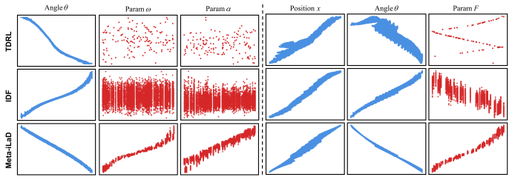
Figure 2 .Scatter plots of estimatedvs. true latent statesz t (blue) and environment variablec(red). Left: Pendulum; Right: CartPole.
원문 · CC BY 4.0 · Yubo Ye, Sweekar Piya, Xiajun Jiang, Linwei Wang · Meta-iLaD: Identifiable Latent Dynamics via Meta-Learning of Dynamics Environments · 원문 그림 인용 · 원본 PDF 7쪽에서 그림 영역을 추출했습니다.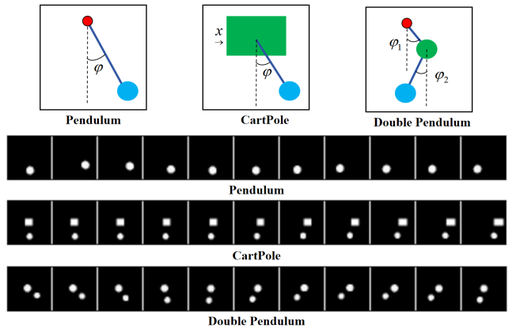
Figure 4 .The general overview of the datasets
원문 · CC BY 4.0 · Yubo Ye, Sweekar Piya, Xiajun Jiang, Linwei Wang · Meta-iLaD: Identifiable Latent Dynamics via Meta-Learning of Dynamics Environments · 원문 그림 인용 · 원본 PDF 17쪽에서 그림 영역을 추출했습니다.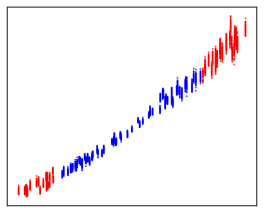
Figure 6 .Scatter plot of estimated versus true environment parameters on CartPole. Blue points represent in-distribution range [−2.5,2.5] , red points represent OOD ranges[−4.0,−2.5]∪[2.5,4.0]. Meta-iLaD maintains identifiability across both ID and OOD regions.
원문 · CC BY 4.0 · Yubo Ye, Sweekar Piya, Xiajun Jiang, Linwei Wang · Meta-iLaD: Identifiable Latent Dynamics via Meta-Learning of Dynamics Environments · 원문 그림 인용 · 원본 PDF 20쪽에서 그림 영역을 추출했습니다.CMU MoCAP 실험
실제 데이터 실험은 CMU MoCAP의 걷기 시퀀스 62개를 사용합니다. 다섯 명의 피험자 각각을 하나의 동역학 환경으로 취급하며, 관측은 50차원입니다. 모델은 처음 75개 시간 단계를 입력받아 125단계 구간을 평가하며, 실제 잠재 변수가 없으므로 측정은 MSE(xt)로 이루어집니다. ID 설정에서 Meta-iLaD는 0-75 재구성 MSE 2.80(0.49)e0, 75-125 예측 MSE 1.95(0.11)e1을 보고합니다. 한 피험자를 제외한 OOD 설정에서는 모든 기준선의 성능이 크게 떨어졌고, Meta-iLaD는 예측에서 상대적으로 안정적이었다고 보고됩니다. IDF의 OOD 성능 저하는 사전 정의된 환경 레이블의 한계를 보여준다고 저자들은 해석합니다.
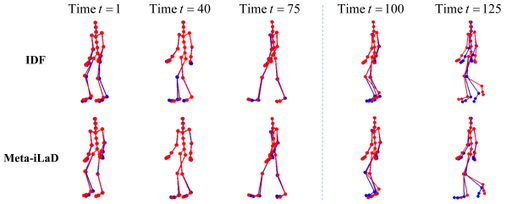
Figure 3 .Examples of IDFvs. Meta-iLaD in reconstruction (t=0:75) and prediction (t=75:125) on an in-distribution subject.
원문 · CC BY 4.0 · Yubo Ye, Sweekar Piya, Xiajun Jiang, Linwei Wang · Meta-iLaD: Identifiable Latent Dynamics via Meta-Learning of Dynamics Environments · 원문 그림 인용 · 원본 PDF 8쪽에서 그림 영역을 추출했습니다.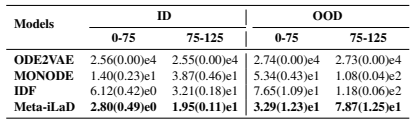
Table 2 .Reconstruction (0-75) and prediction (75-125) MSEs on MoCAP, tested on in-distribution (ID) and OOD subjects.
원문 · CC BY 4.0 · Yubo Ye, Sweekar Piya, Xiajun Jiang, Linwei Wang · Meta-iLaD: Identifiable Latent Dynamics via Meta-Learning of Dynamics Environments · 원문 그림 인용 · 원본 PDF 8쪽에서 그림 영역을 추출했습니다.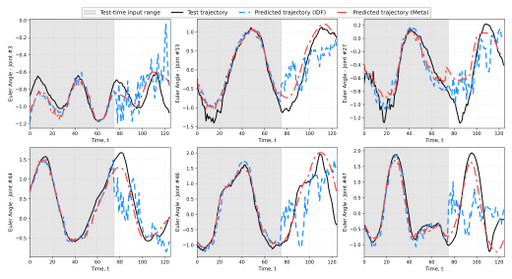
Figure 7 .Test trajectory predictions for IDF and Meta-iLaD methods. At test time, first 75 time points are given as input, and the prediction horizon is 50 steps (frames 76-125). The figure shows comparisons across multiple joints (Joint 3, 13, 27, 44, 46, 47), where the gray shaded region indicates the input range, the black solid line represents the ground truth trajectory, the blue dashed line shows IDF predictions, and the red dash-dot line shows Meta-iLaD predictions.
원문 · CC BY 4.0 · Yubo Ye, Sweekar Piya, Xiajun Jiang, Linwei Wang · Meta-iLaD: Identifiable Latent Dynamics via Meta-Learning of Dynamics Environments · 원문 그림 인용 · 원본 PDF 20쪽에서 그림 영역을 추출했습니다.절제 실험과 구성요소의 역할
절제 실험은 Pendulum 시스템에서 ID와 OOD 환경을 대상으로 수행되었습니다. 첫째, 맥락 샘플에서 c를 추론하는 방식은 질의 샘플 자체에서 c를 추론하는 변형, 사전 정의된 인덱스를 쓰는 iVAE 실현 변형, 참 환경 변수를 쓰는 최선 시나리오와 비교되었습니다. 질의 샘플 기반 변형은 특히 OOD에서 식별 가능성이 제한되었고, 사전 정의 인덱스 변형은 ID에서 비슷한 성능을 보였지만 OOD로 일반화되지 않았습니다. 둘째, TC 손실의 제거는 MCC(c)를 낮추고 warm-up 제거는 MCC(zt)를 낮추는 것으로 보고됩니다. 따라서 이 결과는 각 구성요소가 지정된 지표에 기여한다는 근거이며, 모든 조건에서 모든 구성요소가 같은 방향으로 유익하다는 증명은 아닙니다.
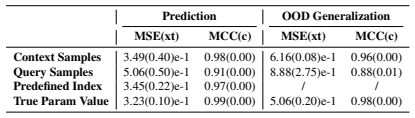
Table 3 .Ablation of conditioning c on few-shot context samples (representing Meta-iLaD), query sample itself (representing an unconditional prior for c), predefined indices of environments (representing a realization of iV AE in our model), and true envi- ronment variables (representing the best scenario).
원문 · CC BY 4.0 · Yubo Ye, Sweekar Piya, Xiajun Jiang, Linwei Wang · Meta-iLaD: Identifiable Latent Dynamics via Meta-Learning of Dynamics Environments · 원문 그림 인용 · 원본 PDF 8쪽에서 그림 영역을 추출했습니다.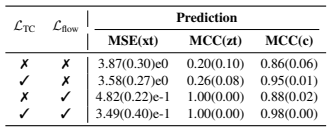
Table 4 .Ablation of the presence/absence of TC regularization LTC and warm-up training strategy (tied toL flow.
원문 · CC BY 4.0 · Yubo Ye, Sweekar Piya, Xiajun Jiang, Linwei Wang · Meta-iLaD: Identifiable Latent Dynamics via Meta-Learning of Dynamics Environments · 원문 그림 인용 · 원본 PDF 8쪽에서 그림 영역을 추출했습니다.적용 범위와 한계
저자들은 Meta-iLaD가 각 동역학 환경마다 few-shot 맥락 샘플을 요구하며, 여러 샘플을 같은 환경에서 얻기 어려운 실제 상황에서는 제약이 될 수 있다고 밝힙니다. 또한 NODE 사용에 따른 계산 부담이 있고, 식별 가능성 보장은 충분한 환경 다양성을 요구하므로 실제에서 항상 확보되지는 않는다고 명시합니다. 부록 E의 실제 이중 진자 탐색 실험은 환경 경계를 알 수 없는 경우 이전 시간 창을 맥락으로 쓰는 시도를 보여주지만, 환경이 빠르게 바뀌면 잘못된 맥락-질의 짝이 성능을 떨어뜨릴 수 있다고 적고 있습니다. 이 결과는 탐색적 실험이며, 다른 데이터나 과제로 일반화하기 위해서는 추가 검증이 필요합니다.
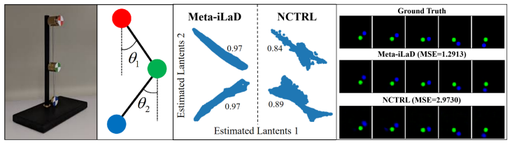
Figure 9 .Results on real double pendulum data (left), including MCC on latent zt’s (middle) and examples on reconstructing (NCTRL) or forecasting (Meta-iLaD)x t’s (right).
원문 · CC BY 4.0 · Yubo Ye, Sweekar Piya, Xiajun Jiang, Linwei Wang · Meta-iLaD: Identifiable Latent Dynamics via Meta-Learning of Dynamics Environments · 원문 그림 인용 · 원본 PDF 22쪽에서 그림 영역을 추출했습니다.논문 정보
- 저자
- Yubo Ye, Sweekar Piya, Xiajun Jiang, Linwei Wang
- 학회·저널
- arXiv · 프리프린트
- 최초 공개일
- 2026년 10월 19일
- 등록일
- 2026년 10월 29일
- 수정일
- 2026년 10월 19일
- 버전
- v1
- arXiv
- 2610.27180
- 분류
- cs.LG
- 원문 이용 조건
- CC BY 4.0
- 제공 범위
- 논문 정보, 해설, 허용된 원문 그림
AI 해설은 논문 원문과 별개의 설명이며 오류가 있을 수 있습니다. 원문과 그림은 각 출처의 이용 조건과 따로 표시된 권리를 따릅니다.
초록
Learning latent dynamics is central to assessing the current states and forecasting the future trajectories of high-dimensional time series. For locally-stationary latent dynamics $\mathcal{F}(\mathbf{z}_{<t}; \mathbf{c})$ with latent dynamics state $\mathbf{z}_t$ and environment variable $\mathbf{c}$, prior identifiability results have largely focused on $\mathbf{z}_t$ when conditioned on predefined label $u$ of dynamics environments. This leaves two limitations: reliance on predefined labels that hinder generalization to unseen environments, and a limited understanding of the identifiability of $\mathcal{F}$ and $\mathbf{c}$ which -- although offering important structural properties for the identifiability of $\mathbf{z}_t$ -- are learned jointly with $\mathbf{z}_t$. We address these limitations with Meta-iLaD, a novel identifiable latent dynamics framework attained by meta-learning across dynamics environments. Meta-iLaD introduces a novel conditional prior of $\mathbf{c}$, modeled as a feedforward meta-learner to rapidly extract $\mathbf{c}$ from few-shot examples. Meta-iLaD further establishes identifiability for $\mathbf{z}_t$, $\mathbf{c}$, and $\mathcal{F}$ simultaneously, for a general formulation of $\mathcal{F}(\mathbf{z}_{< t};\mathbf{c})$ without restricting the dimension of $\mathbf{c}$ or how it modulates $\mathcal{F}$. On synthetic and real data, we provide strong empirical evidence that 1) conditioning on few-shot examples enables generalization to out-of-distribution environments, and 2) identifiability for $\mathbf{c}$ and $\mathcal{F}$ is critical for accurate forecasting beyond reconstructing observed trajectories. Code is available at https://github.com/GoForIt-YYB/Meta-iLaD.
원문 인용
Yubo Ye, Sweekar Piya, Xiajun Jiang, Linwei Wang (2026). Meta-iLaD: Identifiable Latent Dynamics via Meta-Learning of Dynamics Environments. arXiv:2610.27180v1. https://arxiv.org/abs/2610.27180v1
BibTeX
@misc{ye2026meta,
  title = {{Meta-iLaD: Identifiable Latent Dynamics via Meta-Learning of Dynamics Environments}},
  author = {Yubo Ye and Sweekar Piya and Xiajun Jiang and Linwei Wang},
  year = {2026},
  eprint = {2610.27180},
  archivePrefix = {arXiv},
  url = {https://arxiv.org/abs/2610.27180v1}
}