논문 해설
GeoNet++: Iterative Geometric Neural Network with Edge-Aware Refinement for Joint Depth and Surface Normal Estimation
GeoNet++: 깊이 및 표면 법선 공동 추정을 위한 가장자리 인식 정제 기능을 갖춘 반복적 기하 신경망
- 연구 문제 단일 영상에서 깊이와 표면 법선을 독립적으로 예측하면 두 결과가 어긋나 3D 표면이 왜곡될 수 있으며, 이 논문은 기하 관계를 신경망에 명시적으로 넣는 문제를 다룹니다.
- 연구 방법 GeoNet++는 두 스트림 CNN의 초기 깊이와 법선을 depth-to-normal, normal-to-depth 모듈과 edge-aware 정제로 반복 개선합니다.
- 주요 결과 NYUD-V2에서 GeoNet++를 적용한 깊이와 법선 지표가 개선되었고, 제안한 3DGM에서도 3D 재구성 품질이 향상되었습니다. KITTI의 DORN 비교에서는 rmse가 소폭 높은 항목도 있습니다.
단일 영상 깊이와 법선의 독립 추정 문제
단일 RGB 영상에서 깊이와 표면 법선을 추정하는 기존 연구 대부분은 두 과제를 독립적으로 수행합니다. 이 때문에 두 예측이 서로 어긋나 3D 표면이 왜곡될 수 있습니다. 특히 평면 영역에서는 법선이 변하지 않아야 하지만 예측 깊이 맵이 흔들리는 현상이 관찰됩니다. 원문은 기존 CNN이 깊이로부터 좋은 법선을 학습하기 어렵고, 객체 경계 부근에서 pooling과 큰 receptive field로 인해 결과가 흐려진다고 설명합니다. 이 논문은 이러한 문제를 해결하기 위해 깊이와 법선 사이의 기하 관계를 신경망 안에 명시적으로 넣는 GeoNet++를 제안합니다.
깊이에서 법선으로, 법선에서 깊이로의 기하 모듈
GeoNet++는 두 스트림 백본이 만든 초기 깊이와 초기 법선을 입력으로 받습니다. depth-to-normal 모듈은 핀홀 카메라 모델로 화소를 3D 좌표로 바꾼 뒤, 이웃 점들이 같은 접평면에 있다고 가정하고 그 법선을 최소제곱 문제로 구합니다. 이 최소제곱 해에 잔차 서브모듈을 더해 잡음이 있는 법선을 다듬습니다. normal-to-depth 모듈은 정제된 법선으로 정의되는 접평면을 이용해 이웃 화소의 깊이 추정값 z'을 계산하고, 법선 사이의 코사인 유사도를 커널로 사용하는 커널 회귀로 이들을 가중 평균합니다. 이 방식에서 이웃 화소는 깊이 추정에 투표하는 역할을 합니다.
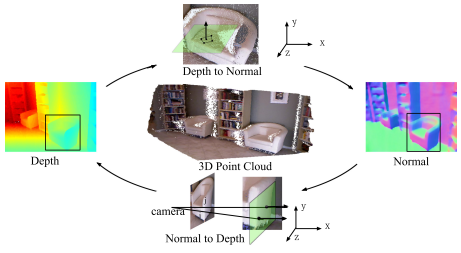
Fig. 1 . The geometric relationship between depth and surface normals. The point cloud is obtained by casting depth values into 3D via the pinhole camera model. Surface normals are estimated from the point cloud by solving a system of linear equations; depth is constrained by the local plane determined by neighboring points and their surface normals.
원문 · CC BY 4.0 · Xiaojuan Qi, Zhengzhe Liu, Renjie Liao, Philip H. S. Torr, Raquel Urtasun, Jiaya Jia · GeoNet++: Iterative Geometric Neural Network with Edge-Aware Refinement for Joint Depth and Surface Normal Estimation · 원문 그림 인용 · 원본 PDF 1쪽에서 그림 영역을 추출했습니다.앙상블과 edge-aware 정제
기하 모듈의 결과는 초기 예측과 깊이(법선) 앙상블 모듈에서 결합됩니다. 이후 edge-aware 정제 모듈은 Canny 경계 정보와 잔차 맵을 결합해 좌우, 우좌, 상하, 하상 네 방향의 가중치 맵을 학습합니다. recursive propagator는 이 가중치를 사용해 입력 신호를 T번 반복 전파합니다. 원문은 T를 3으로 사용했다고 보고합니다. 경계 부근에서는 가중치가 커서 흐림을 줄이고, 비경계 영역에서는 작아져 잡음을 줄이도록 설계되어 있습니다. 2차원 전파를 네 개의 1차원 전파로 나누어 계산 효율을 높인다는 점도 밝혀져 있습니다.
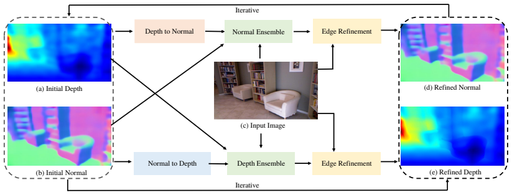
Fig. 3 . The overall structure of GeoNet++. GeoNet++ takes as inputs initial depth estimation (a), initial normal estimation (b), and an input image (c). The initial depth and surface normal are firstly refined with depth-to-normal and normal-to-depth modules. Then, the depth (normal) ensemble module is adopted to combine results from the initial estimation. It is followed by the edge refinement module, which reduces noise and refines boundaries. GeoNet++ can be applied for multiple times by iteratively taking the refined normal and depth as inputs.
원문 · CC BY 4.0 · Xiaojuan Qi, Zhengzhe Liu, Renjie Liao, Philip H. S. Torr, Raquel Urtasun, Jiaya Jia · GeoNet++: Iterative Geometric Neural Network with Edge-Aware Refinement for Joint Depth and Surface Normal Estimation · 원문 그림 인용 · 원본 PDF 4쪽에서 그림 영역을 추출했습니다.NYUD-V2와 KITTI에서의 2D 지표 결과
NYUD-V2 깊이 예측에서 Our Baseline + GeoNet++*는 rmse 0.600, log10 0.063, rel 0.144, δ<1.25 정확도 0.791을 보고합니다. 여기서 *는 GeoNet++가 백본과 함께 end-to-end 미세조정된 경우입니다. 표면 법선 예측에서 GeoNet++를 얹은 Our Baseline은 mean 18.5, median 11.2로 기준선 19.4, 12.5보다 낮습니다. 낮을수록 좋은 오차 지표이므로 이는 개선을 뜻합니다. KITTI에서 DORN + GeoNet++의 rmse는 4.10이고 DORN*의 rmse는 4.06으로, 이 rmse 항목에서는 DORN + GeoNet++가 소폭 높습니다.
다른 지표는 δ<1.25 정확도 0.897과 같이 개선되는 방향을 보입니다. 이 결과들은 주로 VGG-16 백본 또는 해당 표의 초기 깊이 설정에서 얻은 것입니다.
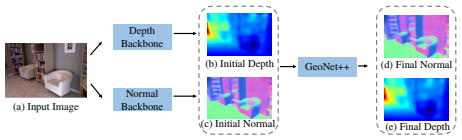
Fig. 5 . Our end-to-end trainable full system with backbone architecture and GeoNet++.
원문 · CC BY 4.0 · Xiaojuan Qi, Zhengzhe Liu, Renjie Liao, Philip H. S. Torr, Raquel Urtasun, Jiaya Jia · GeoNet++: Iterative Geometric Neural Network with Edge-Aware Refinement for Joint Depth and Surface Normal Estimation · 원문 그림 인용 · 원본 PDF 6쪽에서 그림 영역을 추출했습니다.3D geometric metric과 3D 재구성 결과
원문은 화소 단위 지표가 3D 재구성 품질을 직접 측정하지 못한다고 보고, 예측 깊이를 3D 점군으로 바꾼 뒤 재구성된 표면 법선을 평가하는 3D geometric metric을 제안합니다. 이 지표는 제공된 개발 키트로 법선을 계산하고 TV-denoising으로 정제한 결과를 사용합니다. NYUD-V2의 3DGM에서 Our Baseline의 mean 오차는 42.39이고 GeoNet++를 더한 경우 35.78로 낮아집니다. 이 결과는 깊이 자체의 화소 오차가 조금 높은 DORN과의 비교에서도 3D 점군의 구조가 더 나아진다는 저자들의 해석과 함께 제시됩니다.
추론 비용과 반복 적용의 범위
VGG-16 백본을 사용했을 때 GeoNet++는 480×640 영상에 대해 최종 깊이와 법선 추정을 0.87초에 수행한다고 보고됩니다. 이 시간은 Intel i7-6950 CPU와 단일 TitanX GPU에서 측정된 값입니다. 반복 추론은 정제된 깊이와 법선을 다음 반복의 입력으로 사용하며, 학습 단계에서는 메모리와 효율을 위해 한 번만 적용됩니다. 따라서 반복 추론의 효과는 추론 조건에서 설명되며 학습 과정에도 같은 반복 횟수가 적용된 것은 아닙니다.
적용 범위와 남은 질문
원문의 실험은 NYUD-V2와 KITTI 데이터셋, 그리고 VGG-16, DORN, FCRN, SkipNet 등 특정 백본과 초기 예측 조합에서 수행되었습니다. KITTI 깊이 비교의 rmse는 DORN 설정에서 소폭 높아 모든 지표가 항상 개선되지는 않습니다. 또한 3DGM은 법선 재구성 품질을 측정하는 지표이므로, 이 결과를 모든 3D 응용의 성능으로 일반화할 수는 없습니다. 원문은 향후 3D 재구성, 스테레오 매칭, SLAM 등 다른 기하 추정 과제로 확장할 계획을 밝힙니다.
논문 정보
- 저자
- Xiaojuan Qi, Zhengzhe Liu, Renjie Liao, Philip H. S. Torr, Raquel Urtasun, Jiaya Jia
- 학회·저널
- arXiv · 프리프린트
- 최초 공개일
- 2020년 12월 13일
- 등록일
- 2026년 11월 6일
- 수정일
- 2020년 12월 13일
- 버전
- v1
- arXiv
- 2012.06980
- DOI
- 10.1109/tpami.2020.3020800
- 분류
- cs.CV
- 원문 이용 조건
- CC BY 4.0
- 제공 범위
- 논문 정보, 해설, 허용된 원문 그림
AI 해설은 논문 원문과 별개의 설명이며 오류가 있을 수 있습니다. 원문과 그림은 각 출처의 이용 조건과 따로 표시된 권리를 따릅니다.
초록
In this paper, we propose a geometric neural network with edge-aware refinement (GeoNet++) to jointly predict both depth and surface normal maps from a single image. Building on top of two-stream CNNs, GeoNet++ captures the geometric relationships between depth and surface normals with the proposed depth-to-normal and normal-to-depth modules. In particular, the "depth-to-normal" module exploits the least square solution of estimating surface normals from depth to improve their quality, while the "normal-to-depth" module refines the depth map based on the constraints on surface normals through kernel regression. Boundary information is exploited via an edge-aware refinement module. GeoNet++ effectively predicts depth and surface normals with strong 3D consistency and sharp boundaries resulting in better reconstructed 3D scenes. Note that GeoNet++ is generic and can be used in other depth/normal prediction frameworks to improve the quality of 3D reconstruction and pixel-wise accuracy of depth and surface normals. Furthermore, we propose a new 3D geometric metric (3DGM) for evaluating depth prediction in 3D. In contrast to current metrics that focus on evaluating pixel-wise error/accuracy, 3DGM measures whether the predicted depth can reconstruct high-quality 3D surface normals. This is a more natural metric for many 3D application domains. Our experiments on NYUD-V2 and KITTI datasets verify that GeoNet++ produces fine boundary details, and the predicted depth can be used to reconstruct high-quality 3D surfaces. Code has been made publicly available.
원문 인용
Xiaojuan Qi, Zhengzhe Liu, Renjie Liao, Philip H. S. Torr, Raquel Urtasun, Jiaya Jia (2020). GeoNet++: Iterative Geometric Neural Network with Edge-Aware Refinement for Joint Depth and Surface Normal Estimation. arXiv:2012.06980v1. https://doi.org/10.1109/tpami.2020.3020800
BibTeX
@article{qi2020geonet,
  title = {{GeoNet++: Iterative Geometric Neural Network with Edge-Aware Refinement for Joint Depth and Surface Normal Estimation}},
  author = {Xiaojuan Qi and Zhengzhe Liu and Renjie Liao and Philip H. S. Torr and Raquel Urtasun and Jiaya Jia},
  year = {2020},
  eprint = {2012.06980},
  archivePrefix = {arXiv},
  doi = {10.1109/tpami.2020.3020800},
  url = {https://arxiv.org/abs/2012.06980v1}
}