논문 해설
Model-Based Policy Search Using Monte Carlo Gradient Estimation with Real Systems Application
몬테카를로 기울기 추정을 이용한 모델 기반 정책 탐색과 실제 시스템 적용
- 연구 문제 모멘트 매칭 기반 PILCO는 단봉 상태 분포와 SE 커널에 묶여 있어 초기 불확실성이 크거나 다중 모드 해가 필요한 과제에서 제약을 받습니다.
- 연구 방법 MC-PILCO는 GP 동역학 모델로 입자를 전파하여 누적 비용을 Monte Carlo로 추정하고, 재매개변수화 기법과 역전파로 정책 기울기를 계산합니다. 정책 최적화에는 비용 형태 조정과 dropout을 함께 사용합니다.
- 주요 결과 cart-pole 시뮬레이션에서 dropout을 쓴 MC-PILCO는 trial 5에서 100%의 성공률을 보였고, PILCO의 42%와 Black-DROPS의 86%보다 높았습니다. 실제 Furuta pendulum과 ball-and-plate 실험에서도 과제를 해결하는 정책을 학습했습니다.
기존 PILCO의 한계와 문제 설정
PILCO는 GP 동역학 모델과 경사 기반 정책 탐색으로 데이터 효율을 높인 MBRL 알고리즘입니다. 이 방법은 Moment matching으로 장기 상태 분포의 첫 두 모멘트만 계산하여 가우시안으로 근사하므로, 정책 기울기를 닫힌 형태로 얻을 수 있습니다. 그러나 이 근사는 단봉 분포만 모델링할 수 있어서 초기 상태의 분산이 크거나 최적해가 여러 개인 경우에 제약이 됩니다. 또한 모멘트 계산은 SE 커널과 미분 가능한 비용 함수를 가정할 때만 다루기 쉬워서 커널 선택과 비용 설계의 자유도가 줄어듭니다. 이 논문은 이러한 제약을 줄이면서 GP 기반 정책 기울기 학습을 유지하는 방법을 다룹니다.
MC-PILCO의 핵심 구조
MC-PILCO는 학습된 one-step-ahead GP 모델로 여러 입자의 상태 궤적을 전파하고, 입자들의 평균 비용으로 누적 비용의 Monte Carlo 추정치를 계산합니다. 각 시간 단계에서 다음 상태는 평균과 공분산으로 정해진 가우시안에서 샘플링되지만, 재매개변수화 기법을 적용하면 표준 정규분포의 샘플에 평균과 Cholesky 인자를 곱해 더하는 결정적 형태로 바뀝니다. 이 덕분에 정책 매개변수에 대한 기울기를 역전파로 계산할 수 있습니다. 정책은 Gaussian 기저함수의 가중합에 하이퍼볼릭 탄젠트를 적용한 squashed-RBF-network이며, 최적화는 Adam으로 수행합니다. 입자 기반 방식은 커널 함수의 선택을 제한하지 않지만 입자 수와 학습 샘플 수가 늘수록 계산 비용이 커집니다.
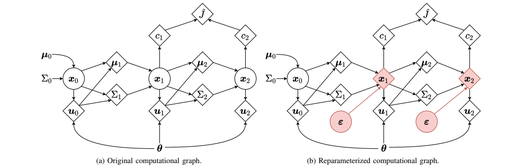
Fig. 2 : (Left) Original computational graph of the GP model predictions for two time steps. (Right) Computational graph modified by the reparameterization trick. Squares and circles represent, respectively, deterministic and stochastic operations.
원문 · CC BY 4.0 · Fabio Amadio, Alberto Dalla Libera, Riccardo Antonello, Daniel Nikovski, Ruggero Carli, Diego Romeres · Model-Based Policy Search Using Monte Carlo Gradient Estimation with Real Systems Application · 원문 그림 인용 · 원본 PDF 7쪽에서 그림 영역을 추출했습니다.비용 형태와 dropout의 역할
MC-PILCO는 비용 함수의 선택성과 정책 최적화 중 dropout을 함께 조정합니다. 비용의 길이 척도가 작을수록 비용 함수가 더 선택적으로 변해, 목표에서 멀리 떨어진 영역에서 기울기가 거의 0이 될 위험이 커집니다. 저자들은 이 현상을 국소 최솟값에 갇히는 원인으로 해석합니다. dropout은 정책 최적화 중 가중치를 확률적으로 제거하여 정책 탐색을 넓히고, 입자 분포의 엔트로피를 높여 낮은 비용 영역을 찾는 데 도움을 준다고 설명됩니다. 최종 목표는 결정적 정책이므로 dropout 확률은 모니터링 신호에 따라 점차 0으로 줄어듭니다.
cart-pole 절제와 선행 알고리즘 비교
시뮬레이션 cart-pole 스윙업 실험에서 dropout을 사용한 MC-PILCO는 trial 4에서 98%, trial 5에서 100%의 성공률을 보였습니다. dropout을 사용하지 않은 설정은 trial 5에서 82%였고, dropout 사용 여부의 차이는 trial 3부터 5까지 통계적으로 유의하다고 보고됩니다. 같은 cart-pole 조건에서 MC-PILCO는 PILCO와 Black-DROPS와 비교되었습니다. trial 5의 성공률은 MC-PILCO 100%, Black-DROPS 86%, PILCO 42%였으며, MC-PILCO는 trial 2부터 5까지 두 기준선보다 성공률이 유의하게 높았습니다.
이 비교는 PILCO와 Black-DROPS에 원래 비용 함수 식(20)을 적용한 결과이고, MC-PILCO에는 speed-integration 모델, SE 커널, dropout, 길이 척도 3과 1을 적용한 결과입니다.
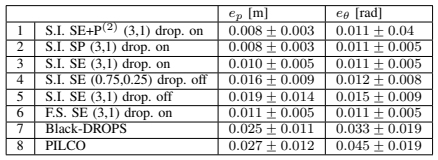
원문 그림 TABLE III: Average distances from the target states ( pt“ 0 and θt “ ˘π) obtained during the last second of interaction with the cart-pole by the successful policies learned by PILCO, Black-DROPS and the various MC-PILCO configurations analyzed in Section V. Different configurations are labeled reporting the adopted dynamical model structure ( speed-integration, S.I., or full-state, F.S.), kernel function, cost length-scales, and if dropout was used or not. Values are reported as mean ˘ standard deviation, calculated over the total number of successful runs at trial 5.
원문 · CC BY 4.0 · Fabio Amadio, Alberto Dalla Libera, Riccardo Antonello, Daniel Nikovski, Ruggero Carli, Diego Romeres · Model-Based Policy Search Using Monte Carlo Gradient Estimation with Real Systems Application · 원문 그림 인용 · 원본 PDF 13쪽에서 그림 영역을 추출했습니다.구조화 커널과 모델 축소의 결과
이 논문은 입자 기반 방식이 SE 커널 외의 커널을 사용할 수 있다는 점을 실험합니다. cart-pole 실험에서 SP 커널은 trial 2에서 70%, trial 3에서 100%의 성공률을 보였고, SE+P(2) 커널은 trial 2에서 36%, SE 커널은 14%였습니다. 이 차이는 구조화된 커널이 데이터 효율을 높일 수 있다는 저자들의 해석과 일치합니다. 한편 speed-integration 모델은 full-state 모델과 비교되었으며, 두 설정의 성공률은 trial 2와 3에서 통계적으로 유의한 차이를 보이지 않았습니다. speed-integration 모델은 학습해야 하는 GP 수를 절반으로 줄이므로 계산 비용을 낮춥니다.

원문 그림 TABLE II: Success rates per trial obtained using full-state or speed-integration dynamical models. The difference between the two options is not statistically significant.
원문 · CC BY 4.0 · Fabio Amadio, Alberto Dalla Libera, Riccardo Antonello, Daniel Nikovski, Ruggero Carli, Diego Romeres · Model-Based Policy Search Using Monte Carlo Gradient Estimation with Real Systems Application · 원문 그림 인용 · 원본 PDF 12쪽에서 그림 영역을 추출했습니다.부분 측정 실제 시스템 적용
MC-PILCO4PMS는 정책 학습 중 측정 시스템과 온라인 상태 추정기를 함께 모델링하여, 위치만 측정되는 실제 시스템에 맞춘 변형입니다. Furuta pendulum 실험에서 SE 커널은 trial 6, SE+P(2) 커널은 trial 4, SP 커널은 trial 3에서 스윙업을 성공했습니다. 이 결과는 구조화된 커널이 더 적은 상호작용으로 과제를 해결한다는 점을 실제 시스템에서도 보여 줍니다. ball-and-plate 실험에서는 카메라로 공의 위치를 측정하고 제어 루프에서 Kalman filter를 사용했습니다. 세 번째 trial 이후 임의의 초기 위치에서 공을 중심으로 제어하는 정책이 학습되었고, 열 개 지점에서 평가한 평균 정상상태 오차는 0.0099 m, 최대 오차는 0.0149 m였습니다.
UR5 궤적 추적 실험
고차원 확장성을 보이기 위해 MC-PILCO는 MuJoCo에서 시뮬레이션한 UR5 로봇 팔의 관절 공간 제어 실험에 적용되었습니다. 제어 지평은 4초, 샘플링 시간은 0.02초였고, 입자 수는 200개였습니다. 초기 탐색은 성능이 낮게 조정된 PD 제어기로 수행되었습니다. 두 번째 trial 이후 학습된 정책의 끝점 오차는 평균 0.65 mm, 최대 1.08 mm로 보고됩니다. 이 결과는 시뮬레이션 UR5 설정에서 얻은 것이며, 실제 로봇 실험의 결과로 확장되지는 않습니다.
계산 비용과 적용 범위
입자 기반 장기 예측의 계산 비용은 입자 수와 학습 샘플 수에 따라 증가한다고 제시됩니다. 저자들은 GPU 병렬화로 이 부담을 줄일 수 있다고 보고하지만, 이 논문의 계산 시간 비교는 구현 언어가 다른 PILCO와 MC-PILCO 사이에서 이루어졌으므로 절대 시간만으로 우열을 판단할 수 없습니다. 평균 학습 시간은 PILCO 1692 s, MC-PILCO 2060 s였으나 PILCO는 마지막 trial에서 42%의 실행에서만 수렴했고 MC-PILCO는 100%에서 수렴했습니다. 주요 검증은 시뮬레이션 cart-pole에 집중되어 있으며, 실제 시스템 실험은 Furuta pendulum과 ball-and-plate에 한정됩니다.
논문 정보
- 저자
- Fabio Amadio, Alberto Dalla Libera, Riccardo Antonello, Daniel Nikovski, Ruggero Carli, Diego Romeres
- 학회·저널
- arXiv · 프리프린트
- 최초 공개일
- 2021년 1월 28일
- 등록일
- 2026년 11월 6일
- 수정일
- 2022년 9월 6일
- 버전
- v4
- arXiv
- 2101.12115
- DOI
- 10.1109/tro.2022.3184837
- 분류
- cs.LG · cs.RO
- 원문 이용 조건
- CC BY 4.0
- 제공 범위
- 논문 정보, 해설, 허용된 원문 그림
AI 해설은 논문 원문과 별개의 설명이며 오류가 있을 수 있습니다. 원문과 그림은 각 출처의 이용 조건과 따로 표시된 권리를 따릅니다.
초록
In this paper, we present a Model-Based Reinforcement Learning (MBRL) algorithm named \emph{Monte Carlo Probabilistic Inference for Learning COntrol} (MC-PILCO). The algorithm relies on Gaussian Processes (GPs) to model the system dynamics and on a Monte Carlo approach to estimate the policy gradient. This defines a framework in which we ablate the choice of the following components: (i) the selection of the cost function, (ii) the optimization of policies using dropout, (iii) an improved data efficiency through the use of structured kernels in the GP models. The combination of the aforementioned aspects affects dramatically the performance of MC-PILCO. Numerical comparisons in a simulated cart-pole environment show that MC-PILCO exhibits better data efficiency and control performance w.r.t. state-of-the-art GP-based MBRL algorithms. Finally, we apply MC-PILCO to real systems, considering in particular systems with partially measurable states. We discuss the importance of modeling both the measurement system and the state estimators during policy optimization. The effectiveness of the proposed solutions has been tested in simulation and on two real systems, a Furuta pendulum and a ball-and-plate rig.
원문 인용
Fabio Amadio, Alberto Dalla Libera, Riccardo Antonello, Daniel Nikovski, Ruggero Carli, Diego Romeres (2021). Model-Based Policy Search Using Monte Carlo Gradient Estimation with Real Systems Application. arXiv:2101.12115v4. https://doi.org/10.1109/tro.2022.3184837
BibTeX
@article{amadio2021model,
  title = {{Model-Based Policy Search Using Monte Carlo Gradient Estimation with Real Systems Application}},
  author = {Fabio Amadio and Alberto Dalla Libera and Riccardo Antonello and Daniel Nikovski and Ruggero Carli and Diego Romeres},
  year = {2021},
  eprint = {2101.12115},
  archivePrefix = {arXiv},
  doi = {10.1109/tro.2022.3184837},
  url = {https://arxiv.org/abs/2101.12115v4}
}