논문 해설
SDPRLayers: Certifiable Backpropagation Through Polynomial Optimization Problems in Robotics
SDPRLayers: 로보틱스의 다항식 최적화 문제를 통한 검증 가능한 역전파
- 연구 문제 비볼록 로봇 최적화 층이 국소 해로 수렴하면 역전파 그래디언트가 전역 최적해와 달라집니다.
- 연구 방법 POP의 SDP 완화를 풀고 타이트한 해에서 KKT 기반 음함수 미분으로 인증된 그래디언트를 계산합니다.
- 주요 결과 스테레오 위치추정 Jacobian 비교와 기준선 보정 실험에서 SDPR 방식은 국소 해법보다 정확한 그래디언트를 보였습니다.
로봇 학습에서 국소 최적해가 그래디언트를 오염시키는 문제
로봇공학의 많은 최적화 문제는 비볼록이어서 국소 최적해로 수렴할 수 있습니다. 이를 학습 파이프라인의 미분 가능한 최적화 계층에 넣으면, 역전파되는 그래디언트가 전역 최적해가 아닌 국소 최적해에서 계산되어 학습을 지연시키거나 실패하게 만들 수 있습니다. 저자들은 이 문제를 해결하기 위해 인증 가능한 전역 최적해와 그 그래디언트를 함께 제공하는 방법을 제안합니다. 이 연구의 범위는 다항식 최적화 문제(POP)로 정식화되고 볼록 반정치 완화가 타이트한 로봇 문제입니다.
SDP 완화와 음함수 미분을 결합한 SDPRLayer
SDPRLayer는 입력 비용 행렬 Qθ와 제약 행렬 Aθi로부터 POP의 SDP 완화를 풀어 primal-dual 해를 캐시합니다. 완화가 타이트하면 행렬 해를 인수분해해 비볼록 문제의 전역 최적해 벡터를 얻으며, 역방향에서는 캐시된 해를 이용해 그래디언트를 계산합니다. 중복 제약이 필요한 경우에도 Theorem 4의 Jacobian을 사용하는 SDPR-IS가 기본 방식으로 쓰입니다. 이때 Jacobian은 Mr의 우측 의사역행렬을 통해 주어지며, 그래디언트 계산에서는 LSQR로 최소제곱 문제를 풉니다. 이 방식은 ACQ와 SOSC, 평활한 feasible set 매핑, PSD인 certificate matrix 등의 가정 아래 전역 최적해의 그래디언트를 제공한다고 저자들이 주장합니다.
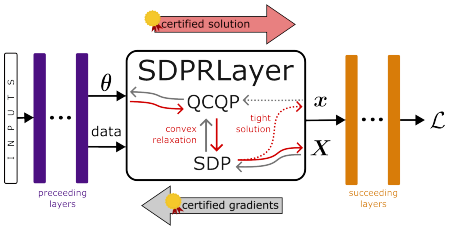
Fig. 1 : Our SDPRLayer embedded in a PyTorch autodifferentiation graph. For non-convex problems with tight semidefinite relaxations, the SDPRLayer finds the certified, globally optimal solution and makes it differentiable via implicit differentiation of the non-convex QCQP. Current differentiable solvers for non-convex problems can return gradients of spurious local minima rather than the gradients of the global solution, corrupting the learning process. In contrast, the gradients produced by the SDPRLayer correspond to the global solution as long as the relaxation is tight, leading to better training. Even when the relaxation is not tight, the relaxed, SDP solution is still provided, and can be used to find good initializations for local methods. The relaxed solution is also made differentiable by leveraging existing differentiable convex optimization layers.
원문 · CC BY 4.0 · Connor Holmes, Frederike Dümbgen, Timothy D. Barfoot · SDPRLayers: Certifiable Backpropagation Through Polynomial Optimization Problems in Robotics · 원문 그림 인용 · 원본 PDF 1쪽에서 그림 영역을 추출했습니다.정확도와 국소 해법 비교 실험
스칼라 가중 위치추정에서 SDPR-IS의 Jacobian 평균 상대 차이는 3.10E-06이고 SDPR-SDP는 1.88E-05입니다. 이 비교의 기준은 SVD Jacobian이며 50회 시행에서 측정되었습니다. 행렬 가중 위치추정에서는 SVD 해가 적용되지 않아 Theseus-GT-UR을 기준으로 삼았고, 무작위 초기화를 쓴 Theseus-RND의 Jacobian 평균 상대 차이는 1.95E-01로 나타났습니다. 같은 행렬 가중 비교에서 SDPR-IS는 3.95E-05였습니다. 이 결과는 본 논문의 스테레오 위치추정 설정과 Mosek 허용오차 조건에서 얻은 것입니다.
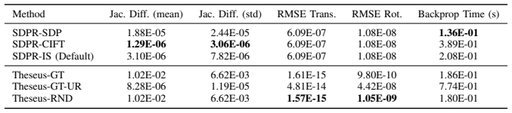
원문 그림 TABLE III: Jacobian Comparison for Solution ( C, t) w.r.t. Feature Locations ( mk) for Scalar-Weighted Localization (Relative To SVD Solution)
원문 · CC BY 4.0 · Connor Holmes, Frederike Dümbgen, Timothy D. Barfoot · SDPRLayers: Certifiable Backpropagation Through Polynomial Optimization Problems in Robotics · 원문 그림 인용 · 원본 PDF 12쪽에서 그림 영역을 추출했습니다.
원문 그림 TABLE IV: Jacobian Comparison for Solution ( C, t) w.r.t. Feature Locations (mk) for Matrix-Weighted Localization (Relative To Theseus- GT-UR Solution)
원문 · CC BY 4.0 · Connor Holmes, Frederike Dümbgen, Timothy D. Barfoot · SDPRLayers: Certifiable Backpropagation Through Polynomial Optimization Problems in Robotics · 원문 그림 인용 · 원본 PDF 12쪽에서 그림 영역을 추출했습니다.기준선 보정과 실세계 위치추정 결과
기준선 보정 bilevel 실험에서 무작위 초기화된 Theseus의 최종 기준선 오차 평균은 1.132e-01로 남았습니다. 반면 Theseus-GT와 SDPRLayer는 각각 3.463e-04와 3.454e-04로 수렴했습니다. 실세계 실험에서는 In-The-Dark 데이터셋으로 학습한 VGG16 기반 특징 추출기와 행렬 가중 위치추정을 결합했으며, 어려운 테스트 세트에서 Ours의 평균 장거리 위치 오차는 0.053 m였고 Baseline은 0.432 m였습니다. 다만 추론 시간은 Ours가 0.327초로 Baseline의 0.089초보다 깁니다.
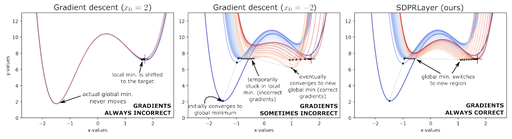
Fig. 2 : Evolution of the polynomial function throughout the bilevel optimization. Columns present different methods for solving the inner optimization problem: ( left) gradient descent initialized at x = 2, (center) gradient descent initialized at x = −2, and ( right) our approach. In all three cases, the colour of the function indicates the progress of outer loop iterations (blue at the beginning, red at the end), the black dots indicate the minima found by the inner optimization, and the plus sign indicates the target. All three cases converge, but gradient descent only converges to a valid solution when it is initialized well ( x0 = −2) and, even then, is temporarily trapped in a local minimum. SPDRLayer converges to a valid solution, does not require initialization, and is even able to discontinuously ‘switch’ the minimum to a new region.
원문 · CC BY 4.0 · Connor Holmes, Frederike Dümbgen, Timothy D. Barfoot · SDPRLayers: Certifiable Backpropagation Through Polynomial Optimization Problems in Robotics · 원문 그림 인용 · 원본 PDF 10쪽에서 그림 영역을 추출했습니다.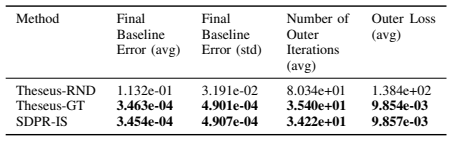
원문 그림 TABLE V: Baseline Tuning Results Across Runs
원문 · CC BY 4.0 · Connor Holmes, Frederike Dümbgen, Timothy D. Barfoot · SDPRLayers: Certifiable Backpropagation Through Polynomial Optimization Problems in Robotics · 원문 그림 인용 · 원본 PDF 13쪽에서 그림 영역을 추출했습니다.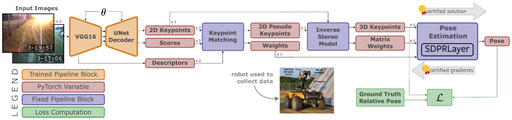
Fig. 5 : Diagram of our Pytorch pipeline (based on the pipeline in [35]) that we use to estimate the relative pose between two images (i.e., localize a target image to a (stored) source image). Orange blocks denote the deep neural networks whose weights are tuned during training (VGG16 network and UNet Decoder network). Blue blocks denote blocks that are part of the pipeline, but do not have trainable parameters. Red blocks indicate key PyTorch tensor variables. Green blocks and arrows indicate training loss function computation.
원문 · CC BY 4.0 · Connor Holmes, Frederike Dümbgen, Timothy D. Barfoot · SDPRLayers: Certifiable Backpropagation Through Polynomial Optimization Problems in Robotics · 원문 그림 인용 · 원본 PDF 14쪽에서 그림 영역을 추출했습니다.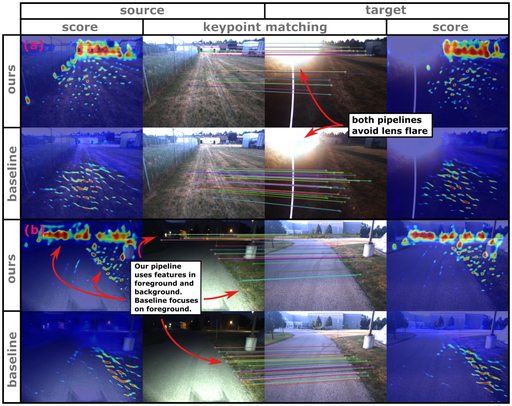
Fig. 6 : Scores and keypoint matches for two selected stereo-image pairs from the In-The-Dark dataset after RANSAC filtering. Image pair (a) corresponds to source (Run 27, Frame 2182) and target (Run 8, Frame 1886) and demonstrates ‘lens flare’. Image pair (b) corresponds to source (Run 21, Frame 2057) and target (Run 27, Frame 1830) and demonstrates a night-day match. The keypoint-match images (center two columns) display the source and target images with the 50 highest-weighted keypoint matches overlaid. The score columns show the score map from the neural network corresponding to their adjacent images.
원문 · CC BY 4.0 · Connor Holmes, Frederike Dümbgen, Timothy D. Barfoot · SDPRLayers: Certifiable Backpropagation Through Polynomial Optimization Problems in Robotics · 원문 그림 인용 · 원본 PDF 15쪽에서 그림 영역을 추출했습니다.완화 타이트성과 계산 비용의 한계
본 논문의 이론은 SDP 완화가 정확히 타이트한 경우를 중심으로 합니다. 타이트하지 않은 완화에서 얻은 그래디언트의 정확성은 이론적으로 보장되지 않으며, 저자들은 이를 향후 과제로 남깁니다. 또한 SDPRLayer의 전방 및 역방향 계산은 현재 CPU에서 수행되어 GPU 학습과 결합할 때 메모리 전송 비용이 생깁니다. CVXPYLayers는 slack 및 dual 변수의 미분 지원이 부족하여 SDP 해의 유일성 가정을 자주 위반하므로, 이 경우 SDPR-SDP 그래디언트를 이론적으로 보장할 수 없습니다.
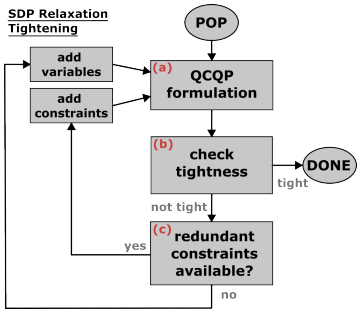
Fig. 7 : General algorithm for tightening an SDP relaxation of a POP. Given a POP, (a) a QCQP can be formulated using the methods discussed in [76] or [13]. (b) Tightness of the relaxation can be assessed using the SDPRLayer presented herein (Section B). (c) If the relaxation is not tight, SDPRLayer provides a method to find all possible constraints to improve tightness based on [25]. If the relaxation is still not tight, then variables can be added (i.e., move to a higher level of Lasserre’s hierarchy).
원문 · CC BY 4.0 · Connor Holmes, Frederike Dümbgen, Timothy D. Barfoot · SDPRLayers: Certifiable Backpropagation Through Polynomial Optimization Problems in Robotics · 원문 그림 인용 · 원본 PDF 17쪽에서 그림 영역을 추출했습니다.논문 정보
- 저자
- Connor Holmes, Frederike Dümbgen, Timothy D. Barfoot
- 학회·저널
- arXiv · 프리프린트
- 최초 공개일
- 2024년 5월 29일
- 등록일
- 2026년 11월 6일
- 수정일
- 2025년 1월 8일
- 버전
- v3
- arXiv
- 2405.19309
- 분류
- cs.RO
- 원문 이용 조건
- CC BY 4.0
- 제공 범위
- 논문 정보, 해설, 허용된 원문 그림
AI 해설은 논문 원문과 별개의 설명이며 오류가 있을 수 있습니다. 원문과 그림은 각 출처의 이용 조건과 따로 표시된 권리를 따릅니다.
초록
A recent set of techniques in the robotics community, known as certifiably correct methods, frames robotics problems as polynomial optimization problems (POPs) and applies convex, semidefinite programming (SDP) relaxations to either find or certify their global optima. In parallel, differentiable optimization allows optimization problems to be embedded into end-to-end learning frameworks and has received considerable attention in the robotics community. In this paper, we consider the ill effect of convergence to spurious local minima in the context of learning frameworks that use differentiable optimization. We present SDPRLayers, an approach that seeks to address this issue by combining convex relaxations with implicit differentiation techniques to provide certifiably correct solutions and gradients throughout the training process. We provide theoretical results that outline conditions for the correctness of these gradients and provide efficient means for their computation. Our approach is first applied to two simple-but-demonstrative simulated examples, which expose the potential pitfalls of reliance on local optimization in existing, state-of-the-art, differentiable optimization methods. We then apply our method in a real-world application: we train a deep neural network to detect image keypoints for robot localization in challenging lighting conditions. We provide our open-source, PyTorch implementation of SDPRLayers.
원문 인용
Connor Holmes, Frederike Dümbgen, Timothy D. Barfoot (2024). SDPRLayers: Certifiable Backpropagation Through Polynomial Optimization Problems in Robotics. arXiv:2405.19309v3. https://arxiv.org/abs/2405.19309v3
BibTeX
@misc{holmes2024sdprlayers,
  title = {{SDPRLayers: Certifiable Backpropagation Through Polynomial Optimization Problems in Robotics}},
  author = {Connor Holmes and Frederike Dümbgen and Timothy D. Barfoot},
  year = {2024},
  eprint = {2405.19309},
  archivePrefix = {arXiv},
  url = {https://arxiv.org/abs/2405.19309v3}
}