논문 해설
Looped Models are Fast Multi-Token Predictors
Floodgates: 루프 모델로 여러 토큰 한 번에 초안
- 연구 문제 기존 루프 언어 모델의 자기 speculative decoding은 얕은 루프가 다음 토큰 하나만 맞혀 초안이 짧았습니다. 게다가 깊이마다 따로 캐시를 저장해야 했습니다.
- 연구 방법 Floodgates는 얕은 루프에 마스크 토큰 블록을 붙여 여러 토큰을 한 번에 초안합니다. 저랭크 어댑터만 학습해, 검증 때 만든 깊은 캐시를 읽게 합니다.
- 주요 결과 일곱 개 모델과 벤치마크 다섯 개에서 대부분 가장 빠른 무손실 디코딩이었고, 최대 7.5배 빨랐습니다.
기존 self-speculative decoding의 병목
언어 모델의 추론 속도는 토큰을 하나씩 생성하는 직렬 구조에 묶여 있습니다. 한 토큰은 앞의 토큰들이 모두 처리된 뒤에야 만들어질 수 있기 때문입니다. speculative decoding은 이 병목을 줄이는 방법입니다. 빠른 drafter가 여러 토큰을 제안하면 대상 모델이 한 번의 forward pass에서 그것들을 모두 검증합니다. 그런데 drafter는 대개 별도의 작은 네트워크이거나 레이어의 일부입니다. 그래서 전체 파라미터의 일부만 쓰게 되고, 모델의 모든 레이어에 담긴 지식을 활용하지 못합니다. 그 결과 초안의 검증 수용률이 제한됩니다.
루프 언어 모델은 이 제약을 피합니다. 같은 레이어 묶음을 반복해 토큰을 처리하므로, 루프를 얕게 돌리면 파라미터를 비례해 줄이지 않고도 계산을 줄일 수 있습니다. 이 성질을 이용해 얕은 루프를 drafter로, 깊은 루프를 verifier로 쓰는 self-speculative decoding이 가능해졌습니다. drafting은 여전히 전체 파라미터를 쓰기 때문에 효과가 있습니다. 기존 루프 기반 방법인 LoopSpec과 WaveFront는 깊이 파이프라이닝(depth pipelining)으로 초안을 만듭니다. 이 방식은 앞 토큰이 R번의 루프를 모두 끝내기 전에 다음 토큰을 첫 루프에서 시작합니다. 하지만 학습되지 않은 얕은 루프는 다음 토큰 하나만 예측하므로, 한 단계에서 얻는 초안은 많아야 한 토큰입니다.
병목은 여러 요청을 동시에 처리할 때 드러납니다. 파이프라이닝은 서로 다른 깊이의 토큰을 함께 배치하므로, 예를 들어 네 루프마다 하나씩 고른 깊이 집합 B의 모든 루프에 대해 prefix cache를 따로 저장하고 읽어야 합니다. 루프 깊이마다 별도의 캐시가 필요한 셈입니다. 이 때문에 요청이 많아지면 메모리 대역폭이 포화됩니다.
얕은 루프 하나로 여러 토큰 초안 만들기
Floodgates는 얕은 루프 하나가 여러 미래 토큰을 미리 맞히도록 만들고, 그 드래프터가 검증 과정에서 이미 계산된 최종 루프의 prefix cache를 읽게 하는 자기 speculative decoding 방법입니다. 구체적으로는 마지막 토큰 x_t 뒤에 학습 가능한 마스크 벡터 m을 k개 이어 붙여 k+1개의 슬롯을 만들고, 공유 블록 fθ를 이 슬롯 전체에 대해 한 번 실행합니다. 이때 슬롯은 첫 루프 캐시가 아니라 deep prefix cache인 c_<tR을 참조하는데, 이 캐시는 앞선 토큰들을 전체 깊이에서 표현한 키와 값이어서 이전 단계의 검증에서 이미 만들어져 있습니다. 각 슬롯의 상태에 출력 헤드 g를 적용하면 드래프트 분포가 나오고, 그 분포에서 가장 높은 토큰을 고르면 루프 한 번으로 k개의 초안 토큰을 얻습니다.
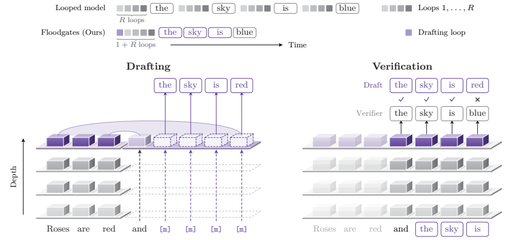
Figure 2 Floodgates drafts a block of tokens with a single loop and verifies it in one decoding step.(Left) A single loop reads the deep prefix cache (purple) computed during the previous verification and drafts several tokens (lilac) in parallel from mask tokens. (Right) The full model verifies the drafts in one decoding step, accepts them up to the first mismatch, and produces the prefix cache for the next draft. (Top) This allows the shallow drafter to leverage full-depth computation for fast speculative decoding.
원문 · CC BY 4.0 · Ayhan Suleymanzade, Sean McLeish, Sehoon Kim, Jinwoo Kim, Antoine Bosselut · Looped Models are Fast Multi-Token Predictors · 원문 그림 인용 · 원본 PDF 2쪽에서 그림 영역을 추출했습니다.드래프터가 이 역할을 맡으려면 얕은 루프가 미래 토큰을 읽어 내는 능력을 새로 배워야 합니다. pre-training에서는 첫 루프가 바로 다음 토큰만 출력하도록 학습되었기 때문입니다. 그래서 Floodgates는 low-rank adapter와 마스크 임베딩만 학습하고, 기반 모델의 가중치와 출력 헤드는 동결합니다. 어댑터는 드래프팅 중에만 활성화되므로 검증기 파라미터는 바뀌지 않고, 이 덕분에 디코딩은 무손실로 유지됩니다. 학습 목표는 j번째 슬롯이 j 토큰 뒤를 예측하도록 하는 교차 엔트로피를 가중합한 것이며, 가중치는 지수적으로 줄어들도록 정했다가 합이 1이 되도록 정규화합니다. 앞쪽 위치일수록 가중치가 커서, 저자들은 앞선 초안이 수용되어야 뒤쪽 초안도 쓰인다는 점을 반영했다고 설명합니다.
학습 데이터는 모델이 직접 생성한 텍스트를 사용했는데, 검증이 드래프트를 모델의 예측과 비교하기 때문입니다. 저자들은 전체 깊이 학습이 얕은 루프의 상태에도 미래 토큰 정보를 담게 한다고 해석하며, deep prefix cache를 읽게 하면 얕은 루프가 전체 깊이의 계산을 활용할 수 있다고 봅니다. 모델이 많은 루프를 돌리는 경우에는 elastic drafting이 초안을 한 번 더 다듬습니다. 한 루프만으로는 모델이 받아들일 만큼 긴 연속을 초안하기 어려울 수 있어서, 사전학습된 루프를 k보다 긴 창 안의 위치들에 반복 적용해 초안을 개선합니다.
결과에서 Floodgates는 일곱 개의 루프 모델과 수학, 코딩, 추론 벤치마크 다섯 개에서 비교되었고, 그리디 디코딩에서는 모든 모델과 과제에서, 샘플링에서는 대부분의 경우 가장 빠른 무손실 디코딩 방법이었습니다(그림 1).
깊은 검증기에서 추가 패스로 초안 다듬기
모델이 많은 루프를 돌 때는 단일 루프로 만든 초안이 충분히 길지 않을 수 있습니다. 이때 Floodgates는 사전학습된 루프를 E번 더 통과시켜 초안 창을 반복해서 고치는데, 이것을 elastic drafting이라고 부릅니다. 창 안의 각 위치는 은닉 특징과 초안 토큰을 함께 가지고, 추가 패스는 어댑터를 거치지 않은 채 이 둘을 최신 토큰으로 함께 갱신하므로 추가 학습이 필요 없습니다.
추가 패스는 드래프팅 비용과 수용률 사이의 교환을 만듭니다. 패스 하나가 창 전체의 초안 토큰 W개를 병렬로 갱신하므로, E번 돌리는 비용은 위치당 E/W 루프에 그칩니다. 토큰마다 R번 루프를 도는 tokenwise generation보다 훨씬 싸기 때문에, E와 W를 검증기 깊이 R에 맞춰 고를 때 속도가 더 올라갑니다. 저자들은 R이 4인 얕은 모델에서는 루프 하나가 디코딩 한 단계의 4분의 1을 차지하므로 E가 0인 단일 패스가 가장 빠르다고 설명하고, R이 32인 깊은 모델에서는 루프 하나가 한 단계의 작은 부분이라 추가 패스가 이득이 된다고 봅니다. 그래서 E는 하이퍼파라미터로 두고, 모델마다 held-out 문제에서 속도 향상이 가장 큰 값을 고릅니다(Appendix B.1).
이는 speculative decoding에서 드래프트 블록 크기를 고르는 관행을 따른 것입니다.
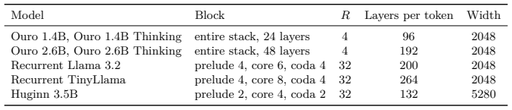
Table 5 The Ouro models loop all of their layers four times, and the other three models loop a middle block 32 times. Block denotes the looped layers,R the default number of loops, and layers per token the total number of layer evaluations in one decoding step.
원문 · CC BY 4.0 · Ayhan Suleymanzade, Sean McLeish, Sehoon Kim, Jinwoo Kim, Antoine Bosselut · Looped Models are Fast Multi-Token Predictors · 원문 그림 인용 · 원본 PDF 18쪽에서 그림 영역을 추출했습니다.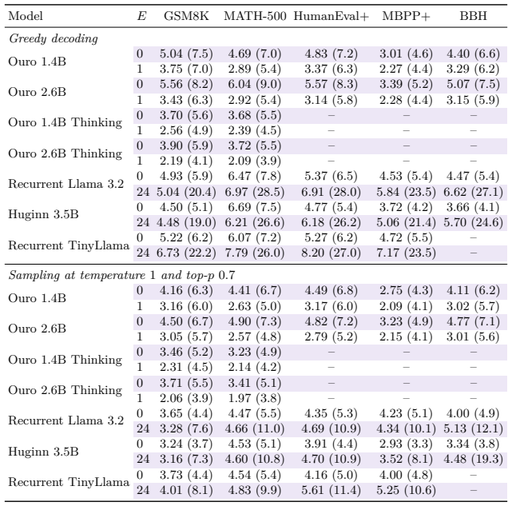
Table 8 A single pass is fastest on the 4-loop Ouro models, and elastic drafting is faster on most tasks of the 32-loop models.Speedup (×) over plain decoding at batch size one, with tokens per stepτ in parentheses, for a single pass (E = 0) and for elastic drafting withE passes. Shaded rows indicate the setting selected on held-out problems and reported in Tables 1 and 2. Reasoning models are sampled at temperature0.6and top-p0.95.
원문 · CC BY 4.0 · Ayhan Suleymanzade, Sean McLeish, Sehoon Kim, Jinwoo Kim, Antoine Bosselut · Looped Models are Fast Multi-Token Predictors · 원문 그림 인용 · 원본 PDF 21쪽에서 그림 영역을 추출했습니다.Figure 5는 Recurrent Llama 3.2를 4루프에서 64루프까지 돌리면서, 32루프에서 학습한 드래프터 하나로 E를 바꿔 본 결과입니다. 16루프까지는 E가 0일 때 가장 빨랐고 추가 패스는 속도를 낮췄으며, 32루프와 64루프에서는 패스가 16에서 24번일 때 속도가 정점을 찍었습니다. Floodgates는 E가 24 이하인 모든 깊이에서 DAS-Wave를 앞섰고, 차이는 패스가 적을 때 가장 컸습니다. 패스가 4번일 때 63에서 89%, 8번일 때 37에서 49%, 16번일 때 16에서 21% 빨랐습니다. 저자들은 Floodgates가 패스를 학습된 다중 토큰 초안에서 시작하기 때문이라고 봅니다.
DAS-Wave는 같은 루프를 마지막 토큰의 복사본에서 시작합니다. Figure 6에서는 깊이 4에서 64까지 모든 깊이에서 Floodgates가 가장 빨랐습니다.
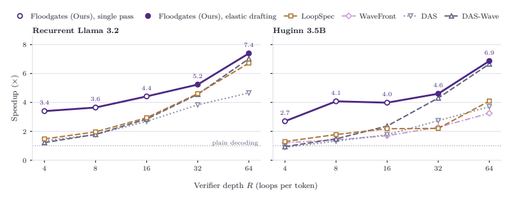
Figure 6 Floodgates is the fastest method at every verifier depth.Speedup over plain decoding on GSM8K when Recurrent Llama 3.2 and Huginn 3.5B run at4to64loops. Each method uses its best setting, and Floodgates uses a single drafter per model trained at32loops. At each depth, we select the elastic drafting budgetE on held-out problems. Open circles mark the depths where a single pass (E = 0) is selected. Filled circles mark the depths where elastic passes (E >0) are preferred (the deeper depths).
원문 · CC BY 4.0 · Ayhan Suleymanzade, Sean McLeish, Sehoon Kim, Jinwoo Kim, Antoine Bosselut · Looped Models are Fast Multi-Token Predictors · 원문 그림 인용 · 원본 PDF 10쪽에서 그림 영역을 추출했습니다.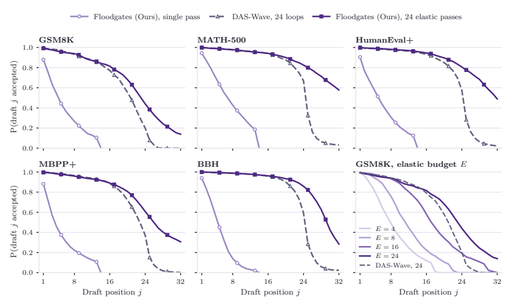
Figure 9 With 24 elastic passes, the acceptance rate stays above 50% up to draft positions 23 to 32.Acceptance rate by draft position on Recurrent Llama 3.2 (R = 32), measured as the fraction of verification steps in which thej-th draft is accepted. DAS-Wave runs the same24loops starting from copies of the last verified token. The last panel varies the elastic drafting budgetEon GSM8K.
원문 · CC BY 4.0 · Ayhan Suleymanzade, Sean McLeish, Sehoon Kim, Jinwoo Kim, Antoine Bosselut · Looped Models are Fast Multi-Token Predictors · 원문 그림 인용 · 원본 PDF 25쪽에서 그림 영역을 추출했습니다.속도와 수용 토큰 수로 본 주요 결과
Floodgates의 격차가 가장 크게 벌어진 곳은 얕은 4루프 Ouro 모델입니다. Ouro 1.4B와 Ouro 2.6B에서 Floodgates는 elastic passes 없이 단일 루프 반복만으로 드래프트를 만들었고, 그 결과 한 단계에 4.6에서 9.0개의 토큰을 수용해 일반 디코딩보다 3.0에서 6.0배 빨랐습니다. 저자들은 이 차이가 단일 루프 드래프트가 여러 토큰을 한꺼번에 맞히는 능력에서 나온다고 봅니다.
이는 가장 강한 학습 없는 기준선인 LoopSpec과 DAS-Wave보다 모든 과제에서 6에서 15퍼센트 높은 수치입니다. 샘플링에서는 확률적 검증이 드래프트 위치마다 적용되면서 모든 블록 드래퍼의 수용 토큰 수가 줄었습니다. 그럼에도 Floodgates는 Ouro 1.4B에서 2.8에서 4.5배, Ouro 2.6B에서 3.2에서 4.9배로 다섯 벤치마크 모두에서 가장 빨랐고, LoopSpec이 더 빨랐던 것은 Recurrent TinyLlama와 Recurrent Llama 3.2의 네 과제였습니다.
장문 추론 모델인 Ouro 1.4B Thinking과 Ouro 2.6B Thinking(Table 2)에서도 Floodgates는 모든 과제에서 가장 높은 속도를 냈습니다. greedy 디코딩에서는 3.7에서 3.9배로 LoopSpec의 2.7에서 3.1배보다 높았고, 샘플링에서는 3.2에서 3.7배로 LoopSpec의 2.4에서 2.9배보다 높았습니다.
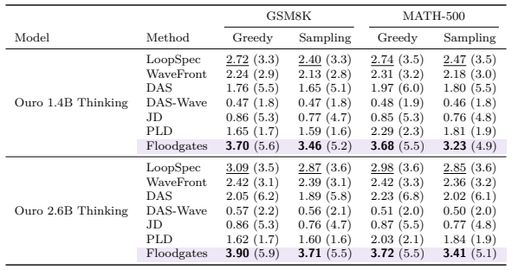
Table 2 On the reasoning models, Floodgates is the fastest method on both tasks under greedy decoding and sampling. We report wall-clock speedup (×) over plain decoding on an A100 at batch size one, with accepted tokens per stepτ in parentheses. Sampling uses temperature0.6and top-p 0.95. We bold the fastest lossless method and underline the second fastest.
원문 · CC BY 4.0 · Ayhan Suleymanzade, Sean McLeish, Sehoon Kim, Jinwoo Kim, Antoine Bosselut · Looped Models are Fast Multi-Token Predictors · 원문 그림 인용 · 원본 PDF 7쪽에서 그림 영역을 추출했습니다.Table 3은 방법의 기여를 분리합니다. 1레이어와 4레이어 EAGLE 계열 별도 드래퍼도 2.6에서 4.1배였습니다. 저자들은 작은 별도 네트워크가 용량이 한정되어 표현을 처음부터 배워야 하지만, 단일 루프를 적응시키는 방식은 목표 모델의 사전학습된 파라미터 전체를 활용해 학습 파라미터는 훨씬 적으면서도 수용률을 훨씬 높인다고 봅니다.
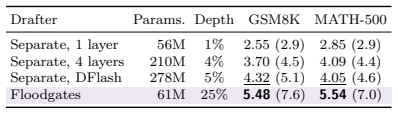
Table 3 Floodgates gives larger speedups than a separate drafter.Speedup ( ×) over plain decoding, with accepted tokens per step in parentheses. Params. is the number of trained parameters, and depth is the number of layer evalua- tions in one drafting pass relative to a full decoding step.
원문 · CC BY 4.0 · Ayhan Suleymanzade, Sean McLeish, Sehoon Kim, Jinwoo Kim, Antoine Bosselut · Looped Models are Fast Multi-Token Predictors · 원문 그림 인용 · 원본 PDF 8쪽에서 그림 영역을 추출했습니다.깊은 prefix 캐시 조건화의 효과
깊은 deep prefix cache가 실제로 도움이 되는지는 학습 전 단계에서 먼저 확인했습니다. Pretraining 때 각 루프는 같은 루프 깊이의 문맥만 보기 때문에, 첫 루프는 앞선 토큰들의 가장 얕은 상태(c<t1)만 보고 최종 루프 캐시(c<tR)는 한 번도 보지 못합니다. 그래서 학습하지 않은 루프 하나를 현재 토큰 위에서 돌리되, prefix 캐시를 몇 번째 루프의 것으로 읽느냐에 따라 다음 토큰 예측이 전체 모델과 얼마나 맞는지 측정했습니다(Figure 4).
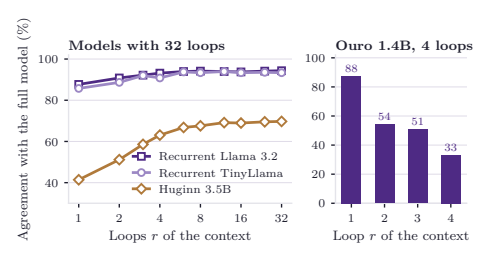
Figure 4 Without training, a deeper prefix cache helps one loop on the 32-loop models but not on Ouro 1.4B.Next-token agreement on GSM8K between the full model and one untrained loop that attends to the prefix cache afterrloops.
원문 · CC BY 4.0 · Ayhan Suleymanzade, Sean McLeish, Sehoon Kim, Jinwoo Kim, Antoine Bosselut · Looped Models are Fast Multi-Token Predictors · 원문 그림 인용 · 원본 PDF 9쪽에서 그림 영역을 추출했습니다.Ouro 1.4B에서는 방향이 반대였습니다. Ouro는 전체 레이어 스택을 통째로 루프하기 때문에, 적응 없이는 첫 루프가 최종 루프 캐시를 직접 읽을 수 없다고 저자들은 설명합니다. 그래서 드래프터를 학습한 뒤에도 깊은 캐시가 여전히 나은지를 따로 물어야 했습니다. 저자들은 같은 설정에서 c<tR 또는 c<t1을 조건으로 드래프터를 학습시키고, 그 결과를 Table 4에 비교했습니다.
적응을 거친 뒤에는 Ouro 1.4B에서 학습 전의 경향이 뒤집혔습니다. c<tR로 드래프트하면 단계당 4.6에서 7.5개의 토큰이 수용되었고, c<t1로 드래프트하면 4.1에서 6.6개였습니다. 저자들은 이 결과들을, 빠른 drafting에는 deep prefix cache와 어댑터 학습이 모두 필요하다는 근거로 봅니다.
고처리량 서빙과 그 범위
Floodgates는 깊이 파이프라이닝을 쓰지 않기 때문에 서로 다른 루프 깊이의 캐시를 따로 저장할 필요가 없습니다.
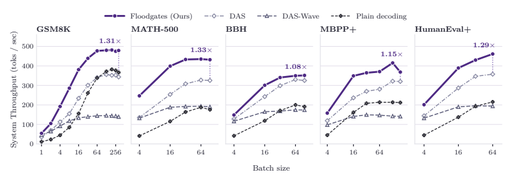
Figure 10 With a single shared cache, Floodgates has the highest throughput at every batch size on all five tasks. System throughput against batch size on an A100 for Huginn 3.5B, served with one key-value cache for all loops. The number in each panel is the throughput of Floodgates relative to the strongest baseline at the largest batch size.
원문 · CC BY 4.0 · Ayhan Suleymanzade, Sean McLeish, Sehoon Kim, Jinwoo Kim, Antoine Bosselut · Looped Models are Fast Multi-Token Predictors · 원문 그림 인용 · 원본 PDF 27쪽에서 그림 영역을 추출했습니다.적응형 검증 예산도 배치가 커질 때 효과를 냅니다. 다만 이 결과는 GSM8K와 MATH-500 등 일부 설정과 특정 하드웨어에서 측정된 것입니다.
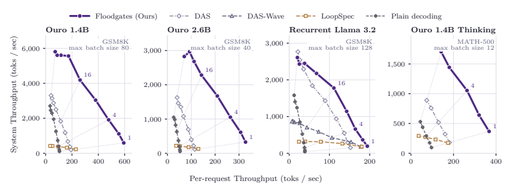
Figure 7 Floodgates has the highest serving throughput at every batch size on the Ouro models, and up to batch size 64 on Recurrent Llama 3.2.System throughput (tokens/s over all requests) against per-request throughput on an A100 under continuous batching. Each point is one batch size, which grows from1at the bottom right to the largest that fits in memory at the top left.
원문 · CC BY 4.0 · Ayhan Suleymanzade, Sean McLeish, Sehoon Kim, Jinwoo Kim, Antoine Bosselut · Looped Models are Fast Multi-Token Predictors · 원문 그림 인용 · 원본 PDF 11쪽에서 그림 영역을 추출했습니다.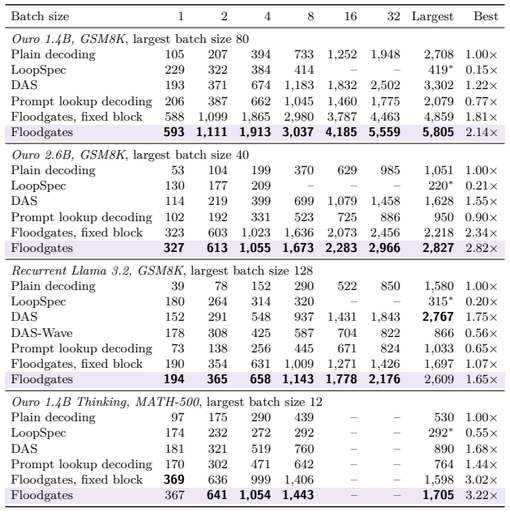
Table 13 Floodgates reaches the highest peak throughput on three of the four models, and the adaptive budget adds up to 54% at the largest batch size.System throughput (tokens/s) across batch sizes. The last column reports the speedup of each method’s peak throughput over that of plain decoding. “Fixed block” verifies allk drafts of every request instead of the budgetM⋆ in (7). LoopSpec (∗) runs as many server instances as fit in memory.
원문 · CC BY 4.0 · Ayhan Suleymanzade, Sean McLeish, Sehoon Kim, Jinwoo Kim, Antoine Bosselut · Looped Models are Fast Multi-Token Predictors · 원문 그림 인용 · 원본 PDF 26쪽에서 그림 영역을 추출했습니다.한계
저자들이 보고한 가장 뚜렷한 제약은 얕은 루프 캐시의 조건입니다. Ouro 1.4B에서는 학습하지 않은 상태에서 최종 루프 캐시를 읽으면 다음 토큰 일치율이 크게 떨어졌습니다. 따라서 이 방법의 효과는 어댑터 학습과 캐시 구조에 의존합니다.
샘플링 조건에서는 확률적 검증으로 단계당 수용 토큰 수가 줄어 기존 방법과의 격차가 좁아지거나 역전되기도 했습니다. 또한 elastic 패스 수 E는 모델 깊이마다 보유 문제로 골라야 하므로, 새 모델에 그대로 옮길 고정값은 없습니다.
논문 정보
- 저자
- Ayhan Suleymanzade, Sean McLeish, Sehoon Kim, Jinwoo Kim, Antoine Bosselut
- 학회·저널
- arXiv · 프리프린트
- 최초 공개일
- 2026년 11월 25일
- 등록일
- 2026년 11월 26일
- 수정일
- 2026년 11월 25일
- 버전
- v1
- arXiv
- 2611.33896
- 분류
- cs.LG · cs.CL
- 원문 이용 조건
- CC BY 4.0
- 제공 범위
- 논문 정보, 해설, 허용된 원문 그림
AI 해설은 논문 원문과 별개의 설명이며 오류가 있을 수 있습니다. 원문과 그림은 각 출처의 이용 조건과 따로 표시된 권리를 따릅니다.
초록
Looped language models can adapt computation for predicting a token without a proportional rescaling in unique model parameters by adjusting the number of loops. This property has been used for self-speculative decoding, taking shallow loops as fast drafters and deep loops as verifiers, which is effective since drafting still uses full parameters. In this paper, we show that shallow loops can be also predictive of several future tokens and leverage this to drastically accelerate the inference of looped language models. To that end, we present Floodgates, a simple self-speculative decoding method that appends a block of mask tokens as a suffix and learns via low-rank adaptation to draft these tokens in parallel. Across seven models, five benchmarks, a range of batch sizes, and both greedy and sampled decoding, Floodgates is the fastest lossless decoding method in most cases, attaining up to 7.5x acceleration. Through analysis, we show that this speedup is enabled by all-depth training of looped models, with the shallow drafter's ability to leverage full-depth computation by conditioning on deep prefix cache evaluated during verification.
원문 인용
Ayhan Suleymanzade, Sean McLeish, Sehoon Kim, Jinwoo Kim, Antoine Bosselut (2026). Looped Models are Fast Multi-Token Predictors. arXiv:2611.33896v1. https://arxiv.org/abs/2611.33896v1
BibTeX
@misc{suleymanzade2026looped,
  title = {{Looped Models are Fast Multi-Token Predictors}},
  author = {Ayhan Suleymanzade and Sean McLeish and Sehoon Kim and Jinwoo Kim and Antoine Bosselut},
  year = {2026},
  eprint = {2611.33896},
  archivePrefix = {arXiv},
  url = {https://arxiv.org/abs/2611.33896v1}
}