논문 해설
Perturbing Inputs Improves Pretraining Distillation
입력 섭동이 pre-training 증류를 개선한다
- 연구 문제 교사 모델이 학습 텍스트 밖의 perturbed 입력에서 예측하도록 하면 pre-training distillation의 학생 성능이 개선되는지를 검증합니다.
- 연구 방법 학습 초기 일정 비율에서 교사와 학생에게 noise 또는 blend된 perturbed 입력을 주고, 나머지 학습은 깨끗한 입력의 표준 distillation으로 진행합니다.
- 주요 결과 인접 토큰 blend는 135M에서 표준 distillation 대비 검증 손실을 0.025 nats, 0.5B에서 0.020 nats 낮췄습니다.
연구 문제: 교사가 본 적 없는 입력을 학습에 쓸 수 있는가
pre-training에서 작은 언어 모델을 만들 때 큰 교사 모델의 다음 토큰 분포를 따라 배우는 distillation이 흔히 쓰입니다. 그러나 표준 distillation에서 학생은 실제 학습 텍스트 위에서만 교사의 예측을 받습니다. 교사 함수는 그 텍스트 밖에서도 정의되어 있지만, 학생은 그 행동에 대한 정보를 받지 못합니다. 이 논문은 교사가 학습 텍스트 밖의 perturbed 입력에서 예측하도록 하면 학생의 성능이 개선되는지를 묻습니다. 여기서 바뀌는 것은 학생 입력만이 아니라, 교사가 학생을 지도하는 입력 자체입니다.
이 질문은 언어 모델 pre-training에서 흔히 쓰는 데이터 증강과 구분됩니다. 일반적인 증강은 학생의 입력을 마스킹이나 토큰 치환으로 손상시키고 원래 다음 토큰을 목표로 둡니다. 저자들은 교사가 손상된 입력 위에서 직접 예측하면 학생이 실제로 보는 입력에 맞는 목표를 줄 수 있다고 설명합니다. 다만 pre-training에서는 데이터를 반복하지 않는 경우가 많고 교사가 깨끗한 텍스트에서 이미 풍부한 감독을 준다는 점에서, 이 방식이 도움이 되는지는 분명하지 않았다고 밝힙니다.
두 단계 distillation과 perturbation 방식
방법은 학습 초기 일정 비율 동안 교사와 학생이 같은 perturbed 입력을 받는 perturbed 단계와, 그 뒤 깨끗한 입력에서 일반 distillation을 수행하는 단계로 구성됩니다. 입력은 one-hot 벡터를 어휘 항목들의 희소한 가중합으로 바꾼 것입니다. 교사와 학생은 각자 자신의 임베딩 행렬로 이 벡터를 처리하며, 학생은 동결된 교사의 다음 토큰 분포에 맞춰 학습합니다. 손실은 모든 위치에서 온도 1의 forward KL입니다.
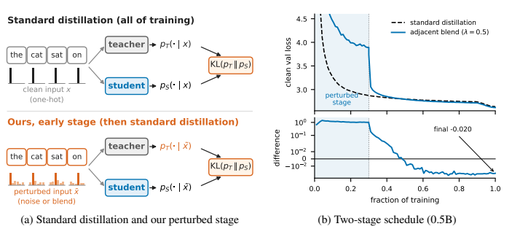
Figure 1 :Overview.(a) In standard distillation, teacher and student read the same clean text and the student is trained to match the teacher’s prediction on it. In the early stage of our method, both read a perturbed version of the text, and the student matches the teacher’s prediction on that perturbed input: the inputs on which the teacher supervises the student change, not only the student’s input. The bars under each token sketch its input vector over a toy vocabulary, one-hot for clean text and spread over several vocabulary items when perturbed (Fig. 2). The rest of training is standard distillation on clean text. (b) Clean validation loss of two 0.5B students trained from the same initialization on the same data order, one with standard distillation and one with adjacent blending (λ=0.5) for the first 30% of training, and their difference (symmetric log scale). While its inputs are perturbed, the blended student lags by about one nat. After the switch it recovers quickly, overtakes the baseline at about 47% of training and finishes 0.020 nats below it.
원문 · CC BY 4.0 · Ziyang Cai, Yihe Dong, Dimitris Papailiopoulos, Shivam Garg · Perturbing Inputs Improves Pretraining Distillation · 원문 그림 인용 · 원본 PDF 2쪽에서 그림 영역을 추출했습니다.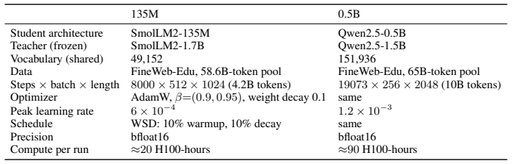
Table 3 :Training configuration.Both scales train the student from random initialization with a frozen teacher; the distillation loss is the forward KL divergence over the full vocabulary at temper- ature 1, with no next-token term.
원문 · CC BY 4.0 · Ziyang Cai, Yihe Dong, Dimitris Papailiopoulos, Shivam Garg · Perturbing Inputs Improves Pretraining Distillation · 원문 그림 인용 · 원본 PDF 13쪽에서 그림 영역을 추출했습니다.세 가지 perturbation이 비교됩니다. Noise는 정답 토큰에 k=8개 무작위 토큰의 Gaussian 가중치를 더하며 σ로 크기를 조절합니다. Parallel blend는 두 독립 문서를 같은 위치에서 λ와 1−λ 가중으로 섞습니다. Adjacent blend는 연속된 두 토큰을 하나의 위치로 λ와 1−λ 가중으로 합치며, 이때 입력 길이를 유지하기 위해 시퀀스를 두 배로 길게 뽑습니다. 학습률은 warmup–stable–decay 스케줄을 따르고, 마지막 decay는 항상 깨끗한 입력에서 진행됩니다. 따라서 perturbed 단계 뒤에도 최종 수렴은 깨끗한 데이터에서 이루어집니다.

Figure 2 :Perturbation familieson a toy vocabulary. Each replaces the one-hot vector of a token with a sparse weighted combination of vocabulary items, with the position’s own token shown dark. Teacher and student both map the perturbed vector through their own embedding tables, and the student is trained to match the frozen teacher’s next-token distribution on it.
원문 · CC BY 4.0 · Ziyang Cai, Yihe Dong, Dimitris Papailiopoulos, Shivam Garg · Perturbing Inputs Improves Pretraining Distillation · 원문 그림 인용 · 원본 PDF 3쪽에서 그림 영역을 추출했습니다.주요 결과: 135M과 0.5B 규모의 개선
135M 규모에서 세 perturbation은 모두 표준 distillation보다 낮은 validation loss를 보였습니다. 인접 토큰 blend가 가장 강했고, λ=0.8에서 표준 distillation 대비 0.025 nats 낮았습니다. 이는 distillation 자체가 next-token 학습 대비 얻는 0.017 nats의 약 1.45배입니다. Noise는 σ=0.4에서 0.019 nats, parallel blend는 λ=0.7에서 0.018 nats를 얻었습니다. 각 perturbation은 뚜렷한 최적점을 가지며 그보다 과하면 성능이 나빠졌습니다.
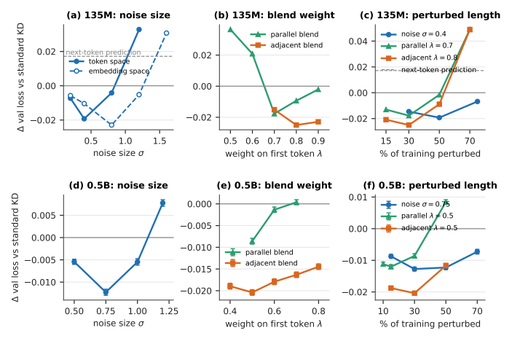
Figure 3 :Change in final validation loss against standard distillation(below zero is better). (a–c) 135M student with the SmolLM2-1.7B teacher, 4.2B tokens. The dashed line is next-token prediction without a teacher. (a) Noise size, with a 50% perturbed stage. The open markers in (a) are Gaussian noise added to each model’s input embedding; theirσis relative to the embedding’s root- mean-square value, so it is not in the same units as token noise. (b) Blend weight for both blends, with a 30% perturbed stage. (c) Length of the perturbed stage at each family’s best size. (d–f) 0.5B student with the Qwen2.5-1.5B teacher, 10B tokens, scored on the full validation split. Error bars are±2paired standard errors. (d) Noise size and (e) blend weight, with the same perturbed-stage lengths as in (a, b). (f) Length of the perturbed stage at each family’s best size.
원문 · CC BY 4.0 · Ziyang Cai, Yihe Dong, Dimitris Papailiopoulos, Shivam Garg · Perturbing Inputs Improves Pretraining Distillation · 원문 그림 인용 · 원본 PDF 4쪽에서 그림 영역을 추출했습니다.0.5B 규모에서도 인접 토큰 blend가 가장 강했습니다. λ=0.5에서 표준 distillation 대비 0.020 nats 낮았고, 쌍을 이룬 표준오차는 0.0003이었습니다. 같은 실행의 두 추가 시드에서는 0.021과 0.019였습니다. Noise는 σ=0.75에서 0.012 nats, parallel blend는 λ=0.5에서 0.009 nats(30% 단계)와 0.012 nats(15% 단계)를 얻었습니다.
개선이 교사 측 입력에서 오는지 확인한 절제 실험
절제 실험은 이득의 원천을 확인하기 위해 설계되었습니다. 교사가 없는 next-token 학습에서 같은 perturbation을 쓰면 개선은 0.003 nats에 그쳤습니다. 인접 토큰 blend는 교사가 없으면 next-token 학습보다 0.03 nats 뒤처졌습니다. 교사 측 입력만 perturbed로 바꾸면 학생은 깨끗한 텍스트를 보지만 perturbed 입력에 대한 교사 예측을 목표로 받습니다. 이때 얻은 이득은 두 모델을 모두 perturbed로 바꾼 경우의 약 90%였습니다. 반대로 학생 입력만 perturbed로 바꾸고 교사 목표는 깨끗한 입력에서 얻으면 이득은 약 3분의 1 수준이었습니다.
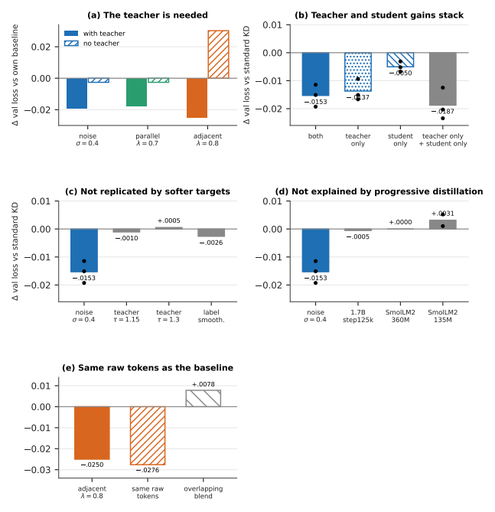
Figure 4 :Ablations(135M, SmolLM2-1.7B teacher; difference in final validation loss, lower is better). Bars show the mean over initialization seeds and dots the individual seeds, each compared with standard distillation from the same seed. (a) Each family at its best setting, with and without the teacher, each compared with its own unperturbed baseline (standard distillation or next-token prediction). (b) Token noise given to both models, to the teacher only, or to the student only. The grey bar is the sum of the two one-sided gains. (c) Clean inputs, with the teacher’s target softened instead, either by a temperatureτ(τ=1.15matches the entropy of the teacher’s prediction onσ=0.4 inputs) or by label smoothing to the same entropy. (d) Clean inputs for the first half of training, distilled from a weaker model (an early checkpoint of the teacher, or a smaller model) instead of the teacher. (e) Adjacent blending atλ=0.8, as in the main runs and on the same raw tokens as the baseline, and the overlapping variant described in the text (one seed).
원문 · CC BY 4.0 · Ziyang Cai, Yihe Dong, Dimitris Papailiopoulos, Shivam Garg · Perturbing Inputs Improves Pretraining Distillation · 원문 그림 인용 · 원본 PDF 6쪽에서 그림 영역을 추출했습니다.저자들은 이 결과를 근거로 noise 실험에서는 교사 측 perturbation이 이득의 대부분을 설명한다고 해석합니다. 이는 ablation 결과에 기반한 해석이며, 세 perturbation 모두에 대해 같은 정도로 확인된 결론으로 제시되지 않습니다. 같은 절에서 평균 네 개의 noisy 교사 예측을 쓰면 단일 샘플보다 이득이 작았다는 결과도 보고되며, 저자들은 목표의 변동성이 도움이 된다고 해석합니다.
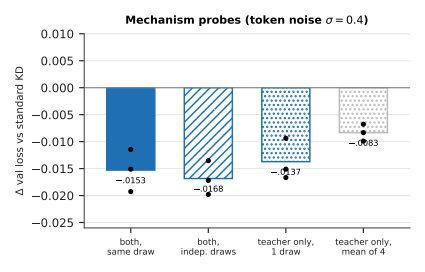
Figure 7 :Mechanism probes(135M, token noiseσ=0.4for the first 50% of training; difference from standard distillation, mean over seeds with individual seeds as dots).
원문 · CC BY 4.0 · Ziyang Cai, Yihe Dong, Dimitris Papailiopoulos, Shivam Garg · Perturbing Inputs Improves Pretraining Distillation · 원문 그림 인용 · 원본 PDF 14쪽에서 그림 영역을 추출했습니다.데이터 반복과 튜닝된 weight decay 기준선
데이터가 제한된 설정에서는 같은 텍스트를 여러 번 쓰므로 정규화가 중요해집니다. 135M 규모에서 같은 4.2B 토큰 예산 안에서 처음 262M 토큰을 16 epoch 반복하는 실험이 수행되었습니다. Weight decay를 스윕한 결과, 기본값 0.1에서 1.0으로 올리면 표준 distillation의 손실이 0.033 nats 낮아졌습니다. 튜닝된 기준선 위에서 token noise(σ=0.4, 학습의 처음 50%)는 두 시드에서 0.023과 0.020 nats의 이득을 보였습니다. 같은 noise를 교사 없이 쓰면 0.008 nats였으므로, 교사가 있을 때의 이득은 약 2.6배입니다.
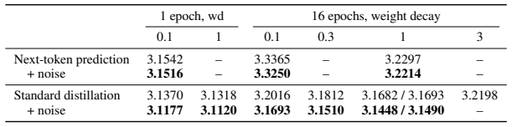
Table 4 :Data-constrained pretrainingat 135M: final validation loss with 16 epochs over 262M unique tokens, by weight decay, against the same 4.2B-token budget without repetition (1 epoch). Two values: two initialization seeds. The 1-epoch runs at weight decay 1 use one seed. Noise: token noiseσ=0.4for the first 50% of training. Bold: the better of each objective with and without noise.
원문 · CC BY 4.0 · Ziyang Cai, Yihe Dong, Dimitris Papailiopoulos, Shivam Garg · Perturbing Inputs Improves Pretraining Distillation · 원문 그림 인용 · 원본 PDF 13쪽에서 그림 영역을 추출했습니다.기본 weight decay 0.1에서의 이득 0.032는 튜닝된 weight decay가 주는 정규화 효과와 겹치므로 더 크게 보입니다. 따라서 튜닝된 기준선에서 보고된 값이 이 설정의 주요 결과입니다.
양자화 후 성능과 zero-shot 전이
0.5B 학생은 post-training weight quantization 후에도 검증 손실 이득을 보였습니다. GPTQ int4에서는 모든 perturbed 학생이 같은 방식으로 양자화한 표준 distillation보다 이득을 유지했고, 인접 토큰 blend의 이득은 0.020에서 0.024 nats로 늘었습니다. 기본 round-to-nearest의 int3에서는 표준 distillation의 손실 증가가 6.2 nats였지만, 두 blend는 각각 1.2와 1.5 nats에 그쳤습니다. 저자들은 이 차이가 중간 학습 체크포인트에서도 유지되며, 선형 층 가중치의 초과 첨도가 두 blend에서 0.14로 표준의 약 0.5보다 낮은 것과 맞물린다고 해석합니다.
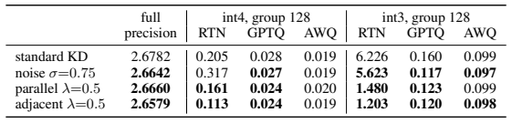
Table 1 :Increase in validation loss from post-training weight quantizationat 0.5B (nats; 512 fixed validation windows, paired across models). RTN: round-to-nearest; GPTQ and AWQ as im- plemented in llm-compressor. All linear layers except the output head are quantized; activations stay in 16 bits. Perturbed stage: 30%, or 15% for the parallel blend. Bold: better than standard KD.
원문 · CC BY 4.0 · Ziyang Cai, Yihe Dong, Dimitris Papailiopoulos, Shivam Garg · Perturbing Inputs Improves Pretraining Distillation · 원문 그림 인용 · 원본 PDF 8쪽에서 그림 영역을 추출했습니다.Zero-shot 평가에서는 0.5B의 평균 정확도가 표준 distillation 52.5%에서 인접 토큰 blend 53.5%, noise 53.6%로 올랐습니다. Parallel blend는 0.5점 증가했습니다. 가장 큰 향상은 SciQ의 약 4점과 HellaSwag의 약 1점이었고, 두 blend는 LAMBADA에서 약 1점 낮았습니다. 135M에서는 평균 차이가 최대 0.6점이었습니다.
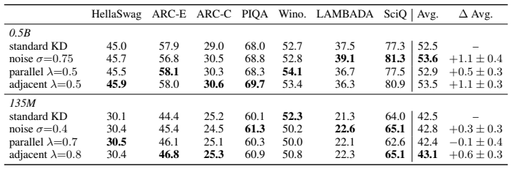
Table 2 :Zero-shot accuracy(%, lm-evaluation-harness; normalized accuracy for HellaSwag, ARC, PIQA and SciQ, accuracy for Winogrande and LAMBADA). Each family at its best setting for that scale, with a perturbed stage of 30% (0.5B parallel blend 15%, 135M noise 50%).∆Avg.: difference from standard distillation in the average over tasks,±paired bootstrap standard error over examples. Best value per scale in bold.
원문 · CC BY 4.0 · Ziyang Cai, Yihe Dong, Dimitris Papailiopoulos, Shivam Garg · Perturbing Inputs Improves Pretraining Distillation · 원문 그림 인용 · 원본 PDF 9쪽에서 그림 영역을 추출했습니다.적용 범위와 한계
저자들은 실험 규모가 제한적이라고 밝힙니다. 더 큰 모델이나 훨씬 많은 학습 데이터에서 이득이 유지되는지는 이 연구에서 확인되지 않았습니다. 최적의 perturbation 크기와 perturbed 단계 길이는 두 규모 사이에서 달랐고, 저자들은 그 범위를 사전에 정하는 원리를 갖지 못하고 sweep으로 찾았다고 씁니다. 또한 부록에 따르면 학습 예산 내에서 측정된 결과가 주된 근거이며, 모든 설정이 여러 시드로 반복된 것은 아닙니다.
이 논문은 교사가 perturbed 입력에서 제공하는 감독이 쓸모 있을 수 있다는 개념 증명을 제시합니다. 교사에게 다른 입력을 질의하는 더 넓은 설계는 향후 과제로 남습니다.
논문 정보
- 저자
- Ziyang Cai, Yihe Dong, Dimitris Papailiopoulos, Shivam Garg
- 학회·저널
- arXiv · 프리프린트
- 최초 공개일
- 2026년 11월 8일
- 등록일
- 2026년 11월 10일
- 수정일
- 2026년 11월 8일
- 버전
- v1
- arXiv
- 2611.11598
- 분류
- cs.CL · cs.AI
- 원문 이용 조건
- CC BY 4.0
- 제공 범위
- 논문 정보, 해설, 허용된 원문 그림
AI 해설은 논문 원문과 별개의 설명이며 오류가 있을 수 있습니다. 원문과 그림은 각 출처의 이용 조건과 따로 표시된 권리를 따릅니다.
초록
Knowledge distillation trains a student language model to match a teacher's predictions on the training text. We ask whether learning the teacher's behavior beyond the training text can further improve the student. We investigate this using three input perturbations: additive token noise, blending two documents, and blending neighboring tokens. Specifically, for an early part of pretraining we perturb the inputs and train the student to match the teacher on them, and we spend the rest of the same token budget on ordinary distillation. When pretraining from scratch, the best method improves on standard distillation at both scales we tried, by 0.025 nats at 135M parameters and by 0.020 nats at 0.5B (mean of three seeds). At 135M this is 1.45 times the gain that distillation itself provides over next-token training. We also observe promising downstream transfer: at 0.5B, the best variant improves average zero-shot accuracy by about one percentage point across seven tasks. It also retains its validation-loss advantage after low-bit weight quantization. We also test a data-limited setting in which training data must be reused, and find that the gains persist. Finally, ablations suggest that, for additive noise, perturbing the teacher's inputs contributes most of the gain, while perturbing only the student's inputs yields much less.
원문 인용
Ziyang Cai, Yihe Dong, Dimitris Papailiopoulos, Shivam Garg (2026). Perturbing Inputs Improves Pretraining Distillation. arXiv:2611.11598v1. https://arxiv.org/abs/2611.11598v1
BibTeX
@misc{cai2026perturbing,
  title = {{Perturbing Inputs Improves Pretraining Distillation}},
  author = {Ziyang Cai and Yihe Dong and Dimitris Papailiopoulos and Shivam Garg},
  year = {2026},
  eprint = {2611.11598},
  archivePrefix = {arXiv},
  url = {https://arxiv.org/abs/2611.11598v1}
}