논문 해설
Learning Pseudo-Riemannian Manifolds for Heterophilic Graphs via Graph Signature
그래프 시그니처를 통한 이종 그래프용 유사 리만 다양체 학습
- 연구 문제 양의 정부호 기하를 전제한 GNN은 간선이 비유사성을 뜻하는 이질성 그래프에서 기하적 불일치를 보이며, 이를 라벨 토폴로지 기반 그래프 신호 인덱스로 진단할 수 있습니다.
- 연구 방법 PRAT은 라벨 토폴로지로 계산한 그래프 신호 행렬로 초기화한 학습 가능한 대각 부정 계량을 주의 로짓의 부호 있는 제곱 의사거리에 사용합니다.
- 주요 결과 PRAT은 여러 벤치마크에서 강한 이질성 적응 모델과 비슷하거나 더 나은 성능을 보였고, 부호 제약 절제 실험에서 음수 고유값을 가진 그래프에서만 성능 손실이 나타났습니다.
이질성 그래프와 양의 정부호 기하의 불일치
많이 쓰이는 GNN 계열은 양의 정부호 기하 사전 분포를 전제합니다. 그래프 합성곱을 열확산으로 읽으면 양의 준정부호 연산자가 필요하고, 쌍곡 모델은 양의 정부호 리만 다양체에 특징을 배치하며, 내적 기반 주의 점수는 음의 제곱거리를 만들지 못합니다. 이 전제는 간선이 유사성을 뜻하는 동질 그래프에는 잘 맞지만, 간선이 비유사성이나 구조적 반발을 뜻하는 이질 그래프에서는 불일치가 생깁니다. 저자들은 이 불일치를 측정할 수 있는 불변량이 필요하다고 봅니다. 이 절의 결론은 라벨 토폴로지만으로 계산되는 그래프 신호 인덱스 sG가 그 진단 도구라는 점입니다.
그래프 신호 행렬과 신호 인덱스
그래프 신호 행렬 SG는 클래스 i와 j 사이의 간선 수를 두 클래스 크기의 곱으로 나눈 실수 대칭 행렬입니다. 그 고유값의 양수, 0, 음수 개수를 세면 신호 인덱스 sG가 됩니다. 실베스터 관성 법칙에 따라 이 인덱스는 가역 선형 좌표 변환에서 바뀌지 않습니다. 정리 2.3은 기대 신호 행렬의 고유값 부호가 임계 호모필리 h*E = Σ n_k^2 / N^2 를 기준으로 바뀐다고 말합니다. 균형 클래스에서는 h*E가 1/|L|로 줄어듭니다. 따라서 호모필리 값 하나로는 부호 구조를 충분히 설명할 수 없으며, 정리 2.4는 유리수 h∈(0,1)에 대해 hE와 hV가 h이면서 음의 고유값을 갖는 그래프가 존재함을 보입니다.
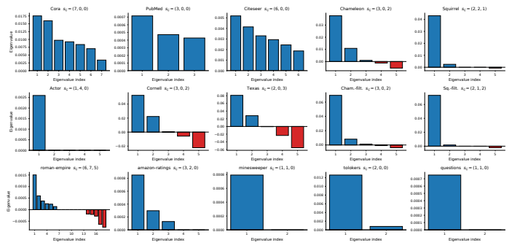
Figure 8 : Eigenvalue distributions of the graph signature matrix of the full labeled graph (Defi- nition 2.1) for all fifteen benchmark datasets (eight standard + seven Platonov), which give the signatures of Table 1 and Table 2. Eigenvalues with |λ|<1.0×10 −4 are rounded to zero for reporting.
원문 · CC BY 4.0 · Yun Young Choi, Asung Kil, Sun Woo Park, Minho Lee, Seokhwan Kim · Learning Pseudo-Riemannian Manifolds for Heterophilic Graphs via Graph Signature · 원문 그림 인용 · 원본 PDF 23쪽에서 그림 영역을 추출했습니다.부정 계량을 가진 기하와 PRAT의 주의 로짓
저자들은 SG를 계량 텐서로 두면 그래프가 부정 계량을 가진 의사 리만 다양체의 부분공간으로 볼 수 있다고 설명합니다. 정리 2.5는 SG가 부정이고 사영 Tpf가 전사이면 Riemannian 계량의 풀백을 f*SG로 바꾸는 미분동형사상이 없다고 말합니다. PRAT은 이 계량을 주의 로짓에 넣습니다. 각 간선 점수는 차이 벡터 Δ를 사용한 부호 있는 제곱 의사거리 Δ⊤DΔ이고, D[l,k]=(W[l,k])⊤S|L|W[l,k]에서 S|L|을 SG로 둡니다. 식 (5)에서 고유분해로 Λ와 W′로 재표현하며, 순전파는 라벨을 읽지 않고 Λ는 학습 가능한 대각 행렬로 학습됩니다.
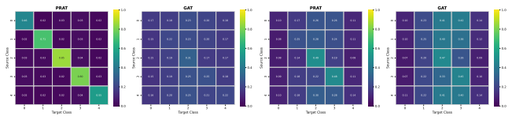
Figure 4 : Attention score distributions of PRAT and GAT. Each heatmap gives mean attention from source class (row) to target class (column).
원문 · CC BY 4.0 · Yun Young Choi, Asung Kil, Sun Woo Park, Minho Lee, Seokhwan Kim · Learning Pseudo-Riemannian Manifolds for Heterophilic Graphs via Graph Signature · 원문 그림 인용 · 원본 PDF 8쪽에서 그림 영역을 추출했습니다.합성 그래프에서 호모필리 변화에 따른 행동
합성 그래프에서는 노드, 간선, 특징, 클래스 수를 고정하고 간선 호모필리 hE만 0부터 1까지 바꿉니다. 비교는 주의 계열 안에서 이루어져 수용 영역은 같고 계량만 다릅니다. GAT와 GATv2는 양의 정부호 계량을 유지하고, FAGCN은 기하를 바꾸지 않고 집계 가중치의 부호만 바꾸며, PRAT은 계량 자체를 부정으로 만듭니다. 그림 2에서 PRAT은 전 구간에서 정확도를 유지하는 반면 다른 세 모델은 hE가 0.5 아래에서 함께 떨어진다고 보고됩니다. 저자들은 이로부터 부호 있는 가중치만으로는 부정 계량을 대신할 수 없다고 해석합니다.
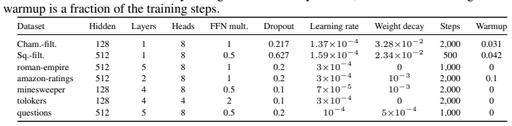
Table 11 : Configuration for synthetic data experiments. Dataset Configuration Hyperparameters
원문 · CC BY 4.0 · Yun Young Choi, Asung Kil, Sun Woo Park, Minho Lee, Seokhwan Kim · Learning Pseudo-Riemannian Manifolds for Heterophilic Graphs via Graph Signature · 원문 그림 인용 · 원본 PDF 28쪽에서 그림 영역을 추출했습니다.표준 벤치마크와 Platonov 벤치마크 결과
표 3에서 PRAT은 Actor와 Texas에서 최고 성능을 보이고 Squirrel에서 2위, Chameleon에서 3위, Cornell에서 4위입니다. 동질 그래프에서는 Citeseer에서 최고, PubMed에서 3위입니다. 저자들은 PRAT이 1-hop 이웃만 사용하면서도 다중 홉 스펙트럼 필터인 BernNet과 GPR-GNN을 Texas, Squirrel, Actor에서 넘어서므로 수용 영역의 차이만으로 설명되지 않는다고 봅니다. Platonov 벤치마크의 표 4에서는 filtered Chameleon, roman-empire, amazon-ratings, tolokers에서 최고 또는 통계적 동률이며, 일부 비교는 동률로 세어집니다.
이 결과들은 특정 백본과 분할 프로토콜 아래의 비교입니다.
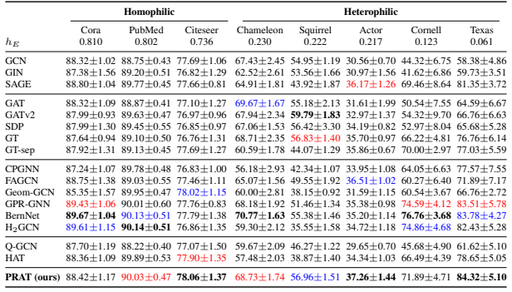
Table 3 : Performance of PRAT and baselines on benchmark datasets. The top 3 performances are highlighted inFirst, Second, and Third.
원문 · CC BY 4.0 · Yun Young Choi, Asung Kil, Sun Woo Park, Minho Lee, Seokhwan Kim · Learning Pseudo-Riemannian Manifolds for Heterophilic Graphs via Graph Signature · 원문 그림 인용 · 원본 PDF 7쪽에서 그림 영역을 추출했습니다.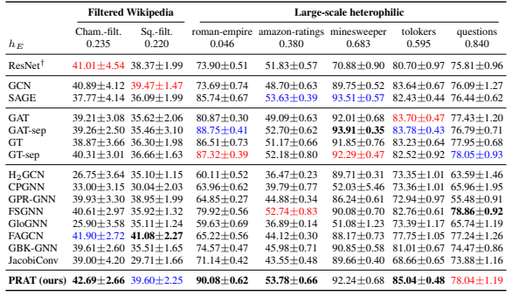
Table 4 : Performance on Platonov et al. [28] benchmarks. Accuracy (↑) is reported for roman-empire, amazon-ratings, Cham.-filt., Sq.-filt.; ROC AUC (↑) for minesweeper, tolokers, questions. †Best per dataset of the graph-agnostic ResNet of Platonov et al.[28] and its graph-aware variants ResNet+SGC and ResNet+adj.
원문 · CC BY 4.0 · Yun Young Choi, Asung Kil, Sun Woo Park, Minho Lee, Seokhwan Kim · Learning Pseudo-Riemannian Manifolds for Heterophilic Graphs via Graph Signature · 원문 그림 인용 · 원본 PDF 7쪽에서 그림 영역을 추출했습니다.부호 제약과 초기화 절제 실험
절제 실험은 PRAT, PRATpos, PRATfixed를 같은 구조와 프로토콜에서 비교합니다. PRATpos는 학습 가능한 Λ를 양의 정부호로 제한하고, PRATfixed는 Λ를 신호 초기화 값으로 고정합니다. 표 5에서 PRAT과 PRATpos의 차이는 음수 고유값을 가진 Chameleon, Squirrel, Cornell, Texas에서 나타나고, 양의 신호를 가진 Cora, PubMed, Citeseer에서는 변하지 않습니다. 이 결과는 부호 구조가 성능 차이와 관련됨을 보이며, 모든 구성요소가 유익하다는 결론으로 확장되지 않습니다. Platonov 쌍 검정에서도 유의한 손실은 음수 고유값 그래프에서만 나타났습니다.
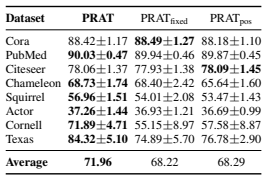
Table 5 : Ablation study results.
원문 · CC BY 4.0 · Yun Young Choi, Asung Kil, Sun Woo Park, Minho Lee, Seokhwan Kim · Learning Pseudo-Riemannian Manifolds for Heterophilic Graphs via Graph Signature · 원문 그림 인용 · 원본 PDF 9쪽에서 그림 영역을 추출했습니다.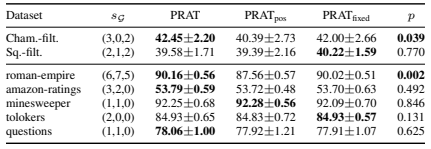
Table 13 : Three-way ablation on the Platonov benchmarks, grouped as in Table 4, with the graph signature index of each dataset. p is an exact paired Wilcoxon signed-rank test of PRAT against PRATpos over the ten shared splits;bold p marks significance at α= 0.05 . Among the three variants the best mean is inbold, and where means tie the smaller deviation takes it.
원문 · CC BY 4.0 · Yun Young Choi, Asung Kil, Sun Woo Park, Minho Lee, Seokhwan Kim · Learning Pseudo-Riemannian Manifolds for Heterophilic Graphs via Graph Signature · 원문 그림 인용 · 원본 PDF 30쪽에서 그림 영역을 추출했습니다.한계와 적용 범위
저자들이 밝힌 한계는 네 가지입니다. 신호 인덱스는 학습 노드의 라벨로 계산되므로 현재 방법은 (준)지도 노드 분류에 묶여 있습니다. 학습과 테스트 그래프 사이의 신호 이동은 연구되지 않았습니다. SG가 노드 라벨 없이 정의되지 않으므로 그래프 수준 과제는 현재 방식으로 다루기 어렵습니다. 또한 rank(D)≤|L|이므로 클래스 수가 적을 때 계량이 담을 구조가 제한됩니다. 라벨 없는 k-means 추정이 일부 설정에서 정확도를 회복했다는 결과는 이 한계를 부분적으로만 완화합니다.
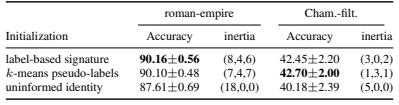
Table 15 : Label-free initialization. The inertia is that of the eigenvalue vector each initialization is built from, before normalization, at the 10−4 rounding convention of Figure 8; the two signature estimates use the training nodes.
원문 · CC BY 4.0 · Yun Young Choi, Asung Kil, Sun Woo Park, Minho Lee, Seokhwan Kim · Learning Pseudo-Riemannian Manifolds for Heterophilic Graphs via Graph Signature · 원문 그림 인용 · 원본 PDF 32쪽에서 그림 영역을 추출했습니다.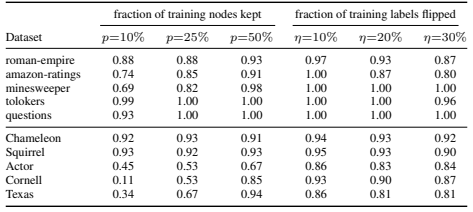
Table 16 : Mean eigenvalue sign agreement of the estimated signature against the full-training-label signature, over 100 repeats.
원문 · CC BY 4.0 · Yun Young Choi, Asung Kil, Sun Woo Park, Minho Lee, Seokhwan Kim · Learning Pseudo-Riemannian Manifolds for Heterophilic Graphs via Graph Signature · 원문 그림 인용 · 원본 PDF 33쪽에서 그림 영역을 추출했습니다.논문 정보
- 저자
- Yun Young Choi, Asung Kil, Sun Woo Park, Minho Lee, Seokhwan Kim
- 학회·저널
- arXiv · 프리프린트
- 최초 공개일
- 2026년 11월 4일
- 등록일
- 2026년 11월 6일
- 수정일
- 2026년 11월 4일
- 버전
- v1
- arXiv
- 2611.06265
- 분류
- cs.LG · cs.AI
- 원문 이용 조건
- CC BY 4.0
- 제공 범위
- 논문 정보, 해설, 허용된 원문 그림
AI 해설은 논문 원문과 별개의 설명이며 오류가 있을 수 있습니다. 원문과 그림은 각 출처의 이용 조건과 따로 표시된 권리를 따릅니다.
초록
Several widely used families of Graph Neural Networks carry a positive-definite geometric prior. Graph convolution read as heat diffusion needs a positive semi-definite operator, hyperbolic models place features on positive-definite Riemannian manifolds, and dot-product and GAT-style attention scores use positive-definite inner products. On heterophilic graphs, where edges often signify dissimilarity or structural repulsion, that prior is a mismatch: no positive-definite form can assign a negative squared distance to a direction the labels separate. To measure the mismatch, we introduce the Graph Signature Index ($s_{\mathcal{G}}$), the inertia of a class-compatibility matrix built from label topology alone, and we prove that no value of the edge or node homophily index in $(0,1)$ rules out a negative eigenvalue. We then propose the Pseudo-Riemannian Attention Network (PRAT), whose attention logit is a signed squared pseudo-distance under a learnable diagonal metric initialized from $s_{\mathcal{G}}$. The design is diagnose-then-learn: the signature supplies a sign structure that unconstrained training keeps outside near-zero directions, and the projection learns the rest of the metric around it. Across fifteen node-classification benchmarks PRAT outperforms or matches the strongest heterophily-adapted models. A controlled ablation ties that performance to the sign structure itself: with architecture and protocol fixed, forbidding the metric to be indefinite costs accuracy on the graphs $s_{\mathcal{G}}$ marks as indefinite and leaves the others unchanged.
원문 인용
Yun Young Choi, Asung Kil, Sun Woo Park, Minho Lee, Seokhwan Kim (2026). Learning Pseudo-Riemannian Manifolds for Heterophilic Graphs via Graph Signature. arXiv:2611.06265v1. https://arxiv.org/abs/2611.06265v1
BibTeX
@misc{choi2026learning,
  title = {{Learning Pseudo-Riemannian Manifolds for Heterophilic Graphs via Graph Signature}},
  author = {Yun Young Choi and Asung Kil and Sun Woo Park and Minho Lee and Seokhwan Kim},
  year = {2026},
  eprint = {2611.06265},
  archivePrefix = {arXiv},
  url = {https://arxiv.org/abs/2611.06265v1}
}