논문 해설
When Bigger Becomes Brittle: Why Compression Hurts More as Language Models Scale
커질수록 취약해질 때: 언어 모델이 확장될수록 압축이 더 큰 피해를 주는 이유
- 연구 문제 모델 압축의 출력 손실은 벤치마크 점수로 보이지만, 내부에서 손상된 검색 헤드와 나머지 네트워크의 보상이 어떻게 결합하는지, 그리고 그 균형이 모델 크기에 따라 변하는지는 분명하지 않습니다.
- 연구 방법 검색 헤드 손상으로 생기는 손실을 결손, 복사 억제 해제, 역방향 반응, 최종 정규화, 출력 손상의 항등식으로 분해하고, 이를 Pythia 크기 비교와 4비트 양자화 및 가지치기 복제에 적용합니다.
- 주요 결과 작은 모델은 같은 결손의 상당 부분을 보상하지만 큰 모델은 손실 대부분을 출력에 남깁니다. 12B에서는 0.5 로짓 결손 중 약 0.38 로짓이 출력 손상으로 남습니다.
압축 손실을 출력 점수만으로 보기 어려운 이유
양자화와 가지치기는 언어 모델의 배포 비용을 줄이지만, 그 영향은 대개 벤치마크 점수로만 보고됩니다. 이런 점수는 출력에 남은 손실만 보여 주며, 모델 내부에서 어떤 구성요소가 얼마나 손상되었고 나머지 네트워크가 그 일부를 어떻게 보상했는지는 드러내지 않습니다. 이 연구는 문맥 내 검색을 대상으로, 소수의 식별 가능한 어텐션 헤드인 retrieval heads를 손상시켰을 때 생기는 손실을 결손, 보상, 출력 손상으로 나눕니다. 이를 통해 손상과 보상이 어떻게 결합하는지, 그리고 그 균형이 Pythia 모델 크기에 따라 어떻게 달라지는지를 확인합니다.
로짓 차이를 항등식으로 분해하는 방법
분석의 기준 값은 로짓 차이 m = z_ans − z_subj입니다. 여기서 z_ans는 정답 이름의 로짓이고 z_subj는 반복된 주어 이름의 로짓입니다. 구성요소 집합 C를 목표 헤드 T, copy-suppression heads CS, 나머지 구성요소 O로 나눕니다. 결손 D는 목표 헤드 직접 기여의 감소량 −Σ_T Δa_i이고, 출력 손상 H는 −Δm입니다. CS 해제 R은 CS 직접 기여의 변화 Σ_CS Δa_i이며, 역방향 반응 B는 O에 속한 모든 헤드와 MLP 층의 직접 기여 변화 Σ_O Δa_i입니다. 최종 정규화 항 N은 Δm에서 깨끗한 실행의 고정 scale로 설명되는 기여 합을 뺀 값입니다.
이 정의에서 H = D − R − B − N이 성립하며, 총 보상은 D − H = R + B + N입니다. 제로 절제에서는 목표 헤드의 개입 후 기여가 0이므로 D가 깨끗한 실행의 목표 헤드 기여 합과 같아집니다. Standing suppression S는 CS 헤드의 깨끗한 기여 합에 음의 부호를 붙인 값이고, R은 S에서 개입 후 억제 S_int를 뺀 값입니다. 따라서 R은 CS의 억제가 약해진 크기를 재며, 개입된 헤드가 자신의 출력을 회복했다는 뜻은 아닙니다. 역방향 반응 B는 여러 변화가 서로 상쇄될 수 있으므로 개별 변화 크기의 합이 아니라 순변화로 측정됩니다.
GPT-2 XL과 Pythia-410M 양자화에서 보이는 보상
GPT-2 XL에서 상위 k개 검색 헤드를 모든 토큰 위치에서 제로 절제하면, 출력 여백은 보상 없는 기준선보다 위에 머무릅니다. 상위 10개 헤드를 절제할 때 역방향 반응은 0.97 로짓의 보상 중 0.51 로짓을 제공하며, 20개 이상의 헤드부터는 역방향 반응이 복사 억제 해제 항의 최소 두 배입니다. 최종 정규화 항은 최대 0.21 로짓으로 상대적으로 작습니다. 같은 분해를 Pythia-410M의 4비트 양자화에 적용하면 목표 헤드는 활성 상태로 남습니다. 이때 상위 10개 헤드의 직접 기여는 1.70 로짓 감소하지만 출력은 0.54 로짓만 떨어집니다. 이 양자화 실험은 의도적으로 낮은 보정을 사용하므로, 최적화된 배포 양자화기의 성능이 아니라 지정된 가중치 교란 아래의 보상을 보여 줍니다.
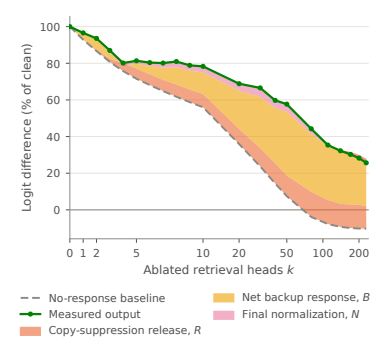
Figure 1 : Repair decomposition in GPT-2 XL as the top-k retrieval heads are ablated. The gap between the no-response baseline and the measured output is filled by copy-suppression release, the net backup response, and final normalization. Values are percentages of the clean logit difference.
원문 · CC BY 4.0 · Gautam Gupta, Dikshant Kukreja, Unique Kumar, Avni Mittal, Deepanshu Dabas, Kshitij Sah, Erik Cambria, Rajiv Ratn Shah, Zhengkui Wang, Avinash Anand · When Bigger Becomes Brittle: Why Compression Hurts More as Language Models Scale · 원문 그림 인용 · 원본 PDF 3쪽에서 그림 영역을 추출했습니다.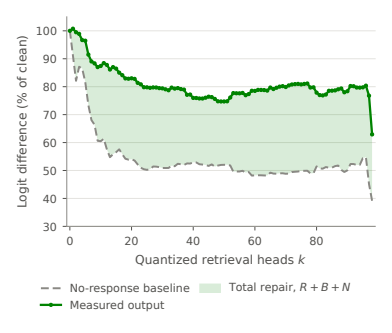
Figure 2 : Repair under 4-bit weight quantization of the top-k retrieval heads in Pythia-410M, using the delib- erately poor calibration described in Appendix A. The shaded gap between the no-response baseline and the measured output is total repair, R+B+N . Values are percentages of the clean logit difference.
원문 · CC BY 4.0 · Gautam Gupta, Dikshant Kukreja, Unique Kumar, Avni Mittal, Deepanshu Dabas, Kshitij Sah, Erik Cambria, Rajiv Ratn Shah, Zhengkui Wang, Avinash Anand · When Bigger Becomes Brittle: Why Compression Hurts More as Language Models Scale · 원문 그림 인용 · 원본 PDF 4쪽에서 그림 영역을 추출했습니다.Pythia 크기에 따른 보상의 감소
Pythia의 여섯 최종 체크포인트를 비교하기 위해, 각 모델의 절제 스윕에서 결손 D = 0.5 로짓 지점을 선형 보간으로 맞춥니다. 410M에서는 복사 억제 해제, 역방향 반응, 최종 정규화가 합쳐 약 0.55 로짓의 보상을 제공하여 출력 여백이 깨끗한 값보다 약 0.05 로짓 높습니다. 12B에서는 약 0.38 로짓의 출력 손상이 남습니다. 복사 억제 해제 뒤 남은 결손 D−R은 410M에서 D의 약 27%이고 12B에서는 거의 90%입니다. 410M의 standing suppression은 약 1.1 로짓으로 깨끗한 로짓 차이의 약 25%이며, 12B에서는 약 0.2 로짓으로 약 5%입니다. 체크포인트 분석에서 중간 층의 최대 초과량과 standing suppression은 함께 발달하는 경향을 보입니다.
저자들은 이를 억제가 초과를 교정하도록 발달한다는 가설로 해석하지만, 관찰된 체크포인트는 조작되지 않았으므로 이 관계를 인과로 확정하지 않습니다. 별도의 held-out 비교에서는 어텐션 역방향 반응이 410M에서 D−R의 약 80%를 상쇄하고, 2.8B 이상에서는 약 10%만 상쇄합니다. 그럼에도 12B에서 보상 가능한 역방향 헤드의 응답을 막으면 손상이 약 0.30 로짓 늘어나므로, 큰 모델에도 보호적 역방향 반응이 남아 있습니다.
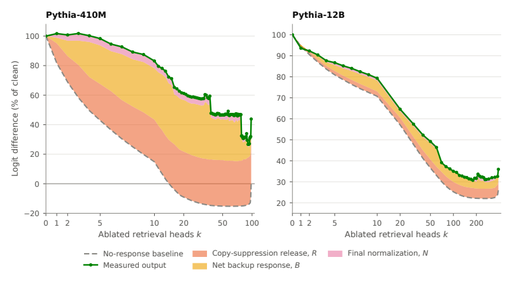
Figure 3 : Repair decomposition at the two ends of the Pythia suite, Pythia-410M (left) and Pythia-12B (right), as the top-k retrieval heads are ablated. The gap between the no-response baseline and the measured output is filled by copy-suppression release, the net backup response, and final normalization, which together account for it to within 10−3 logits. At 410M the response offsets most of the removed contribution; at 12B it offsets a much smaller share. Values are percentages of each model’s clean logit difference.
원문 · CC BY 4.0 · Gautam Gupta, Dikshant Kukreja, Unique Kumar, Avni Mittal, Deepanshu Dabas, Kshitij Sah, Erik Cambria, Rajiv Ratn Shah, Zhengkui Wang, Avinash Anand · When Bigger Becomes Brittle: Why Compression Hurts More as Language Models Scale · 원문 그림 인용 · 원본 PDF 5쪽에서 그림 영역을 추출했습니다.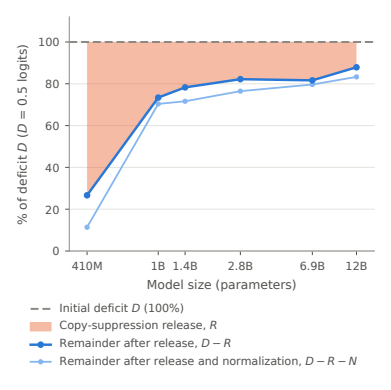
Figure 4 : Deficit remaining after copy-suppression re- lease at D= 0.5 logits, estimated by interpolation within each model’s ablation sweep. The shaded region between the initial deficit (dashed line) and the remain- der D−R (solid line) is copy-suppression release; out- put harm H also depends on the backup response and final normalization. Values are percentages ofD.
원문 · CC BY 4.0 · Gautam Gupta, Dikshant Kukreja, Unique Kumar, Avni Mittal, Deepanshu Dabas, Kshitij Sah, Erik Cambria, Rajiv Ratn Shah, Zhengkui Wang, Avinash Anand · When Bigger Becomes Brittle: Why Compression Hurts More as Language Models Scale · 원문 그림 인용 · 원본 PDF 6쪽에서 그림 영역을 추출했습니다.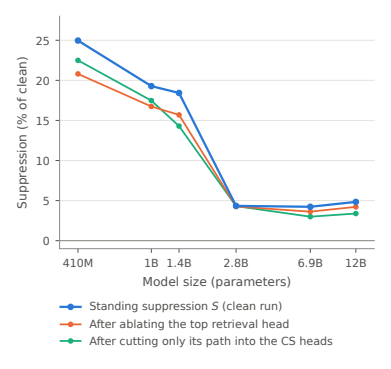
Figure 5 : Standing suppression S across scale, mea- sured on the clean run, as a percentage of each model’s clean logit difference. Less standing suppression in the larger models leaves a smaller contribution available for release after damage.
원문 · CC BY 4.0 · Gautam Gupta, Dikshant Kukreja, Unique Kumar, Avni Mittal, Deepanshu Dabas, Kshitij Sah, Erik Cambria, Rajiv Ratn Shah, Zhengkui Wang, Avinash Anand · When Bigger Becomes Brittle: Why Compression Hurts More as Language Models Scale · 원문 그림 인용 · 원본 PDF 6쪽에서 그림 영역을 추출했습니다.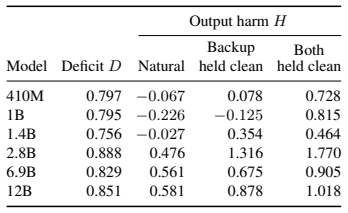
Table 1 : Output harm after retrieval-head damage with natural responses, selected backup heads held at their clean outputs, or both backup and reference copy- suppression heads held clean. Values are means in log- its; negative H indicates an answer margin above its clean value. D gives the natural-condition deficit; at 1.4B, both prevention conditions reduce it to 0.707 log- its.
원문 · CC BY 4.0 · Gautam Gupta, Dikshant Kukreja, Unique Kumar, Avni Mittal, Deepanshu Dabas, Kshitij Sah, Erik Cambria, Rajiv Ratn Shah, Zhengkui Wang, Avinash Anand · When Bigger Becomes Brittle: Why Compression Hurts More as Language Models Scale · 원문 그림 인용 · 원본 PDF 7쪽에서 그림 영역을 추출했습니다.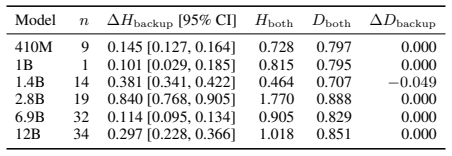
Table 3 : Natural response and the effect of response prevention at the primary ablation condition, in logits. In (a), A is the signed non-CS attention response and M is the MLP response, so the manuscript’s broader backup term is B=A+M . All entries are means. In (b), n is the number of selected backup receivers and ∆Hbackup is extra harm when their adjustment is prevented, with 95% paired template-cluster bootstrap intervals. The joint condition prevents both backup and paper-reference CS adjustment; Hboth and Dboth are its measured harm and deficit. The final column records the change in D under the backup clamp; the same drift occurs under the joint clamp. The attention response and the causal effect concern different receiver populations and measurements.
원문 · CC BY 4.0 · Gautam Gupta, Dikshant Kukreja, Unique Kumar, Avni Mittal, Deepanshu Dabas, Kshitij Sah, Erik Cambria, Rajiv Ratn Shah, Zhengkui Wang, Avinash Anand · When Bigger Becomes Brittle: Why Compression Hurts More as Language Models Scale · 원문 그림 인용 · 원본 PDF 14쪽에서 그림 영역을 추출했습니다.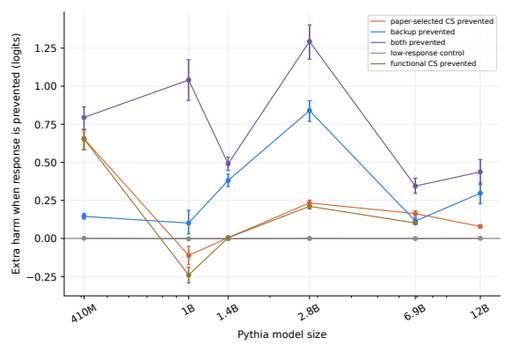
Figure 15 : Extra output harm when selected responses to retrieval-head damage are prevented. Ablations produce deficits of about 0.8 logits on 2,000 held-out prompts, as in Figure 7. Selected heads are held at their clean output at the answer position while subsequent computation remains live. Extra harm is the increase in H relative to the natural response. Backup receivers are selected to cover 90% of the positive attention response on discovery prompts; low-response heads provide a control. The functional-CS curve uses a separate head selection from the paper-reference CS set. Error bars are 95% paired template-cluster bootstrap intervals. The 1.4B backup and joint clamps also change the removed contribution by about −0.05 logits; backup receiver counts and condition-specific deficits are given in Appendix Table 3.
원문 · CC BY 4.0 · Gautam Gupta, Dikshant Kukreja, Unique Kumar, Avni Mittal, Deepanshu Dabas, Kshitij Sah, Erik Cambria, Rajiv Ratn Shah, Zhengkui Wang, Avinash Anand · When Bigger Becomes Brittle: Why Compression Hurts More as Language Models Scale · 원문 그림 인용 · 원본 PDF 18쪽에서 그림 영역을 추출했습니다.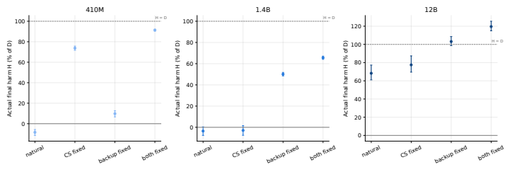
Figure 16 : Absolute output harm under natural response and response prevention at 410M, 1.4B, and 12B. Panels show the natural response, CS held clean, backup receivers held clean, and both held clean. Harm is shown as a percentage of the deficit D; the dashed line marks H=D . Natural deficits are approximately 0.80, 0.76, and 0.85 logits, respectively. At 1.4B, the backup and joint clamps reduce the measured deficit to about 0.71 logits. Error bars are 95% paired template-cluster bootstrap intervals. Table 1 gives natural, backup, and joint-condition harm across all six models.
원문 · CC BY 4.0 · Gautam Gupta, Dikshant Kukreja, Unique Kumar, Avni Mittal, Deepanshu Dabas, Kshitij Sah, Erik Cambria, Rajiv Ratn Shah, Zhengkui Wang, Avinash Anand · When Bigger Becomes Brittle: Why Compression Hurts More as Language Models Scale · 원문 그림 인용 · 원본 PDF 18쪽에서 그림 영역을 추출했습니다.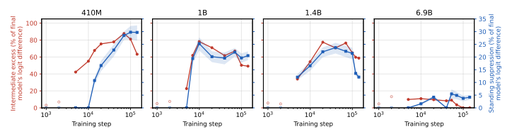
Figure 21 : Co-development of intermediate excess and standing suppression on clean runs across saved training checkpoints. Red circles, left axis: the maximum of the mean answer–distractor logit-difference trajectory minus that checkpoint’s own final-layer value, using the layer-renormalized logit lens. Blue squares, right axis: standing suppression of the copy-suppression heads identified at that checkpoint. Both quantities are percentages of the final model’s clean logit difference. Shading gives 95% paired template-cluster bootstrap intervals for suppression; the excess is a mean-curve statistic without an interval. Hollow markers indicate pairwise IOI accuracy below 0.6. Axis scales are shared across models but differ between the two quantities. Only the four models with usable intermediate checkpoint histories are shown.
원문 · CC BY 4.0 · Gautam Gupta, Dikshant Kukreja, Unique Kumar, Avni Mittal, Deepanshu Dabas, Kshitij Sah, Erik Cambria, Rajiv Ratn Shah, Zhengkui Wang, Avinash Anand · When Bigger Becomes Brittle: Why Compression Hurts More as Language Models Scale · 원문 그림 인용 · 원본 PDF 20쪽에서 그림 영역을 추출했습니다.적용 범위와 남은 질문
분석은 템플릿화된 IOI 프롬프트의 문맥 내 검색에 한정되며, 다른 능력과 모델군으로 일반화하는 것은 후속 과제입니다. 체크포인트 분석은 학습 중 개입 없이 관찰한 공동 발달을 보여 주므로 인과 관계는 확인되지 않았습니다. 2.8B와 12B의 중간 체크포인트는 출처를 확인할 수 없어 제외되었습니다. 양자화와 가지치기는 부동소수점 추론에서 모의 실험되었고 복사 억제 헤드는 보존되므로, 이 헤드들이 함께 손상될 때의 보상이나 배포 커널에서의 평가는 다루지 않습니다. 가지치기에서 unlucky 마스크의 평균 보상은 모델 크기와 함께 줄어들지만 양수를 유지하며, random 마스크의 보상은 단조로운 크기 추세를 보이지 않습니다.
4비트 양자화에서 H/D는 Pythia에서 410M의 0.55에서 12B의 0.91로 상승합니다.
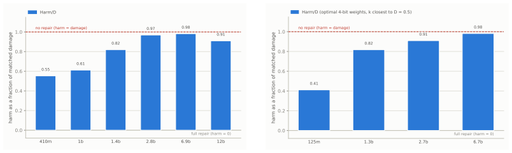
Figure 20 : Output harm as a fraction of the achieved deficit under 4-bit retrieval-head weight quantization in Pythia (left) and OPT (right). For each model, the number of quantized heads is chosen to give a deficit closest to 0.5 logits; Pythia-1.4B and 2.8B use their largest-deficit settings because they do not reach this target. Bars and labels show H/D, and the dashed line marks no net repair, H=D . The selected settings need not have identical deficits.
원문 · CC BY 4.0 · Gautam Gupta, Dikshant Kukreja, Unique Kumar, Avni Mittal, Deepanshu Dabas, Kshitij Sah, Erik Cambria, Rajiv Ratn Shah, Zhengkui Wang, Avinash Anand · When Bigger Becomes Brittle: Why Compression Hurts More as Language Models Scale · 원문 그림 인용 · 원본 PDF 20쪽에서 그림 영역을 추출했습니다.논문 정보
- 저자
- Gautam Gupta, Dikshant Kukreja, Unique Kumar, Avni Mittal, Deepanshu Dabas, Kshitij Sah, Erik Cambria, Rajiv Ratn Shah, Zhengkui Wang, Avinash Anand
- 학회·저널
- arXiv · 프리프린트
- 최초 공개일
- 2026년 11월 5일
- 등록일
- 2026년 11월 6일
- 수정일
- 2026년 11월 5일
- 버전
- v1
- arXiv
- 2611.07891
- 분류
- cs.AI
- 원문 이용 조건
- CC BY 4.0
- 제공 범위
- 논문 정보, 해설, 허용된 원문 그림
AI 해설은 논문 원문과 별개의 설명이며 오류가 있을 수 있습니다. 원문과 그림은 각 출처의 이용 조건과 따로 표시된 권리를 따릅니다.
초록
Quantization and pruning reduce the cost of deploying language models, but their effects are usually reported as benchmark scores. Such scores record only the loss that remains at the output. Inside the model, compression damages some components more than others, and the rest of the network can partly compensate. The observed loss therefore reflects both the damage and this compensation, which benchmark scores cannot separate. How the two combine, and whether their balance changes with model size, remains unclear. We study this compensation for in-context retrieval, a capability carried by a small, identifiable set of attention heads. To separate the two, the expected loss from ablating these heads is decomposed exactly into the part restored by the rest of the network, attributed to the components responsible, and the part that reaches the output. This decomposition is then compared across model sizes. For damage of comparable size, smaller models restore most of the loss, whereas larger models retain most of it, because the compensating responses offset less of it as models grow. Compressing the heads produces the same pattern. Compression that is nearly harmless in small models can therefore be costly in large ones.
원문 인용
Gautam Gupta, Dikshant Kukreja, Unique Kumar, Avni Mittal, Deepanshu Dabas, Kshitij Sah, Erik Cambria, Rajiv Ratn Shah, Zhengkui Wang, Avinash Anand (2026). When Bigger Becomes Brittle: Why Compression Hurts More as Language Models Scale. arXiv:2611.07891v1. https://arxiv.org/abs/2611.07891v1
BibTeX
@misc{gupta2026when,
  title = {{When Bigger Becomes Brittle: Why Compression Hurts More as Language Models Scale}},
  author = {Gautam Gupta and Dikshant Kukreja and Unique Kumar and Avni Mittal and Deepanshu Dabas and Kshitij Sah and Erik Cambria and Rajiv Ratn Shah and Zhengkui Wang and Avinash Anand},
  year = {2026},
  eprint = {2611.07891},
  archivePrefix = {arXiv},
  url = {https://arxiv.org/abs/2611.07891v1}
}