논문 해설
Synthesizing symbolic models of human and machine reasoning at scale
대규모에서 인간과 기계의 추론을 기호 모델로 합성하기
- 연구 문제 기호 모델을 열린 인지 과제에 확장하기 어려운 상황에서, 사람과 기계의 ARC 오류를 대규모로 설명하는 기호 모델을 자동 합성하는 문제를 다룹니다.
- 연구 방법 기준 프로그램에 LLM이 제안한 줄 단위 편집을 적용하고, 실행으로 관찰된 오답을 재현하는 프로그램만 남기는 행동 조건부 기호 합성을 사용합니다.
- 주요 결과 사람 오답의 49.1%(시도 기준)가 재현되고, 설명 프로그램은 기준 프로그램보다 짧으며 부분 설명과 attribute misselection이 두드러집니다. 추론 모델 오류도 유사한 단순화 경향을 보이지만 사람과 구분 가능한 신호가 남습니다.
기호 모델 확장의 어려움
기호 모델은 인지 과정을 해석 가능한 규칙과 프로그램으로 설명하는 강력한 틀이지만, 가설 공간을 사람이 직접 설계해야 한다는 부담이 컸습니다. 이 때문에 제한된 실험 과제에서는 가능했어도 열린 문제 영역으로 확장하기 어려웠습니다. 이 논문은 ARC처럼 가능한 변환의 공간이 사실상 무한한 과제에서 사람과 기계의 오류를 설명하는 기호 모델을 자동으로 찾는 문제를 다룹니다. 핵심 질문은 오답이 무작위 실패인지, 아니면 목표 규칙과 구조적으로 가까운 체계적 추론인지를 대규모로 확인할 수 있는가입니다.
행동 조건부 편집 기반 프로그램 탐색
Behavior-Conditioned Symbolic Synthesis는 과제의 목표 규칙을 구현한 기준 프로그램에서 출발합니다. 각 고유 오답에 대해 LLM에 domain-specific language의 전체 명세, 과제 격자, 기준 프로그램, 관찰된 오답을 제공하고, 줄 단위 편집 집합을 여러 개 제안받습니다. 각 편집을 기준 프로그램에 적용해 후보 프로그램을 만든 뒤 실행하며, 관찰된 응답을 재현한 후보만 남깁니다. 따라서 LLM은 개별 응답에 맞는 그럴듯한 편집 분포를 제안하고, 실행은 재현 여부를 엄격하게 검증하는 역할을 맡습니다. 여러 프로그램이 같은 응답을 설명할 수 있으므로 한 응답에 대해 복수의 프로그램 집합이 반환됩니다.
데이터 필터링과 기준 프로그램 준비
분석에는 Abstraction and Reasoning Corpus의 H-ARC 인간 응답을 사용합니다. 근접 정답과 사소한 복사 오류는 노이즈 허용 기준으로 제거하는데, 열 개 이상의 셀을 가진 격자에서는 정답과 두 셀 이하로 다른 응답을 근접 정답으로 봅니다. 이 기준을 거쳐 6,261개의 고유 오답이 723개 과제, 1,387명의 참가자에서 모델링 대상이 됩니다. 학습 분할의 기준 프로그램은 사람이 작성한 DSL 프로그램이며, 평가 분할의 기준 프로그램은 LLM으로 합성한 가장 짧은 유효 해법입니다. 이 차이는 이후 결과를 해석할 때 분할별로 따로 확인해야 합니다.
사람 오류의 재현률과 단순성
합성된 프로그램은 사람의 오답 가운데 상당 부분을 설명합니다. 시도 기준으로 3,636/7,402, 즉 49.1%가 재현되며 학습 분할은 52.5%, 평가 분할은 46.2%입니다. 같은 데이터에서 기준 프로그램의 한 줄 편집을 모두 나열한 완전 탐색은 3,485개 오답 시도 중 25.8%(899개)만 설명하여 BCSS의 절반 정도 수준이었습니다. 단순성은 상대 줄 수 변화로 측정합니다. 학습 분할에서 사람 오답을 설명하는 프로그램은 참조 프로그램보다 19.1% 짧았고, 정답 출력을 조건으로 한 대조군은 5.2% 짧았습니다. 두 값의 차이인 추가 단축은 13.9퍼센트포인트입니다. 평가 분할에서는 각각 24.3%와 2.7%였고 추가 단축은 21.5퍼센트포인트였습니다.
이 단축은 절차 자체의 단축 편향을 뺀 뒤에도 남는 효과로 해석됩니다.
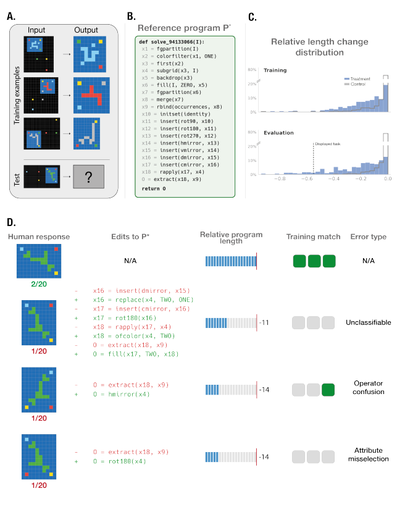
Fig. 2 Synthesized programs suggest people often infer rules simpler than the tar- get rule for a given task. (A): A representative ARC task (94133066). Three training examples demonstrate the target rule—return the contents of the framed sub-grid under whichever of its eight rotations and reflections is consistent with the isolated colored cells scattered around it—followed by the test input for which participants construct an output grid (hidden with a grey square and “?” for illustrative purposes). (B): The reference programP ∗ implementing the target rule for this task. Because this task belongs to theevaluationsplit,P ∗ is itself model-synthesized rather than human-written. (C): Distribution of relative program length change, (L(p)−L(P ∗))/L(P ∗), over all synthesized programs, shown separately for thetrainingandevaluationsplits of ARC-AGI-1. Treat- ment programs (blue) are those conditioned on incorrect human responses; control programs (grey) are produced by an identical procedure conditioned instead on the correct output grid. Because edits replace lines in-place and causally irrelevant code is subsequently removed, synthesized programs can either shorten, or remain the same, but never lengthen. Therefore, the control condition controls for the shortening bias attributable to the procedure itself, against which the leftward displacement of the treatment distribution should be read. The dashed line marks the median shortening of modeled responses for the task displayed in this figure. (D): The correct response (top row) and the three of the most frequent incorrect responses to that task, with response frequencies below each grid (green, correct; red, incorrect). For each, we show the diff withP ∗ after applying BCSS, the length of the resulting program relative toP ∗ (blue, retained lines; gray, removed lines; red rule, reference length), which training examples the program reproduces (green, reproduced), and its error category. A sin- gle edit can account for a large simplification: for example, replacing the finalextractover the eight candidate transforms by one fixed transform renders fourteen lines of the reference program inconse- quential, and they are removed. Thus, the simpler resulting program hardcodes a transform instead of exhaustively searching over possible transformations.
원문 · CC BY 4.0 · Solim LeGris, Philipp Mondorf, Jinran Jin, Akshay K. Jagadish, Brenden M. Lake, Todd M. Gureckis · Synthesizing symbolic models of human and machine reasoning at scale · 원문 그림 인용 · 원본 PDF 8쪽에서 그림 영역을 추출했습니다.부분 설명과 학습 예시 순서
오답 프로그램 가운데 22.6%는 학습 예시 중 적어도 하나를 맞히는 규칙으로 나타났습니다. 이 중 부분 일치는 20.9%이고, 모든 학습 예시를 맞히지만 시험 입력에서 틀리는 대안 규칙은 1.7%입니다. 부분 일치 프로그램이 재현하는 학습 예시의 위치를 보면 학습 분할에서는 62.5%가 처음 k개나 마지막 k개처럼 구조화된 부분집합이었고, 평가 분할에서는 48.5%였습니다. 저자들은 이 결과를 사람이 모든 증거를 확인하기 전에 충분히 좋은 규칙에서 멈추는 satisficing과 연결해 해석합니다. 이 해석은 직접 측정이 아니라 관찰된 부분 설명 패턴에 대한 가설입니다.
오류 범주의 분포
저자들은 일곱 개의 인지 범주와 unclassifiable 범주로 이루어진 오류 분류 체계를 만들고, LLM 분류기로 학습 분할의 프로그램을 분류했습니다. 가장 많은 범주는 attribute misselection으로, 수정된 인간 오답 시도의 45.2%를 차지합니다. 이 범주는 올바른 목표 매개변수를 결정하는 속성 의존성을 잘못 찾거나 더 단순한 의존성으로 대체한 경우를 가리킵니다. 부분 프로그램은 11.9%, 변환 오선택은 10.8%이며, unclassifiable은 22.3%입니다. 나머지 네 개 인지 범주는 각각 5% 미만입니다. 분류 결과는 LLM 분류기와 분류 체계의 정의에 의존하므로 범주 비율은 분류 절차의 결과로 읽어야 합니다.
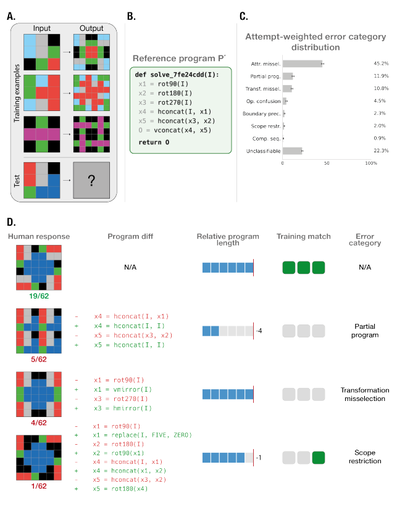
Fig. 4 Synthesized programs reveal a restricted set of recurring deviations from target rules. (A): A representative ARC task (7fe24cdd). Three training examples specify the target rule— tile the input into a 2×2 arrangement in which each quadrant holds the input rotated by a further 90◦ clockwise, starting from the input at the top left—followed by the test input for which participants construct an output grid (hidden with a gray square and “?” for illustrative purposes). (B): A human- written reference programP ∗ implementing the target rule for this task. (C): Prevalence of each error category among modeled incorrect attempts. An LLM classifier assigned every program one of seven cognitive categories, given the reference program, the task grids, the synthesized program and its execution trace (Table 1 for definitions). Bars give the posterior median of the attempt-weighted prevalence derived from a hierarchical Bayesian categorical model, and error bars the 94% HDI; the categories are mutually exclusive. Classification was performed on programs fitting responses totrainingsplit tasks only. (D): The correct response (top row) and three of the most frequent modeled incorrect responses to the task in panel A, with the response frequency below (green, correct; red, incorrect). For each, we show the diff withP ∗ after applying BCSS, the length of the resulting program relative toP ∗ (blue, retained lines; gray, removed lines; red rule, reference length), which training examples the program reproduces when executed on their inputs (green, reproduced), and its error category. The programs that reproduce these three incorrect responses diverge fromP ∗ in different ways: omitting the rotations and tiling the input four times, carrying out reflections instead of rotations, or correctly carrying out the rule on a restricted portion of the input.
원문 · CC BY 4.0 · Solim LeGris, Philipp Mondorf, Jinran Jin, Akshay K. Jagadish, Brenden M. Lake, Todd M. Gureckis · Synthesizing symbolic models of human and machine reasoning at scale · 원문 그림 인용 · 원본 PDF 13쪽에서 그림 영역을 추출했습니다.추론 모델 오류와 사람 오류의 비교
같은 절차를 Qwen3.5-27B와 GPT-OSS-120B에 적용했습니다. 두 모델의 공통 과제에서 Qwen3.5-27B는 80.63%, GPT-OSS-120B는 높음, 중간, 낮음 추론 강도에서 각각 72.28%, 50.96%, 25.02%의 정확도를 보입니다. 사람의 단일 시도 평균 정확도는 59.9%로 제시됩니다. 오류 프로그램의 단축 정도는 모델 성능과 함께 커졌고, 정확도와 단축량의 상관은 저자들이 보고한 n=5 분석에서 Pearson r=−0.80입니다. 사람과 LRM 오류를 구분하는 분류기는 과제 내 ROC-AUC 기준 0.65–0.69 수준이었으며, 판별력은 성능이 낮은 설정에서 더 뚜렷했습니다.
이는 두 집단의 오류 구조가 완전히 같지 않다는 근거이지만, 어떤 편집 신호가 원인인지는 분산된 약한 신호로 보고됩니다.
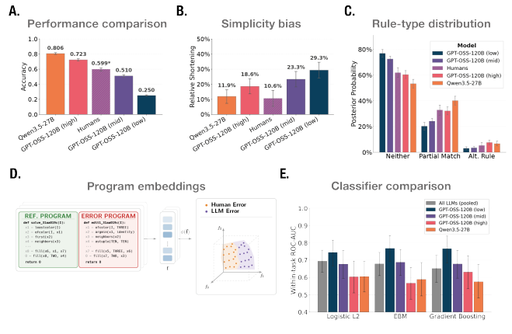
Fig. 5 Machine errors are systematic and performance-dependent.(A): Average accuracy across responses of large reasoning models at different reasoning efforts and humans on thetraining set of ARC-AGI-1. Note that GPT-OSS-120B uses a mixture-of-experts architecture and thus only has 5.1 billion active parameters during inference. (B): Relative shortening of programs synthesized from model errors compared with programs for correct-output controls; all model configurations exhibit a simplicity bias, which is stronger for lower-performing configurations. (C): The proportion of error programs that partially match or fully reproduce the support examples increases with model performance. (D) Schematic of the classification analysis distinguishing human and machine errors using features derived from synthesized error programs. (E) Within-task ROC-AUC of three fitted classifiers provides evidence of varying degrees of discriminability of human and machine errors on held-out tasks, with less performant models better discriminated from people. Classifiers are trained using linearized program-level feature vectors. ROC-AUC is computed among the errors of each of the 56 shared tasks and averaged across tasks, with error bars showing 95% task-level bootstrap CIs. PanelsBandCreport results on the subset of 56 tasks where both reasoning language models and people generated incorrect responses (see Appendix S5 for similar trends across all errors). All machine responses are independently sampled, and we restrict comparisons to human first-attempt responses.
원문 · CC BY 4.0 · Solim LeGris, Philipp Mondorf, Jinran Jin, Akshay K. Jagadish, Brenden M. Lake, Todd M. Gureckis · Synthesizing symbolic models of human and machine reasoning at scale · 원문 그림 인용 · 원본 PDF 15쪽에서 그림 영역을 추출했습니다.적용 범위와 한계
저자들은 BCSS가 비뚤어진 오류의 약 절반만 포착한다고 밝힙니다. 편집이 기존 줄을 교체하는 방식이므로, 목표 규칙을 확장하는 오류는 분석 집합에서 과소 표현될 수 있습니다. DSL은 ARC 해법을 위해 설계되었으므로 모든 연산이 인지적으로 대응하는 것은 아니며, 복잡도 대응도 일대일이 아닐 수 있습니다. 여러 프로그램이 같은 응답을 재현할 때 현재는 가중치를 두지 않았고, 분류기와 편집 제안기가 같은 계열의 LLM이라는 점도 범주 분포에 영향을 줄 수 있습니다. 또한 프로그램은 어떤 규칙이 실행되었는지를 설명할 뿐, 사람이 규칙을 찾는 과정을 직접 모델링하지 않습니다.
논문 정보
- 저자
- Solim LeGris, Philipp Mondorf, Jinran Jin, Akshay K. Jagadish, Brenden M. Lake, Todd M. Gureckis
- 학회·저널
- arXiv · 프리프린트
- 최초 공개일
- 2026년 11월 4일
- 등록일
- 2026년 11월 6일
- 수정일
- 2026년 11월 4일
- 버전
- v1
- arXiv
- 2611.07088
- 분류
- cs.AI · cs.LG
- 원문 이용 조건
- CC BY 4.0
- 제공 범위
- 논문 정보, 해설, 허용된 원문 그림
AI 해설은 논문 원문과 별개의 설명이며 오류가 있을 수 있습니다. 원문과 그림은 각 출처의 이용 조건과 따로 표시된 권리를 따릅니다.
초록
Symbolic models offer a powerful account of cognition, but their scope has historically been limited by the need for hand-engineering and computational tractability. We show how advances in artificial intelligence (AI) can scale symbolic modeling and help overcome these engineering limitations. We introduce Behavior-Conditioned Symbolic Synthesis (BCSS)---an approach for automated search of interpretable, deterministic symbolic programs that verifiably reproduce behavior---and apply it to model both human and machine behavior across hundreds of challenging reasoning problems. Analyzing these programs reveals that both people and machines tend to oversimplify, adopt rules that are partial explanations for their observations, and misinfer dependencies between problem features. These shared signatures are modulated by available resources, with reasoning effort predicting the extent to which machines simplify and explain their observations. Together, these results point to underlying mechanisms reminiscent of satisficing in both people and machines, and illustrate how BCSS offers a general approach for interpreting and comparing rule-based reasoning of humans and black-box AI systems.
원문 인용
Solim LeGris, Philipp Mondorf, Jinran Jin, Akshay K. Jagadish, Brenden M. Lake, Todd M. Gureckis (2026). Synthesizing symbolic models of human and machine reasoning at scale. arXiv:2611.07088v1. https://arxiv.org/abs/2611.07088v1
BibTeX
@misc{legris2026synthesizing,
  title = {{Synthesizing symbolic models of human and machine reasoning at scale}},
  author = {Solim LeGris and Philipp Mondorf and Jinran Jin and Akshay K. Jagadish and Brenden M. Lake and Todd M. Gureckis},
  year = {2026},
  eprint = {2611.07088},
  archivePrefix = {arXiv},
  url = {https://arxiv.org/abs/2611.07088v1}
}