논문 해설
Structured Visual Landscape: Generating Preferred Representations in Biological and Artificial Neural Networks
구조화된 시각 지형: 생물학적 및 인공 신경망에서 선호 표상 생성
- 연구 문제 뇌 영역이나 인공 유닛의 활성화를 증가 또는 감소시키는 선호 이미지를 생성하는 것이 목표입니다.
- 연구 방법 활성화 값에 따라 평균과 분산이 달라지는 사전분포를 VAE 잠재 공간에 적용하고, 편집된 잠재 코드를 고정된 확산 모델로 디코딩합니다.
- 주요 결과 NSD 실험의 FFA에서 본 방법은 FID@2k 153.70으로 BrainACTIV의 256.44보다 낮게 보고되었습니다.
연구 문제와 배경
신경망 유닛이나 뇌 영역이 어떤 시각 표현에 반응하는지 이해하는 것은 딥러닝의 해석 가능성과 뇌 과학 모두에 중요합니다. 기존 방법은 특정 영역을 강하게 활성화하는 이미지를 찾거나 뇌 활동을 직접 입력으로 받아 이미지를 복원하는 방식이 많았습니다. 그러나 뇌 활동은 잡음이 많고 해상도가 낮으며 일부만 관측되므로, 이를 직접 입력으로 쓰면 해석이 어렵습니다. 저자들은 이 문제를 줄이기 위해 뇌 활동을 복원 입력이 아니라 잠재 공간의 사전분포를 조절하는 신호로 사용하는 방향을 제안합니다. 이 연구는 활성화를 증가시키거나 감소시키는 선호 이미지를 생성하는 것을 목표로 합니다.
활성화 기반 사전분포와 잠재 공간 편집
제안 방법 Vis-Lens는 입력 이미지를 고정된 CLIP 인코더로 1024차원 CLIP 임베딩 x로 바꾼 뒤 VAE 인코더로 잠재 변수 z에 대응시킵니다. 핵심은 사전분포의 평균과 표준편차가 목표 활성화 값 r에 따라 달라진다는 점입니다. 표준편차는 |r|이 커질수록 작아지고, 평균은 r이 양수이면 양의 중심 μ_pos, 그렇지 않으면 음의 중심 μ_neg를 사용합니다. 따라서 강한 양의 활성화와 강한 음의 활성화는 서로 다른 중심 근처에 모이고, 0에 가까운 활성화는 상대적으로 느슨하게 제약됩니다. KL 항은 이 활성화 기반 사전분포에 대해 닫힌 형태로 계산되며, VAE는 재구성 손실과 이 KL 항을 함께 최소화하도록 학습됩니다.
학습 중에는 VAE만 갱신되고 CLIP 인코더와 확산 모델은 고정됩니다.
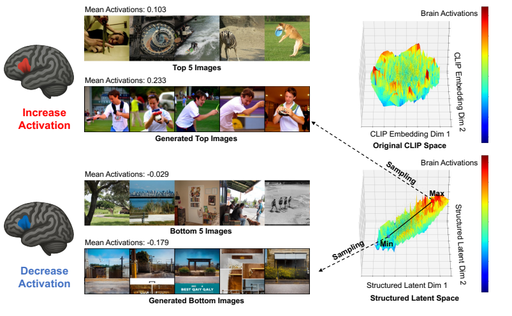
Figure 1 : Original CLIP Space (Top): Original CLIP embedding space without any activation constraint: image embeddings that elicit high and low neural responses are dispersed and not clustered throughout the space without shared visual structure. Structured Landscape (Bottom): By encoding CLIP embeddings into the regularized latent space constrained with neuronal activations (after z-score normalization) as theprior, our method Vis-Lens could provide a more structured and representative landscape to better identify the representations and preferences of brain regions than sorting top-k images in a dataset. The results are based on brain activations from the NSD dataset [ 2]. In the landscape plots, the color bar and z axis indicate the activation of the target brain region given different images as inputs, while the x and y axes represent two latent dimensions, respectively.
원문 · CC BY 4.0 · Yusong Zhao, Edgar Y. Walker, Hao Wang, Mi Lu · Structured Visual Landscape: Generating Preferred Representations in Biological and Artificial Neural Networks · 원문 그림 인용 · 원본 PDF 2쪽에서 그림 영역을 추출했습니다.잠재 코드 편집과 이미지 생성
생성 단계에서는 테스트 이미지를 같은 CLIP 인코더와 학습된 VAE 인코더에 통과시켜 잠재 코드 z를 얻습니다. 이후 z를 선택한 양 또는 음의 사전 중심 쪽으로 보간하여 z′ = α·μ_prior + (1−α)·z를 만듭니다. 이 편집된 잠재 코드는 VAE 디코더를 거쳐 중간 CLIP 임베딩으로 바뀌고, 고정된 IP-Adapter를 통해 Stable Diffusion v1.5에 전달되어 최종 선호 이미지를 생성합니다. 실험에서 SDEdit 강도는 γ=1.0으로 설정되어 출력이 편집된 임베딩에만 의존하도록 했습니다. 이 설정은 비교 실험의 특정 조건이며, 저자들은 이를 기준선과의 깨끗한 비교를 위한 설정으로 설명합니다.
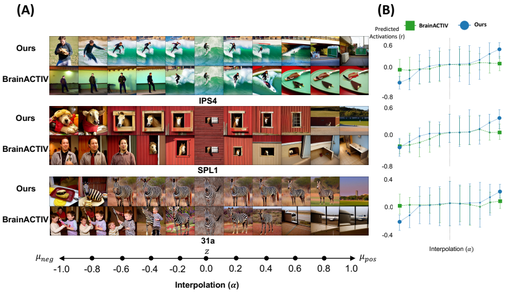
Figure 3 : Activation change results of our method and BrainACTIV [ 17] (A) Generate preferred representations of multiple ROIs with example images from COCO dataset by our method and baselines. The alpha value in interpolation indicates the strength and direction of preferred semantic in generation. (B) Comparison between predicted activations of ROIs made by DINO-ViT encoder. Means and ranges of activations are presented for different alpha settings. Our method outperforms the baseline in terms of maximizing or minimizing the ROI activations.
원문 · CC BY 4.0 · Yusong Zhao, Edgar Y. Walker, Hao Wang, Mi Lu · Structured Visual Landscape: Generating Preferred Representations in Biological and Artificial Neural Networks · 원문 그림 인용 · 원본 PDF 5쪽에서 그림 영역을 추출했습니다.NSD 뇌 영역 실험
NSD 실험에서는 피험자 1의 테스트 이미지 1000장을 사용하고, 활성화 변화는 DINO-ViT 기반 in-silico 뇌 시뮬레이터로 평가합니다. 같은 표에서 FFA의 FID@2k는 본 방법이 153.70이고 BrainACTIV가 256.44로 보고됩니다. 이 값은 낮을수록 실제 분포에 가까운 현실성을 뜻하므로 본 방법의 생성 이미지가 이 조건에서 더 현실적인 분포를 보였다고 해석할 수 있습니다. 다만 이 수치는 FFA 한 영역의 결과이며 표의 다른 영역과 모든 설정으로 일반화되지 않습니다. 저자들은 감소 방향의 활성화 변화가 BrainACTIV보다 더 잘 나타난다고 보고하지만, 이 비교는 같은 평가 프로토콜 안의 결과입니다.
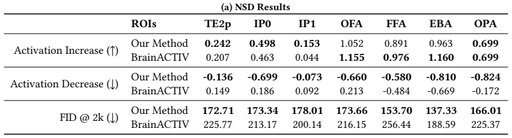
Table 1 : Comparison of activation change and realism between our method and the baseline on NSD datasets. Better values are in bold face. For activation changes,↑ indicates that higher values are better, and↓ indicates that lower values are better. Our method produces activation changes that are more consistently aligned with the intended direction.
원문 · CC BY 4.0 · Yusong Zhao, Edgar Y. Walker, Hao Wang, Mi Lu · Structured Visual Landscape: Generating Preferred Representations in Biological and Artificial Neural Networks · 원문 그림 인용 · 원본 PDF 6쪽에서 그림 영역을 추출했습니다.인공 신경망 유닛과 ImageNet-mini 실험
인공 신경망 실험에서는 SimCLR 인코더의 중간층 유닛과 ViT의 중간층 유닛을 대상으로 활성화 증가 이미지를 생성합니다. ImageNet-mini에서는 잠재 공간 편집과 함께 VAE 잠재 변수를 Adam으로 최적화하는 실험을 수행했습니다. 이때 목표 유닛에 대응하는 잠재 차원만 갱신하고 나머지 차원은 초기값으로 유지합니다. 특징 보존은 ResNet18 특징의 코사인 유사도로 측정하며, 본 방법은 표준 VAE 최적화보다 더 큰 활성화 변화와 원본과의 유사도 유지를 보였다고 보고됩니다. 이 결과는 SimCLR 유닛과 ImageNet-mini의 설정에 한정되며, 다른 인공 신경망이나 데이터셋에 대한 일반 결론은 아닙니다.
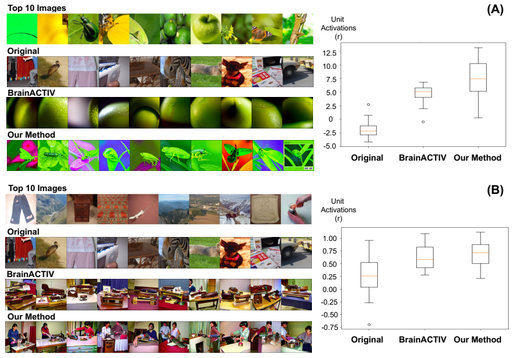
Figure 4 : Generate preferred images with increasing unit activations in ANNs. (A) The top 10 images demonstrate a notable pattern of “green plant & insect” represented by a unit in the middle layer of the SimCLR model. Our method generates images that better match this pattern and increase activation more than the BrainACTIV [ 17]. (B) For a mid-layer unit in a more complex Vision Transformer (ViT), our method synthesizes images that can better activate the unit compared with the baseline, although the underlying concept appears more ambiguous.
원문 · CC BY 4.0 · Yusong Zhao, Edgar Y. Walker, Hao Wang, Mi Lu · Structured Visual Landscape: Generating Preferred Representations in Biological and Artificial Neural Networks · 원문 그림 인용 · 원본 PDF 7쪽에서 그림 영역을 추출했습니다.한계와 적용 범위
이 연구의 평가는 in-silico 뇌 시뮬레이터에 기반하며 실제 임상 중재나 의료적 개입으로 검증되지 않았습니다. 억제 방향의 활성화 조절은 임상적으로 의미가 있을 수 있다는 선행 연구를 인용하지만, 이는 본 연구가 증명한 효과가 아니라 관련 가능성으로 제시된 배경입니다. 또한 CLIP 인코더와 이미지 생성기가 고정되어 있으므로 pre-training 데이터의 편향이 생성된 선호 이미지에 전파될 수 있습니다. 향후에는 EEG나 MEG 같은 다른 모달리티와 인간 실험을 통한 폐쇄 루프 검증이 필요하다고 저자들은 밝힙니다.
논문 정보
- 저자
- Yusong Zhao, Edgar Y. Walker, Hao Wang, Mi Lu
- 학회·저널
- arXiv · 프리프린트
- 최초 공개일
- 2026년 11월 2일
- 등록일
- 2026년 11월 6일
- 수정일
- 2026년 11월 2일
- 버전
- v1
- arXiv
- 2611.03597
- 분류
- cs.CV · cs.LG · cs.NE
- 원문 이용 조건
- CC BY 4.0
- 제공 범위
- 논문 정보, 해설, 허용된 원문 그림
AI 해설은 논문 원문과 별개의 설명이며 오류가 있을 수 있습니다. 원문과 그림은 각 출처의 이용 조건과 따로 표시된 권리를 따릅니다.
초록
Understanding how neurons respond to visual stimulus is an important question in both deep learning and neuroscience. It has significant implications for enhancing the interpretability of black-box artificial neural networks and for understanding the visual representation in the human brain. We propose a structured visual representations landscape and design an activation-based prior that allows us to effectively regularize the landscape with activations from brain regions or neural network units. Our model Vis-Lens integrates a variational autoencoder and a diffusion model into an image generation framework. It enables the generation of natural, realistic preferred images by directly modifying the activation-regularized latent codes without per-image iterative optimization. We demonstrate the effectiveness of our framework on both artificial neural networks and human visual cortex using functional magnetic resonance imaging (fMRI) data. Our framework improves activation modulation and image realism compared with a recent state-of-the-art method for generating preferred visual representations of these neural targets.
원문 인용
Yusong Zhao, Edgar Y. Walker, Hao Wang, Mi Lu (2026). Structured Visual Landscape: Generating Preferred Representations in Biological and Artificial Neural Networks. arXiv:2611.03597v1. https://arxiv.org/abs/2611.03597v1
BibTeX
@misc{zhao2026structured,
  title = {{Structured Visual Landscape: Generating Preferred Representations in Biological and Artificial Neural Networks}},
  author = {Yusong Zhao and Edgar Y. Walker and Hao Wang and Mi Lu},
  year = {2026},
  eprint = {2611.03597},
  archivePrefix = {arXiv},
  url = {https://arxiv.org/abs/2611.03597v1}
}