논문 해설
Situationally-Aware Dynamics Learning
상황 인식 동역학 학습
- 연구 문제 관측되지 않는 잠재 요인이 로봇의 전이 동역학을 바꿀 때, 고유감각 정보만으로 이를 온라인·비지도 방식으로 표현하고 계획에 활용할 수 있는지를 다룹니다.
- 연구 방법 결합 전이 분포를 다변량 BOCD로 온라인 모델링하여 상황을 식별하고, 그 로그 적률생성함수 값을 기호로 바꿔 확률적 앙상블 동역학 모델과 MPPI 계획에 입력합니다.
- 주요 결과 UGV 실험에서 상황 인식 모델은 Inspection World 학습 과제에서 기준선보다 빠르게 높은 보상에 도달했고, 실제 지형 10회 시도에서 모든 시도를 완료했습니다. 쿼드로터 풍향 변화 과제에서는 SA-PETS가 PETS보다 100k와 5M 전이 모두에서 더 높은 평균 보상을 얻었습니다.
관측되지 않는 요인과 동역학 모델의 한계
무인 지상 로봇이 울퉁불퉁하거나 미끄러운 지형을 지날 때, 지형 종류·마찰·바퀴 마모처럼 센서로 직접 측정하지 않는 요인이 같은 명령에도 서로 다른 결과를 만듭니다. 논문은 같은 상태에서 같은 행동을 해도 결과가 크게 달라지는 현상을 aleatoric 잡음만으로 설명하기 어렵다고 보고, 이를 관측되지 않은 잠재 요인이 전이 동역학에 미치는 영향으로 봅니다. 따라서 문제는 로봇이 부분적인 상태 정보만으로도 이런 잠재 요인을 온라인으로 추론하고 동역학 모델과 계획에 반영할 수 있는지입니다.
기존 접근은 보조 표현을 학습하는 경우가 많았지만, 특권 정보나 다단계 학습이 필요하거나 시뮬레이션에서만 얻을 수 있는 정보에 의존하는 한계가 있다고 논문은 설명합니다. 이 논문은 고유감각 정보만으로 잠재 상황 표현을 온라인·비지도 방식으로 학습하는 것을 목표로 하며, 그 효과를 UGV 지형 주행과 바람이 변하는 쿼드로터 과제에서 검증합니다.
결합 전이 분포를 상황으로 보는 방법
제안 방법은 상태, 명령 행동, 다음 상태를 이어 붙인 결합 전이 벡터 x_t=[s_{t-1};a_{t-1};s_t]의 분포를 로봇의 현재 상황으로 봅니다. 각 국소 구간의 전이 동역학은 평균 µ와 정밀도 행렬 Λ를 가진 다변량 정규분포로 근사되며, 이 분포의 모수를 다변량 BOCD로 온라인에서 추정합니다. Normal-Wishart 사전분포를 사용하면 평균과 정밀도 행렬의 사후 갱신이 닫힌 형태로 계산되어 실시간 처리가 가능해집니다.
변화점이 탐지되면 새 구간의 모수가 상황 라이브러리에 추가되며, 테스트 단계에서는 라이브러리를 고정하고 현재 구간과 평균 마할라노비스 거리가 가장 가까운 상황을 선택합니다. 각 상황은 적률생성함수의 로그 값 Θ_t(ψ)=t^T µ_ψ + ½ t^T Λ_ψ^{-1} t로 하나의 기호 θ로 바뀌고, 이 기호가 동역학 모델의 입력에 추가됩니다. 원문은 t를 0.1로 고정한다고 설명합니다.
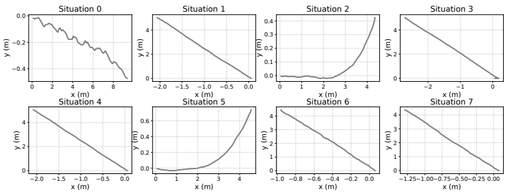
Figure 12 .Predicted dynamics for the same action across different situations. The hidden state effectively captures both subtle and significant variations in the robot’s dynamics, providing critical information that can be leveraged during decision-making to enhance performance.
원문 · CC BY 4.0 · Alejandro Murillo-Gonzalez, Lantao Liu · Situationally-Aware Dynamics Learning · 원문 그림 인용 · 원본 PDF 19쪽에서 그림 영역을 추출했습니다.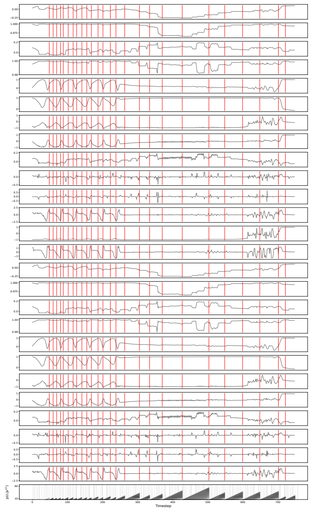
Figure 24 .Observations received by the proposed situation identification algorithm during a mission in the Inspection World. The red vertical lines mark the time when we predict a situation change happened. The last row shows the run length probabilities indicating how likely it is that the robot stayed in the same situation (run length grows) or a situation change happened (run length becomes zero).
원문 · CC BY 4.0 · Alejandro Murillo-Gonzalez, Lantao Liu · Situationally-Aware Dynamics Learning · 원문 그림 인용 · 원본 PDF 34쪽에서 그림 영역을 추출했습니다.동역학 모델은 확률적 가우시안 신경망 앙상블이며, 학습 손실은 상황 빈도의 역수로 가중한 음의 로그우도입니다. 드문 상황이 학습에서 충분히 반영되도록 하려는 설계입니다.
UGV 학습 효율과 지형 주행 검증
UGV 실험에서 Inspection World의 희소 웨이포인트 과제를 사용했습니다. 이 과제에서 상황 인식 모델(Ours)은 CaDM, PE+LSTM, TD-MPC2, CDL-CMI, PETS 및 모델 프리 RL 기준선보다 빠르게 높은 보상에 도달했고, 50 에피소드 안에 과제를 완료한 유일한 방법으로 보고됩니다. 각 실험은 다섯 번 반복되었으며, 에피소드는 웨이포인트 도달까지 90초를 넘으면 종료됩니다.
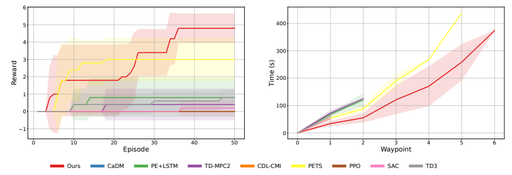
Figure 7 .Dynamics Learning Results. Our model achieves a high reward faster and is able to complete its tasks in a shorter time frame.(Left)Training task reward. We compare against model-based and model-free RL methods.(Right)Mean±standard deviation of the time that it takes the robot to reach the waypoints in the task. Each experiment was repeated five times.
원문 · CC BY 4.0 · Alejandro Murillo-Gonzalez, Lantao Liu · Situationally-Aware Dynamics Learning · 원문 그림 인용 · 원본 PDF 17쪽에서 그림 영역을 추출했습니다.실제 지형 실험에서는 Clearpath Jackal에 Velodyne 16 LiDAR와 IMU를 장착했고, 여러 지형 조합 과제에서 10회 시도한 결과를 비교했습니다. 저자들은 상황 인식 모델이 모든 시도에서 과제를 완료했다고 보고하며, 완료 시간은 성공한 시도 중 최고 기준선인 Dubins보다 길었다고 밝힙니다. 원문은 이 증가를 상황 전환에 따른 느린 신중한 행동과 연결합니다.
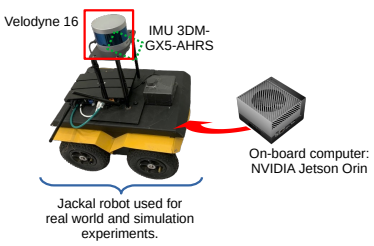
Figure 4 .Hardware setup used during real world experiments.
원문 · CC BY 4.0 · Alejandro Murillo-Gonzalez, Lantao Liu · Situationally-Aware Dynamics Learning · 원문 그림 인용 · 원본 PDF 13쪽에서 그림 영역을 추출했습니다.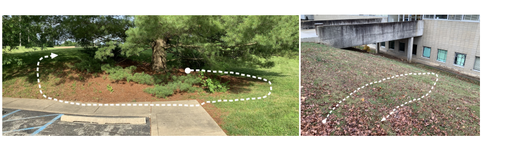
Figure 5 .Somereal-world scenarios used to evaluate and compare the proposed dynamics model against the competitive baselines.(Left)Navigation across diverse terrain types, including mulch, grass, concrete, and mud, each with distinct surface properties and geometries. The final section involves a short but steep climb on mulch and grass, which presents a significant challenge due to reduced traction.(Right)Traversing a highly demanding terrain with steep ascents and descents, compounded by numerous hidden bumps and irregularities. These features make the environment difficult to navigate safely and efficiently. Notably, our method is the only one capable of successfully completing this scenario.
원문 · CC BY 4.0 · Alejandro Murillo-Gonzalez, Lantao Liu · Situationally-Aware Dynamics Learning · 원문 그림 인용 · 원본 PDF 15쪽에서 그림 영역을 추출했습니다.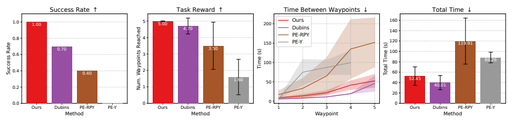
Figure 16 .Results from the UGV experiments in the real world. We repeat the experiments ten times with each baseline and report the success rate, number of waypoints reached, the cumulative time between successive waypoints and the total time to complete the task.
원문 · CC BY 4.0 · Alejandro Murillo-Gonzalez, Lantao Liu · Situationally-Aware Dynamics Learning · 원문 그림 인용 · 원본 PDF 21쪽에서 그림 영역을 추출했습니다.시뮬레이션 무작위 지형 네 환경에서는 난이도별 50개 초기·목표 위치를 평가했고, 성공률이 가장 높았지만 일부 경로 매끄러움 지표는 상황 전환으로 재계획되며 소폭 악화되었습니다.
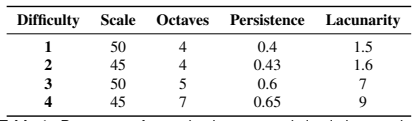
Table 1 .Parameters for randomly generated simulation terrains with increasing levels of difficulty.Scaleadjusts slope steepness, with larger values producing smoother hills.Octaves define terrain detail, whilepersistenceaffects roughness by reducing octave amplitude.Lacunaritycontrols octave frequency, with higher values adding ruggedness.
원문 · CC BY 4.0 · Alejandro Murillo-Gonzalez, Lantao Liu · Situationally-Aware Dynamics Learning · 원문 그림 인용 · 원본 PDF 14쪽에서 그림 영역을 추출했습니다.쿼드로터 풍향 변화 과제에서 SA-PETS와 PETS 비교
쿼드로터 실험에서는 PyFlyt 게이트 통과 과제의 풍향을 무작위로 바꾸었습니다. 풍향 조건은 세 환경으로 나뉘며, 바람 유형과 전환 간격이 환경마다 다릅니다. 에이전트는 풍향 변화 시점과 종류를 알 수 없고 고유감각에만 의존해야 합니다.
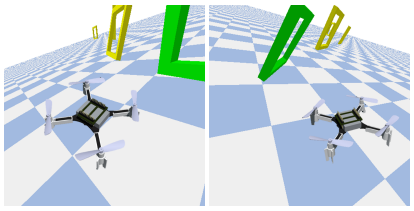
Figure 18 .Crazyflie simulated in PyFlyt’s gates environment with changing wind conditions. The next target gate is colored green and the remaining targets yellow.
원문 · CC BY 4.0 · Alejandro Murillo-Gonzalez, Lantao Liu · Situationally-Aware Dynamics Learning · 원문 그림 인용 · 원본 PDF 21쪽에서 그림 영역을 추출했습니다.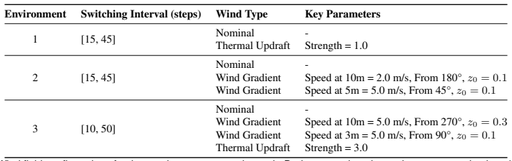
Table 4 .Wind field configurations for the quadrotor gate-crossing task. During execution, the environments randomly switch between their available wind types without revealing this information to the agent. The agent has to rely on its proprioception to detect and characterize this conditions and adapt accordingly.
원문 · CC BY 4.0 · Alejandro Murillo-Gonzalez, Lantao Liu · Situationally-Aware Dynamics Learning · 원문 그림 인용 · 원본 PDF 22쪽에서 그림 영역을 추출했습니다.비교 대상은 PETS와 SA-PETS입니다. SA-PETS는 PETS와 동일한 다섯 개 확률적 MLP 앙상블 구조를 쓰되 입력에 상황 기호를 추가한 모델입니다. 학습은 100k와 5M 상태 전이 데이터에서 진행되었고, 10개 에피소드 보상으로 비교했습니다.
100k 전이에서 SA-PETS는 전체 평균 기준 34.2% 높은 성능을 보였으며, 5M 전이에서는 43.6% 높았습니다. 환경 2에서는 개선율이 0.5%에서 197.0%로 커졌습니다. 저자들은 더 많은 데이터가 잠재 요인을 섞어 PETS의 성능을 떨어뜨렸다고 해석하며, 이 해석은 원문의 가설로 제시됩니다.
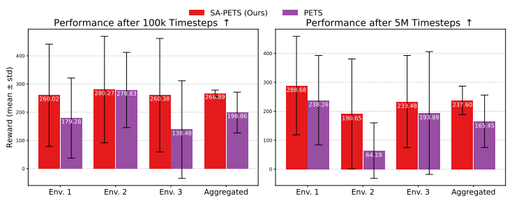
Figure 19 .Quadrotor performance on three environments with different randomly changing wind fields. Shown are task rewards across ten episodes after training on 100k (left) and 5M (right) state transitions; higher reward indicates greater robustness.
원문 · CC BY 4.0 · Alejandro Murillo-Gonzalez, Lantao Liu · Situationally-Aware Dynamics Learning · 원문 그림 인용 · 원본 PDF 23쪽에서 그림 영역을 추출했습니다.분포 밖 동역학과 적용 범위
논문은 학습한 상황의 지지 집합 밖에 있는 동역학에서는 성능이 저하될 수 있다고 명시합니다. 예를 들어 강체 접촉에서 변형 접촉으로 바뀌는 현상이나 학습 때 보지 못한 액추에이터 열화가 여기에 해당합니다. 새 환경에서는 관측된 전이가 가장 가까운 상황에 배정되며, 이 배정이 실제 동역학과 맞지 않으면 예측 오차가 남을 수 있습니다.
상황 식별에는 변화점 사전확률과 새 상황을 만들기 위한 최소 지지 샘플 수가 있으며, 이 설정은 탐지 지연과 잡음에 대한 민감도 사이의 절충입니다. 또한 UGV 시뮬레이션에서는 상황 전환에 따른 재계획이 경로 매끄러움을 소폭 낮췄습니다. 저자들은 외부 지각을 변화점 사전확률에 반영하는 방향을 향후 과제로 제시하지만, 이는 이 논문에서 검증한 결과가 아닙니다.
논문 정보
- 저자
- Alejandro Murillo-Gonzalez, Lantao Liu
- 학회·저널
- arXiv · 프리프린트
- 최초 공개일
- 2025년 5월 26일
- 등록일
- 2026년 11월 6일
- 수정일
- 2026년 4월 1일
- 버전
- v3
- arXiv
- 2505.19574
- DOI
- 10.1177/02783649261431863
- 분류
- cs.RO · cs.AI · cs.LG · math.OC
- 원문 이용 조건
- CC BY 4.0
- 제공 범위
- 논문 정보, 해설, 허용된 원문 그림
AI 해설은 논문 원문과 별개의 설명이며 오류가 있을 수 있습니다. 원문과 그림은 각 출처의 이용 조건과 따로 표시된 권리를 따릅니다.
초록
Autonomous robots operating in complex, unstructured environments face significant challenges due to latent, unobserved factors that obscure their understanding of both their internal state and the external world. Addressing this challenge would enable robots to develop a more profound grasp of their operational context. To tackle this, we propose a novel framework for online learning of hidden state representations, with which the robots can adapt in real-time to uncertain and dynamic conditions that would otherwise be ambiguous and result in suboptimal or erroneous behaviors. Our approach is formalized as a Generalized Hidden Parameter Markov Decision Process, which explicitly models the influence of unobserved parameters on both transition dynamics and reward structures. Our core innovation lies in learning online the joint distribution of state transitions, which serves as an expressive representation of latent ego- and environmental-factors. This probabilistic approach supports the identification and adaptation to different operational situations, improving robustness and safety. Through a multivariate extension of Bayesian Online Changepoint Detection, our method segments changes in the underlying data generating process governing the robot's dynamics. The robot's transition model is then informed with a symbolic representation of the current situation derived from the joint distribution of latest state transitions, enabling adaptive and context-aware decision-making. To showcase the real-world effectiveness, we validate our approach in the challenging task of unstructured terrain navigation, where unmodeled and unmeasured terrain characteristics can significantly impact the robot's motion. Extensive experiments in both simulation and real world reveal significant improvements in data efficiency, policy performance, and the emergence of safer, adaptive navigation strategies.
원문 인용
Alejandro Murillo-Gonzalez, Lantao Liu (2025). Situationally-Aware Dynamics Learning. arXiv:2505.19574v3. https://doi.org/10.1177/02783649261431863
BibTeX
@article{murillogonzalez2025situationally,
  title = {{Situationally-Aware Dynamics Learning}},
  author = {Alejandro Murillo-Gonzalez and Lantao Liu},
  year = {2025},
  eprint = {2505.19574},
  archivePrefix = {arXiv},
  doi = {10.1177/02783649261431863},
  url = {https://arxiv.org/abs/2505.19574v3}
}