논문 해설
ArtistMus: A Globally Diverse, Artist-Centric Benchmark for Retrieval-Augmented Music Question Answering
ArtistMus: 검색 증강 음악 질의응답을 위한 전 세계적으로 다양한 아티스트 중심 벤치마크
- 연구 문제 음악 아티스트 질문에서 LLM은 파라미터에 저장된 지식이 희박해 사실을 환각하기 쉬우며, 이 논문은 음악 특화 검색 자원과 객관식 벤치마크로 RAG의 효과를 검증합니다.
- 연구 방법 MusWikiDB 벡터 데이터베이스에서 BM25로 passage를 검색해 입력에 넣는 RAG와 BGE reranker 재정렬, 검색 passage를 포함한 RAG-style fine-tuning을 비교합니다.
- 주요 결과 RAG와 재정렬은 오픈소스 모델의 사실 정확도를 크게 높이며, 검색 근거를 포함한 학습은 맥락 정확도를 93.0%까지 끌어올립니다.
음악 질문응답에서 파라미터 지식의 한계
음악 관련 질문, 특히 아티스트의 경력·디스코그래피·협업처럼 세부 사실을 묻는 질문에서 LLM은 pre-training 데이터의 음악 지식이 희박해 사실을 환각하거나 일반적인 답을 내놓기 쉽습니다. 이 논문은 모델 파라미터에 저장된 지식에 기대는 대신, 외부 지식 베이스에서 passage를 검색해 답의 근거로 삼는 RAG가 음악 질문응답(MQA)에서 얼마나 효과적인지 묻습니다. 저자들은 기존 음악 벤치마크가 음악 이론이나 멀티모달 이해에 치우쳐 있어 아티스트 중심 지식을 평가하는 자원이 부족하다고 지적합니다. 이에 따라 이 연구는 음악 특화 검색 데이터베이스 MusWikiDB와 아티스트 중심 객관식 벤치마크 ArtistMus를 함께 제시하고, 같은 자원 위에서 검색 증강과 검색 기반 fine-tuning이 사실 회상과 맥락 추론에 주는 영향을 비교합니다.
MusWikiDB와 ArtistMus의 구축 방식
MusWikiDB는 음악 관련 Wikipedia 페이지를 artists, genres, instruments, history, technology, theory, forms의 일곱 범주에서 수집해 구축됩니다. 시작점 루트 페이지 7개에서 하이퍼링크를 따라 깊이 3까지 확장하고, 섹션 단위로 나눈 뒤 60 tokens보다 짧은 섹션은 제거합니다. 이후 텍스트를 최대 256 tokens의 passage로 나누며 인접 passage 사이에 10% 겹침을 둬 문맥 연속성을 유지합니다. 그 결과는 144K 페이지와 3.2M passages입니다. ArtistMus는 MusWikiDB_raw에서 genre와 debut year 정보를 가진 아티스트를 고르고, 섹션 주제 빈도 상위 다섯 개를 활용해 500명을 선정합니다.
국가는 inverse frequency 전략으로 대표성이 낮은 지역을 우선해 163개 국가 또는 지역을 포함하도록 구성됩니다. GPT-4o가 섹션 텍스트를 바탕으로 아티스트당 사실 질문 하나와 맥락 질문 하나를 만들고, 음악 관련성과 Faithfulness 검증, 사람 검증을 거쳐 최종 1,000문항을 얻습니다. 정답 위치는 선택지마다 250개씩 되도록 조정됩니다.
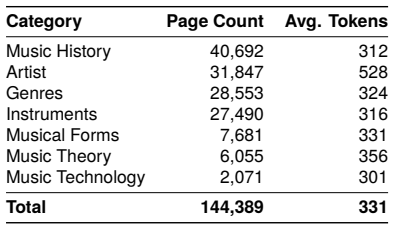
Table2 : NumberofuniqueWikipediapagesandav- erage token count per category in MusWikiDB_raw.
원문 · CC BY 4.0 · Daeyong Kwon, SeungHeon Doh, Juhan Nam · ArtistMus: A Globally Diverse, Artist-Centric Benchmark for Retrieval-Augmented Music Question Answering · 원문 그림 인용 · 원본 PDF 4쪽에서 그림 영역을 추출했습니다.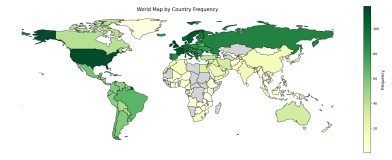
Figure 2 : Regional distribution of the 500 music artists in ArtistMus, spanning 163 countries (or re- gions) to ensure global diversity beyond the tradi- tional U.S.- and Europe-centric focus.
원문 · CC BY 4.0 · Daeyong Kwon, SeungHeon Doh, Juhan Nam · ArtistMus: A Globally Diverse, Artist-Centric Benchmark for Retrieval-Augmented Music Question Answering · 원문 그림 인용 · 원본 PDF 5쪽에서 그림 영역을 추출했습니다.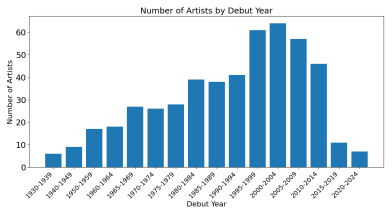
Figure 3 : Debut years of the 500 music artists in ArtistMus.
원문 · CC BY 4.0 · Daeyong Kwon, SeungHeon Doh, Juhan Nam · ArtistMus: A Globally Diverse, Artist-Centric Benchmark for Retrieval-Augmented Music Question Answering · 원문 그림 인용 · 원본 PDF 5쪽에서 그림 영역을 추출했습니다.Zero-shot, RAG, Rerank와 학습 방식의 실제 동작
추론 설정은 세 가지입니다. Zero-shot은 질문만 모델에 입력합니다. RAG는 BM25로 MusWikiDB에서 1단계 검색한 256 tokens passage 가운데 top-4를 입력에 넣습니다. Rerank는 같은 BM25 검색 결과를 BGE reranker로 2단계 재정렬해 가장 관련성이 높은 passage를 선택한 뒤 답을 생성합니다. 학습 쪽 비교는 Llama 3.1 8B Instruct를 고정 기반 모델로 두고 수행됩니다. QA fine-tuning은 MusWikiDB에서 만든 8K 객관식 QA 쌍으로 학습하고, RAG-style fine-tuning은 검색된 passage를 포함한 8K (context, question, answer) 삼중항으로 학습합니다.
두 방식 모두 LoRA와 8-bit 양자화를 사용해 1 epoch 학습합니다. RAG-style fine-tuning은 학습 단계에서 외부 passage를 함께 보여 주어 모델이 근거를 활용하도록 가르치는 방식이며, 추론 시에는 같은 passage를 검색해 입력에 넣는 것이 전제가 됩니다.
주 실험과 외부 도메인 결과
주 실험은 ArtistMus의 사실 질문 500문항과 맥락 질문 500문항에서 Zero-shot, RAG, Rerank의 정확도를 비교합니다. 모든 평가는 temperature 0의 결정적 설정에서 수행되었습니다. Zero-shot에서 GPT-4o는 사실 67.4%, 맥락 93.0%입니다. RAG는 오픈소스 모델의 사실 정확도를 크게 끌어올렸습니다. 본문은 Llama 3.1 3B가 39.0%에서 85.4%로 +46.4 pp 오른다고 적지만, Table 4에서 39.0과 85.4는 Llama 3 8B 행에 표시되어 있어 모델 표기가 원문 안에서 일치하지 않습니다. 같은 표에서 Llama 3 3B의 zero-shot 사실 정확도는 35.4%, RAG는 82.8%입니다.
Qwen3 8B는 zero-shot 사실 정확도 35.0%에서 Rerank 91.8%로 올라 abstract가 보고한 최대 +56.8 pp 향상의 한 사례입니다. 맥락 질문에서는 개선 폭이 작았으며, 저자들은 사실 근거가 주어지면 모델 자체의 추론 능력이 이미 충분하다고 해석합니다. ChatMusician은 지시 따르기 실패가 많아 약 26% 수준에 머물렀습니다. 외부 도메인 TrustMus에서는 Llama 3.1 1B가 정확도 25.0%에서 RAG로 36.0%, Rerank로 38.0%가 되어 MusWikiDB 검색의 이점이 다른 지식원 벤치마크에도 일부 이어짐을 보여 줍니다.
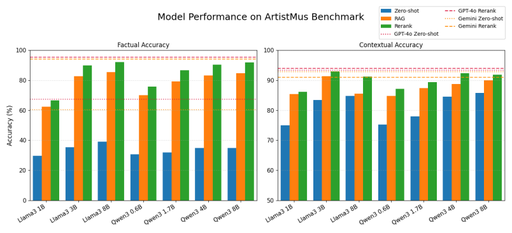
Figure1 : Performancecomparisonofopen-sourceLLMsontheArtistMusbenchmarkunderthreesettings (Zero-shot, RAG, and Rerank). The dashed lines denote closed-source models (GPT-4o and Gemini 2.5 Flash) evaluated in the same conditions. The Rerank strategy consistently yields the highest factual and contextual accuracy across all open models, narrowing the gap with proprietary systems.
원문 · CC BY 4.0 · Daeyong Kwon, SeungHeon Doh, Juhan Nam · ArtistMus: A Globally Diverse, Artist-Centric Benchmark for Retrieval-Augmented Music Question Answering · 원문 그림 인용 · 원본 PDF 2쪽에서 그림 영역을 추출했습니다.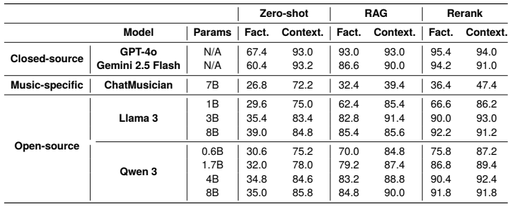
Table 4 : Performance on the ArtistMus benchmark across models and retrieval strategies. RAG uses BM25-based retrieval (top-4 passages, 256 tokens). Rerank applies BGE reranker to refine passage selection. Factual questions (Fact.) test entity recall (e.g., names, dates); contextual questions (Context.) require reasoning over narrative information. All results are accuracy (%) on 500 questions per type.
원문 · CC BY 4.0 · Daeyong Kwon, SeungHeon Doh, Juhan Nam · ArtistMus: A Globally Diverse, Artist-Centric Benchmark for Retrieval-Augmented Music Question Answering · 원문 그림 인용 · 원본 PDF 7쪽에서 그림 영역을 추출했습니다.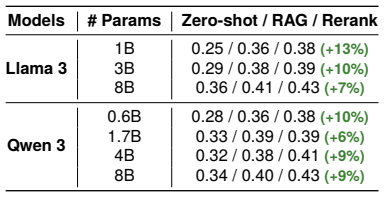
Table 5 : Performance on the TrustMus benchmark. In this setting, RAG corresponds to first-stage re- trievalbasedonBM25,whereasRerankrepresents two-stage retrieval employing the BGE reranker.
원문 · CC BY 4.0 · Daeyong Kwon, SeungHeon Doh, Juhan Nam · ArtistMus: A Globally Diverse, Artist-Centric Benchmark for Retrieval-Augmented Music Question Answering · 원문 그림 인용 · 원본 PDF 7쪽에서 그림 영역을 추출했습니다.학습 전략 비교의 결과
학습 전략 비교는 Llama 3.1 8B Instruct 하나를 기반으로 수행되었습니다. Zero-shot 기준은 사실 39.0%, 맥락 84.8%, 평균 61.9%입니다. QA fine-tuning은 사실 정확도를 40.8%로 약간 올렸지만 맥락 정확도가 75.6%로 떨어져 평균이 58.2%가 됩니다. 저자들은 이를 QA fine-tuning이 학습 데이터 암기를 늘리면서 일반 추론을 해쳤다고 해석합니다. RAG-style fine-tuning은 맥락 정확도를 93.0%로 끌어올리고 사실 정확도 86.8%를 유지합니다. 같은 모델에 RAG 추론만 적용하면 평균 85.5이고, RAG-style fine-tuning만 적용하면 평균 89.9입니다.
재정렬을 함께 쓴 RAG-style fine-tuning은 사실 92.2%, 맥락 94.0%, 평균 93.1%로 이 표에서 가장 높습니다. 따라서 학습 단계의 검색 근거 활용과 추론 단계의 재정렬이 각각 기여하는 방향을 함께 읽어야 합니다.
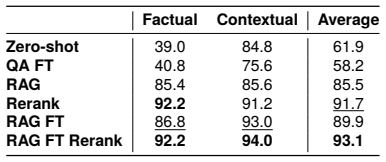
Table 6 : Ablation study. QA FT refers to the zero- shotperformanceoftheQAfine-tunedmodel, RAG and Rerank are taken from the main experiment, and RAG FT and RAG FT Rerank correspond to the performance of the RAG-style fine-tuned model with RAG and reranker applied. The best result is highlighted inbold, while the second best is underlined.
원문 · CC BY 4.0 · Daeyong Kwon, SeungHeon Doh, Juhan Nam · ArtistMus: A Globally Diverse, Artist-Centric Benchmark for Retrieval-Augmented Music Question Answering · 원문 그림 인용 · 원본 PDF 7쪽에서 그림 영역을 추출했습니다.검색기 구성과 MusWikiDB의 검색 효율
검색기 구성 실험은 Llama 3.1 8B Instruct에서 passage 크기 128, 256, 512 tokens와 BM25 또는 Contriever를 비교합니다. 총 토큰 예산은 1024로 고정되어 128 tokens에서는 top-8, 256 tokens에서는 top-4, 512 tokens에서는 top-2를 검색합니다. BM25와 BGE reranker를 결합하고 256 tokens passage를 쓴 설정이 사실 92.2%, 맥락 91.2%로 가장 좋은 결과입니다. Contriever는 passage가 길어질수록 사실 정확도가 떨어져 512 tokens에서 54.6%입니다. 한편 MusWikiDB는 Wikipedia Corpus와 비교해 검색 정확도가 +6.0 pp 높고 검색 속도는 40% 빠르다고 보고됩니다.
이 비교는 Figure 4의 RAG 성능과 검색 시간 비교에 근거하며, MusWikiDB는 0.14M 페이지와 3.2M passages, Wikipedia Corpus는 3.2M 페이지와 21M passages로 구성되어 규모가 다릅니다.
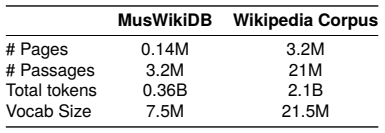
Table 3 : MusWikiDB and Wikipedia Cor- pus (Karpukhin et al., 2020) statistics.
원문 · CC BY 4.0 · Daeyong Kwon, SeungHeon Doh, Juhan Nam · ArtistMus: A Globally Diverse, Artist-Centric Benchmark for Retrieval-Augmented Music Question Answering · 원문 그림 인용 · 원본 PDF 4쪽에서 그림 영역을 추출했습니다.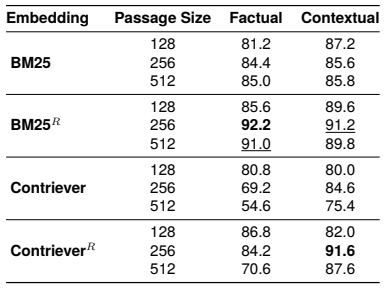
Table 7 : Llama 3.1 8B Instruct (Grattafiori et al., 2024) RAG performance on ArtistMus, by different passage size and embeddings.R indicates the use of a reranker. The best result is highlighted inbold, while the second best is underlined.
원문 · CC BY 4.0 · Daeyong Kwon, SeungHeon Doh, Juhan Nam · ArtistMus: A Globally Diverse, Artist-Centric Benchmark for Retrieval-Augmented Music Question Answering · 원문 그림 인용 · 원본 PDF 8쪽에서 그림 영역을 추출했습니다.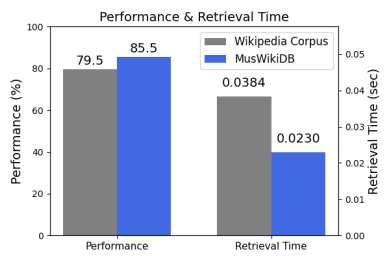
Figure 4 : RAG performance and retrieval time for Wikipedia Corpus (Karpukhin et al., 2020) and MusWikiDB.
원문 · CC BY 4.0 · Daeyong Kwon, SeungHeon Doh, Juhan Nam · ArtistMus: A Globally Diverse, Artist-Centric Benchmark for Retrieval-Augmented Music Question Answering · 원문 그림 인용 · 원본 PDF 8쪽에서 그림 영역을 추출했습니다.적용 범위와 한계
ArtistMus는 객관식 형식이므로 개방형 설명, 아티스트 간 비교, 다단계 추론은 평가하지 못합니다. 저자들은 1,000문항이 경향을 확인하기에는 충분하지만 하위 장르나 시대별 세부 분석에는 확장이 필요하다고 밝힙니다. MusWikiDB는 Wikipedia에만 의존하므로 틈새 장르, 지역 음악 전통, 최근 아티스트에 대한 깊이가 부족할 수 있으며, 깊이 기반 링크 크롤링도 커버리지 공백을 만들 수 있습니다. RAG는 사실 정확도를 높이지만 부정확한 정보를 여전히 생성할 수 있으므로 저자들은 생성 결과를 출발점으로 다루라고 권고합니다. 학습 전략 비교는 Llama 3.1 8B Instruct 한 모델에서만 수행되었고, MusicTheoryBench와 ZIQI-Eval 결과는 본문에 포함되지 않았습니다.
TrustMus는 외부 도메인 평가이지만 ArtistMus와 같은 지식 원천이 아니므로 결과를 모든 음악 지식 영역으로 일반화하지 않습니다.
논문 정보
- 저자
- Daeyong Kwon, SeungHeon Doh, Juhan Nam
- 학회·저널
- arXiv · 프리프린트
- 최초 공개일
- 2025년 12월 5일
- 등록일
- 2026년 11월 5일
- 수정일
- 2026년 2월 15일
- 버전
- v2
- arXiv
- 2512.05430
- 분류
- cs.CL · cs.AI · cs.IR · cs.LG
- 원문 이용 조건
- CC BY 4.0
- 제공 범위
- 논문 정보, 해설, 허용된 원문 그림
AI 해설은 논문 원문과 별개의 설명이며 오류가 있을 수 있습니다. 원문과 그림은 각 출처의 이용 조건과 따로 표시된 권리를 따릅니다.
초록
Recent advances in large language models (LLMs) have transformed open-domain question answering, yet their effectiveness in music-related reasoning remains limited due to sparse music knowledge in pretraining data. While music information retrieval and computational musicology have explored structured and multimodal understanding, few resources support factual and contextual music question answering (MQA) grounded in artist metadata or historical context. We introduce MusWikiDB, a vector database of 3.2M passages from 144K music-related Wikipedia pages, and ArtistMus, a benchmark of 1,000 questions on 500 diverse artists with metadata such as genre, debut year, and topic. These resources enable systematic evaluation of retrieval-augmented generation (RAG) for MQA. Experiments show that RAG markedly improves factual accuracy; open-source models gain up to +56.8 percentage points (for example, Qwen3 8B improves from 35.0 to 91.8), approaching proprietary model performance. RAG-style fine-tuning further boosts both factual recall and contextual reasoning, improving results on both in-domain and out-of-domain benchmarks. MusWikiDB also yields approximately 6 percentage points higher accuracy and 40% faster retrieval than a general-purpose Wikipedia corpus. We release MusWikiDB and ArtistMus to advance research in music information retrieval and domain-specific question answering, establishing a foundation for retrieval-augmented reasoning in culturally rich domains such as music.
원문 인용
Daeyong Kwon, SeungHeon Doh, Juhan Nam (2025). ArtistMus: A Globally Diverse, Artist-Centric Benchmark for Retrieval-Augmented Music Question Answering. arXiv:2512.05430v2. https://arxiv.org/abs/2512.05430v2
BibTeX
@misc{kwon2025artistmus,
  title = {{ArtistMus: A Globally Diverse, Artist-Centric Benchmark for Retrieval-Augmented Music Question Answering}},
  author = {Daeyong Kwon and SeungHeon Doh and Juhan Nam},
  year = {2025},
  eprint = {2512.05430},
  archivePrefix = {arXiv},
  url = {https://arxiv.org/abs/2512.05430v2}
}