논문 해설
A Fresh Take on Stale Embeddings: Improving Dense Retriever Training with Corrector Networks
낡은 임베딩에 대한 새로운 접근: 보정 네트워크로 고밀도 검색기 학습 개선
- 연구 문제 대규모 목표 집합에서 스테일 캐시 임베딩은 학습 편향을 만들며, 목표 보정 네트워크는 재임베딩 없이 이를 보정합니다.
- 연구 방법 캐시된 스테일 목표 표현을 입력으로 받는 작은 보정 네트워크를 학습해 절단 소프트맥스의 목표 부분집합을 고르고, 예측 시에는 학습된 듀얼 인코더만 사용합니다.
- 주요 결과 NQ 실험에서 재임베딩 0의 보정 네트워크는 스테일 방식보다 Recall@1을 높이며 전체 재임베딩 방식에 거의 필적합니다.
스테일 임베딩이 만드는 학습 비용과 편향
듀얼 인코더를 소프트맥스로 학습하려면 모든 목표의 로짓을 매 스텝 계산해야 하지만, 목표가 수천만 개에 이르면 이는 현실적이지 않습니다. 그래서 실제로는 목표 임베딩을 미리 계산해 캐시 버퍼에 저장하고, 그 스테일 표현으로 상위 k개의 목표 부분집합을 골라 절단 소프트맥스를 계산합니다. 이때 목표 인코더 파라미터가 학습 중 계속 바뀌므로 캐시된 표현과 현재 표현 사이의 차이가 쌓이고, 저자들은 이 차이가 학습의 편향과 후회를 만든다고 설명합니다. 주기적으로 전체 목표를 재임베딩하면 이 문제를 줄일 수 있지만 대규모 목표 집합에서는 계산 비용이 큽니다. 이 논문은 재임베딩 없이 스테일 표현을 보정하는 방법이 가능한지를 다룹니다.
목표 보정 네트워크의 구조와 학습 절차
제안 방법은 캐시된 스테일 목표 표현 g′(y)를 입력으로 받는 작은 매개변수 모델 h를 추가합니다. 보정된 근사는 Ph(y|x) ∝ exp(β⟨f(x), h∘g′(y)⟩)로 정의되며, 원문은 h의 파라미터 수가 듀얼 인코더 파라미터 수보다 훨씬 작다고 설명합니다. 학습 중에는 버퍼 B를 학습 시작 시점에 한 번 만들고, 매 스텝마다 h를 버퍼 표현에 적용해 상위 k개 목표를 선택합니다. 작업 손실은 선택된 부분집합에서 듀얼 인코더 파라미터만 갱신하고, 보정 손실은 교차 엔트로피로 보정 네트워크 파라미터 Ψ만 갱신합니다. 원문은 보정 네트워크를 보통 두 층 MLP로 구현하며, 예측 시점에는 보정 네트워크를 쓰지 않고 학습된 듀얼 인코더 g(y, Θ)를 사용한다고 밝힙니다.
검색 증강 언어 모델에서의 적용
검색 증강 언어 모델은 검색기와 독자 모델로 구성되며, 검색된 목표를 잠재 변수로 취급합니다. 원문은 질문과 정답 쌍만 감독으로 받고 어떤 목표를 검색해야 하는지는 감독받지 않는다고 설명합니다. 이 경우 검색기 손실은 퍼플렉시티 증류로 계산되며, 독자 모델이 정답을 생성할 가능성으로 검색 목표의 소프트 관련도 레이블을 만듭니다. 독자 손실은 음의 로그우도로 계산하고 두 손실을 평균해 파라미터를 갱신합니다. 보정 네트워크는 이 경우에도 학습 중 부분집합을 고르는 데 쓰이며, 보정 손실 자체는 학습 시에만 사용됩니다.
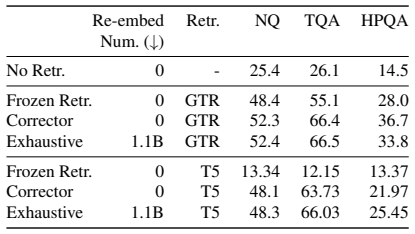
Table 3 . Exact Match Accuracy, RLM Training . We find that our target corrector approach can match the performance of the fully refreshed index while never re-embedding the targets across NQ, TriviaQA (TQA), and HotPotQA (HPQA).
원문 · CC BY 4.0 · Nicholas Monath, Will Grathwohl, Michael Boratko, Rob Fergus, Andrew McCallum, Manzil Zaheer · A Fresh Take on Stale Embeddings: Improving Dense Retriever Training with Corrector Networks · 원문 그림 인용 · 원본 PDF 8쪽에서 그림 영역을 추출했습니다.일반화 경계의 구성 요소
이론 분석은 실제 분포 DY 아래의 위험과 스테일 분포 D̃Y 아래의 위험 차이를 바서슈타인 거리로 제한합니다. 원문 보조정리 4.1은 이 차이가 W(DY, D̃Y) 이하이며, g′가 g와 같은 신경망에서 섭동 u로 생긴 경우 ∥g−g′∥1 ≤ L∥u∥로 이어진다고 설명합니다. 정리 4.3은 실제 모집단 위험을 경험적 위험 항, 바서슈타인 항, 라데마허 복잡도 항으로 나누어 확률 1−δ 이상으로 상한을 줍니다. 원문은 보정 네트워크가 너무 복잡하거나 표본이 부족하면 복잡도 항이 지배하고, g와 g′가 많이 다르면 바서슈타인 항이 지배한다고 해석합니다. 이 분석은 정리된 가정 아래의 상한을 다루며, 실험 결과가 이 상한의 모든 항을 직접 측정한 것은 아닙니다.
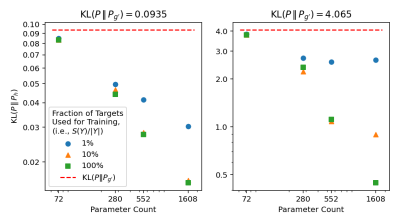
Figure 3 . Training Sample Size The figure shows the trade-offs between the complexity of h (parameter count), the approximation error, KL(P ||Ph), and the fraction of samples used for training. The left hand side shows only somewhat stale representations. The right hand side shows significantly stale representations. Using a higher fraction of training samples is needed with more staleness.
원문 · CC BY 4.0 · Nicholas Monath, Will Grathwohl, Michael Boratko, Rob Fergus, Andrew McCallum, Manzil Zaheer · A Fresh Take on Stale Embeddings: Improving Dense Retriever Training with Corrector Networks · 원문 그림 인용 · 원본 PDF 8쪽에서 그림 영역을 추출했습니다.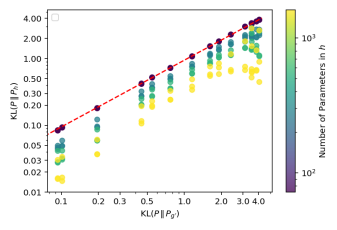
Figure 4 . Parameter Count We plot the KL divergence using the stale embeddings (KL(P ∥Pg′ ), on the x-axis) against that of the trained correction models ( KL(P ∥Ph), on the y-axis). Parity is indicated by the dashed red line, demonstrating that the trained correction model is significantly better than using the stale embed- dings. Increasing the parameter count of h is more important when the discrepancy between stale and current embeddings is higher, indicated by a larger improvement toward the right of this plot.
원문 · CC BY 4.0 · Nicholas Monath, Will Grathwohl, Michael Boratko, Rob Fergus, Andrew McCallum, Manzil Zaheer · A Fresh Take on Stale Embeddings: Improving Dense Retriever Training with Corrector Networks · 원문 그림 인용 · 원본 PDF 9쪽에서 그림 영역을 추출했습니다.NQ에서 재임베딩 비용과 검색 성능의 비교
Natural Questions 실험에서 GTR-base를 초기화로 쓴 설정은 목표 보정 네트워크, 재임베딩 없이 캐시만 쓰는 스테일 방식, 500스텝마다 전체를 재임베딩하는 방식 등을 비교합니다. 표 1에 따르면 목표 보정 네트워크는 재임베딩 횟수 0으로 NQ Test Recall@1 50.61을 얻으며, 전체 재임베딩 방식은 1.68B 재임베딩에서 50.30입니다. 같은 표에서 스테일 방식은 46.76이므로, 보정 네트워크는 재임베딩 없이 스테일 방식보다 Recall@1을 높입니다. 원문은 이 결과가 전체 재임베딩 성능에 거의 필적한다고 보고합니다. 다만 이 수치는 GTR-base 설정과 NQ 학습 조건에서의 결과이며, 다른 데이터셋이나 모델로 일반화된 결과는 아닙니다.
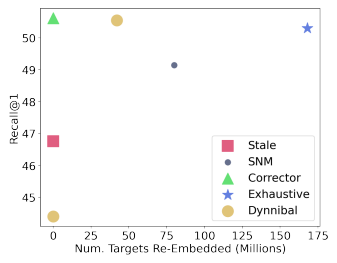
Figure 2 . NQ Test Recall@1. We show the computational trade- offs between the amount of re-embedding during training and the task performance (GTR initialization). Our proposed target correc- tor approach achieves matching task performance at a fraction of the computational expense.
원문 · CC BY 4.0 · Nicholas Monath, Will Grathwohl, Michael Boratko, Rob Fergus, Andrew McCallum, Manzil Zaheer · A Fresh Take on Stale Embeddings: Improving Dense Retriever Training with Corrector Networks · 원문 그림 인용 · 원본 PDF 6쪽에서 그림 영역을 추출했습니다.재임베딩 비용 비교와 적용 범위
원문은 보정 네트워크가 4-80x의 재임베딩 계산 비용 절감을 가진다고 초록에서 보고합니다. 다만 이 절감 범위는 비교 대상의 재임베딩 규모에 따라 달라지며, 모든 설정에 같은 배율이 적용되는 것은 아닙니다. MSMARCO 부록 실험에서 T5-base를 쓴 경우 목표 보정 네트워크는 재임베딩 0으로 Recall@1 17.07을 얻고, 전체 재임베딩은 352M 재임베딩에서 18.18입니다. Dynnibal은 8M 재임베딩에서 18.23이므로, 이 설정에서는 보정 네트워크가 재임베딩 비용 대비 일부 성능 차이를 남깁니다. 원문도 목표 수가 적은 MSMARCO에서는 확률적 음성 채굴의 격차가 줄어든다고 밝힙니다.
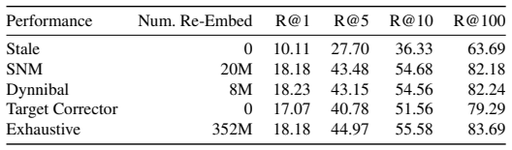
Table 4 . MSMARCO, T5 Initialization. In this experiment, we measure performance of methods on MSMARCO. With fewer targets than Natural Questions, the gap between stochastic negative mining and the refreshed index is reduced.
원문 · CC BY 4.0 · Nicholas Monath, Will Grathwohl, Michael Boratko, Rob Fergus, Andrew McCallum, Manzil Zaheer · A Fresh Take on Stale Embeddings: Improving Dense Retriever Training with Corrector Networks · 원문 그림 인용 · 원본 PDF 14쪽에서 그림 영역을 추출했습니다.논문 정보
- 저자
- Nicholas Monath, Will Grathwohl, Michael Boratko, Rob Fergus, Andrew McCallum, Manzil Zaheer
- 학회·저널
- arXiv · 프리프린트
- 최초 공개일
- 2024년 9월 3일
- 등록일
- 2026년 11월 5일
- 수정일
- 2024년 9월 3일
- 버전
- v1
- arXiv
- 2409.01890
- 분류
- cs.LG
- 원문 이용 조건
- CC BY 4.0
- 제공 범위
- 논문 정보, 해설, 허용된 원문 그림
AI 해설은 논문 원문과 별개의 설명이며 오류가 있을 수 있습니다. 원문과 그림은 각 출처의 이용 조건과 따로 표시된 권리를 따릅니다.
초록
In dense retrieval, deep encoders provide embeddings for both inputs and targets, and the softmax function is used to parameterize a distribution over a large number of candidate targets (e.g., textual passages for information retrieval). Significant challenges arise in training such encoders in the increasingly prevalent scenario of (1) a large number of targets, (2) a computationally expensive target encoder model, (3) cached target embeddings that are out-of-date due to ongoing training of target encoder parameters. This paper presents a simple and highly scalable response to these challenges by training a small parametric corrector network that adjusts stale cached target embeddings, enabling an accurate softmax approximation and thereby sampling of up-to-date high scoring "hard negatives." We theoretically investigate the generalization properties of our proposed target corrector, relating the complexity of the network, staleness of cached representations, and the amount of training data. We present experimental results on large benchmark dense retrieval datasets as well as on QA with retrieval augmented language models. Our approach matches state-of-the-art results even when no target embedding updates are made during training beyond an initial cache from the unsupervised pre-trained model, providing a 4-80x reduction in re-embedding computational cost.
원문 인용
Nicholas Monath, Will Grathwohl, Michael Boratko, Rob Fergus, Andrew McCallum, Manzil Zaheer (2024). A Fresh Take on Stale Embeddings: Improving Dense Retriever Training with Corrector Networks. arXiv:2409.01890v1. https://arxiv.org/abs/2409.01890v1
BibTeX
@misc{monath2024fresh,
  title = {{A Fresh Take on Stale Embeddings: Improving Dense Retriever Training with Corrector Networks}},
  author = {Nicholas Monath and Will Grathwohl and Michael Boratko and Rob Fergus and Andrew McCallum and Manzil Zaheer},
  year = {2024},
  eprint = {2409.01890},
  archivePrefix = {arXiv},
  url = {https://arxiv.org/abs/2409.01890v1}
}