논문 해설
Neurosymbolic Models for Computer Graphics
컴퓨터 그래픽스를 위한 뉴로심볼릭 모델
- 연구 문제 절차적 모델은 해석 가능성과 품질의 장점이 있지만 저작이 어렵고, 신경망은 쉽게 생성하지만 표현이 불투명합니다.
- 연구 방법 신경기호 모델은 작업 명세, DSL, 프로그램 합성기, 실행 엔진, 학습 방식의 설계 축으로 나뉘어 정리됩니다.
- 주요 결과 보고서는 2D 형상, 3D 형상, 재료와 텍스처 분야의 대표 연구를 설계 공간에 배치하여 각 방법의 선택지를 비교합니다.
절차적 모델과 신경망 사이의 간극
절차적 모델은 시각 데이터를 출력하는 기호 프로그램으로, 해석 가능한 설계 파라미터와 확률적 변형, 높은 품질의 출력, 간결한 표현이라는 장점이 있습니다. 반면 이런 프로그램을 처음부터 작성하는 일은 프로그래밍 전문성과 디자인 감각을 함께 요구하며, 단일 모델이 만들 수 있는 변형도 대개 파라미터 변화에 한정됩니다. 신경망 기반 생성 모델은 예시 데이터만 주면 학습되어 다양한 시각 데이터를 만들 수 있지만, 표현이 불투명해 편집하기 어렵고 출력에 흐림이나 덩어리진 형상 같은 아티팩트가 나타날 수 있습니다. 이 보고서는 두 방식의 상보적 강점을 결합하는 신경기호 모델(neurosymbolic model)을 다룹니다.
여기서 범위는 모델이 시각 데이터의 중간 기호 표현을 명시적으로 구성하는 경우로 제한됩니다.
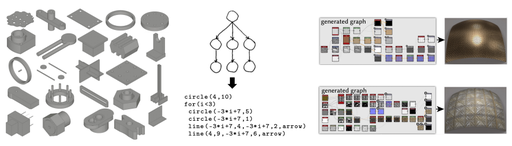
Figure 1 : Neurosymbolic models produce visual data via a combination of symbolic programs and machine learning. From left to right: outputs of CAD programs written by a neural network [XWL ∗22]; inferring a 2D drawing program that reproduces an input hand-drawn diagram [ERSLT18]; procedural material programs (i.e. node graphs) generated by a neural network [GHS∗22].
원문 · CC BY 4.0 · Daniel Ritchie, Paul Guerrero, R. Kenny Jones, Niloy J. Mitra, Adriana Schulz, Karl D. D. Willis, Jiajun Wu · Neurosymbolic Models for Computer Graphics · 원문 그림 인용 · 원본 PDF 1쪽에서 그림 영역을 추출했습니다.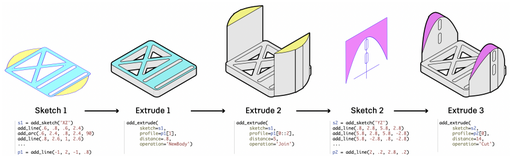
Figure 2 : Procedural modeling as applied to CAD: using feature-based modeling to produce solid geometry as a composition of operations on 2D sketches extruded into boundary representations [WPL∗21].
원문 · CC BY 4.0 · Daniel Ritchie, Paul Guerrero, R. Kenny Jones, Niloy J. Mitra, Adriana Schulz, Karl D. D. Willis, Jiajun Wu · Neurosymbolic Models for Computer Graphics · 원문 그림 인용 · 원본 PDF 4쪽에서 그림 영역을 추출했습니다.신경기호 모델의 설계 공간
보고서는 신경기호 모델을 작업 명세, DSL, 프로그램 합성기, 실행 엔진, 학습 방식의 단계로 나누는 설계 공간을 제시합니다. 사용자 의도는 시각 목표, 시각 예시, 블랙박스 생성기, 텍스트 프롬프트, 목적 함수 중 하나 이상으로 주어지고, 출력은 결정적 프로그램, 확률적 프로그램, 프로그램 분포 중 하나가 됩니다. DSL은 함수형, 명령형, 제약 기반 등의 패러다임과 학습된 신경 원시 요소 또는 하드코딩된 원시 요소를 가질 수 있으며, 입력 언어가 고정되거나 전처리·진화·발명될 수도 있습니다. 프로그램 합성기는 프로그램 사전 분포와 탐색 알고리즘을 정하며, 실행 엔진은 직접 실행, 솔버, 학습된 프록시 중 하나를 씁니다.
마지막으로 학습 방식은 종단간 학습 또는 모듈별 학습으로 나뉩니다.
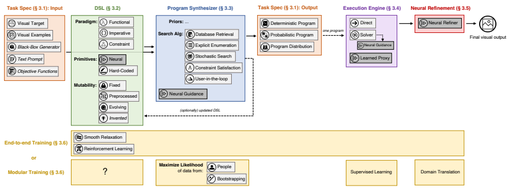
Figure 3 : The design space of neurosymbolic models. A neurosymbolic model takes as input a specification of user intent and a domain- specific language (DSL), and it synthesizes programs that output visual data that satisfy the user intent. The visual output may then be further refined in a non-symbolic, neural postprocess. Several approaches have been proposed for learning the various neural components of such a model. Note: the icons and color scheme introduced in this figure are used throughout the report to identify where in this design space different prior works fall.
원문 · CC BY 4.0 · Daniel Ritchie, Paul Guerrero, R. Kenny Jones, Niloy J. Mitra, Adriana Schulz, Karl D. D. Willis, Jiajun Wu · Neurosymbolic Models for Computer Graphics · 원문 그림 인용 · 원본 PDF 6쪽에서 그림 영역을 추출했습니다.프로그램 합성과 탐색의 선택
프로그램 합성기는 작업 명세와 DSL이 주어졌을 때 명세를 만족하는 생성 프로그램을 찾습니다. 같은 명세를 만족하는 프로그램이 여럿일 때 어떤 프로그램을 선호할지는 프로그램 사전 분포가 정하며, 기존 연구는 짧고 단순한 프로그램을 선호하는 방향으로 정리됩니다. 탐색 방식으로는 기존 프로그램을 검색하는 방식, 결정적으로 열거하는 방식, 무작위 변경을 반복하는 확률적 탐색, 명세를 제약으로 바꾸어 SAT 또는 SMT 솔버로 푸는 방식, 사람이 개입하는 방식이 있습니다. 신경 가이던스는 이 탐색 단계에서 다음 탐색 상태를 제안하는 휴리스틱으로 쓰이며, 자기회귀 언어 모델이 가장 널리 사용됩니다. 원문은 검색 방식과 탐색 알고리즘의 분류를 제시할 뿐이며, 특정 방법이 모든 과제에서 우월하다고 주장하지 않습니다.
종단간 학습과 모듈별 학습
신경 구성 요소를 학습하는 방법은 크게 두 가지입니다. 종단간 학습은 최종 작업 손실을 전체 모델에 역전파해 모든 신경 구성 요소를 함께 학습합니다. 다만 프로그램의 이산적 구조 선택을 거치면 그래디언트가 정의되지 않으므로, 연속 완화나 정책 경사 강화학습 같은 우회가 필요합니다. 강화학습은 미분 불가능한 부분이 있어도 적용할 수 있지만 추정량의 분산이 커 수렴이 느리거나 나쁜 지역 최적에 이를 수 있다고 원문은 설명합니다. 모듈별 학습은 단계마다 감독 신호를 두고 따로 학습하며, 사람이 작성한 프로그램, 합성 프로그램, 부트스트래핑, 학습된 프록시 실행기의 데이터 등을 사용합니다. 합성 프로그램으로 학습한 모델은 실제 작업 명세에 잘 일반화되지 않는 경우가 많아 초기화 용도로 쓰인다고 설명됩니다.
3D 형상과 재료 응용의 예
3D 형상 분야에서 CAPRI-Net은 CSG 프로그램을 끝에서 끝까지 학습하는 신경 아키텍처로, 입력 형상을 재구성하는 CSG 실행 엔진 역할을 합니다. 이 구조는 발견할 수 있는 프로그램 구조를 제한하지만 종단간 학습을 가능하게 합니다. ShapeAssembly는 3D 형상의 부품 구조를 명시하는 DSL을 정의하고, 계층적 시퀀스 VAE가 PartNet 형상에서 파싱된 프로그램으로 학습해 새로운 프로그램을 작성합니다. 재료와 텍스처 분야에서 MatFormer는 절차적 재료를 노드 그래프로 생성하는 무조건 생성기이며, 노드·매개변수·간선을 각각 생성하는 세 Transformer로 구성됩니다. 이 모델은 참조 이미지를 조건으로 받는 생성은 지원하지 않는다고 원문에 명시되어 있습니다.
학습 데이터인 Substance Source는 약 7k개의 노드 그래프로 소개되며, 원문에서는 공개되지 않은 데이터로 언급됩니다.
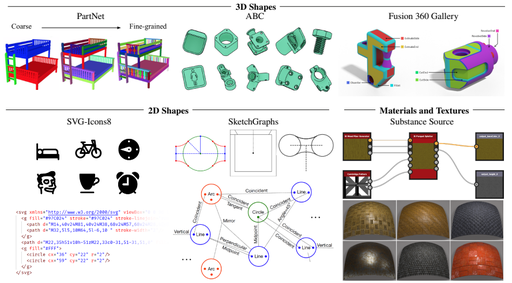
Figure 4 : Examples of datasets that provide structured data that is more amenable to neurosymbolic models. We show examples of datasets for 2D shapes, 3D shapes, and materials. All datasets provide some form of structural information, such as part decompositions, construction sequences, or geometric relationships between parts.
원문 · CC BY 4.0 · Daniel Ritchie, Paul Guerrero, R. Kenny Jones, Niloy J. Mitra, Adriana Schulz, Karl D. D. Willis, Jiajun Wu · Neurosymbolic Models for Computer Graphics · 원문 그림 인용 · 원본 PDF 10쪽에서 그림 영역을 추출했습니다.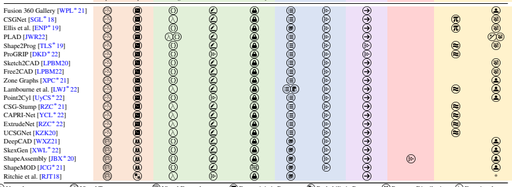
Table 3 : A summary of the work on neurosymbolic 3D shape modeling discussed in Section 6, where each approach is situated in our design space. * Ritchie et al. [RJT18] use supervised training for their neural language primitives.
원문 · CC BY 4.0 · Daniel Ritchie, Paul Guerrero, R. Kenny Jones, Niloy J. Mitra, Adriana Schulz, Karl D. D. Willis, Jiajun Wu · Neurosymbolic Models for Computer Graphics · 원문 그림 인용 · 원본 PDF 14쪽에서 그림 영역을 추출했습니다.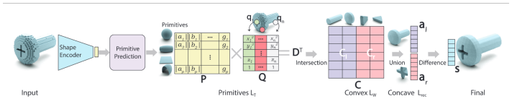
Figure 11 : CAPRI-Net [YCL∗22] infers a CSG program that reconstructs an input shape. Its neural architecture acts as a CSG execution engine, which limits the types of program structures that it can discover but allows the system to train in an end-to-end fashion.
원문 · CC BY 4.0 · Daniel Ritchie, Paul Guerrero, R. Kenny Jones, Niloy J. Mitra, Adriana Schulz, Karl D. D. Willis, Jiajun Wu · Neurosymbolic Models for Computer Graphics · 원문 그림 인용 · 원본 PDF 14쪽에서 그림 영역을 추출했습니다.
Table 4 : A summary of the work on neurosymbolic material & texture modeling discussed in Section 7, where each approach is situated in our design space.
원문 · CC BY 4.0 · Daniel Ritchie, Paul Guerrero, R. Kenny Jones, Niloy J. Mitra, Adriana Schulz, Karl D. D. Willis, Jiajun Wu · Neurosymbolic Models for Computer Graphics · 원문 그림 인용 · 원본 PDF 16쪽에서 그림 영역을 추출했습니다.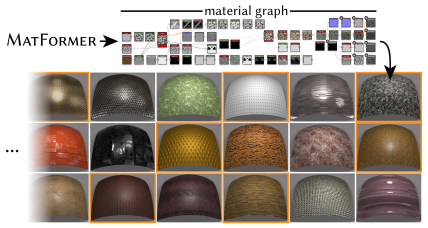
Figure 16 : MatFormer [GHS∗22] is an unconditional generator for procedural materials represented as node graphs. It creates a node graph with three Transformers that are trained to generate nodes, node parameters, and edges, respectively.
원문 · CC BY 4.0 · Daniel Ritchie, Paul Guerrero, R. Kenny Jones, Niloy J. Mitra, Adriana Schulz, Karl D. D. Willis, Jiajun Wu · Neurosymbolic Models for Computer Graphics · 원문 그림 인용 · 원본 PDF 17쪽에서 그림 영역을 추출했습니다.남은 과제와 한계
보고서는 프로그램 감독 데이터가 대부분의 언어에 부족하다는 점을 한계로 꼽고, 종단간 학습, 강화학습, 부트스트래핑 등 대안이 각각 추가 연구를 필요로 한다고 제시합니다. 또한 새로운 언어를 발명하는 문제, 사용자 의도를 텍스트로 받는 입력, 프로그램의 사용성과 해석 가능성, 프로그램 재작성을 통한 편집 같은 열린 문제가 남아 있다고 정리합니다. 이 보고서는 새로운 실험 결과를 제시하지 않는 서베이이므로, 각 방법의 성능 우열은 원문에 인용된 개별 연구의 결과로만 읽어야 합니다.
논문 정보
- 저자
- Daniel Ritchie, Paul Guerrero, R. Kenny Jones, Niloy J. Mitra, Adriana Schulz, Karl D. D. Willis, Jiajun Wu
- 학회·저널
- arXiv · 프리프린트
- 최초 공개일
- 2023년 4월 20일
- 등록일
- 2026년 11월 5일
- 수정일
- 2023년 4월 20일
- 버전
- v1
- arXiv
- 2304.10320
- 분류
- cs.GR
- 원문 이용 조건
- CC BY 4.0
- 제공 범위
- 논문 정보, 해설, 허용된 원문 그림
AI 해설은 논문 원문과 별개의 설명이며 오류가 있을 수 있습니다. 원문과 그림은 각 출처의 이용 조건과 따로 표시된 권리를 따릅니다.
초록
Procedural models (i.e. symbolic programs that output visual data) are a historically-popular method for representing graphics content: vegetation, buildings, textures, etc. They offer many advantages: interpretable design parameters, stochastic variations, high-quality outputs, compact representation, and more. But they also have some limitations, such as the difficulty of authoring a procedural model from scratch. More recently, AI-based methods, and especially neural networks, have become popular for creating graphic content. These techniques allow users to directly specify desired properties of the artifact they want to create (via examples, constraints, or objectives), while a search, optimization, or learning algorithm takes care of the details. However, this ease of use comes at a cost, as it's often hard to interpret or manipulate these representations. In this state-of-the-art report, we summarize research on neurosymbolic models in computer graphics: methods that combine the strengths of both AI and symbolic programs to represent, generate, and manipulate visual data. We survey recent work applying these techniques to represent 2D shapes, 3D shapes, and materials & textures. Along the way, we situate each prior work in a unified design space for neurosymbolic models, which helps reveal underexplored areas and opportunities for future research.
원문 인용
Daniel Ritchie, Paul Guerrero, R. Kenny Jones, Niloy J. Mitra, Adriana Schulz, Karl D. D. Willis, Jiajun Wu (2023). Neurosymbolic Models for Computer Graphics. arXiv:2304.10320v1. https://arxiv.org/abs/2304.10320v1
BibTeX
@misc{ritchie2023neurosymbolic,
  title = {{Neurosymbolic Models for Computer Graphics}},
  author = {Daniel Ritchie and Paul Guerrero and R. Kenny Jones and Niloy J. Mitra and Adriana Schulz and Karl D. D. Willis and Jiajun Wu},
  year = {2023},
  eprint = {2304.10320},
  archivePrefix = {arXiv},
  url = {https://arxiv.org/abs/2304.10320v1}
}