논문 해설
Best-of-Depth: Learning Exploratory Dynamics in Looped Transformers
Best-of-Depth: 루프형 트랜스포머에서 탐색적 동역학 학습
- 연구 문제 루프 트랜스포머는 최종 깊이만 감독되어 중간 깊이의 다른 유효한 해 후보가 충분히 학습되지 않는 문제가 있습니다.
- 연구 방법 BoD는 깊이별 예측 손실의 최솟값으로 한 목표를 하나의 깊이에서 학습하여, 하나의 재귀 궤적이 서로 다른 유효한 해를 방문하도록 합니다.
- 주요 결과 N-Queens에서 BoD 커버리지는 91.03%로 최종 깊이 학습의 45.75%보다 높았고, graph coloring과 코드 생성에서도 같은 비교 조건에서 개선이 보고되었습니다.
최종 깊이 학습의 한계
루프 트랜스포머는 같은 변환을 잠재 상태에 반복 적용하여 추론 시 계산을 늘립니다. 그러나 기존 학습은 마지막 깊이의 예측만 감독하는 경우가 많아, 중간 깊이에서 얻는 다른 유효한 해 후보를 직접 보상하지 않습니다. 저자들은 이 문제를 하나의 재귀 궤적이 서로 다른 유용한 해 후보를 방문하도록 학습할 수 있는지로 설정합니다. 모든 깊이를 같은 정답에 맞추는 방식은 모든 읽기 지점이 같은 목표를 재현하도록 요구하므로 서로 다른 해를 찾는 데 맞지 않습니다.
Best-of-Depth 목적 함수
Best-of-Depth(BoD)는 학습 깊이 집합 D 안에서 각 깊이의 손실 L_d를 계산하고, 목표 하나에 대해 그중 최솟값 min_d L_d만 학습 신호로 사용합니다. 선택된 깊이 하나가 그 목표의 손실을 담당하므로, 서로 다른 유효한 목표는 서로 다른 깊이에서 맞춰질 수 있습니다. 구조 변경이나 깊이별 정답 라벨은 필요하지 않습니다. 정확 일치 손실에서 BoD는 목표가 어느 깊이에서든 도달되는지를 평가하며, 목표를 균등하게 샘플링할 때 그 위험은 Coverage@Depth와 1에서 뺀 값으로 연결됩니다.
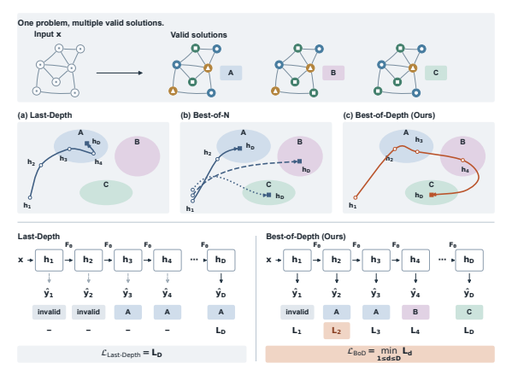
Figure 1 :Learning alternative solutions along one recurrent trajectory. Top:One input admits multiple valid solutions.Middle:Schematic latent trajectories illustrate (a) repeated predictions under Last-Depth, (b) independent candidates from Best-of-N, and (c) distinct solutions along one BoD trajectory; shaded regions decode to A–C.Bottom:Both models reuseF θ across depths. Last- Depth trains onL D; BoD trains on the lowest loss across depths (highlightedL 2 for target A).
원문 · CC BY 4.0 · Shota Takashiro, Takeshi Kojima, Masanori Koyama, Kohei Hayashi, Yusuke Iwasawa · Best-of-Depth: Learning Exploratory Dynamics in Looped Transformers · 원문 그림 인용 · 원본 PDF 2쪽에서 그림 영역을 추출했습니다.제어 과제에서의 해 커버리지
N-Queens completion과 graph coloring은 유효한 해를 열거할 수 있어 커버리지를 직접 셀 수 있습니다. 두 과제 모두 학습 깊이 16, 평가 깊이 64에서 비교했습니다. N-Queens에서 BoD는 커버리지 91.03%와 성공률 99.03%를 기록했고, 최종 깊이 학습은 커버리지 45.75%였습니다. graph coloring에서 BoD의 깊이 64 커버리지는 72.16%이며, Soft-Depth는 성공률이 높았지만 커버리지는 44.39%에 그쳤습니다. 이 결과는 같은 조건의 제어 과제에서 얻은 값입니다.
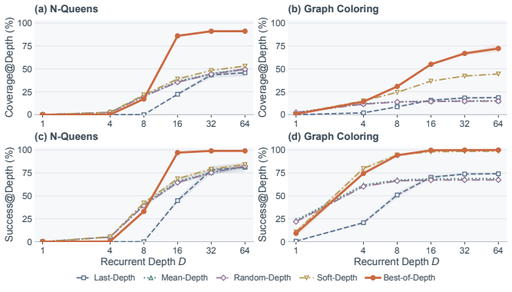
Figure 2 :Depth-wise solution discovery.Coverage@Depth (top) and Success@Depth (bottom) for greedy trajectories trained at depth 16. Bands indicate±1SD.
원문 · CC BY 4.0 · Shota Takashiro, Takeshi Kojima, Masanori Koyama, Kohei Hayashi, Yusuke Iwasawa · Best-of-Depth: Learning Exploratory Dynamics in Looped Transformers · 원문 그림 인용 · 원본 PDF 6쪽에서 그림 영역을 추출했습니다.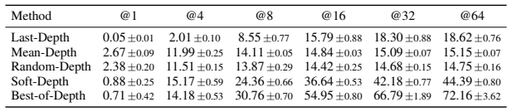
Table 7 : Graph-coloring Coverage@Depth (%) on 512 test graphs. Models are trained atD train = 16.
원문 · CC BY 4.0 · Shota Takashiro, Takeshi Kojima, Masanori Koyama, Kohei Hayashi, Yusuke Iwasawa · Best-of-Depth: Learning Exploratory Dynamics in Looped Transformers · 원문 그림 인용 · 원본 PDF 15쪽에서 그림 영역을 추출했습니다.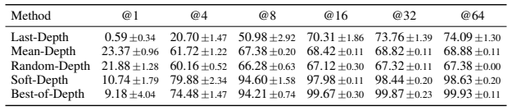
Table 8 : Graph-coloring Success@Depth (%) on 512 test graphs. Models are trained atDtrain = 16.
원문 · CC BY 4.0 · Shota Takashiro, Takeshi Kojima, Masanori Koyama, Kohei Hayashi, Yusuke Iwasawa · Best-of-Depth: Learning Exploratory Dynamics in Looped Transformers · 원문 그림 인용 · 원본 PDF 15쪽에서 그림 영역을 추출했습니다.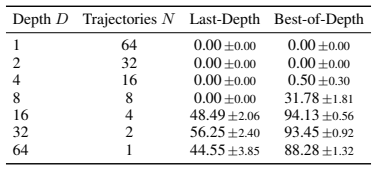
Table 9 : N-Queens Coverage@Depth (%) atN D= 64, pooling allNtrajectories through depthD.
원문 · CC BY 4.0 · Shota Takashiro, Takeshi Kojima, Masanori Koyama, Kohei Hayashi, Yusuke Iwasawa · Best-of-Depth: Learning Exploratory Dynamics in Looped Transformers · 원문 그림 인용 · 원본 PDF 16쪽에서 그림 영역을 추출했습니다.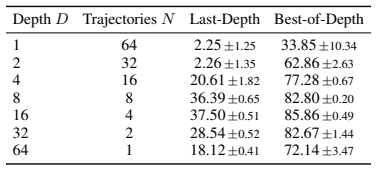
Table 10 : Graph-coloring Coverage@Depth (%) atN D= 64, pooling allNtrajectories through depthD.
원문 · CC BY 4.0 · Shota Takashiro, Takeshi Kojima, Masanori Koyama, Kohei Hayashi, Yusuke Iwasawa · Best-of-Depth: Learning Exploratory Dynamics in Looped Transformers · 원문 그림 인용 · 원본 PDF 16쪽에서 그림 영역을 추출했습니다.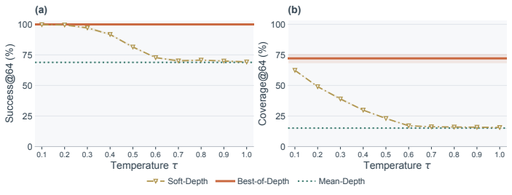
Figure 6 :Sensitivity to the Soft-Depth temperature on graph coloring.Test success and coverage use all greedy readouts through depth 64. The curve variesτ= 0.1,0.2, . . . ,1.0; horizontal lines show BoD and Mean-Depth under the same configuration. Bands indicate±1SD.
원문 · CC BY 4.0 · Shota Takashiro, Takeshi Kojima, Masanori Koyama, Kohei Hayashi, Yusuke Iwasawa · Best-of-Depth: Learning Exploratory Dynamics in Looped Transformers · 원문 그림 인용 · 원본 PDF 17쪽에서 그림 영역을 추출했습니다.코드 생성에서의 깊이 풀링
코드 생성 실험에서는 사전 학습된 3B 파라미터 루프 언어 모델 Huginn을 CodeFeedback의 Python 예제 20,000개로 깊이 32에서 미세 조정했습니다. 각 모델은 깊이 4, 8, 12, 16, 24, 32에서 프로그램을 따로 greedy로 생성했고, Success@32는 이 여섯 후보를 합쳐 계산했습니다. HumanEval에서 BoD는 37.8%, Last-Depth는 34.8%였고, MBPP에서는 BoD 44.2%, Last-Depth 39.2%였습니다. 다만 얕은 깊이에서는 Mean-Depth, Random-Depth, Soft-Depth가 더 높은 값을 보였으므로 BoD의 이점은 깊이 32 단독 정확도보다 풀링한 성공률에서 나타납니다.
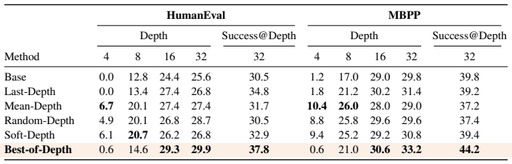
Table 1 : Code-generation results (%). Base is pretrained; other rows denote fine-tuning objectives. Depth columns show accuracy for one greedy program per problem. Success@32 pools the six evaluated depths{4,8,12,16,24,32}. Bold marks each column’s best result.
원문 · CC BY 4.0 · Shota Takashiro, Takeshi Kojima, Masanori Koyama, Kohei Hayashi, Yusuke Iwasawa · Best-of-Depth: Learning Exploratory Dynamics in Looped Transformers · 원문 그림 인용 · 원본 PDF 6쪽에서 그림 영역을 추출했습니다.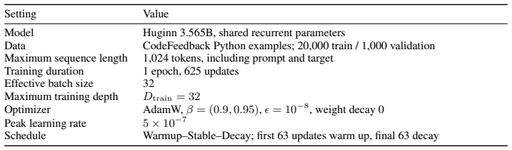
Table 4 : Shared fine-tuning settings for the five code-generation objectives.
원문 · CC BY 4.0 · Shota Takashiro, Takeshi Kojima, Masanori Koyama, Kohei Hayashi, Yusuke Iwasawa · Best-of-Depth: Learning Exploratory Dynamics in Looped Transformers · 원문 그림 인용 · 원본 PDF 14쪽에서 그림 영역을 추출했습니다.적용 범위와 한계
저자들은 증거가 소규모 조합 과제와 하나의 사전 학습된 언어 모델에 한정된다고 밝힙니다. 해 탐색은 깊이가 커질수록 포화되며, 더 큰 과제와 추가 모델에 대한 일반성은 아직 검증되지 않았습니다. 이 결과는 BoD가 모든 루프 모델이나 모든 코드 생성 설정에서 같은 효과를 낸다는 뜻이 아닙니다.
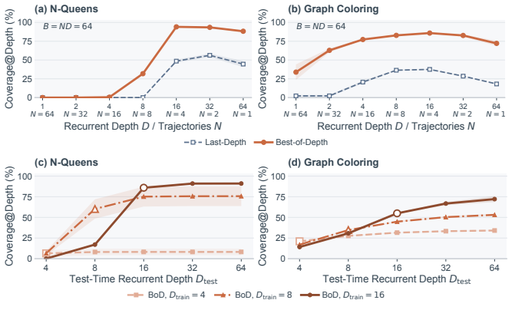
Figure 3 :Depth allocation and extrapolation.(a, b) Coverage pooling intermediate predictions from randomized trajectories underN D= 64. (c, d) BoD with unperturbed greedy readouts; open markers denote training depth. Bands indicate±1SD.
원문 · CC BY 4.0 · Shota Takashiro, Takeshi Kojima, Masanori Koyama, Kohei Hayashi, Yusuke Iwasawa · Best-of-Depth: Learning Exploratory Dynamics in Looped Transformers · 원문 그림 인용 · 원본 PDF 7쪽에서 그림 영역을 추출했습니다.논문 정보
- 저자
- Shota Takashiro, Takeshi Kojima, Masanori Koyama, Kohei Hayashi, Yusuke Iwasawa
- 학회·저널
- arXiv · 프리프린트
- 최초 공개일
- 2026년 11월 3일
- 등록일
- 2026년 11월 5일
- 수정일
- 2026년 11월 3일
- 버전
- v1
- arXiv
- 2611.04663
- 분류
- cs.LG · cs.AI
- 원문 이용 조건
- CC BY 4.0
- 제공 범위
- 논문 정보, 해설, 허용된 원문 그림
AI 해설은 논문 원문과 별개의 설명이며 오류가 있을 수 있습니다. 원문과 그림은 각 출처의 이용 조건과 따로 표시된 권리를 따릅니다.
초록
Looped Transformers extend inference-time computation through repeated latent-state updates, but final-depth training does not directly encourage useful intermediate alternatives. We introduce Best-of-Depth (BoD), which trains a recurrent trajectory as a candidate set by minimizing prediction loss across depths. Different valid targets can be matched at different depths without architectural changes or depth-specific labels. An exact-match analysis connects this objective to solution coverage. On N-Queens completion and graph coloring, BoD improves coverage over final-depth and intermediate-supervision objectives. N-Queens coverage reaches 91.03%, versus 45.75% for final-depth training. Further experiments show discovery beyond the training depth and recovery of solutions withheld from teacher pools on familiar inputs. Fine-tuning a pretrained looped language model with BoD yields higher pooled code-generation success than final-depth training when programs are generated separately at evaluated fixed depths. These results support training recurrent computation for solution discovery along its trajectory.
원문 인용
Shota Takashiro, Takeshi Kojima, Masanori Koyama, Kohei Hayashi, Yusuke Iwasawa (2026). Best-of-Depth: Learning Exploratory Dynamics in Looped Transformers. arXiv:2611.04663v1. https://arxiv.org/abs/2611.04663v1
BibTeX
@misc{takashiro2026best,
  title = {{Best-of-Depth: Learning Exploratory Dynamics in Looped Transformers}},
  author = {Shota Takashiro and Takeshi Kojima and Masanori Koyama and Kohei Hayashi and Yusuke Iwasawa},
  year = {2026},
  eprint = {2611.04663},
  archivePrefix = {arXiv},
  url = {https://arxiv.org/abs/2611.04663v1}
}