논문 해설
Sonar-MoE: In-Backward Expert Updates for Memory-Efficient Mixture-of-Experts Training
Sonar-MoE: 메모리 효율적인 혼합 전문가 학습을 위한 역전파 중 전문가 업데이트
- 연구 문제 MoE 모델은 expert 파라미터가 많아 표준 학습에서 expert gradient가 optimizer 단계까지 GPU 메모리에 남습니다. SONAR-MOE는 batched expert 텐서를 backward 중 갱신하고 gradient를 즉시 해제합니다.
- 연구 방법 각 batched expert 텐서에 post-accumulate hook을 걸어 fused AdamW 갱신과 gradient 해제를 수행하고, 나머지 파라미터는 global-norm clipping을 유지합니다.
- 주요 결과 OLMoE SonicMoE 백엔드에서 peak allocated 메모리가 55.55 GB에서 43.57 GB로 줄었고(−21.6%), Granite에서는 step time이 84.4 ms로 표준 global clip의 109.1 ms보다 짧았습니다.
MoE 학습에서 expert gradient가 메모리를 차지하는 이유
Mixture-of-Experts 모델은 토큰마다 소수의 expert만 활성화하지만, 파라미터의 대부분은 expert에 있습니다. OLMoE-1B-7B에서는 6.92B개 파라미터 중 6.44B개가 expert에 있으며, 이들의 bf16 gradient만으로 12.9 GB가 필요합니다. 표준 학습은 backward pass가 끝난 뒤에야 optimizer를 호출하므로, 각 MoE layer의 gradient가 optimizer 단계까지 메모리에 남습니다. AdamW처럼 원소별로 갱신하는 옵티마이저는 텐서의 갱신이 그 텐서의 gradient와 optimizer 상태에만 의존하므로 이 대기가 필요하지 않습니다.
다만 모든 파라미터를 backward 중에 갱신하면 전체 gradient가 한꺼번에 존재하지 않아 global-norm clipping을 할 수 없습니다. 이 논문은 expert gradient가 대부분의 메모리를 차지한다는 점에 착안해, expert만 backward 중에 갱신하고 나머지 파라미터는 표준 경로의 clipping을 유지하는 방법을 다룹니다.
batched expert 텐서에 걸린 hook과 gradient 해제
SONAR-MOE는 각 MoE layer의 두 batched expert 텐서 W_up과 W_down마다 post-accumulate hook을 등록하고, 이 2L개 텐서를 end-of-step optimizer에서 제외합니다. 순전파는 표준 방식으로 수행하며, backward가 layer를 역순으로 방문할 때 각 텐서의 gradient가 준비되면 hook이 fused AdamW 갱신을 적용한 뒤 gradient를 None으로 설정합니다. 그래서 layer 하나의 expert gradient만 동시에 남으며, 보관되는 expert gradient 메모리는 최대 layer별 expert 파라미터 합의 최댓값으로 제한됩니다.
attention, embedding, router 같은 나머지 파라미터는 backward가 끝난 뒤 global-norm clipping을 거쳐 갱신합니다. 원문은 이 hook 갱신이 학습 설정 단계에서 정한 학습률을 backward 중에도 읽기 때문에, 학습률은 backward 이전에 설정되어야 한다고 설명합니다.
hook을 batched 텐서에 붙이는 이유
같은 스케줄을 expert마다 별도의 hook으로 구성할 수도 있습니다. 이 경우 hook 호출 수는 2EL이 되고, batched 텐서에 붙이면 2L이 됩니다. AdamW는 원소별 연산이므로 (E,2n,d) 형태의 텐서에 한 번 적용한 결과는 E개의 슬라이스에 각각 적용한 결과와 같습니다. 따라서 두 방식은 같은 갱신과 같은 메모리를 내지만, 호출 횟수에 따른 고정 비용이 다릅니다. OLMoE에서는 batched hook이 32회, per-expert hook이 2,048회 호출되며, 표 3에서 per-expert의 step time은 139.7 ms, batched는 116.1 ms입니다. 이 차이는 각 호출이 Python callback과 작은 커널을 실행하는 비용에서 나온다고 저자들은 해석합니다.
global-norm clipping과 gradient accumulation의 한계
global-norm clipping은 모든 gradient의 norm을 계산한 뒤에 갱신해야 하므로, expert gradient를 backward 중에 해제하는 SONAR-MOE와 직접 충돌합니다. 그래서 논문은 표준 학습을 두 종류로 비교합니다. 하나는 모든 gradient를 clipping하는 global clip이고, 다른 하나는 expert gradient만 clipping하지 않는 방식으로 SONAR-MOE와 같은 갱신을 수행합니다. gradient accumulation에서는 A개의 microbatch마다 hook이 AdamW 갱신을 한 번씩 수행하므로, 표준 방식이 평균 gradient로 한 번 갱신하는 것과 다릅니다.
두 번째 모멘트 v_t의 갱신 방식도 달라지므로, 저자들은 A=1을 주 실험에 사용합니다. A가 2 이상이면 원문 표 8 기준으로 표준 global clip보다 A=2에서 5%, A=4에서 23%, A=8에서 35% 느립니다.
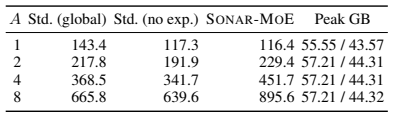
Table 8 . Gradient accumulation with A microbatches per step (OL- MoE, 500 steps). Step time in ms; peak allocated memory in GB for standard training (both variants) / SONAR-MOE. SONAR-MOE makesAupdates per step.
원문 · CC BY 4.0 · Avni Mittal, Avinash Anand, Ashutosh Kumar, Dikshant Kukreja, Kritarth Prasad, Chaitanya Lakhchaura, Rishitej Reddy Vyalla, Erik Cambria, Zhengkui Wang, Rajiv Ratn Shah · Sonar-MoE: In-Backward Expert Updates for Memory-Efficient Mixture-of-Experts Training · 원문 그림 인용 · 원본 PDF 8쪽에서 그림 영역을 추출했습니다.실험 설정과 비교 기준
실험은 OLMoE-1B-7B와 Granite-3.1-3B-A800M을 Alpaca 데이터의 8,000개 예제로 2,000 step 미세조정하여 수행됩니다. 원문은 batch size 2, 최대 256 토큰, bf16 가중치·gradient·AdamW 상태를 사용하며 fp32 master weight를 쓰지 않는다고 설명합니다. 비교 기준은 global clip 표준 학습, expert gradient를 clipping하지 않는 표준 학습, all-parameter optimizer-in-backward입니다. 두 expert 커널 백엔드인 SonicMoE와 ScatterMoE를 함께 사용하며, step time은 steps 201–2,000의 중앙값입니다.
각 모델과 백엔드 안에서만 step time을 비교하도록 원문이 명시하며, 같은 seed 반복 실행의 변동은 step time 최대 1.4%, held-out loss 최대 0.0016입니다.
메모리 절감과 속도 결과
SONAR-MOE가 expert gradient를 해제하는 효과는 메모리 측정에서 확인됩니다. SonicMoE 백엔드에서 OLMoE의 peak allocated 메모리는 표준 학습(global clip)의 55.55 GB에서 SONAR-MOE의 43.57 GB로 줄며, 원문 표의 Δ는 −21.6%입니다. Granite에서는 26.91 GB에서 21.14 GB로 줄어 −21.4%입니다. 속도는 모델과 백엔드에 따라 다르게 읽어야 합니다. OLMoE에서는 expert gradient를 clipping하지 않는 표준 학습과 SONAR-MOE의 step time이 116.1 ms와 115.9 ms로 거의 같으므로, OLMoE의 속도 이득은 주로 expert gradient clipping을 건너뛴 데서 나온다고 저자들은 해석합니다.
Granite에서 SONAR-MOE의 step time은 84.4 ms로 global clip 표준 학습의 109.1 ms보다 짧으며, 같은 백엔드의 no-expert-clip 표준 학습 95.5 ms보다도 짧습니다. 원문은 이 추가 이득을 idle GPU 시간에서 AdamW 커널이 실행되는 효과로 설명합니다.
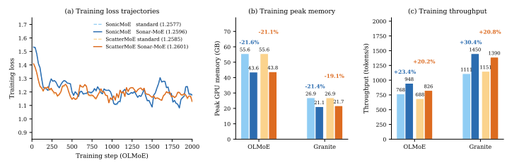
Figure 1 . Alpaca fine-tuning of OLMoE-1B-7B and Granite-3.1-3B-A800M for 2,000 steps with the SonicMoE and ScatterMoE back- ends, standard training with global-norm clipping (baseline) vs. SONAR-MOE. (a) Training loss on OLMoE; (b) peak GPU memory; (c) throughput averaged over steps 201–2,000.
원문 · CC BY 4.0 · Avni Mittal, Avinash Anand, Ashutosh Kumar, Dikshant Kukreja, Kritarth Prasad, Chaitanya Lakhchaura, Rishitej Reddy Vyalla, Erik Cambria, Zhengkui Wang, Rajiv Ratn Shah · Sonar-MoE: In-Backward Expert Updates for Memory-Efficient Mixture-of-Experts Training · 원문 그림 인용 · 원본 PDF 2쪽에서 그림 영역을 추출했습니다.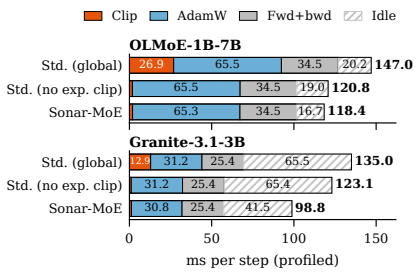
Figure 3 . Where step time goes (ms per step): torch.profiler over steps 300–309. Profiling adds CPU overhead, so absolute times are higher than in Table 1; compare bars only. “Clip” covers the norm and scaling kernels of global-norm clipping, which take 1.8–1.9 ms on OLMoE and 1.1–1.2 ms on Granite when the expert gradients are not clipped. “Fwd+bwd” covers the forward and backward kernels.
원문 · CC BY 4.0 · Avni Mittal, Avinash Anand, Ashutosh Kumar, Dikshant Kukreja, Kritarth Prasad, Chaitanya Lakhchaura, Rishitej Reddy Vyalla, Erik Cambria, Zhengkui Wang, Rajiv Ratn Shah · Sonar-MoE: In-Backward Expert Updates for Memory-Efficient Mixture-of-Experts Training · 원문 그림 인용 · 원본 PDF 5쪽에서 그림 영역을 추출했습니다.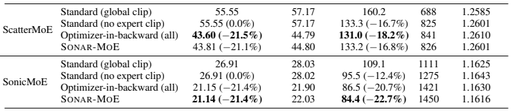
Table 1 . Alpaca fine-tuning for 2,000 steps with batch size 2 and seed 42 on two expert-kernel backends; every row uses the same data order. ∆ is relative to standard training with global clipping on the same model and backend. Step time is the median over steps 201–2,000. Same-seed repeats vary by at most 1.4% in step time and 0.0016 in held-out loss. All rows of one model and backend ran on one GPU; the OLMoE SonicMoE rows ran on a different GPU from all other rows, so compare step times only within a model and backend. Bold marks the lowest memory and step time per model and backend. Model Backend Method Peak alloc. GB (∆) Peak res. GB Step ms (∆) Tok/s Held-out loss
원문 · CC BY 4.0 · Avni Mittal, Avinash Anand, Ashutosh Kumar, Dikshant Kukreja, Kritarth Prasad, Chaitanya Lakhchaura, Rishitej Reddy Vyalla, Erik Cambria, Zhengkui Wang, Rajiv Ratn Shah · Sonar-MoE: In-Backward Expert Updates for Memory-Efficient Mixture-of-Experts Training · 원문 그림 인용 · 원본 PDF 6쪽에서 그림 영역을 추출했습니다.정확성과 학습 품질의 확인
갱신의 정확성은 gradient accumulation이 없는 조건에서 SONAR-MOE와 expert gradient를 clipping하지 않는 표준 학습을 비교해 확인합니다. OLMoE를 학습률 10^-4로 세 step 학습했을 때 두 방식은 6.44B개 expert 가중치가 정확히 같고, 기타 477M개 가중치 중 6개가 다릅니다. 같은 baseline을 두 번 실행해도 6개 요소가 달라서, 원문은 이를 실행 간 잡음으로 해석합니다. 학습 품질은 held-out loss와 downstream 정확도로 확인합니다. OLMoE 2,000 step 후 held-out loss 차이는 표준 학습 대비 0.003 이내이며, 8-bit AdamW와 SONAR-MOE를 결합한 경우 held-out loss는 1.2601로 표준 학습 1.2577과 0.003 이내입니다.
ARC-Challenge 정확도는 Pretrained 0.482, 표준 학습 0.532, SONAR-MOE 0.516입니다. HellaSwag와 MMLU는 거의 변하지 않으며, GSM8K는 이 모델이 Alpaca fine-tuning 뒤에도 약 0.1 정확도에 머물러 평가에서 제외되었습니다.
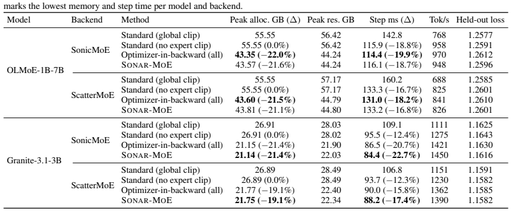
Table 2 . Downstream accuracy on OLMoE after 2,000 steps (full test sets). Standard errors are 0.015 for ARC-Challenge and 0.004 for HellaSwag and MMLU in every row. Checkpoint ARC-C HellaSwag MMLU
원문 · CC BY 4.0 · Avni Mittal, Avinash Anand, Ashutosh Kumar, Dikshant Kukreja, Kritarth Prasad, Chaitanya Lakhchaura, Rishitej Reddy Vyalla, Erik Cambria, Zhengkui Wang, Rajiv Ratn Shah · Sonar-MoE: In-Backward Expert Updates for Memory-Efficient Mixture-of-Experts Training · 원문 그림 인용 · 원본 PDF 6쪽에서 그림 영역을 추출했습니다.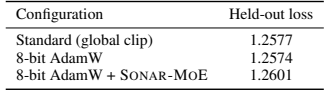
Table 7 . Held-out loss on OLMoE after 2,000 steps with 8-bit AdamW, compared with standard training from Table 1.
원문 · CC BY 4.0 · Avni Mittal, Avinash Anand, Ashutosh Kumar, Dikshant Kukreja, Kritarth Prasad, Chaitanya Lakhchaura, Rishitej Reddy Vyalla, Erik Cambria, Zhengkui Wang, Rajiv Ratn Shah · Sonar-MoE: In-Backward Expert Updates for Memory-Efficient Mixture-of-Experts Training · 원문 그림 인용 · 원본 PDF 8쪽에서 그림 영역을 추출했습니다.적용 범위와 남은 제약
이 방법의 적용 조건은 원문이 제시한 네 가지입니다. optimizer가 원소별이어야 하고, gradient가 microbatch 간에 누적되지 않아야 하며, expert가 batched 텐서로 저장되어야 하고, expert gradient가 global-norm clipping에 필요하지 않아야 합니다. 모든 결과는 한 대의 GPU에서 측정되었고, 데이터 병렬 학습에서는 all-reduce 뒤에 갱신해야 하므로 이 경우는 원문에서 다음 과제로 남아 있습니다. 실험은 최대 7B 파라미터 모델, Alpaca fine-tuning, 하나의 seed에 한정됩니다. 메모리 절감은 작은 batch에서 가장 크며, batch size 32에서는 할당 메모리 절감이 나타나지 않습니다.
저자들은 gradient checkpointing이 batch size 2에서 peak memory를 낮추지 않고 시간만 늘린다고 보고합니다.
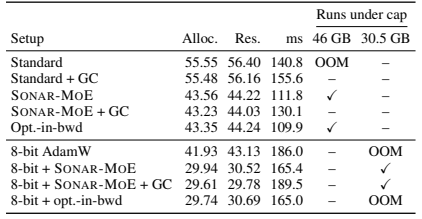
Table 6 . Memory composition on OLMoE at batch size 2 (300-step runs). Peak allocated and reserved memory in GB, step time in ms, and whether 300 steps completed with the PyTorch allocator capped at 46 GB (standing for a 48 GB GPU) or 30.5 GB (a 32 GB GPU). GC = gradient checkpointing; opt.-in-bwd = all-parameter optimizer-in-backward.
원문 · CC BY 4.0 · Avni Mittal, Avinash Anand, Ashutosh Kumar, Dikshant Kukreja, Kritarth Prasad, Chaitanya Lakhchaura, Rishitej Reddy Vyalla, Erik Cambria, Zhengkui Wang, Rajiv Ratn Shah · Sonar-MoE: In-Backward Expert Updates for Memory-Efficient Mixture-of-Experts Training · 원문 그림 인용 · 원본 PDF 7쪽에서 그림 영역을 추출했습니다.논문 정보
- 저자
- Avni Mittal, Avinash Anand, Ashutosh Kumar, Dikshant Kukreja, Kritarth Prasad, Chaitanya Lakhchaura, Rishitej Reddy Vyalla, Erik Cambria, Zhengkui Wang, Rajiv Ratn Shah
- 학회·저널
- arXiv · 프리프린트
- 최초 공개일
- 2026년 11월 2일
- 등록일
- 2026년 11월 4일
- 수정일
- 2026년 11월 2일
- 버전
- v1
- arXiv
- 2611.03577
- 분류
- cs.LG · cs.AI · cs.CL · cs.PF
- 원문 이용 조건
- CC BY 4.0
- 제공 범위
- 논문 정보, 해설, 허용된 원문 그림
AI 해설은 논문 원문과 별개의 설명이며 오류가 있을 수 있습니다. 원문과 그림은 각 출처의 이용 조건과 따로 표시된 권리를 따릅니다.
초록
Most parameters of a Mixture-of-Experts (MoE) model belong to its experts, and standard training keeps every expert gradient in GPU memory until the optimizer step. This memory grows with the number and size of the experts, so it rises as MoE models scale. We introduce Sonar-MoE, which updates each expert tensor during the backward pass and frees its gradient right away. It brings optimizer-in-backward from dense models to batched MoE expert tensors, so the GPU never holds more than one layer of expert gradients. When we fine-tune OLMoE-1B-7B and Granite-3.1-3B-A800M in bf16 with two expert-kernel backends, Sonar-MoE lowers peak memory by 19% to 22%. Its updates are bitwise identical to standard training without expert gradient clipping, and held-out loss stays within 0.003 of all baselines. Each step also takes 17% to 23% less time than standard training with global-norm clipping. Updating whole batched tensors rather than individual experts is what keeps Sonar-MoE fast, as it avoids a 20% to 72% slowdown while using the same memory. Sonar-MoE matches optimizer-in-backward over all parameters in memory and speed while still clipping the dense parameters.
원문 인용
Avni Mittal, Avinash Anand, Ashutosh Kumar, Dikshant Kukreja, Kritarth Prasad, Chaitanya Lakhchaura, Rishitej Reddy Vyalla, Erik Cambria, Zhengkui Wang, Rajiv Ratn Shah (2026). Sonar-MoE: In-Backward Expert Updates for Memory-Efficient Mixture-of-Experts Training. arXiv:2611.03577v1. https://arxiv.org/abs/2611.03577v1
BibTeX
@misc{mittal2026sonar,
  title = {{Sonar-MoE: In-Backward Expert Updates for Memory-Efficient Mixture-of-Experts Training}},
  author = {Avni Mittal and Avinash Anand and Ashutosh Kumar and Dikshant Kukreja and Kritarth Prasad and Chaitanya Lakhchaura and Rishitej Reddy Vyalla and Erik Cambria and Zhengkui Wang and Rajiv Ratn Shah},
  year = {2026},
  eprint = {2611.03577},
  archivePrefix = {arXiv},
  url = {https://arxiv.org/abs/2611.03577v1}
}