논문 해설
What Do Tokenizer Comparisons Measure? Disentangling Granularity, Root Assignment, and Word-Level Readout across Amharic and Hausa
토크나이저 비교는 무엇을 측정하는가? Amharic과 Hausa에 걸친 세분성, 어근 할당, 단어 수준 판독의 분리
- 연구 문제 BPE 대비 형태소 토크나이저의 이득이 어근 할당 때문인지, 더 잘게 나누는 세분화나 토큰 수준 읽기 방식 때문인지 분리되지 않습니다.
- 연구 방법 어근 식별자만 바꾼 대조군, BPE 세분화 스윕, 읽기 방식 교차 설계로 세 요인을 한 번에 하나씩 통제합니다.
- 주요 결과 처음부터 학습한 모델에서 읽기 방식은 비교의 방향을 뒤집었습니다.
토크나이저 비교만으로는 무엇이 효과를 만드는지 알 수 없는 이유
형태소 인식 토크나이저는 BPE보다 형태론적으로 풍부한 언어에서 성능이 좋다고 보고되어 왔습니다. 그런데 이 토크나이저는 세 가지를 동시에 바꿉니다. 텍스트를 더 잘게 나누고(granularity), 같은 어근을 가진 단어에 같은 토큰을 주며(root assignment), 토큰 수준 과제에서 단어 레이블을 여러 하위 토큰 상태 중 어떻게 읽을지(readout)가 달라집니다. 그래서 BPE와 두 조건만 비교하면 이득이 어디서 왔는지 가릴 수 없습니다. 이 논문은 암하라어 개체명 인식을 중심으로 이 세 요인을 한 번에 하나씩 바꾼 대조군으로 분리합니다.
어근 대조군과 세분화 통제 설계
핵심 설계는 실제 어근 할당을 기준으로 두고, 토큰 목록과 단어별 토큰 수, 파라미터 수를 유지한 채 어근 식별자만 바꾸는 대조군을 만드는 것입니다. 무작위 대조군(scrambled)은 분석 가능한 단어 유형마다 어근 식별자를 균등하게 뽑습니다. 치환 대조군(permuted)은 실제 어근 배정을 단어 유형 사이에서 무작위로 섞어 어근별 단어 수를 그대로 보존합니다. 층화 치환(stratified)은 코퍼스 빈도 데실 안에서만 섞어 빈도가 높은 단어가 높은 빈도의 식별자를 유지하게 합니다. 세분화는 BPE를 다섯 가지 어휘 크기로 학습해 기준 대비 약 1.0에서 2.3~2.4배의 fertility를 얻는 방식으로 조절합니다.
읽기 방식은 첫 하위 토큰 상태와 모든 하위 토큰 상태의 평균 풀링을 모든 토크나이저에 교차 적용합니다. 이때 readout gain은 평균 풀링 점수에서 첫 하위 토큰 점수를 뺀 값으로 정의됩니다.
어근 할당의 효과와 빈도 구조의 설명력
치환 대조군과 층화 대조군에 대해서는 테스트 문장 기준으로는 실제 어근이 높았지만, 한 실제 시드의 점수가 높아 시드 단위 검정은 유의하지 않았습니다. 이 시드를 뺀 네 시드에서는 무작위 대조군 대비 평균 +3.68 F1, 시드 기준 p=0.003이었습니다. 층화 치환 대비 차이는 분포 빈도 구조로 설명되는 부분이 작다는 의미로 동치 판정되었습니다.
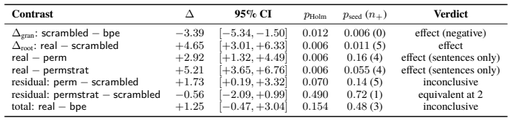
Table 6 : Study II identification family (pooled readout, F1 ×100). pseed: paired t-test over seeds; n+: number of seeds with a positive difference; verdicts at δ = 2 F1.
원문 · CC BY 4.0 · Abdul Rehman Antall, Baidya Nath Saha · What Do Tokenizer Comparisons Measure? Disentangling Granularity, Root Assignment, and Word-Level Readout across Amharic and Hausa · 원문 그림 인용 · 원본 PDF 19쪽에서 그림 영역을 추출했습니다.읽기 방식이 토크나이저 비교의 방향을 바꾸는 이유
이는 풀링이 토크나이저마다 다른 폭으로 점수를 올리기 때문입니다. 저자들은 이 차이를 읽기 교란으로 해석합니다. 연구 II의 처음부터 학습한 모델에서도 readout gain은 모두 양수(+2.7~+4.7 F1)였지만, fertility가 늘수록 커진다는 상호작용은 검출되지 않았습니다.

Table 5 : Study I Amharic NER by tokenizer and readout (F1×100, mean± between-seed SD). “Root token” reads the word label from the state of the root token.
원문 · CC BY 4.0 · Abdul Rehman Antall, Baidya Nath Saha · What Do Tokenizer Comparisons Measure? Disentangling Granularity, Root Assignment, and Word-Level Readout across Amharic and Hausa · 원문 그림 인용 · 원본 PDF 19쪽에서 그림 영역을 추출했습니다.세분화 효과가 언어에 따라 반대로 나타나는 이유
동일 용량의 BPE에서 세분화 효과는 두 언어에서 반대입니다. 암하라어는 기준 대비 1.97배까지 세분화하면 +7.7 F1 개선되고 2.42배에서는 기준선으로 돌아왔습니다. 저자들은 암하라어의 게즈 문자가 자음과 모음을 함께 묶는 특성을 원인으로 해석하지만, 두 언어만으로는 이를 확정할 수 없다고 명시합니다. 어근 대조군의 세분화 단계는 구현에 따라 달랐습니다. 그 결과 연구 II의 전체 비교(real − BPE)는 +1.25 F1로 검정이 확정되지 않았습니다.
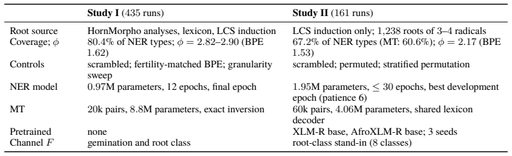
Table 4 : What Study II changes relative to Study I.
원문 · CC BY 4.0 · Abdul Rehman Antall, Baidya Nath Saha · What Do Tokenizer Comparisons Measure? Disentangling Granularity, Root Assignment, and Word-Level Readout across Amharic and Hausa · 원문 그림 인용 · 원본 PDF 18쪽에서 그림 영역을 추출했습니다.번역 결과의 적용 범위
연구 I의 번역 시스템에서 BPE 기준 목표 측 세분화는 두 언어 모두 점수를 낮췄습니다. 암하라어 ROOTPAT 설정은 0.95~1.47 chrF++ 낮았고, 무작위 대조군은 0.90 낮았으며, 하우사어 fertility 일치 BPE는 1.52 낮았습니다. 실제 어근과 무작위 어근의 차이는 −0.05 chrF++로 유의하지 않았지만, 분석기가 번역 단어의 59.7%만 다루므로 번역에서 어근 할당에 대한 결론은 내리지 않습니다. 따라서 번역 결과로 확정할 수 있는 것은 더 세분화된 목표 분할의 비용뿐입니다.
한 언어와 작은 모델이라는 제약
어근 결과는 암하라어 한 언어에서 두 분석기로 얻은 것입니다. 티그리냐어 확장은 개체명 인식 말뭉치가 없어 수행하지 못했습니다. 모델은 1,750문장으로 처음부터 학습한 약 1M~2M 파라미터의 인코더이며, 더 큰 모델이나 지속 pre-training에서는 검증하지 않았습니다. 시드는 5개여서 한 실행이 대조를 지배할 수 있고, 두 단계 부트스트랩은 수행하지 않았습니다. 번역은 종교 텍스트 비율이 약 44%이고 탐욕 디코딩을 썼으며, 연구 II의 번역 시스템은 낮은 점수 수준에서 원인이 진단되지 않았습니다.
논문 정보
- 저자
- Abdul Rehman Antall, Baidya Nath Saha
- 학회·저널
- arXiv · 프리프린트
- 최초 공개일
- 2026년 11월 10일
- 등록일
- 2026년 11월 13일
- 수정일
- 2026년 11월 10일
- 버전
- v1
- arXiv
- 2611.14818
- 분류
- cs.CL · cs.LG
- 원문 이용 조건
- CC BY 4.0
- 제공 범위
- 논문 정보, 해설, 허용된 원문 그림
AI 해설은 논문 원문과 별개의 설명이며 오류가 있을 수 있습니다. 원문과 그림은 각 출처의 이용 조건과 따로 표시된 권리를 따릅니다.
초록
Morphology-aware tokenizers are expected to help morphologically rich languages, and their reported gains over byte-pair encoding (BPE) are usually credited to their linguistic units. A comparison with BPE cannot support this attribution, since such a tokenizer also segments text more finely (granularity) and, on token-level tasks, changes how much the sub-token readout matters. We separate both factors from the effect of grouping words by their roots (root assignment) in Amharic, a Semitic language whose Ge'ez abugida hides consonantal roots inside syllabic glyphs, with Latin-script Hausa as an orthographic contrast. Our design combines a lossless root-and-pattern tokenizer with controls that change one factor at a time, in two independent implementations. In both, real root assignment improves Amharic named-entity recognition over scrambled roots (+4.9 and +4.7 F1), and root-frequency structure explains little of this gain. In small from-scratch models, the readout choice moves F1 by up to 13.4 points and reverses the sign of every comparison of the root-and-pattern arms with BPE, whereas in two pretrained encoders it moves F1 by less than one point. The granularity effect changes sign across languages and implementations. We recommend decomposing tokenizer effects, and reporting the readout, before a gain is attributed to linguistic structure.
원문 인용
Abdul Rehman Antall, Baidya Nath Saha (2026). What Do Tokenizer Comparisons Measure? Disentangling Granularity, Root Assignment, and Word-Level Readout across Amharic and Hausa. arXiv:2611.14818v1. https://arxiv.org/abs/2611.14818v1
BibTeX
@misc{antall2026what,
  title = {{What Do Tokenizer Comparisons Measure? Disentangling Granularity, Root Assignment, and Word-Level Readout across Amharic and Hausa}},
  author = {Abdul Rehman Antall and Baidya Nath Saha},
  year = {2026},
  eprint = {2611.14818},
  archivePrefix = {arXiv},
  url = {https://arxiv.org/abs/2611.14818v1}
}