논문 해설
Large language models as oracles for instantiating ontologies with domain-specific knowledge
도메인 특화 지식으로 온톨로지를 구현하기 위한 오라클로서의 대규모 언어 모델
- 연구 문제 기존 온톨로지 인구화는 수작업이나 말뭉치 기반 추출에 의존하여 시간·오류·편향 또는 품질 저하 문제가 있습니다.
- 연구 방법 KGFiller는 부분 초기화된 온톨로지와 질의 템플릿으로 LLM 오라클에 질의하여 개체 생성, 관계 생성, 재분배, 병합의 네 단계로 인스턴스를 채웁니다.
- 주요 결과 식품 영양 온톨로지 사례에서 GPT 3.5 Turbo는 Q 0.924를, Harvest 비교에서는 KGFiller가 보고된 모든 지표에서 우수했습니다. 이 결과는 해당 사례 연구의 설정에 한정됩니다.
온톨로지 인스턴스 채우기의 어려움
온톨로지에 도메인 지식을 담으려면 클래스와 속성으로 이루어진 스키마를 만든 뒤, 그 안에 개체와 관계를 채우는 인구화(population) 작업이 필요합니다. 이 작업은 전문가가 수작업으로 수행하는 경우가 많아 시간이 많이 들고 오류와 개인의 편향이 섞이기 쉽습니다. 반대로 텍스트 말뭉치에서 자동으로 추출하는 방법은 빠르지만, 말뭉치가 편향되거나 불완전하면 결과 온톨로지의 품질이 낮아집니다.
원문은 이 문제를 해결하기 위해 대규모 언어모델(LLM)을 오라클로 사용하는 방법을 제안합니다. 이 방법은 LLM이 웹 규모의 pre-training으로 도메인 지식을 상당량 담고 있다는 가정에 기대며, 별도의 말뭉치 없이 기존 스키마에 인스턴스를 채우는 것을 목표로 합니다.
KGFiller의 네 단계 작동 방식
KGFiller는 부분적으로 초기화된 온톨로지, 질의 템플릿, LLM 오라클을 입력으로 받습니다. 템플릿은 개체 탐색, 관계 탐색, 최적 클래스 매칭, 개체 병합의 네 종류이며, 각 템플릿의 자리표시자에 클래스나 속성, 개체 이름을 채워 질문을 만듭니다.
알고리즘은 네 단계로 실행됩니다. 먼저 개체 생성 단계에서 각 클래스에 대해 LLM에 질의하여 새 개체를 얻고 해당 클래스에 추가합니다. 다음으로 관계 생성 단계에서 각 속성에 대해 도메인 개체마다 관계 탐색 질문을 던져 관계와 새 범위 개체를 추가합니다. 재분배 단계에서는 최적 클래스 매칭 질의로 각 개체를 가장 구체적인 하위 클래스에 옮깁니다. 마지막으로 병합 단계에서 문자열이 유사한 개체 쌍을 찾고, 온도 0.0으로 LLM에 의미상 중복 여부를 묻어 병합합니다. 이 순서는 개체 생성이 관계 단계의 입력이 되고, 관계 단계가 다시 새 개체를 만들 수 있으므로 재분배가 필요하다는 점에 근거합니다.
사례 연구 설정과 LLM 비교
검증은 식품 영양 도메인의 온톨로지를 사용한 사례 연구로 이루어졌습니다. 온톨로지는 최상위 클래스 Edible 아래 54개 클래스로 구성되며, 레시피와 식재료를 연결하는 ingredientOf 속성을 포함합니다. 온톨로지는 처음에 개체가 없는 골격 상태에서 출발합니다.
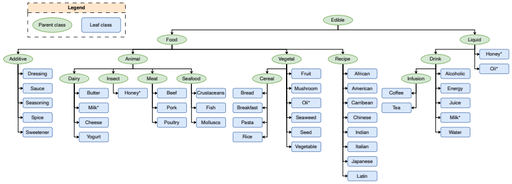
Figure 3 : Class hierarchy of the case study ontology. Notice that the hierarchy is not really a tree, but rather a DAG. The asterisk (*) denotes classes having multiple super-classes (they are depicted once per super-class for the sake of readability).
원문 · CC BY 4.0 · Giovanni Ciatto, Andrea Agiollo, Matteo Magnini, Andrea Omicini · Large language models as oracles for instantiating ontologies with domain-specific knowledge · 원문 그림 인용 · 원본 PDF 15쪽에서 그림 영역을 추출했습니다.연구진은 GPT 3.5 Turbo, GPT 4 Turbo, Openchat, Llama2, Mistral, Gemma, Mixtral, Nous Hermes의 여러 LLM 오라클을 같은 KGFiller 파이프라인에 넣어 비교했습니다. 결과의 정확성은 연구진이 수동으로 검사하여 판단했으며, 품질 지표 Q는 정확한 개체와 관계의 수를 전체 생성 수로 나눈 값으로 정의됩니다. 상대 개체 오류율 RIE와 상대 관계 오류율 RRE도 함께 보고됩니다. 표 2에서 GPT 3.5 Turbo는 Q가 0.924, RIE가 0.0861, RRE가 0.0693으로 보고되었고, GPT 4 Turbo는 Q가 0.896으로 보고되었습니다.
이 수치는 이 사례 연구의 온톨로지와 설정에서 얻은 결과입니다.
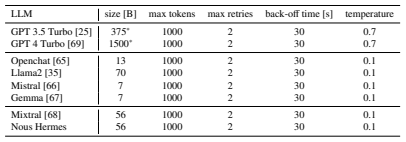
Table 1 : Size (number of parameters) and experiments setup of the dif- ferent LLMs used in KGFiller. Values reported with∗ are an educated estimate – not confirmed –, as the corresponding models have not be fully disclosed to the public.
원문 · CC BY 4.0 · Giovanni Ciatto, Andrea Agiollo, Matteo Magnini, Andrea Omicini · Large language models as oracles for instantiating ontologies with domain-specific knowledge · 원문 그림 인용 · 원본 PDF 16쪽에서 그림 영역을 추출했습니다.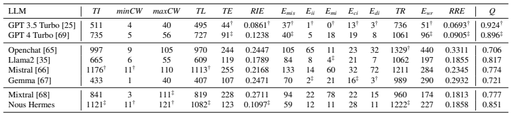
Table 2 : Performance of KGFiller over different state-of-the-art LLMs. For each performance metric (column) we denote with† and‡ the best and second best performing model respectively.
원문 · CC BY 4.0 · Giovanni Ciatto, Andrea Agiollo, Matteo Magnini, Andrea Omicini · Large language models as oracles for instantiating ontologies with domain-specific knowledge · 원문 그림 인용 · 원본 PDF 20쪽에서 그림 영역을 추출했습니다.Harvest와의 비교와 결과의 범위
저자들은 같은 온톨로지 스키마에서 Harvest를 실행해 KGFiller와 같은 지표로 평가했습니다. Harvest는 RoBERTa base, RoBERTa large, BERT large cased 모델로 비교되었고, 보고된 Q는 0.2465, 0.2646, 0.1680입니다. 같은 비교에서 KGFiller의 최고 결과는 Q 0.924, RIE 0.0861로 보고되어, 연구진은 KGFiller가 모든 지표에서 Harvest보다 우수하다고 해석합니다.

Table 5 : Performance of Harvest [59] over different state-of-the-art pre-trained models.
원문 · CC BY 4.0 · Giovanni Ciatto, Andrea Agiollo, Matteo Magnini, Andrea Omicini · Large language models as oracles for instantiating ontologies with domain-specific knowledge · 원문 그림 인용 · 원본 PDF 23쪽에서 그림 영역을 추출했습니다.다만 이 비교는 Harvest의 원래 설정을 이 온톨로지에 맞춰 재실행한 결과이며, 여기서 얻은 우위는 본 사례 연구의 설정과 평가 기준에 한정됩니다. 원문에서 Harvest는 문서 없이 작동하며 학습이 필요 없는 가장 비교 가능한 선행 방법으로 선택되었습니다.
환각과 정확성의 한계
KGFiller는 LLM의 환각 문제를 그대로 물려받습니다. 원문은 Mistral이 화학요법 주입을 주입 클래스의 개체로 제안한 사례를 들며, 이런 잘못된 개체는 문법적으로 맞고 의미상 그럴듯해 자동 후처리에서 걸러지지 않는다고 설명합니다. 또한 Gemma는 식용 버섯 클래스에 독성 있는 Amanita muscaria를 제안했으며, 연구진은 같은 모델에 따로 물었을 때 이 버섯이 독성이라고 답했다고 보고합니다.
따라서 온톨로지에 추가된 정보가 사실이라는 보장은 없으며, 특히 사용자 신뢰가 낮은 환경에서 결과를 그대로 쓰는 것은 위험합니다. 원문은 완전성과 편향, 모델 업데이트에 따른 불안정성, 특정 LLM에 대한 종속도 한계로 함께 논의합니다.
논문 정보
- 저자
- Giovanni Ciatto, Andrea Agiollo, Matteo Magnini, Andrea Omicini
- 학회·저널
- arXiv · 프리프린트
- 최초 공개일
- 2024년 4월 5일
- 등록일
- 2026년 11월 6일
- 수정일
- 2024년 12월 12일
- 버전
- v2
- arXiv
- 2404.04108
- DOI
- 10.1016/j.knosys.2024.112940
- 분류
- cs.AI · cs.CL · cs.IR · cs.LG · cs.LO
- 원문 이용 조건
- CC BY 4.0
- 제공 범위
- 논문 정보, 해설, 허용된 원문 그림
AI 해설은 논문 원문과 별개의 설명이며 오류가 있을 수 있습니다. 원문과 그림은 각 출처의 이용 조건과 따로 표시된 권리를 따릅니다.
초록
Background. Endowing intelligent systems with semantic data commonly requires designing and instantiating ontologies with domain-specific knowledge. Especially in the early phases, those activities are typically performed manually by human experts possibly leveraging on their own experience. The resulting process is therefore time-consuming, error-prone, and often biased by the personal background of the ontology designer. Objective. To mitigate that issue, we propose a novel domain-independent approach to automatically instantiate ontologies with domain-specific knowledge, by leveraging on large language models (LLMs) as oracles. Method. Starting from (i) an initial schema composed by inter-related classes and properties and (ii) a set of query templates, our method queries the LLM multiple times, and generates instances for both classes and properties from its replies. Thus, the ontology is automatically filled with domain-specific knowledge, compliant to the initial schema. As a result, the ontology is quickly and automatically enriched with manifold instances, which experts may consider to keep, adjust, discard, or complement according to their own needs and expertise. Contribution. We formalise our method in general way and instantiate it over various LLMs, as well as on a concrete case study. We report experiments rooted in the nutritional domain where an ontology of food meals and their ingredients is automatically instantiated from scratch, starting from a categorisation of meals and their relationships. There, we analyse the quality of the generated ontologies and compare ontologies attained by exploiting different LLMs. Experimentally, our approach achieves a quality metric that is up to five times higher than the state-of-the-art, while reducing erroneous entities and relations by up to ten times. Finally, we provide a SWOT analysis of the proposed method.
원문 인용
Giovanni Ciatto, Andrea Agiollo, Matteo Magnini, Andrea Omicini (2024). Large language models as oracles for instantiating ontologies with domain-specific knowledge. arXiv:2404.04108v2. https://doi.org/10.1016/j.knosys.2024.112940
BibTeX
@article{ciatto2024large,
  title = {{Large language models as oracles for instantiating ontologies with domain-specific knowledge}},
  author = {Giovanni Ciatto and Andrea Agiollo and Matteo Magnini and Andrea Omicini},
  year = {2024},
  eprint = {2404.04108},
  archivePrefix = {arXiv},
  doi = {10.1016/j.knosys.2024.112940},
  url = {https://arxiv.org/abs/2404.04108v2}
}