논문 해설
Sentiment Analysis in Finance: From Transformers Back to eXplainable Lexicons (XLex)
- 연구 문제 금융 감성 분석의 수동 주석 사전은 구축과 갱신에 많은 노력이 들고 어휘 범위가 제한되어 있습니다.
- 연구 방법 XLex는 금융 문장으로 미세조정한 트랜스포머 감성 모델과 SHAP 설명을 이용해 단어별 긍정·부정 기여도를 추출하고, 이를 LM 사전과 결합하여 문장 단위 극성을 판정합니다.
- 주요 결과 XLex는 LM보다 평균 정확도가 0.431 높았고 XLex+LM은 0.450 높았습니다. 최고 정확도는 nasdaq 소스 사전을 financial_phrase_bank에 적용한 XLex+LM 모델의 84.3%입니다.
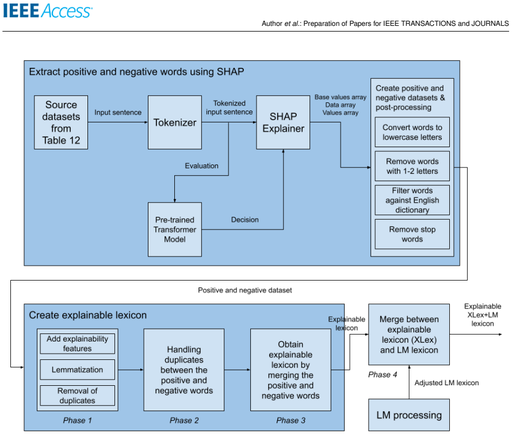
FIGURE 1 : Architecture of the data processing pipeline for generating the explainable lexicon (XLex). The upper section of the figure, labeled as “Extract positive and negative words using SHAP”, illustrates the word extraction process using SHAP, followed by post-processing steps to generate separate positive and negative word datasets from the chosen source datasets. The lower section of the figure, referred to as “Create explainable lexicon”, encompasses adding explainability features, handling duplicates, and merging the positive and negative datasets to form the comprehensive explainable lexicon XLex. The pipeline concludes by merging XLex with the Loughran-McDonald (LM) lexicon, resulting in the combined XLex+LM lexicon.
원문 · CC BY 4.0 · Maryan Rizinski, Hristijan Peshov, Kostadin Mishev, Milos Jovanovik, Dimitar Trajanov · Sentiment Analysis in Finance: From Transformers Back to eXplainable Lexicons (XLex) · 원문 그림 인용 · 원본 PDF 6쪽에서 그림 영역을 추출했습니다.연구 문제: 수동 주석 사전의 한계
금융 감성 분석에서 Loughran-McDonald(LM) 사전은 전문가가 수동으로 주석을 단 기준 어휘 사전으로 널리 쓰입니다. 그러나 이 사전은 создание과 유지·갱신에 많은 수작업이 필요하며, 10-K 보고서에서 빈도가 50 이상인 단어만 선별했기 때문에 많은 문장의 단어를 포괄하지 못합니다. 이 논문은 트랜스포머 모델의 강점과 사전 기반 방법의 단순성·해석 가능성을 결합하는 것을 목표로 합니다. 트랜스포머는 성능이 높지만 많은 데이터와 계산 자원을 요구하고 예측 시간이 길어 실시간 환경에 부담이 됩니다.
XLex의 단어 추출 방법
XLex는 금융 문장으로 미세조정한 RoBERTa-Large 기반 감성 분류 모델에 SHAP 설명기를 적용하여 각 문장에서 단어별 기여도를 계산합니다. SHAP은 Shapley 값으로 각 특징의 기여도를 할당하며, 입력이 전혀 없을 때의 기준값인 base value에서 출발해 단어 기여도를 더하는 방식으로 예측을 설명합니다. 양의 기여를 한 단어는 긍정 데이터셋에, 음의 기여를 한 단어는 부정 데이터셋에 모이며, 각 단어에 대해 평균·합·최댓값·최솟값과 출현 횟수가 저장됩니다. 이후 소문자화, 한두 글자 항목 제거, 영어 사전에 없는 단어 제거, 불용어 제거의 후처리를 거칩니다.
중복 처리와 사전 병합
표제어화 이후 서로 다른 형태의 단어가 같은 기본형을 가지므로 중복이 생깁니다. 같은 범주 안의 중복에서는 출현 횟수와 합 SHAP 값을 합산하고, 최댓값과 최솟값은 각각 최대·최소로 집계하며, 평균 SHAP 값은 합을 출현 횟수로 나누어 다시 계산합니다. 긍정과 부정 집합에 동시에 나타난 단어는 합 SHAP 값을 비교하여 큰 쪽에 배정합니다. 배정되지 않은 쪽의 값은 opposite 특징으로 옮기고, 선택된 범주의 평균 SHAP 값을 두 범주 평균 합으로 나눈 SHAP ratio를 계산합니다. 이후 두 범주를 Category 특징으로 구분하여 하나의 XLex 사전으로 합칩니다.
LM 사전과의 결합과 예측 규칙
LM 사전의 단어에는 XLex와 같은 특징을 채우되, 선택된 범주의 특징은 1로, opposite 특징은 0으로 둡니다. 두 사전은 src 특징과 접두사 XLex·LM으로 구분하여 병합하며, 한쪽에 없는 단어의 특징은 0으로 처리합니다. 문장 감성 판정에서는 SHAP avg, SHAP ratio, count 중 선택한 특징의 합인 누적 값을 범주별로 계산하고, 부정 범주의 누적 값에는 −1을 곱합니다. 여러 사전 항목의 감성 값을 문장 단위로 합산하고, 합이 0보다 크면 positive, 0보다 작으면 negative, 그 밖에는 neutral로 판정합니다. 계수 cxlp, cxlo, clmp, clmo는 각 사전과 범주의 영향력을 조절합니다.
데이터와 격자 탐색 설정
소스 데이터셋은 nasdaq, financial_phrase_bank, fiqa_fpb_sentfin_neutral 세 가지이며, 평가 데이터셋은 financial_phrase_bank, fiqa_labeled_df, sem_eval, fpb_fiqa입니다. 단 financial_phrase_bank 사전과 financial_phrase_bank 평가 조합은 편향을 피하려고 평가에서 제외했습니다. 계수 후보는 0.1, 0.3, 0.5, 0.7, 0.9이며 clmo는 LM 사전에 opposite 단어가 없으므로 0.5로 고정합니다. 계수 조합은 accuracy, F1, MCC를 평균한 집계 값으로 평가되며, 그 결과 (cxlp, cxlo, clmp, clmo)=(0.3, 0.1, 0.1, 0.5)가 선택되었습니다.
이 탐색은 격자 해상도가 낮은 단순 탐색이었습니다.
정확도 결과와 LM 대비 개선
RoBERTa 기반 실험에서 LM 단독 사전은 평가 데이터 전체에서 낮은 정확도를 보였는데, 이는 LM 사전이 많은 문장의 단어를 포함하지 않아 응답하지 못한 문장이 많기 때문입니다. XLex는 평균 정확도에서 LM보다 0.431 높았고, XLex+LM은 0.450 높았습니다. 최고 정확도 84.3%는 nasdaq 소스 사전을 financial_phrase_bank 데이터셋에 적용한 XLex+LM 모델에서 나타났습니다. FinBERT 기반 실험에서도 XLex와 XLex+LM이 LM보다 높은 정확도를 보였으며, 평균 차이는 각각 0.463과 0.479로 보고됩니다. LM이 답을 낸 부분집합에서는 XLex가 LM과 비슷하거나 약간 낮은 결과를 보였고, XLex+LM은 대부분 더 높았습니다.
처리 속도·크기와 해석 가능성
CPU 환경에서 XLex 기반 모델은 RoBERTa 모델보다 약 87배, FinBERT 모델보다 약 21배 빠른 처리 시간을 보고합니다. 모델 크기는 XLex 사전이 202KB에서 363KB, RoBERTa는 1.32GB, FinBERT는 417.8MB입니다. 이러한 효율 측정은 사전 기반 모델과 트랜스포머 모델의 실행 비용을 비교한 것이며, 정확도 실험과 같은 체크포인트의 결과로 읽지 않습니다. 해석 가능성은 사전의 규칙과 단어별 점수가 직접 보인다는 점에서 저자들이 강조하는 장점이지만, 이는 저자의 해석이며 사용자 평가로 검증된 결과는 아닙니다.
적용 범위와 한계
이 결과는 금융 문장 데이터셋과 RoBERTa 또는 FinBERT 기반 SHAP 추출에 한정됩니다. 하이퍼파라미터 탐색은 상대적으로 낮은 해상도의 grid search로 수행되었으므로 더 세밀한 탐색에서 달라질 수 있습니다. LM 사전 단독 결과가 낮은 이유는 주로 어휘 범위의 부족이며, 저자들은 이를 사전의 한계로 해석합니다. 전문가 검토를 거친 사전 승인은 본 논문에서 수행되지 않았으므로, 다른 영역에 그대로 적용하려면 추가 검증이 필요합니다.
논문 정보
- 저자
- Maryan Rizinski, Hristijan Peshov, Kostadin Mishev, Milos Jovanovik, Dimitar Trajanov
- 학회·저널
- arXiv · 프리프린트
- 최초 공개일
- 2023년 6월 6일
- 등록일
- 2026년 11월 6일
- 수정일
- 2024년 3월 26일
- 버전
- v3
- arXiv
- 2306.03997
- DOI
- 10.1109/access.2024.3349970
- 분류
- cs.CL
- 원문 이용 조건
- CC BY 4.0
- 제공 범위
- 논문 정보, 해설, 허용된 원문 그림
AI 해설은 논문 원문과 별개의 설명이며 오류가 있을 수 있습니다. 원문과 그림은 각 출처의 이용 조건과 따로 표시된 권리를 따릅니다.
초록
Lexicon-based sentiment analysis (SA) in finance leverages specialized, manually annotated lexicons created by human experts to extract sentiment from financial texts. Although lexicon-based methods are simple to implement and fast to operate on textual data, they require considerable manual annotation efforts to create, maintain, and update the lexicons. These methods are also considered inferior to the deep learning-based approaches, such as transformer models, which have become dominant in various NLP tasks due to their remarkable performance. However, transformers require extensive data and computational resources for both training and testing. Additionally, they involve significant prediction times, making them unsuitable for real-time production environments or systems with limited processing capabilities. In this paper, we introduce a novel methodology named eXplainable Lexicons (XLex) that combines the advantages of both lexicon-based methods and transformer models. We propose an approach that utilizes transformers and SHapley Additive exPlanations (SHAP) for explainability to learn financial lexicons. Our study presents four main contributions. Firstly, we demonstrate that transformer-aided explainable lexicons can enhance the vocabulary coverage of the benchmark Loughran-McDonald (LM) lexicon, reducing the human involvement in annotating, maintaining, and updating the lexicons. Secondly, we show that the resulting lexicon outperforms the standard LM lexicon in SA of financial datasets. Thirdly, we illustrate that the lexicon-based approach is significantly more efficient in terms of model speed and size compared to transformers. Lastly, the XLex approach is inherently more interpretable than transformer models as lexicon models rely on predefined rules, allowing for better insights into the results of SA and making the XLex approach a viable tool for financial decision-making.
원문 인용
Maryan Rizinski, Hristijan Peshov, Kostadin Mishev, Milos Jovanovik, Dimitar Trajanov (2023). Sentiment Analysis in Finance: From Transformers Back to eXplainable Lexicons (XLex). arXiv:2306.03997v3. https://doi.org/10.1109/access.2024.3349970
BibTeX
@article{rizinski2023sentiment,
  title = {{Sentiment Analysis in Finance: From Transformers Back to eXplainable Lexicons (XLex)}},
  author = {Maryan Rizinski and Hristijan Peshov and Kostadin Mishev and Milos Jovanovik and Dimitar Trajanov},
  year = {2023},
  eprint = {2306.03997},
  archivePrefix = {arXiv},
  doi = {10.1109/access.2024.3349970},
  url = {https://arxiv.org/abs/2306.03997v3}
}