논문 해설
Explainable Autonomous Cyber Defense using Adversarial Multi-Agent Reinforcement Learning
적대적 다중 에이전트 강화학습을 활용한 설명 가능한 자율 사이버 방어
- 연구 문제 상관 기반 자율 사이버 방어는 모호하거나 적대적인 텔레메트리에서 과잉 대응과 오탐을 일으킬 수 있습니다. 이 논문은 인과 구조 제약과 적대적 이중 정책을 결합하는 것이 이 문제를 줄이는지 검토합니다.
- 연구 방법 C-MADF는 텔레메트리로부터 SCM을 학습하고 이를 MDP-DAG 로드맵으로 컴파일하여 허용 전이를 제한합니다. Blue-Team과 Red-Team 정책의 불일치와 ETS를 사용해 자율 실행 또는 사람 에스컬레이션을 결정합니다.
- 주요 결과 CICIoT2023에서 C-MADF는 정밀도 0.997, 재현율 0.961, F1 0.979, FPR 1.8%를 보고하며, 비교 기준선의 FPR 8.4%~11.2%보다 낮습니다. 절제 실험에서는 Causal SCM 제거 시 FPR이 59.4%로 크게 높아집니다.
자율 사이버 방어의 상관 기반 오탐 문제
자율 사이버 방어 에이전트는 빠르게 대응하지만, 적대적이거나 모호한 텔레메트리 아래에서는 상관관계에만 기반한 자동화가 정상 행동을 악성으로 분류하고 불필요한 완화 조치를 실행할 수 있습니다. 원문은 이러한 실패를 APT의 Living off the Land 기법과 텔레메트리 교란이 만드는 문제로 제시합니다. 이 논문은 인과 구조, 제약된 행동 공간, 적대적 이중 정책 검토, 설명 가능한 에스컬레이션을 하나의 파이프라인으로 결합하는 것을 목표로 합니다. 따라서 질문은 인과적으로 허용된 전이만 사용하면 오탐을 줄일 수 있는지, 그리고 정책 불일치와 ETS가 실행 여부를 판단하는 신호로 작동할 수 있는지입니다.
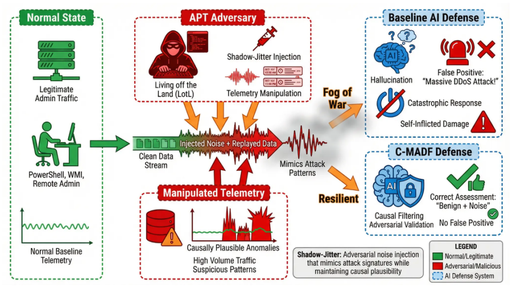
Fig. 1 . Illustration of a Shadow-Jitter telemetry manipulation scenario. Controlled perturbations in host and network logs distort apparent event correlations, leading an unconstrained correlation-based defense to misclassify benign activity as malicious. In contrast, C-MADF applies causal filtering and adversarial dual-policy validation within a constrained MDP-DAG structure, reducing spurious mitigation actions under ambiguous observations.
원문 · CC BY 4.0 · Yiyao Zhang, Diksha Goel, Hussain Ahmad · Explainable Autonomous Cyber Defense using Adversarial Multi-Agent Reinforcement Learning · 원문 그림 인용 · 원본 PDF 7쪽에서 그림 영역을 추출했습니다.SCM에서 MDP-DAG 로드맵까지의 구조
C-MADF는 과거 텔레메트리에서 제약 기반 인과 탐색으로 DAG를 추정하고, 이를 구조방정식을 가진 SCM으로 해석합니다. 이어서 학습된 인과 그래프를 조사 단계의 MDP-DAG 로드맵으로 컴파일합니다. 로드맵에서 허용된 전이는 학습된 그래프에서 나온 연결이며, 행동 마스킹은 허용되지 않은 행동의 확률을 0으로 만들어 학습과 실행이 허용된 상태-행동 공간 안에서만 이루어지게 합니다. 원문은 신뢰도가 임계값을 넘는 전이를 강한 구조 제약으로, 낮은 전이를 약한 제약으로 나눕니다. 이 구분은 낮은 신뢰도 전이를 영구히 제거하지 않고 감시와 에스컬레이션을 강화하는 방식으로 다룹니다.
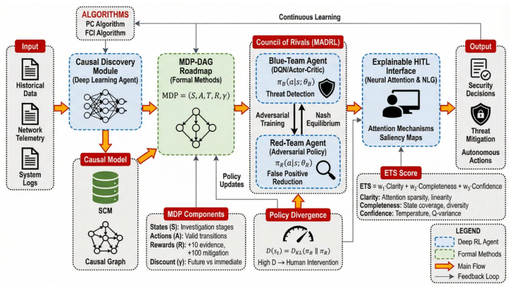
Fig. 2 . The architecture of the Causal Multi-Agent Decision Framework (C-MADF). The process begins with the Causal Discovery Module learning a causal model from data. This model informs the MDP-DAG Roadmap, which provides a verifiable structure for investigations. The Council of Rivals, consisting of a Blue-Team and a Red-Team agent, deliberates on the best course of action within this roadmap. Their debate and the resulting policy divergence are fed into the Explainable Human-in-the-Loop Interface, which computes the ETS and presents a clear recommendation to the supervisory adjudication.
원문 · CC BY 4.0 · Yiyao Zhang, Diksha Goel, Hussain Ahmad · Explainable Autonomous Cyber Defense using Adversarial Multi-Agent Reinforcement Learning · 원문 그림 인용 · 원본 PDF 9쪽에서 그림 영역을 추출했습니다.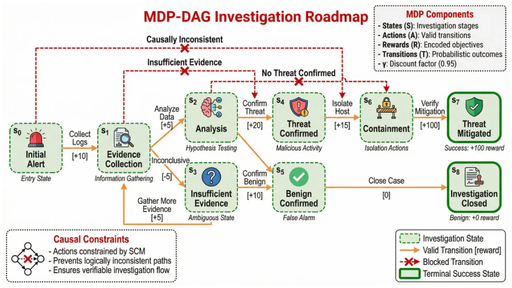
Fig. 3 . The MDP-DAG Investigation Roadmap showing valid state transitions (orange arrows with reward values) and causally inconsistent blocked transitions (red X). The roadmap constrains the action space to ensure verifiable investigation flows, preventing logically inconsistent paths such as jumping directly from Initial Alert to Threat Mitigated without sufficient evidence collection.
원문 · CC BY 4.0 · Yiyao Zhang, Diksha Goel, Hussain Ahmad · Explainable Autonomous Cyber Defense using Adversarial Multi-Agent Reinforcement Learning · 원문 그림 인용 · 원본 PDF 10쪽에서 그림 영역을 추출했습니다.Council of Rivals와 정책 불일치 신호
Council of Rivals에서 Blue-Team 정책은 위협 완화 효용을 최대화하도록 학습되고, Red-Team 정책은 근거가 부족한 개입을 벌하는 보수적 보상으로 학습됩니다. 원문은 이 둘이 고전적 제로섬 적대 게임이 아니라 같은 제약 MDP-DAG 위의 비대칭 목적 함수라고 명시합니다. 두 정책은 같은 허용 행동 집합 안에서 행동을 제안하고 비교하며, 정책 불일치는 Policy Divergence Score D(s_t)로 측정됩니다. 원문은 D(s_t)가 임계값을 넘으면 자율 실행을 멈추고 사람 개입으로 넘긴다고 설명합니다. 학습은 Double DQN과 독립된 재생 버퍼를 사용하는 self-play로 이루어집니다.
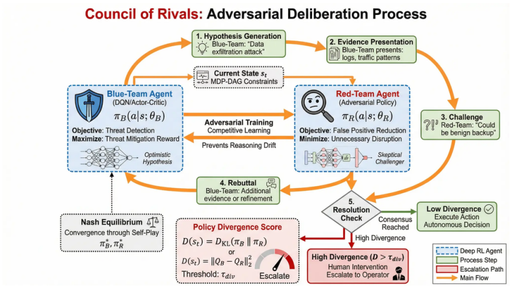
Fig. 4 . Council of Rivals adversarial deliberation architecture. At each investigation states t in the causally constrained MDP-DAG, the Blue-Team policy proposes a mitigation action based on its learned value estimates, while the Red-Team policy evaluates and challenges the proposal under a conservatively shaped objective. The interaction proceeds through iterative hypothesis evaluation, evidential justification, and action arbitration within the constrained action space. Inter-policy disagreement is quantified via the Policy Divergence ScoreD(s t), which serves as an epistemic uncertainty signal and triggers human escalation whenD(s t)> τdiv. The policies are trained via self-play in a two-player stochastic game defined over the MDP-DAG, yielding stabilized adversarial decision policies.
원문 · CC BY 4.0 · Yiyao Zhang, Diksha Goel, Hussain Ahmad · Explainable Autonomous Cyber Defense using Adversarial Multi-Agent Reinforcement Learning · 원문 그림 인용 · 원본 PDF 12쪽에서 그림 영역을 추출했습니다.ETS 계산과 에스컬레이션 게이팅
ETS는 명확성, 완결성, 신뢰도 세 구성 요소의 가중합으로 정의되며 모든 하위 점수를 [0,1]로 정규화합니다. 명확성은 주의 분포의 엔트로피, 가치 함수의 국소 선형 충실도, 행동 순위의 안정성을 포함합니다. 완결성은 재생 버퍼의 상태 밀도와 유사 상태에서 관찰된 행동 분포의 엔트로피를 포함합니다. 신뢰도는 최적 행동의 정책 온도, 가치의 부트스트랩 분산, 그리고 D(s_t)의 단조 변환을 포함합니다. 원문은 ETS를 사람 신뢰의 주관적 점수가 아니라 시스템 내부 결정 신뢰도의 대리 지표로 설명합니다. 실행 알고리즘에서는 ETS가 임계값보다 낮거나 D(s_t)가 임계값을 넘으면 에스컬레이션합니다.
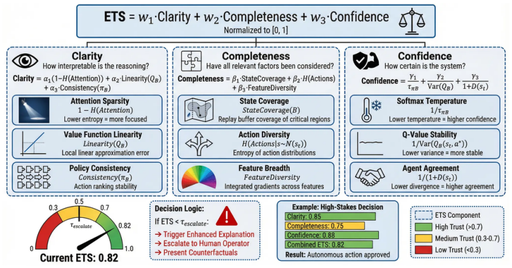
Fig. 5 . Illustrative decomposition of the ETS into its three primary components, Clarity, Completeness, and Confidence, and their respective sub-metrics. The figure visualizes the aggregation structure used to compute ETS(s t)and demonstrates how the resulting score is compared against the escalation threshold τescalate. In this example, ETS(s t) = 0.82exceeds the calibrated threshold, and the system proceeds without mandatory human escalation. When ETS(s t) falls below the threshold, structured explanation artifacts and human oversight are triggered.
원문 · CC BY 4.0 · Yiyao Zhang, Diksha Goel, Hussain Ahmad · Explainable Autonomous Cyber Defense using Adversarial Multi-Agent Reinforcement Learning · 원문 그림 인용 · 원본 PDF 14쪽에서 그림 영역을 추출했습니다.CICIoT2023 기준선 비교와 절제 결과
CICIoT2023 실험에서 C-MADF는 정밀도 0.997, 재현율 0.961, F1 0.979, FPR 1.8%를 보고합니다. 같은 분할과 텔레메트리 채널에서 DUGAT-LSTM, BiLSTM IDS, Hybrid Weighted-XGBoost의 FPR은 각각 11.2%, 9.7%, 8.4%로 제시됩니다. 결과는 세 random seed의 평균이며 표준편차는 0.02 미만으로 보고됩니다. 절제 실험에서 Causal SCM을 제거하면 FPR이 59.4%, Red Team을 제거하면 21.2%, Blue Team을 제거하면 25.1%로 나타납니다. 이 수치들은 각 구성 요소를 유지했을 때의 오탐 억제 효과를 보여 주는 관찰이며, 학습 예산과 데이터셋 범위 안의 결과로 읽어야 합니다.
외부 타당성과 ETS 검증의 한계
원문은 CICIoT2023이 실험실 환경에서 수집된 벤치마크이며, 운영 로그에서의 외부 타당성은 아직 열린 실증 질문이라고 명시합니다. 또한 ETS는 벤치마크 기반 신뢰도 기준과 정렬되는 예비 결과를 보였을 뿐, 실제 운영 신뢰성을 확정하는 증거로 제시되지 않습니다. 보안 분석의 보장도 학습된 인과 모델의 품질과 경계 조건에 조건부이며, 전체 상태 공간의 모델 검사를 대신하지 않습니다. 따라서 이 논문의 결과는 설계 원칙을 지지하는 근거로 읽어야 하며, 실제 배포 준비 상태를 뜻하지 않습니다.
논문 정보
- 저자
- Yiyao Zhang, Diksha Goel, Hussain Ahmad
- 학회·저널
- arXiv · 프리프린트
- 최초 공개일
- 2026년 4월 6일
- 등록일
- 2026년 11월 6일
- 수정일
- 2026년 4월 6일
- 버전
- v1
- arXiv
- 2604.04442
- 분류
- cs.CR · cs.LG · cs.MA
- 원문 이용 조건
- CC BY 4.0
- 제공 범위
- 논문 정보, 해설, 허용된 원문 그림
AI 해설은 논문 원문과 별개의 설명이며 오류가 있을 수 있습니다. 원문과 그림은 각 출처의 이용 조건과 따로 표시된 권리를 따릅니다.
초록
Autonomous agents are increasingly deployed in both offensive and defensive cyber operations, creating high-speed, closed-loop interactions in critical infrastructure environments. Advanced Persistent Threat (APT) actors exploit "Living off the Land" techniques and targeted telemetry perturbations to induce ambiguity in monitoring systems, causing automated defenses to overreact or misclassify benign behavior as malicious activity. Existing monolithic and multi-agent defense pipelines largely operate on correlation-based signals, lack structural constraints on response actions, and are vulnerable to reasoning drift under ambiguous or adversarial inputs. We present the Causal Multi-Agent Decision Framework (C-MADF), a structurally constrained architecture for autonomous cyber defense that integrates causal modeling with adversarial dual-policy control. C-MADF first learns a Structural Causal Model (SCM) from historical telemetry and compiles it into an investigation-level Directed Acyclic Graph (DAG) that defines admissible response transitions. This roadmap is formalized as a Markov Decision Process (MDP) whose action space is explicitly restricted to causally consistent transitions. Decision-making within this constrained space is performed by a dual-agent reinforcement learning system in which a threat-optimizing Blue-Team policy is counterbalanced by a conservatively shaped Red-Team policy. Inter-policy disagreement is quantified through a Policy Divergence Score and exposed via a human-in-the-loop interface equipped with an Explainability-Transparency Score that serves as an escalation signal under uncertainty. On the real-world CICIoT2023 dataset, C-MADF reduces the false-positive rate from 11.2%, 9.7%, and 8.4% in three cutting-edge literature baselines to 1.8%, while achieving 0.997 precision, 0.961 recall, and 0.979 F1-score.
원문 인용
Yiyao Zhang, Diksha Goel, Hussain Ahmad (2026). Explainable Autonomous Cyber Defense using Adversarial Multi-Agent Reinforcement Learning. arXiv:2604.04442v1. https://arxiv.org/abs/2604.04442v1
BibTeX
@misc{zhang2026explainable,
  title = {{Explainable Autonomous Cyber Defense using Adversarial Multi-Agent Reinforcement Learning}},
  author = {Yiyao Zhang and Diksha Goel and Hussain Ahmad},
  year = {2026},
  eprint = {2604.04442},
  archivePrefix = {arXiv},
  url = {https://arxiv.org/abs/2604.04442v1}
}