논문 해설
Pixel Difference Convolutional Network for RGB-D Semantic Segmentation
RGB-D 의미론적 분할을 위한 픽셀 차이 합성곱 네트워크
- 연구 문제 RGB-D 의미 분할에서 기존 합성곱은 고정 격자 구조 때문에 화소 간 미세한 차이와 기울기 정보를 충분히 포착하기 어렵습니다.
- 연구 방법 Depth 분기에는 지역 화소 차이를 포착하는 PDC를, RGB 분기에는 CLK로 확장한 CPDC를 적용하는 두 분기 구조를 제안합니다.
- 주요 결과 NYUDv2와 SUN RGB-D에서 PDCNet은 보고된 비교 조건에서 기준선보다 높은 Pixel Accuracy와 mIoU를 보입니다.
RGB-D 분할에서 풀려는 문제
RGB 영상은 색과 질감이 비슷한 물체를 구분하기 어렵습니다. 논문의 예로 침대와 같은 색의 베개는 2차원 외관만으로는 분리하기 어렵습니다. Depth 데이터는 물체의 경계와 기하 정보를 제공하지만, 기존 합성곱 신경망은 고정된 격자 커널 구조 때문에 화소 사이의 미세한 차이와 기울기 정보를 충분히 포착하지 못한다고 저자들은 지적합니다. 이 논문은 두 모달리티의 역할을 나누어 Depth에서는 지역적인 화소 차이와 기울기를, RGB에서는 전역 문맥을 얻는 구조를 제안합니다.
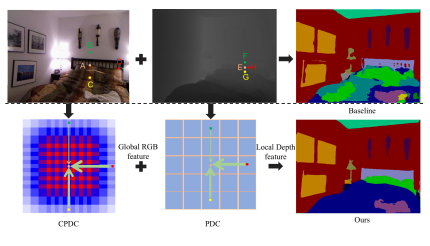
Fig. 1 . Illustration of our PDCNet. In the RGB image, pixels A and D are the edges of pillow; B and C belong to other categories. RGB images reflect overall spatial information. In the Depth image, G is the junction of the bed and the pillow. While the pillow and bed have similar visual characteristics in the RGB image, they can be distinguished in Depth. Based on this, we propose PDC to capture local subtle pixel differences in RGB and CPDC to focus on long-range pixel dependence for RGB.
원문 · CC BY 4.0 · Jun Yang, Lizhi Bai, Yaoru Sun, Chunqi Tian, Maoyu Mao, Guorun Wang · Pixel Difference Convolutional Network for RGB-D Semantic Segmentation · 원문 그림 인용 · 원본 PDF 1쪽에서 그림 영역을 추출했습니다.화소 차이 합성곱과 대형 커널의 구성
Pixel Difference Convolution은 일반 합성곱의 가중합에 중심 화소 x(p0)와 이웃 화소의 차이를 더하는 연산입니다. 식 (3)은 화소 차이 항 α·Conv(w, Δp)와 바닐라 합성곱 항 (1−α)·Conv(w, pn)을 결합합니다. 구현 형태인 식 (4)에서는 두 항이 같은 가중치 w(pn)를 공유하며, 차이 항은 −α·Σw(pn)·x(p0)로, 바닐라 항은 Σw(pn)·x(p0+pn)로 계산됩니다. α는 학습 가능한 값으로 설정되고, 고정값 0.1부터 0.9까지의 설정도 함께 시험되었습니다. CLK는 깊이별 5×5 합성곱, dilation 3의 깊이별 7×7 합성곱, 점별 1×1 합성곱을 순서대로 쌓아 21×21 수용영역을 얻는다고 설명합니다.
병렬 방식인 Conv5×5 더하기 Conv7×7과 비교하면 cascade 방식은 더 큰 수용영역을 가진다고 논문은 보고합니다. CPDC는 PDC 5×5와 PDC 7×7을 이어 붙인 Fout = PDC7×7(PDC5×5(F))로 정의됩니다.
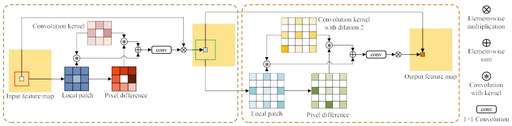
Fig. 2 . The structure of PDC 1 (left) and PDC 2 (right). Without loss of generality, we show the 3× 3 convolution kernel for the PDC 1 and the 3× 3 convolution kernel with dilation of 2 for the PDC 2. The operation combining PDC 1 and PDC 2 contributes the CPDC.
원문 · CC BY 4.0 · Jun Yang, Lizhi Bai, Yaoru Sun, Chunqi Tian, Maoyu Mao, Guorun Wang · Pixel Difference Convolutional Network for RGB-D Semantic Segmentation · 원문 그림 인용 · 원본 PDF 3쪽에서 그림 영역을 추출했습니다.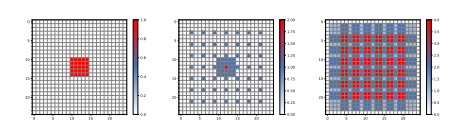
Fig. 4 . Illustration of parallel mode and cascade mode. (a) indicates Conv5×5, (b) indicates parallel mode: Conv5×5(·) +Conv7×7(·) and (c) indicates cascade mode:Conv7×7(Conv5×5(·)). The color bar indicates the number of times each pixel point in the feature map is used.
원문 · CC BY 4.0 · Jun Yang, Lizhi Bai, Yaoru Sun, Chunqi Tian, Maoyu Mao, Guorun Wang · Pixel Difference Convolutional Network for RGB-D Semantic Segmentation · 원문 그림 인용 · 원본 PDF 4쪽에서 그림 영역을 추출했습니다.두 분기 구조와 단계별 융합
PDCNet은 DeepLabv3+를 기준 모델로 삼고, 두 개의 ResNet-101 인코더를 쓰는 두 분기 구조입니다. Depth 분기의 각 블록에는 PDC가, RGB 분기의 각 블록에는 CPDC가 배치됩니다. 두 분기의 특징은 ECF 모듈에서 각 단계마다 융합되며, RGB 특징 쪽은 η, Depth 특징 쪽은 λ로 가중되는 학습 가능한 파라미터로 결합됩니다. 학습 손실은 교차 엔트로피이며, 원문 식은 화소 평균의 음의 로그 확률 형태로 적혀 있습니다.
데이터셋과 비교 조건
실험은 NYUDv2의 40개 클래스 설정과 SUN RGB-D의 37개 범주 설정에서 수행됩니다. 평가 지표는 Pixel Accuracy와 mIoU이며, 기본 평가는 단일 스케일 테스트이고 표에서 별표가 붙은 결과는 다중 스케일 전략입니다. 공정한 비교를 위해 기준선은 원래 DeepLabv3+의 두 인코더 가운데 한쪽 또는 양쪽을 PDC나 CPDC로 바꾼 구조로 두고, 나머지 설정은 DeepLabv3+와 같게 유지합니다.
주요 분할 성능 비교
NYUDv2에서 PDCNet은 단일 스케일 테스트에서 Pixel Accuracy 77.7%와 mIoU 52.7%를 보고합니다. 같은 표의 ShapeConv 단일 스케일 값 75.8과 50.2와 비교하면 각각 1.9, 2.5 높은 값입니다. 본문은 Transformer 백본의 InverseForm보다 Pixel Accuracy 0.3, mIoU 0.4 높다고 쓰지만, 표 I에서 InverseForm은 다중 스케일 값 78.1과 53.1로 표시되어 단일 스케일 PDCNet 값과는 방향이 반대입니다. 이 차이는 다중 스케일 PDCNet 78.4와 53.5를 기준으로 한 차이와 일치하므로, 본문의 비교 조건이 다중 스케일이었을 가능성을 원문만으로는 확정할 수 없습니다.
SUN RGB-D에서는 다중 스케일 기준으로 PDCNet이 83.3과 49.6을 보이며, SGNet 다중 스케일 값 82.0과 47.6보다 Pixel Accuracy 1.3, mIoU 2.0 높습니다. 이 결과는 두 데이터셋의 특정 테스트 설정에서 얻은 것입니다.
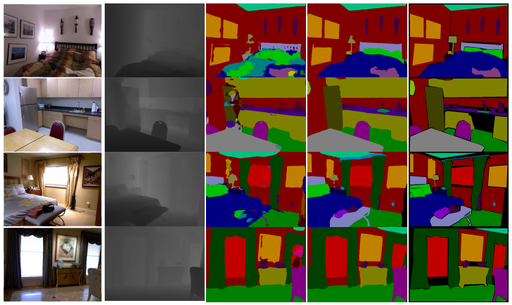
Fig. 6 . Visual comparison of scene semantic segmentation on NYUDv2 dataset.
원문 · CC BY 4.0 · Jun Yang, Lizhi Bai, Yaoru Sun, Chunqi Tian, Maoyu Mao, Guorun Wang · Pixel Difference Convolutional Network for RGB-D Semantic Segmentation · 원문 그림 인용 · 원본 PDF 7쪽에서 그림 영역을 추출했습니다.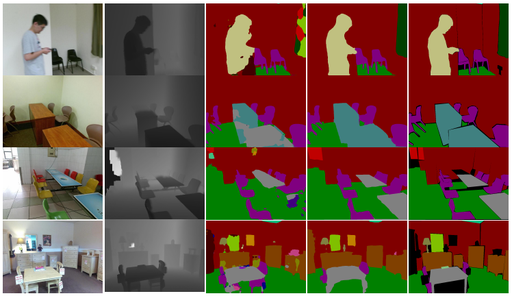
Fig. 7 . Visual comparison of scene semantic segmentation on SUN RGB-D dataset.
원문 · CC BY 4.0 · Jun Yang, Lizhi Bai, Yaoru Sun, Chunqi Tian, Maoyu Mao, Guorun Wang · Pixel Difference Convolutional Network for RGB-D Semantic Segmentation · 원문 그림 인용 · 원본 PDF 8쪽에서 그림 영역을 추출했습니다.모듈 배치와 CLK 대안 비교
Table IV에서 Baseline은 Pixel Accuracy 75.1과 mIoU 47.4입니다. Depth 분기에 PDC, RGB 분기에 CPDC를 올바른 자리에 둔 전체 구조는 77.7과 52.7입니다. PDC만 넣은 경우는 76.9와 51.8, CPDC만 넣은 경우는 76.8과 51.6이며, 두 모듈의 위치를 바꾼 경우는 75.7과 50.7로 낮아집니다. 저자들은 이 결과를 Depth에는 PDC, RGB에는 CPDC가 맞는다는 해석으로 제시합니다. RGB 분기의 장거리 문맥만 비교한 Table V에서는 Parallel 방식 PLK가 75.1과 47.8, Non-local이 75.5와 49.5, CLK가 75.8과 50.3입니다.
따라서 CLK는 Non-local보다 Pixel Accuracy 0.3, mIoU 0.8 높고, CPDC가 76.8과 51.6으로 가장 높습니다. 다중 스케일 설정의 α 표에서는 학습 가능한 α가 78.4와 53.5로 가장 높고, 커널 크기 비교에서는 5×5가 78.4와 53.5로 선택됩니다.
적용 범위와 남은 질문
주요 검증은 NYUDv2와 SUN RGB-D 두 데이터셋의 분할 설정에 한정됩니다. 다른 백본과 DeepLabv3+ 외의 구조에서는 Table III의 여러 구성에서 개선이 보고되지만, 이것을 모든 RGB-D 과제로 확장할 근거는 아닙니다. 저자들은 PDC가 깊이 잡음을 억제한다고 원리와 시각화를 통해 설명하지만, 이 설명을 뒷받침하는 정량적 잡음 실험은 본문 근거에서 확인되지 않습니다. 또한 CLK의 계산 비용 절감은 큰 커널과 비교한 설명이며, 구체적인 계산량 수치는 제시되지 않습니다.
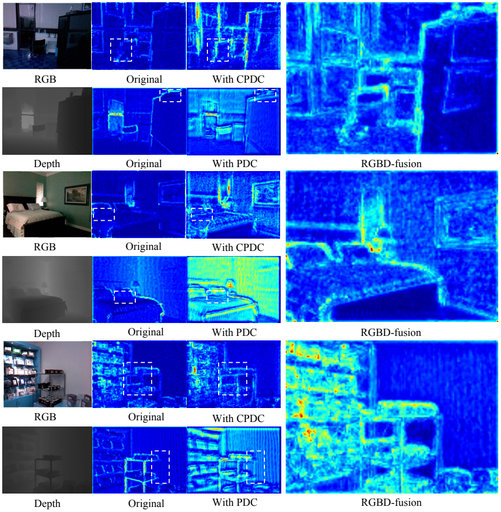
Fig. 8 . Visualizations of feature map response. We compare the response map of Depth data with/without PDC and RGB data with/without CPDC.
원문 · CC BY 4.0 · Jun Yang, Lizhi Bai, Yaoru Sun, Chunqi Tian, Maoyu Mao, Guorun Wang · Pixel Difference Convolutional Network for RGB-D Semantic Segmentation · 원문 그림 인용 · 원본 PDF 9쪽에서 그림 영역을 추출했습니다.논문 정보
- 저자
- Jun Yang, Lizhi Bai, Yaoru Sun, Chunqi Tian, Maoyu Mao, Guorun Wang
- 학회·저널
- arXiv · 프리프린트
- 최초 공개일
- 2023년 2월 23일
- 등록일
- 2026년 11월 6일
- 수정일
- 2023년 2월 23일
- 버전
- v1
- arXiv
- 2302.11951
- 분류
- cs.CV
- 원문 이용 조건
- CC BY 4.0
- 제공 범위
- 논문 정보, 해설, 허용된 원문 그림
AI 해설은 논문 원문과 별개의 설명이며 오류가 있을 수 있습니다. 원문과 그림은 각 출처의 이용 조건과 따로 표시된 권리를 따릅니다.
초록
RGB-D semantic segmentation can be advanced with convolutional neural networks due to the availability of Depth data. Although objects cannot be easily discriminated by just the 2D appearance, with the local pixel difference and geometric patterns in Depth, they can be well separated in some cases. Considering the fixed grid kernel structure, CNNs are limited to lack the ability to capture detailed, fine-grained information and thus cannot achieve accurate pixel-level semantic segmentation. To solve this problem, we propose a Pixel Difference Convolutional Network (PDCNet) to capture detailed intrinsic patterns by aggregating both intensity and gradient information in the local range for Depth data and global range for RGB data, respectively. Precisely, PDCNet consists of a Depth branch and an RGB branch. For the Depth branch, we propose a Pixel Difference Convolution (PDC) to consider local and detailed geometric information in Depth data via aggregating both intensity and gradient information. For the RGB branch, we contribute a lightweight Cascade Large Kernel (CLK) to extend PDC, namely CPDC, to enjoy global contexts for RGB data and further boost performance. Consequently, both modal data's local and global pixel differences are seamlessly incorporated into PDCNet during the information propagation process. Experiments on two challenging benchmark datasets, i.e., NYUDv2 and SUN RGB-D reveal that our PDCNet achieves state-of-the-art performance for the semantic segmentation task.
원문 인용
Jun Yang, Lizhi Bai, Yaoru Sun, Chunqi Tian, Maoyu Mao, Guorun Wang (2023). Pixel Difference Convolutional Network for RGB-D Semantic Segmentation. arXiv:2302.11951v1. https://arxiv.org/abs/2302.11951v1
BibTeX
@misc{yang2023pixel,
  title = {{Pixel Difference Convolutional Network for RGB-D Semantic Segmentation}},
  author = {Jun Yang and Lizhi Bai and Yaoru Sun and Chunqi Tian and Maoyu Mao and Guorun Wang},
  year = {2023},
  eprint = {2302.11951},
  archivePrefix = {arXiv},
  url = {https://arxiv.org/abs/2302.11951v1}
}