논문 해설
PORT: Preference Optimization via Robust Token-Level Reweighting
PORT: 견고한 토큰 단위 재가중을 통한 선호 최적화
- 연구 문제 노이즈가 있는 선호 데이터에서 시퀀스 단위 강건화 방법은 응답 내부의 토큰별 신뢰도 차이를 반영하지 못합니다.
- 연구 방법 PORT는 배치 내 토큰 로그확률의 경험적 CDF 차이로 토큰별 가중치를 계산하여 DPO형 손실을 재가중합니다.
- 주요 결과 AlpacaFarm과 Anthropic HH의 설정에서 PORT는 비교된 기준선보다 높은 점수를 보고합니다.
잡음 있는 선호 데이터의 문제
선호 최적화는 대규모 언어 모델을 사람의 선호에 맞추는 데 널리 쓰이지만, 그 효과는 선호 주석의 품질에 크게 좌우됩니다. 주석자 간 불일치와 모호한 쌍, 라벨 오류가 학습 신호에 노이즈를 넣어 그래디언트 추정을 편향시킵니다. 기존 강건 선호 최적화 방법들은 응답 전체를 하나의 단위로 보고 시퀀스 수준에서 노이즈를 다루기 때문에, 거부된 응답 안의 유용한 추론 단계나 선택된 응답 안의 국소적 오류를 구분하지 못합니다. 이 논문은 이 한계를 토큰 단위 재가중으로 다룹니다.
토큰 단위 CDF 가중치의 작동
PORT는 노이즈 선호 데이터의 손실을 토큰별 로그비율 δ_t에 가중치 w_t를 곱한 형태로 바꿉니다. 이론적으로는 그래디언트 편향의 상한을 최소화하여 w*(z,t) ∝ exp(-λ η(z) ||∇δ_t(z;θ)||)를 얻습니다. 그러나 노이즈 확률과 그래디언트 노름은 학습 중 관측할 수 없고 계산 비용도 큽니다. 그래서 PORT는 배치 안의 선택·거부 토큰 로그확률을 모아 경험적 CDF F를 만들고, 선택 토큰의 백분위 F_w,t와 거부 토큰의 백분위 F_l,t의 차이 Δ = F_l,t − F_w,t를 이용해 w_t = γ exp(−ρ Δ)를 계산합니다. 가중치는 그래디언트 계산에서 고정 계수로 취급되며 정규화 제약을 두지 않습니다.
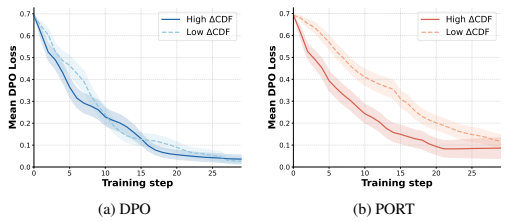
Figure 3 : Comparison of per-sample training loss trajectories between standard DPO and our proposed PORT method across 30 gradient steps. The training samples are partitioned into High ∆CDF (more reliable) and Low∆CDF (more noisy) groups.
원문 · CC BY 4.0 · Ding Zhu, Xiukun Wei, Tian Xie, Zhihui Zhu, Xueru Zhang, Mohammad Mahdi Khalili · PORT: Preference Optimization via Robust Token-Level Reweighting · 원문 그림 인용 · 원본 PDF 9쪽에서 그림 영역을 추출했습니다.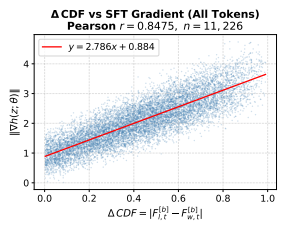
Figure 4 : Scatter plot of ∆CDF versus token-level gradient discrepancy. Since ∥∇h(z;θ)∥=∥∇ θπθ(yw|x)− ∇θπθ(yl|x)∥, we compute this quantity by taking the SFT gradients of the chosen and rejected responses separately and evaluating the norm of their dif- ference. Across a large population of tokens, an implicit linear trend emerges between the two quantities, suggesting that ∆CDF may serve as a lightweight proxy for the noise- induced gradient magnitude η(z)∥∇h(z;θ)∥ in Theorem 1, without requiring access to the unobservable statistics.
원문 · CC BY 4.0 · Ding Zhu, Xiukun Wei, Tian Xie, Zhihui Zhu, Xueru Zhang, Mohammad Mahdi Khalili · PORT: Preference Optimization via Robust Token-Level Reweighting · 원문 그림 인용 · 원본 PDF 19쪽에서 그림 영역을 추출했습니다.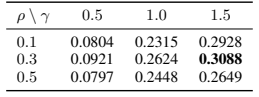
Table 5 : Sensitivity analysis of γ and ρ on LLaMA2-7B. Performance is measured by the mean ground-truth log-probability margin between chosen and rejected responses on a held-out validation set. Higher is better.
원문 · CC BY 4.0 · Ding Zhu, Xiukun Wei, Tian Xie, Zhihui Zhu, Xueru Zhang, Mohammad Mahdi Khalili · PORT: Preference Optimization via Robust Token-Level Reweighting · 원문 그림 인용 · 원본 PDF 21쪽에서 그림 영역을 추출했습니다.이론적 근거와 적용 조건
논문은 노이즈 라벨이 만드는 그래디언트 편향을 B = E[η(z)(∇ℓ(−z;θ) − ∇ℓ(z;θ))]로 정의하고, 가중 목적의 편향 상한을 최소화하는 문제를 세웁니다. 정리 1은 이 상한에서 최적 가중치가 지수형 함수로 주어진다고 제시합니다. 명제 1은 η(z)와 그래디언트의 공분산 조건이 성립할 때 작은 λ에서 가중 목적이 편향을 줄인다는 충분조건을 설명합니다. 원문은 이 조건이 충분조건일 뿐 필요조건은 아니라고 밝힙니다. α-uncertain 노이즈에서는 α가 1보다 작을 때 조건이 성립한다고 설명하며, ε-mislabeled 노이즈에서는 ε가 학습 초기의 기준보다 커야 한다는 형태로 정리됩니다.
AlpacaFarm과 Anthropic HH 실험
AlpacaFarm 실험에서 선호 라벨은 0.3의 확률로 뒤집혔고, LLaMA2-7B와 Qwen3-4B를 사용했습니다. Qwen3-4B에서는 Gold RM Score 2.98과 GPT Win Rate 53.6%를 기록했습니다. Anthropic HH에서는 harmlessness 분할로 학습하고 PKU-Beaver 분류기로 안전성 비율을 평가했으며, PORT의 SR은 0.55, GPT Win Rate는 67.6%입니다. 이 값들은 특정 모델과 노이즈 설정의 결과입니다.
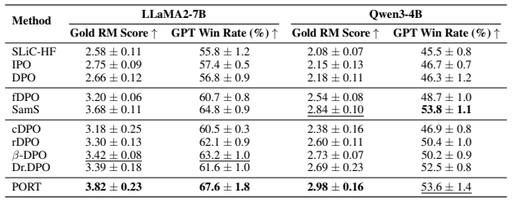
Table 1 : Evaluation results on the AlpacaFarm dataset under two model settings.Boldindicates the best performance, and underline denotes the second-best performance. The results is reported under 3 different seed and as the format of mean±standard deviation.
원문 · CC BY 4.0 · Ding Zhu, Xiukun Wei, Tian Xie, Zhihui Zhu, Xueru Zhang, Mohammad Mahdi Khalili · PORT: Preference Optimization via Robust Token-Level Reweighting · 원문 그림 인용 · 원본 PDF 8쪽에서 그림 영역을 추출했습니다.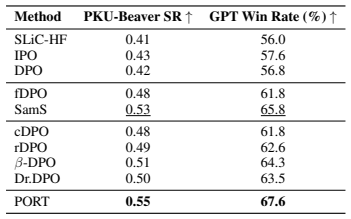
Table 2 : Results on Anthropic HH dataset (Harm- less split).Bolddenotes the best performance, underline indicates the second-best performance.
원문 · CC BY 4.0 · Ding Zhu, Xiukun Wei, Tian Xie, Zhihui Zhu, Xueru Zhang, Mohammad Mahdi Khalili · PORT: Preference Optimization via Robust Token-Level Reweighting · 원문 그림 인용 · 원본 PDF 8쪽에서 그림 영역을 추출했습니다.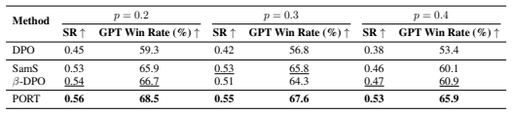
Table 3 : Ablation of Noise Intensity on Anthropic HH (evaluated by PKU- Beaver SR ↑).Bolddenotes the best performance, underline indicates the second-best performance.
원문 · CC BY 4.0 · Ding Zhu, Xiukun Wei, Tian Xie, Zhihui Zhu, Xueru Zhang, Mohammad Mahdi Khalili · PORT: Preference Optimization via Robust Token-Level Reweighting · 원문 그림 인용 · 원본 PDF 8쪽에서 그림 영역을 추출했습니다.범위와 한계
PORT의 CDF 기반 proxy는 배치 수준 통계에 의존하므로 매우 작은 배치 크기에서는 신뢰도가 떨어질 수 있다고 원문이 밝힙니다. 이론적 보장도 특정 충분조건 아래에서 성립하며, 실제 학습에서 이 조건을 항상 검증할 수 있는 것은 아닙니다. 논문은 노이즈 모델을 ε-mislabeled와 α-uncertain 두 가지로 제한하고 있어, 다른 형태의 노이즈에 대한 결과는 이 실험 범위 밖입니다.
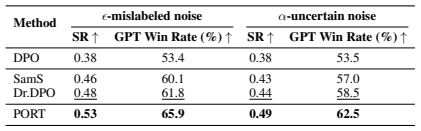
Table 4 : Impact of Noise Type on Model Performance (evaluated by PKU-Beaver SR ↑) on Anthropic HH with p= 0.4 noise level. Bolddenotes the best performance, underline indicates the second-best performance. PORT achieves consistent gains of ∼4% WR and 0.05 SR over the strongest baseline across both noise types.
원문 · CC BY 4.0 · Ding Zhu, Xiukun Wei, Tian Xie, Zhihui Zhu, Xueru Zhang, Mohammad Mahdi Khalili · PORT: Preference Optimization via Robust Token-Level Reweighting · 원문 그림 인용 · 원본 PDF 9쪽에서 그림 영역을 추출했습니다.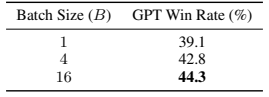
Table 6 : Effect of batch size on GPT win rate using Qwen2.5-0.5B. The reference set R pools all non-padding chosen and rejected token logits across the batch. Higher is better.
원문 · CC BY 4.0 · Ding Zhu, Xiukun Wei, Tian Xie, Zhihui Zhu, Xueru Zhang, Mohammad Mahdi Khalili · PORT: Preference Optimization via Robust Token-Level Reweighting · 원문 그림 인용 · 원본 PDF 21쪽에서 그림 영역을 추출했습니다.논문 정보
- 저자
- Ding Zhu, Xiukun Wei, Tian Xie, Zhihui Zhu, Xueru Zhang, Mohammad Mahdi Khalili
- 학회·저널
- arXiv · 프리프린트
- 최초 공개일
- 2026년 11월 9일
- 등록일
- 2026년 11월 11일
- 수정일
- 2026년 11월 9일
- 버전
- v1
- arXiv
- 2611.12763
- 분류
- cs.CL · cs.AI
- 원문 이용 조건
- CC BY 4.0
- 제공 범위
- 논문 정보, 해설, 허용된 원문 그림
AI 해설은 논문 원문과 별개의 설명이며 오류가 있을 수 있습니다. 원문과 그림은 각 출처의 이용 조건과 따로 표시된 권리를 따릅니다.
초록
Preference optimization has become a central approach for aligning large language models with human values, but its effectiveness depends heavily on the quality of preference annotations. In practice, preference data is often noisy due to annotation errors and ambiguity. Existing robust preference optimization methods primarily operate at the sequence level, implicitly treating entire responses as uniformly correct or incorrect. However, rejected responses may still contain informative reasoning steps, while preferred responses can include subtle errors. In this work, we propose \textbf{P}reference \textbf{O}ptimization via \textbf{R}obust \textbf{T}oken-level reweighting \textbf{(PORT)}, a fine-grained framework for robust alignment under noisy preferences. PORT performs token-level reweighting using the empirical cumulative distribution function (CDF) of token log-probabilities, yielding an efficient forward-pass-only proxy to gradient-norm penalization that selectively suppresses corrupted tokens without additional backward-pass computation. We provide theoretical analysis showing that PORT reduces the gradient bias from noisy preference labels by minimizing an upper bound on the bias term. Extensive experiments across diverse noise settings demonstrate that PORT consistently improves robustness and outperforms existing sequence-level baselines. The code is available at https://github.com/osu-srml/PORT
원문 인용
Ding Zhu, Xiukun Wei, Tian Xie, Zhihui Zhu, Xueru Zhang, Mohammad Mahdi Khalili (2026). PORT: Preference Optimization via Robust Token-Level Reweighting. arXiv:2611.12763v1. https://arxiv.org/abs/2611.12763v1
BibTeX
@misc{zhu2026port,
  title = {{PORT: Preference Optimization via Robust Token-Level Reweighting}},
  author = {Ding Zhu and Xiukun Wei and Tian Xie and Zhihui Zhu and Xueru Zhang and Mohammad Mahdi Khalili},
  year = {2026},
  eprint = {2611.12763},
  archivePrefix = {arXiv},
  url = {https://arxiv.org/abs/2611.12763v1}
}